
kiddi
We all know too well the specific level of chaos that only exists in a home with young kids, and the ongoing underlying stress that comes with it.
Not the dramatic, one-off mess. It’s that constant, low-level, “how is there already sand on the floor again?” kind. The kind that builds quietly while you’re doing ten other things, packing lunches, answering questions, finding lost shoes, until suddenly the house feels like it’s working against you.
Most of us aren’t trying to keep a spotless home. We’re trying to keep things manageable.
And that’s where the shift happens, not in cleaning harder, but in setting things up so the mess doesn’t take over in the first place.
Research from the Australian Institute of Family Studies shows that everyday household demands are a major contributor to parental mental load and stress¹. What’s often overlooked is that it’s not just the physical tasks, it’s the constant background thinking, remembering, and decision-making that drains energy.
These are the small, realistic shifts that make a noticeable difference, not just in how your home looks, but in how it feels to live in it.
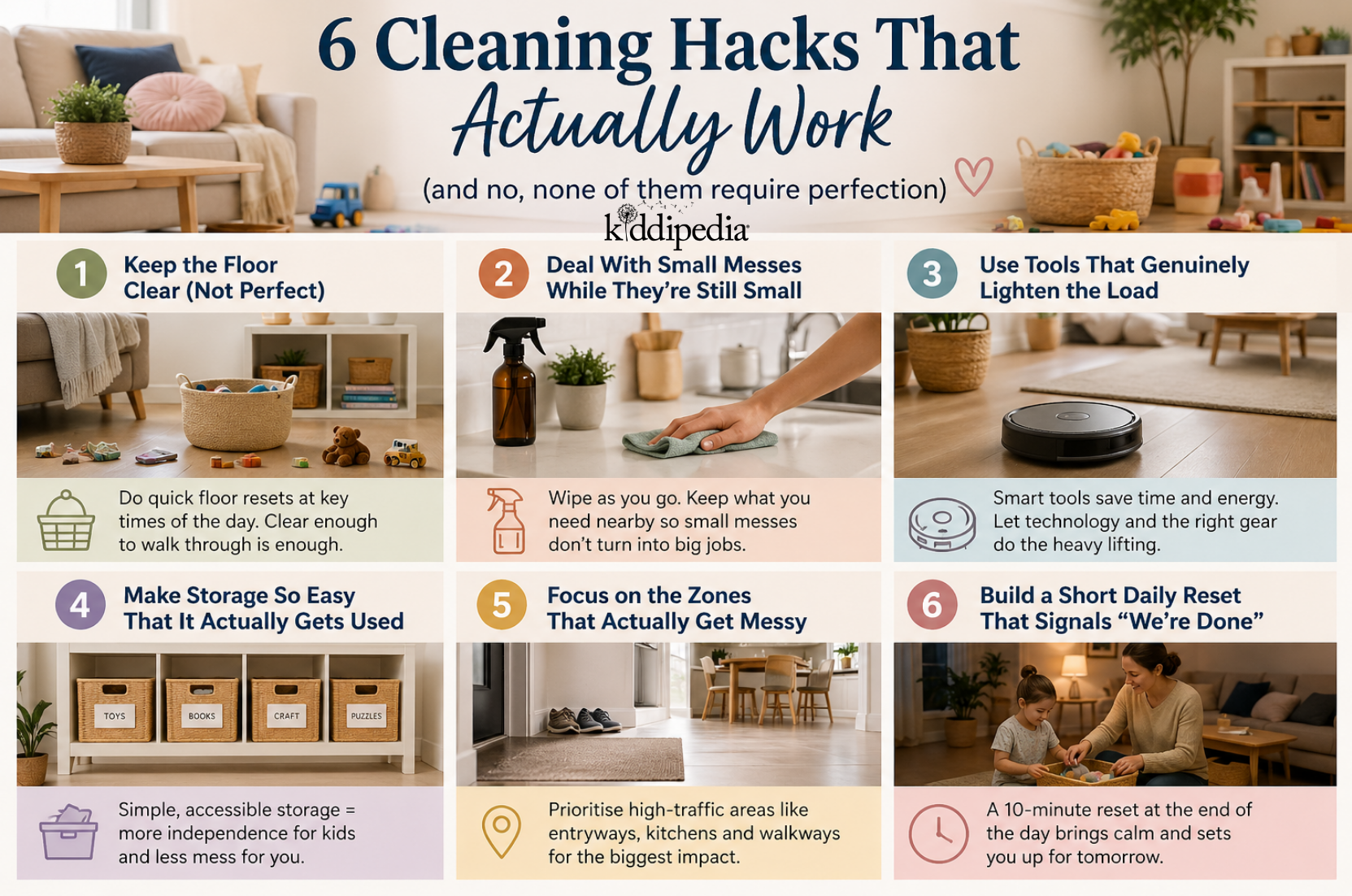
1. Keep the Floor Clear (Not Perfect)
There’s something about a cluttered floor that makes everything feel heavier.
It’s not just the toys or the rogue socks, it’s what they represent. Visual clutter has been shown to increase cognitive load and make everyday tasks feel more overwhelming². When your brain is constantly processing “unfinished things,” it quietly raises stress levels in the background.
Instead of trying to “keep things tidy,” focus on one simple habit: clearing the floor at set points in the day.
Not constantly. Not obsessively. Just at natural reset moments, before dinner, before bedtime, or when everyone’s transitioning out of a room.
This works because it taps into what psychologists call Habit Stacking, linking a small action to something you already do.
In real life, this looks like:
You’re calling the kids for dinner anyway, so you grab a basket and do a 60-second sweep as you go.
Make it even easier
The goal isn’t a perfect floor — it’s a floor that never feels overwhelming.
- Set simple “floor zones” instead of rules
Give kids clear areas where things can stay on the floor (like a play rug). Outside of that is just walking space. Less correcting, less stress. - Use baskets as “drop spots”
Put a few open baskets in busy areas. Things don’t need to be put away properly — just dropped in the basket for later. - Only clear the space you’re using
Focus on the area around where you are (sofa, kitchen, table). Not the whole house. - Link tidying to moments you already do every day
Like before dinner, after dinner, or when moving rooms. No extra thinking needed. - Aim for “easy to walk through,” not perfect
If you can move around safely, that’s enough.
A small shift that changes everything:
Clearing the floor isn’t about appearances; it’s about removing friction from your next task. When the path is clear, everything else feels easier to start.
Why it matters for your child:
Clear, calm spaces help reduce overstimulation and support focus, something highlighted in early childhood guidance from the Raising Children Network³.
2. Deal With Small Messes While They’re Still Small
It’s never the big mess that gets you; it’s the build-up.
The toothpaste splatter that dries on. The juice drips that turn sticky. The crumbs that somehow multiply.
The reason this feels so draining isn’t just physical; it’s mental. Every “I’ll deal with that later” adds to what’s known as Decision Fatigue, where your brain gets worn down by constant micro-decisions.
So instead of relying on motivation, reduce the effort required.
Keep what you need where you need it:
- A cloth within reach in the kitchen
- Wipes in the bathroom
- A small handheld vacuum nearby
Research into household systems shows that reducing the number of steps between noticing and acting significantly increases follow-through⁴.
In real life, this looks like:
You wipe the bench while waiting for the kettle. Not later. Not properly. Just enough.
Make it even easier
Small messes are easier than big ones, if you catch them early.
- Keep cleaning things right where you use them
Cloth in the kitchen, wipes in the bathroom, vacuum nearby. No searching. - Do tiny clean-ups in the moment
Wipe the bench while the kettle boils. Clean while you wait for things. - Only take 20 seconds max
If it takes less than 20 seconds, do it straight away. If not, leave it. - Use waiting time for quick wipes
Like microwave time, shower heating, or kettle boiling. - Wipe once, not later
One quick wipe now stops bigger cleaning later.
A small shift that changes everything:
You’re not adding more cleaning; you’re removing the backlog that turns into bigger, more exhausting jobs later.
Why it matters for your child:
Consistent, small resets create predictable environments, which support emotional regulation and reduce overwhelm⁵.
3. Use Tools That Genuinely Lighten the Load
Not all cleaning tools are created equal, and when you’re already stretched, the wrong ones just add another layer of effort.
The right tools remove friction.
For example:
- Microfibre cloths have been shown to remove more bacteria than traditional cloths, even without chemicals⁶
- Robot vacuums can significantly reduce daily cleaning time, according to testing by CHOICE Australia⁷. Some robot vacuum models, such as the DEEBOT range, also come with features like
obstacle detection and self-emptying stations, which can make day-to-day cleaning easier when you already
have plenty to manage.
This isn’t about adding gadgets for the sake of it, it’s about strategically reducing repetition.
In real life, this looks like:
The vacuum runs while you’re doing the school run. You don’t think about it again.
Make it even easier
The best tools are the ones that make life easier without thinking.
- Use tools that are quick to grab and use
If it’s hard to set up, it won’t get used. - Keep cleaning things out where you can see them
If you can see it, you’ll use it. If it’s hidden, you’ll forget. - Have doubles where you need them most
One upstairs, one downstairs if it saves steps. - Let machines do the repeating work
Like robot vacuums or dishwashers running on routine times. - Keep things simple
One spray, one cloth type, one vacuum setting. Less thinking.
Research from CSIRO highlights how effective cleaning materials can reduce both bacteria and cleaning time when used correctly⁶.
A small shift that changes everything:
When tools work with your routine instead of against it, cleaning stops feeling like a constant interruption.
Why it matters for your child:
Less time spent on repetitive cleaning = more available attention, which is one of the biggest predictors of positive child outcomes⁸.
4. Make Storage So Easy That It Actually Gets Used
If putting something away feels like a process, it won’t happen. Not by you, and definitely not by your kids.
The shift here is simple: prioritise access over aesthetics.
Think:
- Open baskets instead of lids
- Low shelves instead of stacked storage
- One clear “home” for frequently used items
This aligns with what we know about Executive Function, young children are still developing the ability to plan, organise, and follow multi-step processes⁹.
In real life, this looks like:
Everything gets tossed into the right basket. Not sorted. Not perfect. Just contained.
Make it even easier
If it feels hard to put something away, it won’t get put away.
- Use baskets instead of lids and drawers
Open = easy. Closed = ignored. - Keep storage at kid height and easy to reach
If they can see it and reach it, they’ll use it. - Keep categories very simple
Just a few groups like toys, books, blocks. - Don’t store everything out at once
Put some toys away and swap them over time. Less mess, less stress. - Make the easiest option the right one
The basket should be easier to use than the floor.
A small shift that changes everything:
When systems are simple, they actually get used, and that’s what keeps things manageable.
Why it matters for your child:
Simple systems build independence. Kids are far more likely to help when the task matches their developmental stage³.
5. Focus on the Zones That Actually Get Messy
Not every room needs the same level of attention.
In most homes, mess clusters around a few key areas:
- Entryways
- Kitchen and dining spaces
- High-traffic walkways
Instead of spreading your energy thin, prioritise the zones that carry the most load.
Environmental health research highlights that high-traffic areas also accumulate more dust and allergens, which can impact respiratory health, particularly for children prone to conditions like Allergic Rhinitis¹⁰, as noted by the National Asthma Council Australia.
In real life, this looks like:
Shoes off at the door. A mat that actually catches dirt. A quick post-dinner floor check that stops crumbs from spreading further.
Make it even easier
Not every room needs the same effort.
- Focus on the busiest areas first
Entryways, kitchen, dining, and walkways. - Give these areas a “home for clutter”
A basket or spot where things naturally land. - Only clean what you can see right now
Hidden mess can wait. - Stop mess coming into the house early
Shoes off at the door, mats that catch dirt, bag drop zones. - Put most of your energy where life happens most
The kitchen and main living spaces matter most.
A small shift that changes everything:
When the busiest areas are under control, the whole house feels calmer, even if other rooms aren’t perfect.
Why it matters for your child:
Cleaner high-use spaces support healthier indoor environments, especially for developing immune systems¹⁰.
6. Build a Short Daily Reset That Signals “We’re Done”
There’s something powerful about a small reset at the end of the day.
Not a full clean. Not a late-night overhaul. Just a clear signal that the day is wrapping up.
This taps into Behavioural Activation, where small, consistent actions help reduce stress and restore a sense of control.
Research from the Australian Institute of Family Studies shows that structured routines can significantly reduce parental overwhelm and improve family wellbeing¹.
Keep it short and repeatable:
- Clear the table
- Stack the dishwasher
- Quick floor sweep
- Toys back into baskets
In real life, this looks like:
Ten minutes. Everyone involved (in varying degrees of enthusiasm).
Make it even easier
A short reset helps the day feel finished.
- Keep it very simple
Clear surfaces, stack dishwasher, quick floor tidy, toys in baskets. - Do it together, even in small ways
Everyone helps a little. - Use music or a timer
It makes it feel easier and more like a routine. - Don’t aim for perfect
Just “good enough” is the goal. - Make it the same each night
Repetition makes it easier over time.
A small shift that changes everything:
You’re not ending the day in chaos; you’re giving yourself a calmer starting point for tomorrow.
Why it matters for your child:
Predictable routines support emotional security and help children transition more easily into rest and sleep³.
The Takeaway: It’s Not About Cleaning More: It’s About Thinking Differently
The homes that feel manageable aren’t the ones being cleaned constantly.
They’re the ones where:
- The floor gets reset regularly
- Small messes don’t get a chance to build
- Systems are simple enough to stick
- Effort is focused where it actually matters
And most importantly, they allow for real life to happen in between.
Because the goal was never a spotless house.
It’s a home that supports you, not one that quietly drains you.
References
- Australian Institute of Family Studies – Parenting, time pressure and mental load
- CSIRO – Environmental psychology and cognitive load
- Raising Children Network – Routines and child development
- Behavioural science research on habit formation and environmental cues
- Australian early childhood emotional regulation studies
- CSIRO – Microfibre cleaning effectiveness
- CHOICE Australia – Cleaning product testing
- Australian Institute of Family Studies – Parent-child interaction outcomes
- Executive function development research in early childhood
- National Asthma Council Australia – Indoor allergens and respiratory health
- Cronulla Beach