
Kiddipedia
From the very first moment you discovered you were expecting a baby, your intention has always been the same: to give your child the best life possible.
Every decision you’ve made, from the pram and car seat you chose to the kindergarten or school you selected, has come from a place of love, hope, and wanting to do the very best for them.
But let’s be honest, life is busy.
Our attention is pulled in every direction, especially with how crazy the world feels right now. Irrespective of where you get your news from and how you keep up to date with current affairs, it’s hard to know who and what information to trust. With so much happening, who do we believe any more?
The one person you can always trust is … yourself. Your instinct. Your gut feeling is your truth, and will never stray you away from where you need to be.
But then come those moments… the quiet ones, when everything slows down, and your thoughts catch up with you.
Who hasn’t asked themselves:
“Am I a good parent?”
Despite everything you do, the love you give, and the effort you pour in every single day, you still question yourself. You compare. You wonder if you’re getting it wrong.
If that sounds familiar, you’re not alone.
This is your moment to take a breath and let some of that pressure go.
If you can do one thing for yourself today, take five minutes to read through the list below of the most common worries parents carry. Each one is paired with a supportive reframe to help you see things from a different perspective… and gently remind you that you’re doing better than you think.
So, pour yourself a glass of your finest, or pop the kettle on, and take a moment for you.
You deserve it. And you’re not in this alone
It’s all good, mama, we’ve got ya!
💛 Emotional & Connection Worries
“Am I spending enough quality time with my child?”
Reframe: Connection isn’t measured in hours—it’s felt in moments.
Even small, intentional pockets of time create deep, lasting bonds.
Those quick chats in the car, the bedtime snuggles, the shared laughter over something silly—these are the moments that shape a child’s sense of belonging. You don’t need perfectly planned days; you just need presence within the ordinary. Children remember how they felt with you, not how long you were there.
It might be the way you look up when they start talking. The way you sit beside them, even for a few minutes, without rushing. The way you listen to the same story for the third time because it matters to them.
These micro-moments build emotional security over time.
🧠 What research tells us:
The Raising Children Network highlights that everyday “in-between” interactions are some of the most powerful for building secure attachment and emotional safety. These small, repeated interactions help shape how a child’s brain wires for connection, trust, and belonging.
💡 Parent moment:
Even five minutes of fully present connection can outweigh hours of distracted time.
“Do they feel loved, safe, and supported?”
Reframe: Love shows up in a thousand quiet ways—your presence, your care, your consistency.
If you’re asking this, you’re already showing it.
Love isn’t just spoken—it’s in the way you respond, the way you check in, the way you keep showing up even on hard days. Safety is built through predictability and warmth, not perfection. Your child doesn’t need grand gestures—they need your steady, reliable care.
It’s in the packed lunch. The reminder to take a jumper. The way you notice when something feels “off.” The way you stay, even when emotions are big.
Children don’t measure love the way adults do—they feel it through consistency.
🧠 Why this matters:
Secure attachment is one of the strongest predictors of long-term emotional wellbeing, supported by research from the Australian Institute of Family Studies. When children feel safe and supported, their brains are better able to learn, regulate emotions, and build healthy relationships.
💡 Gentle reminder:
You don’t have to say it perfectly—you just have to show it consistently.
“Am I really listening to them—or just reacting?”
Reframe: Awareness is the turning point.
Every time you pause, soften, and try again—you’re strengthening trust.
We’ve all had reactive moments. What matters is repair. When a child feels truly heard, their stress system calms—and over time, they learn to regulate emotions more effectively.
Listening isn’t just about hearing words—it’s about making space for their feelings without rushing to fix, correct, or dismiss.
That moment when you kneel down, make eye contact, and say, “Tell me what happened”—that’s powerful.
🧠 What’s happening in the brain:
When children feel heard, their nervous system shifts from stress mode into safety mode. This supports long-term emotional regulation and resilience.
💡 Parent moment:
That split second where you pause instead of react? That’s where connection grows.
“Am I too distracted (work, phone, stress)?”
Reframe: You’re balancing a full life, not failing your child.
What matters is that you come back—again and again.
Modern parenting includes constant interruptions. But children don’t need uninterrupted perfection—they need reconnection. Looking up, putting the phone down, and re-engaging teaches them they matter.
It’s not about never being distracted—it’s about repairing the disconnection.
Saying, “Sorry, I got distracted—what were you saying?” is incredibly powerful.
🧠 Research insight:
The Beyond Blue notes that parental stress is normal—but reconnection after distraction is what protects emotional safety and strengthens relationships.
💡 Real-life truth:
You don’t have to be always present—you just have to keep coming back.
“Will they come to me when something is wrong?”
Reframe: Safe relationships are built over time.
Every hug, every calm response, every “I’m here” is laying that foundation.
Children don’t decide trust in one moment—they build it through hundreds of micro-interactions. Your consistency becomes their safety map.
When you respond without judgment… when you stay calm in their storms… when you choose curiosity over criticism—you’re teaching them:
“I can come to you.”
🧠 Why this matters:
Consistent emotional safety builds what researchers call “relational trust”—a key factor in whether children seek support during challenges.
💡 Parent perspective:
The way you respond to the small things is what shapes whether they come to you for the big things.
🧠 Development & Growth Concerns
“Am I helping them learn and grow enough?”
Reframe: Growth isn’t just academic—it’s emotional, social, and creative too.
You’re shaping a whole human, not just ticking boxes.
Everyday experiences—problem-solving, navigating friendships, expressing emotions—are all powerful forms of learning.
Play is learning. Conversations are learning. Even boredom is learning.
🧠 Research insight:
The Raising Children Network highlights that play-based experiences are essential for brain development, creativity, and problem-solving skills.
💡 Gentle reminder:
You’re already teaching them—every single day.
“Are they hitting milestones (emotionally, socially, academically)?”
Reframe: Children aren’t on a fixed timeline.
They grow at their own pace—and your support matters more than any milestone chart.
Development is not linear. Some children leap ahead in one area and take longer in another.
What matters most is that they feel supported, not pressured.
🧠 Why this matters:
The Australian Institute of Family Studies emphasises that emotional support plays a bigger role in long-term outcomes than strict milestone achievement.
“Am I encouraging independence—or being too controlling?”
Reframe: The fact you’re reflecting means you’re adjusting.
Parenting is a constant recalibration—not a fixed setting.
Independence grows when children feel safe enough to explore, knowing you’re there when they need you.
“Am I doing enough to support their confidence and self-esteem?”
Reframe: Confidence grows from feeling seen, heard, and accepted.
And you’re already creating that space.
Confidence isn’t built through pressure—it’s built through connection.
🧠 Science insight:
Children develop self-worth through repeated experiences of being accepted and valued.
🗣️ Discipline & Behaviour Doubts
“Am I too strict… or too lenient?”
Reframe: There’s no perfect balance—only a responsive one.
You’re learning what your child needs in real time.
Parenting doesn’t sit neatly at one end of the spectrum. Some days require firmer boundaries, other days call for flexibility and softness. What matters most isn’t getting it “right” every time—it’s your willingness to adjust based on your child’s needs, temperament, and the situation in front of you.
It’s in those moments where you pause and think, “Maybe I could have handled that differently”—that’s where growth lives.
Children don’t need perfectly balanced parents. They need attuned ones.
🧠 What research tells us:
The Raising Children Network highlights that responsive parenting—where caregivers adapt based on a child’s emotional and developmental needs—leads to stronger emotional regulation and behaviour outcomes than rigid or overly permissive approaches.
💡 Parent moment:
If you’re questioning your approach, you’re already doing the work that matters.
“Do I handle tantrums and big emotions well?”
Reframe: You don’t have to handle it perfectly—just safely and with care.
Your calm (even when imperfect) is their guide.
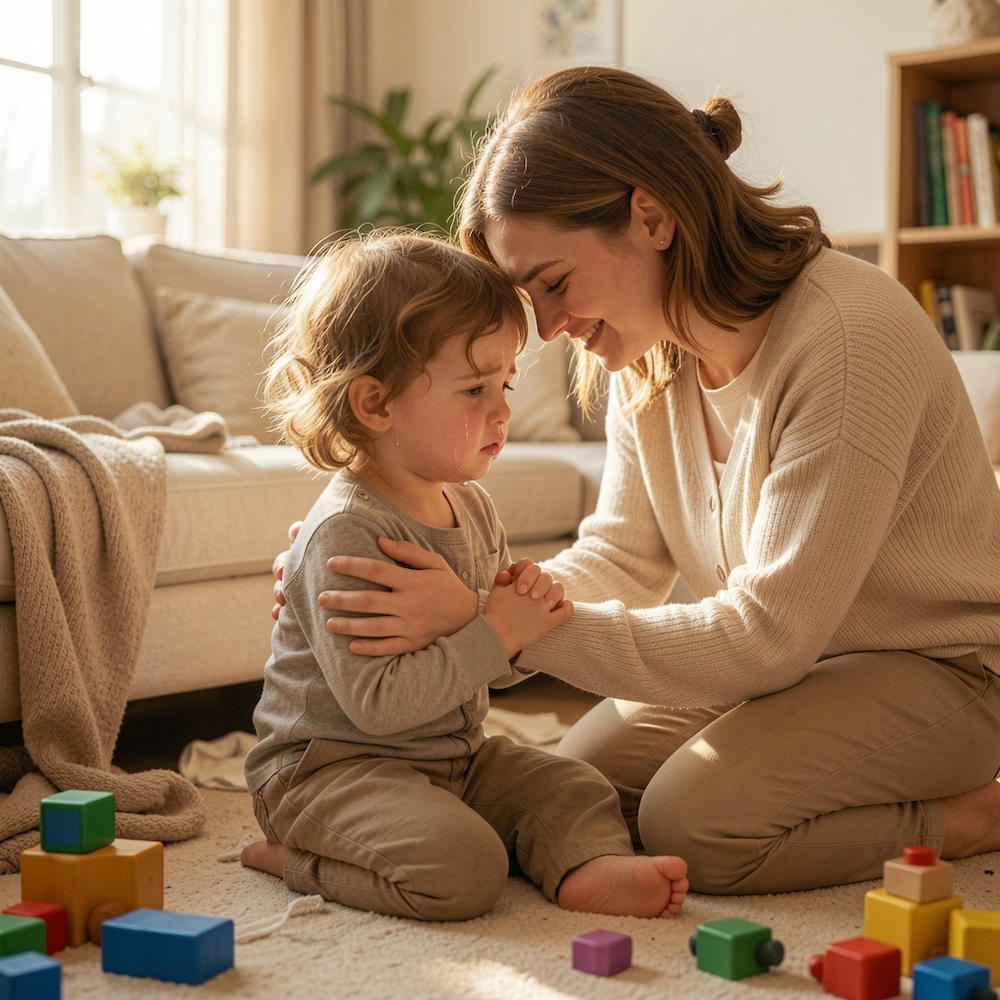
Tantrums can feel overwhelming—for both of you. But beneath every outburst is a child whose brain is still learning how to process big feelings.
Your presence—more than your words—is what helps.
Sitting nearby. Staying calm (or coming back to calm). Letting them know you’re there without trying to immediately fix or stop the emotion.
These are the moments that teach children:
“Big feelings are safe. I’m safe. I’ll be okay.”
🧠 What’s happening developmentally:
Children rely on co-regulation—your calm nervous system helps regulate theirs. Over time, this becomes self-regulation.
💡 Gentle truth:
It’s not about stopping the meltdown—it’s about supporting them through it.
“Am I consistent with boundaries?”
Reframe: Consistency grows over time.
Showing up and trying again is what builds it.
Consistency doesn’t mean perfection—it means predictability over time.
There will be days where you’re tired, stretched, or just trying to get through—and that’s okay. What matters is the overall pattern your child experiences: that boundaries exist, and that they are guided with care.
Children don’t need rigid enforcement—they need reliable guidance.
🧠 Why this matters:
Predictable boundaries help children feel safe because they understand what to expect. This reduces anxiety and supports emotional regulation.
💡 Parent perspective:
It’s not about never wavering—it’s about returning to what matters.
“Do I lose my patience too often?”
Reframe: Patience isn’t endless—it’s practiced.
Every repair strengthens your relationship more than perfection ever could.
Every parent loses patience. Especially in a world where you’re juggling more than ever.
What defines your parenting isn’t the moment of frustration—it’s what happens after.
Coming back. Softening your tone. Saying, “I’m sorry—I got overwhelmed.”
These moments don’t weaken your role—they deepen trust.
🧠 Research insight:
The headspace highlights that repairing emotional ruptures teaches children resilience, emotional awareness, and relationship skills.
💡 Real-life truth:
Your child doesn’t need a perfectly patient parent—they need one who comes back.
“Am I modelling the behaviour I expect?”
Reframe: Modelling includes showing mistakes and how to recover from them.
That’s where the real learning happens.
Children don’t learn from what we say as much as what we do.
They watch how you handle stress. How you respond when things go wrong. How you treat others—and yourself.
And importantly, they learn from how you recover.
🧠 Why this matters:
Modelling emotional awareness and repair helps children internalise those same skills.
💡 Parent reflection:
You’re teaching every day—even in the messy moments.
❤️ Emotional Regulation & Guilt
“Do I yell too much?”
Reframe: Yelling doesn’t define you—what you do after matters more.
Repair, reassurance, and reflection teach far more than silence ever could.
Every parent reaches a point of overwhelm. When stress builds, tiredness accumulates, and demands stack up, emotions can spill over. What matters most is not the moment of volume—but the moments that follow it.
When you come back and reconnect—when you soften your voice, explain what happened, and reassure your child that love hasn’t changed—you are actively teaching emotional safety and relational repair.
Children don’t interpret perfection as safety—they interpret repair as safety.
🧠 What research tells us:
The Kids Helpline highlights that repairing emotional disconnection after conflict is essential for healthy child development, helping children build trust, resilience, and emotional understanding.
💡 Parent-to-parent truth:
Your child doesn’t need you to never lose your patience. They need to know you always come back.
“Am I emotionally available when they need me?”
Reframe: You don’t have to get it right every time.
Being there most of the time is more than enough.
Emotional availability doesn’t mean constant availability—it means a reliable connection over time. Children build emotional security through repeated experiences of being seen, heard, and responded to.
Even when you’re busy, tired, or mentally stretched, small moments of attunement—eye contact, a gentle response, a pause to listen—send a powerful message: you matter to me.
🧠 Why this matters:
Research consistently shows that consistent emotional responsiveness supports secure attachment, which in turn influences emotional regulation, social development, and resilience.
💡 Gentle reminder:
You don’t have to be perfect in every moment—just present enough in the moments that matter.
“Am I projecting my own stress onto them?”
Reframe: Awareness is powerful.
Noticing this means you’re already breaking cycles and choosing differently.
Parenting doesn’t happen in isolation. It happens inside real lives—stress, pressure, financial strain, emotional load, and exhaustion included. It’s natural for children to sometimes feel the ripple effects of that stress.
But the moment you notice it, you create choice.
You can pause. You can soften. You can repair. And that shift alone changes the emotional environment of a home.
🧠 What research tells us:
The Beyond Blue emphasises that parental wellbeing directly influences child emotional health, but that awareness and support significantly reduce the impact of stress transmission.
💡 Parent reflection:
You are not your stress. And your child is not responsible for carrying it.
“Do I apologise when I get it wrong?”
Reframe: Every apology builds trust, respect, and emotional safety.
It doesn’t weaken your role—it strengthens it.
Apologising to your child is one of the most powerful relational tools you have. It teaches them that relationships are safe even when imperfect—that mistakes don’t end connection.
When you say, “I’m sorry I reacted like that,” you are modelling emotional responsibility, humility, and repair.
These are lifelong relational skills your child will carry into friendships, school, and eventually their own parenting.
🧠 What research tells us:
The Australian Institute of Family Studies highlights that relational repair is a key predictor of secure attachment and emotional resilience in children.
💡 Parent-to-parent truth:
Apologies don’t damage authority—they deepen connection.
⚖️ Balance & Lifestyle Pressures
“Am I balancing work and family well enough?”
Reframe: Balance isn’t perfect—it shifts daily.
Providing, showing up, and caring deeply all count.
If you’ve ever ended the day feeling like you didn’t give enough to either work or family—you’re not alone. Modern parenting rarely exists in balance; it exists in motion. Some days lean heavily toward deadlines and responsibility, while others lean toward school pickups, emotions, and family needs.
What matters most isn’t equal time—it’s meaningful presence when you are there.
Children don’t measure love by how evenly life is split. They measure it by whether they feel you when you’re with them—your attention, your tone, your availability in that moment.
You are not failing because life is full. You are navigating a very real, very demanding world.
🧠 What research tells us:
The Australian Institute of Family Studies highlights that parental wellbeing, workload stress, and family functioning are deeply interconnected—but that even small, consistent moments of connection buffer the impact of work-family strain on children.
💡 Parent-to-parent truth:
Balance isn’t something you achieve—it’s something you constantly adjust.
“Am I present, or just ‘getting through the day’?”
Reframe: Some days are about surviving—and that’s okay.
You’re still showing up, even when it’s hard.
There’s a quiet honesty many parents feel but rarely say out loud: “Today I just got through it.”
And that still counts.
Not every day is filled with meaningful connection, calm energy, or intentional parenting moments. Some days are about logistics—getting everyone fed, dressed, and where they need to be.
But even on those days, your presence matters. Your child still experiences you as their safe base, even if you feel stretched thin.
💡 Gentle reminder:
Children don’t need emotionally perfect days—they need reliably present ones.
🧠 Why this matters:
Research from Raising Children Network shows that children build security through consistent caregiving patterns over time, not individual “perfect” interactions.
“Am I doing enough fun things together?”
Reframe: Fun doesn’t have to be big or planned.
Laughter in ordinary moments is what children remember most.
It’s easy to feel pressure to create “memorable childhood experiences”—outings, activities, events. But children don’t build their strongest memories from big moments alone.
They build them from feeling connected in everyday life.
The silly dance in the kitchen. The shared joke in the car. The spontaneous couch snuggle after a long day.
These moments are not small to a child—they are everything.
🧠 What research tells us:
The Raising Children Network highlights that positive shared interactions are a key predictor of strong parent-child relationships and emotional wellbeing.
💡 Parent truth:
You don’t need more activities—you need more connection in the everyday.
“Are they getting too much screen time?”
Reframe: You’re raising a child in a digital world, not avoiding it.
You’re teaching balance—and that matters more than limits alone.
Screen time worries are one of the most common modern parenting concerns. But the reality is more complex than “more” or “less.”
What shapes a child’s relationship with technology isn’t just exposure—it’s how that exposure is guided.
Are you talking about what they’re watching?
Are you co-viewing sometimes?
Are you helping them transition back into offline play?
These moments matter more than strict restriction alone.
🧠 What research tells us:
The eSafety Commissioner emphasises that co-engagement, guidance, and open discussion are more effective than restriction alone in building healthy digital habits in children.
💡 Parent reflection:
You’re not just managing screen time—you’re shaping digital wellbeing.
👶 Comparison & External Pressure
“Am I doing as well as other parents?”
Reframe: You’re comparing your reality to someone else’s highlight reel.
Every parent is figuring it out as they go.
It’s so easy to fall into comparison without even realising it—especially in a world where parenting is constantly visible. School groups, social media, conversations at pickup… it can feel like everyone else is doing it better, calmer, more organised.
But what you’re seeing is never the full story. It’s the managed moments—the clean rooms, the happy photos, the polished version of a very messy reality.
Behind every parent you admire is another parent having the same doubts you are.
💡 Parent truth:
There is no invisible scoreboard for parenting.
🧠 Why this matters:
The Australian Institute of Family Studies highlights that parental wellbeing is significantly impacted by perceived social comparison, but that grounding in real-life connection reduces stress and improves confidence in parenting decisions.
“Why does everyone else seem to have it together?”
Reframe: They don’t—they just don’t show the hard parts.
You’re not behind—you’re honest.
Honesty can feel heavy sometimes, but it’s also what makes parenting real. Every family has moments of overwhelm, doubt, exhaustion, and uncertainty—they’re just not always visible.
What looks like calm often sits on top of invisible effort.
The truth is, most parents are quietly asking the same question you are.
💡 Gentle reminder:
You are not the exception—you are part of the shared experience.
“Am I making the ‘right’ parenting choices?”
Reframe: There’s no universal “right”—only what works for your child and your family.
And you know them best.
Parenting decisions can feel high-stakes because they feel permanent—but most aren’t. Routines change, needs evolve, children grow.
What works beautifully for one child may not work at all for another. And that’s not failure—it’s individuality.
Your lived experience with your child is one of the most valuable forms of expertise you have.
🧠 What research tells us:
The Raising Children Network emphasises that child development is highly individual, and responsive parenting based on the child’s needs is more effective than rigid adherence to external “best practice” models.
“Am I judging myself too harshly?”
Reframe: The voice in your head isn’t always the truth.
You deserve the same compassion you give your child.
Self-criticism often grows stronger in caring parents because the stakes feel high. But constant internal pressure can make parenting feel heavier than it already is.
When you speak to yourself with the same gentleness you offer your child, something shifts—you become more patient, more grounded, more able to respond rather than react.
🧠 Research insight:
The Beyond Blue highlights that self-compassion is a key protective factor against parental stress and burnout, improving emotional regulation and family wellbeing.
💡 Parent reflection:
You are not failing—you are carrying a lot.
🌱 Long-Term Impact Fears
“Will my child grow up happy and secure?”
Reframe: Happiness isn’t constant—but security comes from feeling loved.
And that’s what you’re giving them every day.
Children don’t need a life without struggle. They need a foundation where they feel safe enough to move through struggle.
Security is built in thousands of small moments: being comforted, being listened to, being understood—even when emotions are big or messy.
That sense of “I am safe and loved here” becomes the anchor they carry into adulthood.
🧠 What research tells us:
The Australian Institute of Family Studies identifies secure attachment in early life as a strong predictor of long-term emotional stability, resilience, and relationship health.
“Am I shaping them into a kind, resilient person?”
Reframe: Children learn this through you—your love, your repair, your example.
And you’re modelling it more than you realise.
Kindness and resilience are not taught through instruction alone—they are absorbed through experience.
How you respond when things go wrong.
How you treat yourself when you make mistakes.
How you repair after hard moments.
All of this becomes their internal blueprint for how to move through the world.
💡 Parent truth:
You are teaching them more in your hardest moments than you realise.
“Will my mistakes affect them later in life?”
Reframe: It’s not mistakes that shape children—it’s how they’re repaired.
You’re teaching resilience, not perfection.
Every parent makes mistakes. Every relationship has ruptures.
What matters is not the absence of those moments—it’s the presence of repair.
Repair teaches children that relationships can bend without breaking. That love can stretch through conflict and return stronger.
🧠 Research insight:
The headspace highlights that supportive relationships with repair after conflict help build emotional resilience and stronger coping skills in children.
“Am I preparing them for the ‘real world’?”
Reframe: The greatest preparation is a secure foundation.
With that, they can face anything.
A child who feels emotionally safe develops stronger confidence, adaptability, and problem-solving skills.
The “real world” doesn’t require perfection—it requires resilience, connection, and the ability to navigate challenges without losing a sense of self.
And those are built at home, in relationship with you.
🏡 Safety & Wellbeing
“Am I keeping them physically safe?”
Reframe: Your awareness and care already reduce so much risk.
You’re protecting them in ways they may never even see.
Physical safety is often the most visible part of parenting—and therefore the one that carries the most quiet pressure. But what many parents don’t realise is that safety isn’t about eliminating every risk. It’s about creating an environment where risk is understood, managed, and gently guided.
Every time you check the road before crossing, remind them to hold your hand, or scan a playground before they run ahead—you are actively building their safety framework.
These small, repeated actions become internalised. Over time, your child learns how to assess risk, pause, and make safer choices independently.
💡 Parent truth:
You are not just protecting them—you are teaching them how to protect themselves.
🧠 What research tells us:
The Raising Children Network highlights that children develop safety awareness through consistent modelling and guided independence, not overprotection or restriction.
“Am I protecting their mental health?”
Reframe: Emotional safety starts with feeling heard and accepted.
And you’re creating that space.
Mental health in children is not built in one defining moment—it is shaped in everyday interactions. The tone you use when they’re upset, the way you respond to big emotions, the way you listen when something feels “too small” or “too silly” to adults—all of it matters.
When a child feels emotionally safe at home, they develop the ability to process stress more effectively, regulate emotions, and seek support when needed.
You don’t need perfect responses—you need present ones.
💡 Parent moment:
Sometimes the most protective thing you can say is simply, “I’m here with you.”
🧠 What research tells us:
The headspace emphasises that early emotional attunement and supportive relationships are key protective factors for lifelong mental wellbeing.
“Am I teaching them how to stay safe and make good choices?”
Reframe: Every conversation, every boundary, every lesson adds up.
You’re guiding them step by step.
Children don’t learn safety through one conversation—they learn it through repetition, modelling, and lived experience.
It’s in the way you talk through decisions.
The way you explain consequences calmly.
The way you let them try, stumble, and try again within safe boundaries.
These everyday moments are quietly shaping their decision-making skills far more than any formal lesson ever could.
🧠 What research tells us:
The Australian Institute of Family Studies notes that children develop stronger long-term decision-making skills when parents use consistent guidance paired with emotional support rather than punishment-based approaches.
💡 Parent reflection:
You are not just keeping them safe today—you are preparing them for every “out in the world” decision tomorrow.
💸 Providing & Stability
“Am I providing enough financially?”
Reframe: Security isn’t just financial—it’s emotional.
Your love and stability are what they’ll remember most.
This worry often sits heavily on parents, especially in times where everything feels more expensive, uncertain, and fast-moving. But children don’t measure childhood in financial terms—they measure it in emotional ones.
They remember feeling safe.
They remember feeling held.
They remember feeling like home was a place where they mattered.
Financial provision is important—but it is only one layer of security. Emotional safety is the deeper, lasting one.
💡 Parent truth:
A calm presence in a chaotic world is worth more than perfection in provision.
“Am I giving them the opportunities they deserve?”
Reframe: Opportunities don’t have to be endless to be meaningful.
What matters is support, encouragement, and belief.
It’s easy to feel like “more” equals better—more activities, more experiences, more opportunities. But what children truly need is not excess—they need engagement.
A child who feels encouraged, supported, and believed in will often thrive far beyond what resources alone can provide.
Sometimes the most powerful opportunity you can give your child is your belief in them when they don’t yet believe in themselves.
🧠 What research tells us:
The Raising Children Network highlights that parental encouragement and emotional support are key predictors of children’s confidence, motivation, and learning engagement.
💡 Parent reflection:
You are already an opportunity—your belief in them is one of the strongest foundations they have.
“Will they feel secure growing up?”
Reframe: Security comes from consistency, love, and knowing someone is always there.
And you are that person.
Security isn’t built in grand gestures—it is built in repetition. The repeated experience of you showing up. The repeated reassurance that they are safe. The repeated feeling that no matter what happens, they can return to you.
Even when life feels unpredictable, your presence becomes their anchor.
That sense of “I can come back to you” becomes one of the most powerful protective factors they carry into adulthood.
🧠 What research tells us:
The Australian Institute of Family Studies identifies consistent caregiving as a central contributor to secure attachment and long-term emotional stability.
💡 Parent truth:
You are their home base—even when everything else feels uncertain.
🧩 Identity & Individual Needs
🧾 WHAT THE RESEARCH SAYS
- Secure attachment and emotional responsiveness are key predictors of lifelong well-being (Australian Institute of Family Studies)
- Everyday interactions matter more than “big parenting moments” (Raising Children Network)
- Repair after conflict strengthens resilience in children (Beyond Blue)
- Emotional availability supports regulation and long-term mental health (headspace)
- Safe digital guidance is more effective than restriction alone (eSafety Commissioner)
📚 Reference List (Australian Sources)
Australian Institute of Family Studies (AIFS). (n.d.). Parenting and child development resources.
https://aifs.gov.au
(Accessed concepts relating to attachment, parenting styles, and long-term child wellbeing outcomes.)
Raising Children Network. (n.d.). Child development and parenting guidance.
https://raisingchildren.net.au
(Used for evidence on everyday interactions, attachment-building, and responsive parenting practices.)
Beyond Blue. (n.d.). Parenting, mental health and family wellbeing resources.
https://www.beyondblue.org.au
(Referenced for parental stress, emotional regulation, and the importance of repair after conflict.)
headspace. (n.d.). Youth mental health and early intervention resources.
https://headspace.org.au
(Referenced for emotional availability, early relational experiences, and protective factors in mental health.)
eSafety Commissioner (Australian Government). (n.d.). Online safety and digital parenting guidance.
https://www.esafety.gov.au
(Referenced for safe digital engagement, co-use strategies, and healthy technology boundaries in families.)
Kids Helpline (yourtown). (n.d.). Counselling and emotional support for children and young people in Australia.
https://kidshelpline.com.au
(Referenced for emotional repair, communication, and the importance of supportive relationships after conflict.)