
Kiddipedia
Why Emotional Regulation Is One of the Most Important Skills We Can Teach Our Children
Every parent knows the moment all too well, that feeling of despair when your child is having an emotional meltdown.
For those of us with toddlers, those moments in the supermarket when you’re in a rush, and suddenly they are on the floor, crying, yelling, completely overwhelmed because they can’t have the Kinder Egg that just happened to be perfectly positioned on the impulse buy shelves.
Or, for older kids, maybe it’s quieter than that… your child shuts down after school, retreats to their room, and you can feel something’s not quite right.
In those moments, it’s easy to think: Why are they reacting like this?
But the truth is, it’s not that our children won’t regulate their emotions… it’s that they can’t yet.
And this is where we come in.
🧠 The science behind it (in simple terms—but deeper than we usually hear)
In early childhood, the brain is still under construction. The emotional centre (amygdala) develops early and reacts quickly, while the thinking brain (prefrontal cortex), responsible for impulse control, reasoning, and emotional regulation, takes years to mature.
So when your child is overwhelmed, their “thinking brain” essentially goes offline.
They’re not being difficult.
They’re dysregulated.
And what helps bring them back?
Connection. Calm. Co-regulation.
What’s often less talked about is this:
- A child’s nervous system is not independent—it is shaped in real time by the adult in front of them
- Repeated calm responses from a parent literally lower baseline stress reactivity over time
- Chronic stress without support can wire the brain toward hypervigilance or shutdown
This aligns with evidence from:
- Raising Children Network
- Emerging Minds
Both emphasise that responsive caregiving doesn’t just soothe a moment, it shapes lifelong emotional patterns.
💛 Why emotional regulation matters so much
1. It shapes the developing brain
In early childhood, the brain is wiring itself rapidly, especially the areas responsible for impulse control, decision-making, and emotional balance. When parents consistently co-regulate (soothing, naming feelings, guiding responses), they help strengthen these neural pathways.
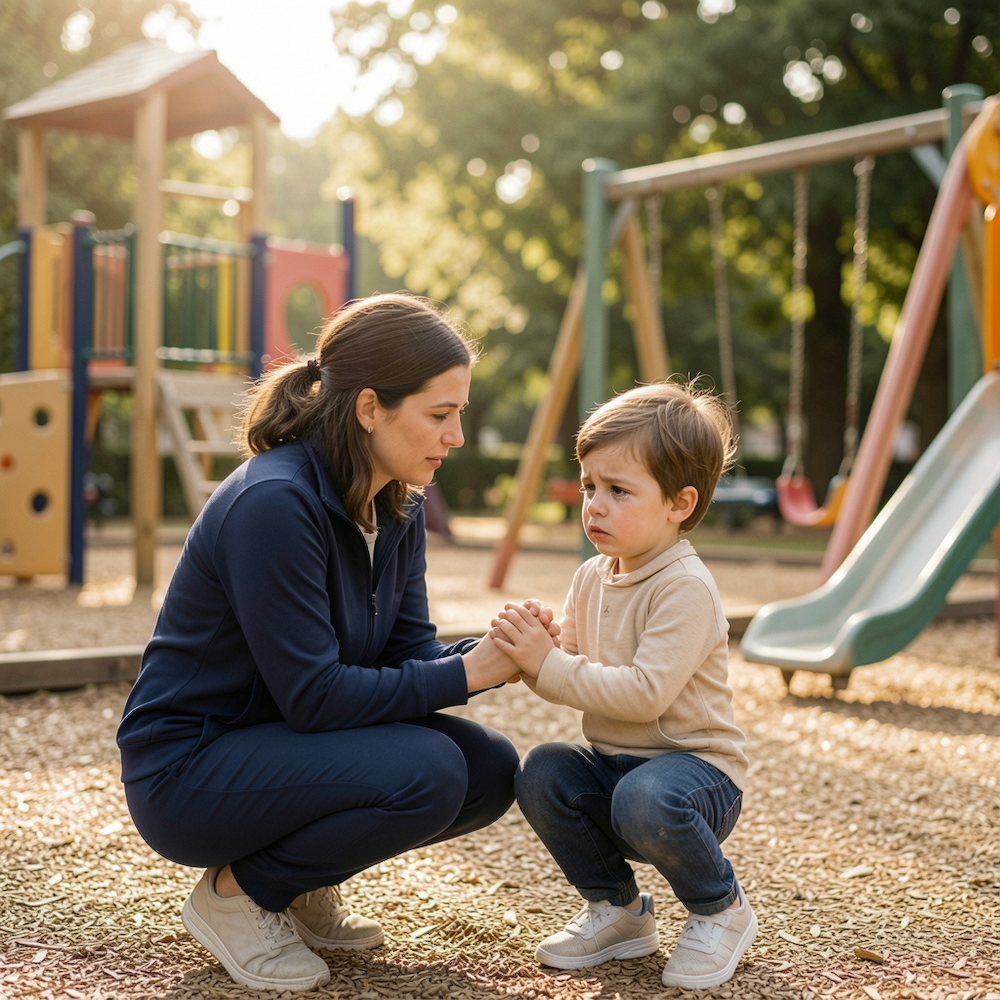
When we stay calm with our children, we are quite literally helping build their brain.
🔍 Deeper insight:
Repeated co-regulation strengthens connections between the emotional and thinking parts of the brain, this is what allows a child, over time, to pause instead of react.
2. It underpins behaviour (not the other way around)
What looks like “bad behaviour” is often a child who is overwhelmed and doesn’t yet have the skills to cope. Regulation skills reduce tantrums, aggression, and shutdown.
This perspective is strongly supported by the Australian Institute of Family Studies, which emphasises that behaviour is often a form of communication, not defiance.
🔍 Deeper insight:
When we focus only on behaviour (timeouts, consequences) without addressing regulation, we may stop the behaviour temporarily—but we don’t build the skill.
3. It predicts long-term well-being
Research consistently links strong emotional regulation with:
- Better mental health
- Stronger relationships
- Academic success
- Lower risk of anxiety, depression, and behavioural issues
Longitudinal research highlighted by the Australian Psychological Society and Beyond Blue reinforces that early emotional skills are a key predictor of lifelong wellbeing.
🔍 Deeper insight:
Self-regulation in early childhood is one of the strongest predictors of school readiness and life outcomes—even more than IQ in some studies.
4. It builds resilience
Children who can move through big feelings (instead of being stuck in them) are more adaptable, confident, and capable when life gets hard.
🔍 Deeper insight:
Resilience isn’t about “toughening kids up”, it’s about giving them repeated experiences of being supported through difficulty so they internalise: “I can handle this.”
5. It strengthens the parent-child bond
When a child feels understood and supported in their emotions, it builds trust, safety, and connection—the foundation for everything else.
And connection isn’t just “nice to have”, it’s what makes regulation possible.
🔍 Deeper insight:
Children are biologically wired to seek safety in their caregiver. When that safety is consistent, it becomes the foundation for:
- confidence
- independence
- emotional security
🧠 Kids borrow your calm before they build their own
Children don’t naturally self-regulate early on—they learn it through:
co-regulation (you calming them) → guided practice → independence over time
This concept is widely supported by Australian child development frameworks, including Emerging Minds.
💬 “Kids borrow your calm before they build their own.”
🔍 Deeper insight:
This isn’t just emotional—it’s physiological.
Heart rate, breathing, and stress hormones can literally sync between parent and child.
👶 How it changes from ages 0–12
0–2 years: Regulation is external (they need you for everything)
What’s happening: The brain is immature; emotions are intense and overwhelming.
What they need: Immediate soothing and physical comfort.
Parent role:
- Hold, rock, soothe, respond quickly
- Use calm tone and predictable routines
- Label simple feelings (“You’re upset. I’m here.”)
👉 You are their nervous system.
Deeper layer:
Consistent responsiveness in this stage is strongly linked to secure attachment, which underpins emotional regulation later in life
2–4 years: Big emotions, tiny control
What’s happening: Emotional centres are highly active; impulse control is minimal.
Common: Tantrums, frustration, “no” phase
Parent role:
- Stay calm during meltdowns
- Validate feelings but hold boundaries
- Introduce simple tools (breathing, naming feelings)
👉 They feel it all—but can’t manage it yet.
Deeper layer:
Tantrums are not manipulation—they are neurological overload.
4–6 years: Learning the language of emotions
What’s happening: Growing ability to understand and talk about feelings
Common: Emotional swings, sensitivity, testing limits
Parent role:
- Teach emotional vocabulary
- Model coping strategies
- Guide problem-solving (“What can we do next time?”)
👉 This is the training ground for lifelong skills.
Deeper layer:
Children who can name emotions are significantly more likely to regulate them.
6–9 years: Building internal skills
What’s happening: Increased self-awareness and cognitive development
Common: Social challenges, frustration with rules or failure
Parent role:
- Encourage reflection (“What helped you calm down?”)
- Support independence in using coping tools
- Normalise mistakes and emotional ups and downs
👉 They’re starting to regulate—but still need support.
Deeper layer:
This is where children begin forming internal self-talk—your voice becomes their inner voice.
9–12 years: Transition to independence
What’s happening: More complex emotions, social comparison, early identity development
Common: Peer pressure, self-doubt, mood fluctuations
Parent role:
- Be a safe space without judgment
- Coach rather than control
- Help them connect emotions to actions and consequences
👉 They can regulate more—but connection still matters deeply.
Deeper layer:
Pre-teens still rely heavily on emotional safety at home—even when they appear more independent.
🌿 What actually helps in the moment: Real phrases that build regulation
💛 Emotion Validation & Safety
- “I can see this feels really big for you right now.”
- “Your feelings make sense.”
- “It’s okay to feel angry/sad/frustrated.”
- “I’m here with you. You’re not alone in this.”
- “You’re safe. We’ll figure this out together.”
🧠 Building Emotional Awareness
- “Can you tell me what your body is feeling right now?”
- “What do you think this feeling is trying to tell you?”
- “Let’s name the feeling—does it feel like anger, sadness, or something else?”
- “Where do you feel that in your body?”
- “Feelings come and go, like waves.”
🌿 Calming & Regulation Strategies
- “Let’s take a slow breath together.”
- “In through your nose… and out through your mouth.”
- “Would you like a quiet minute or a cuddle?”
- “Let’s pause and reset.”
- “You can take your time. There’s no rush.”
💪 Encouraging Coping Skills
- “What usually helps you feel better?”
- “Would drawing or writing about it help?”
- “Let’s think of a small step we can take.”
- “You’ve handled hard things before—you can do this.”
- “What’s one thing that might help right now?”
🧩 Problem-Solving & Reflection
- “What happened just before you felt this way?”
- “What could we try next time?”
- “Let’s figure this out together.”
- “What do you need right now?”
- “How can I support you?”
❤️ Connection & Co-Regulation
- “I’m right here with you.”
- “We can sit together until you feel calmer.”
- “Do you want to hold my hand or have a hug?”
- “We’re a team.”
- “You don’t have to go through this alone.”
🌈 Reframing & Empowerment
- “Big feelings don’t last forever.”
- “You’re learning how to handle this—one step at a time.”
- “It’s okay to make mistakes. That’s how we learn.”
- “You’re getting stronger at managing your feelings.”
- “You can feel this and still be okay.”
🛑 Setting Gentle Boundaries (while validating feelings)
- “It’s okay to feel angry, but it’s not okay to hurt others.”
- “You can be upset, but we still need to be kind.”
- “Let’s find a safe way to express that feeling.”
- “I won’t let you hurt yourself or others.”
- “We can calm down first, then talk about what happened.”
🌟 Mindfulness & Grounding
- “Can you name 5 things you can see right now?”
- “Let’s listen for 3 different sounds.”
- “Feel your feet on the ground—are they steady?”
- “Let’s imagine your favourite calm place.”
- “Focus on your breathing—it can help your body settle.”
🔍 Why these phrases matter:
Language shapes emotional development. These phrases:
- validate (calm the nervous system)
- label (build awareness)
- guide (build skills)
They align with evidence-based approaches including emotion coaching and CBT-informed parenting strategies supported by:
- Australian Psychological Society
✨ You can also build on your original phrases:
- “Writing about this emotion may help—want to try together?”
- “You’re allowed to take a break when you feel overwhelmed.”
- “When feelings feel big, let’s imagine a place where you feel happy and safe.”
- “It’s okay to cry—tears can help your body release feelings.”
- “We’ll work together to understand what’s going on inside you.”
🧠 What happens if children don’t learn this?
Without support, ongoing emotional dysregulation can show up as:
- Increased anxiety or withdrawal
- Aggression or behavioural challenges
- Difficulty forming and maintaining friendships
- Lower confidence and resilience
🔍 Deeper insight:
Unmet emotional needs don’t disappear—they often show up as behaviour, anxiety, or avoidance later on.
🌿 The bottom line
Children who learn to regulate their emotions don’t just “behave better”—they:
- feel safer in themselves
- communicate more effectively
- bounce back from challenges
- and grow into emotionally healthy adults
And it all starts with a calm, responsive adult helping them through the storm—again and again.
💛 If you take one thing from this…
- Connection comes before correction
- Behaviour is communication
- Calm builds calm
You don’t have to get it perfect.
You just have to keep showing up.
📚 References
- Raising Children Network
- Australian Institute of Family Studies
- Emerging Minds
- Beyond Blue
- The Royal Children’s Hospital Melbourne
- Australian Psychological Society