CPR Kids
When it comes to choking, prevention is always better than cure.
As parents, we spend so much time worrying about the big things — illnesses, injuries, milestones, sleep, school readiness — but some of the most serious risks can happen quietly, quickly and during completely ordinary moments like lunch, snack time or play.
One minute your toddler is happily eating grapes in the highchair. The next, everything changes.
The scary reality is that choking can happen silently and in seconds. Unlike what we often see in movies, many children who are choking cannot cough, cry or call out for help. That’s why prevention, supervision and knowing what to do in an emergency matters so much.
The good news? Many choking incidents are preventable with a few simple habits and small changes at home.
According to Healthdirect Australia, babies and young children are at greater risk of choking because they naturally explore the world with their mouths and have very small airways. (healthdirect.gov.au)
Young children are also still learning how to chew, swallow and manage different food textures safely. Their chewing skills are immature, their molars are still developing, and they are often distracted, active and impulsive during meals.
And honestly? Parenting is busy. We’ve all turned away for “just a second” to unload the dishwasher, answer a text, wipe another child’s hands or grab a drink from the fridge.
That’s why simple, realistic prevention strategies are so important.
We can’t — and shouldn’t — wrap our kids up in cotton wool either. Otherwise we’d still be spoon-feeding our teenagers purée. Children need opportunities to learn, explore textures, develop feeding skills and build confidence around food.
Accidents can still happen, even to the most vigilant parents.
But there are four simple actions we can take to significantly reduce the risk of choking in little ones.
These are the four S’s of choking prevention.
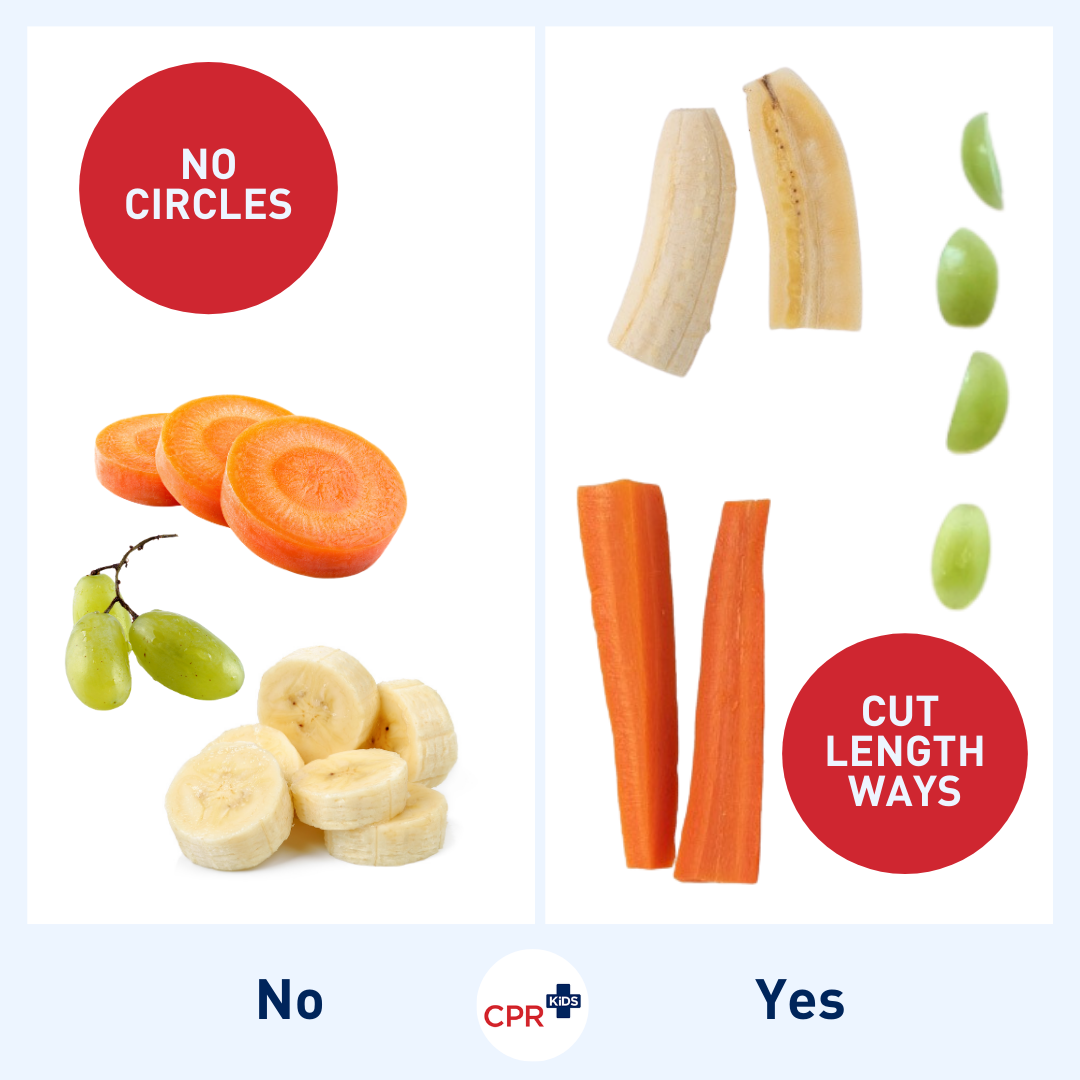
Shapes: Why The Shape Of Food Matters More Than You Think
Cutting foods into developmentally appropriate shapes and sizes is one of the most important ways to reduce choking risk in babies and young children.
Many parents are surprised to learn that it’s often not the food itself that is dangerous — it’s the shape, size and texture.
Round, firm foods are particularly risky because they can completely block a small child’s airway and create an airtight seal.
According to Sydney Children’s Hospitals Network and Royal Children’s Hospital Melbourne, common choking hazards for young children include grapes, popcorn, hard lollies, sausages, raw carrot, apple pieces, nuts and corn chips. (schn.health.nsw.gov.au)
High-Risk Choking Foods For Young Children
- Whole grapes
- Cherry tomatoes
- Blueberries
- Popcorn
- Marshmallows
- Whole nuts
- Hard lollies
- Raw carrot rounds
- Apple chunks
- Sausages
- Corn chips
- Large pieces of meat
- Peanut butter served in thick spoonfuls
Safer Ways To Prepare Common Foods
Grapes & Cherry Tomatoes
Cut lengthways into quarters.
Sausages
Slice lengthways into thin strips rather than coin-shaped rounds.
Raw Carrot & Apple
Grate, steam or cut into very thin matchstick pieces.
Blueberries
Squash gently or cut depending on size.
Nut Butters
Spread thinly on toast or crackers rather than serving thick spoonfuls.
Meat
Cut into small, manageable pieces and remove bones.
Why Young Children Are More Vulnerable To Choking
Babies and toddlers are still developing the complex coordination needed to chew and swallow safely.
Their airways are tiny — in some cases only about the width of a drinking straw — meaning even small foods or objects can block airflow. (health.qld.gov.au)
Young children also:
- Tend to overstuff their mouths
- Become easily distracted during meals
- Move while eating
- Explore objects orally
- Have immature chewing patterns
- Often swallow before food is fully chewed
This is why age-appropriate food preparation matters so much.
Sitting Down: Why Toddlers Should Never Eat On The Run
The risk of choking increases dramatically when children are walking, running, climbing, laughing, crying or playing while eating.
We’ve all done it:
- Handing out snacks in the pram
- Offering crackers during errands
- Giving toddlers food while they wander the house
But movement and distraction increase choking risk because children are less focused on chewing and swallowing safely.
According to Healthdirect Australia, children should always sit down calmly while eating and drinking. (healthdirect.gov.au)
Sitting down to eat meals together not only reduces choking risk, but also:
- Encourages mindful eating
- Supports language development
- Builds healthy eating habits
- Creates family connection and bonding
And yes — getting toddlers to stay seated during snacks can sometimes feel like an Olympic sport.
Supervise: Choking Can Be Silent
This is one of the most important things every parent should know:
Choking is often silent.
Many people imagine choking as loud coughing and dramatic distress. But when a child’s airway is completely blocked, they may be unable to make any sound at all.
That silence is what makes choking so frightening.
According to Queensland Health, signs of choking can include:
- Inability to cry or speak
- Silent panic
- Difficulty breathing
- Weak or ineffective coughing
- Blue lips or skin
- Wide eyes or distressed facial expression
- Loss of consciousness in severe cases (health.qld.gov.au)
Gagging vs Choking: What’s The Difference?
One of the most confusing things for parents is knowing the difference between gagging and choking.
Gagging
- Loud and noisy
- Child may cough or splutter
- Red face or watery eyes
- Protective reflex that helps prevent choking
- Child is still moving air
Choking
- Often silent
- Unable to cry or cough properly
- Difficulty breathing
- Blue or pale lips
- Panic or frozen expression
- Medical emergency
Gagging can look scary, especially when babies are learning solids, but it is a protective reflex.
Choking is different because airflow is compromised.
“I Looked Away For One Second”
Many choking incidents happen during completely normal parenting moments:
- Cleaning the kitchen
- Helping a sibling
- Driving in the car
- Chatting at a birthday party
- Folding laundry nearby
No parent is perfect. No parent supervises flawlessly every second of every day.
But because choking can happen so quickly and quietly, it’s important to keep children within your direct line of sight while eating whenever possible.
Even foods they’ve eaten safely a hundred times before can become a choking hazard under the wrong circumstances.
Search: Get Down To Your Child’s Level
Anything that can fit through a cardboard toilet paper roll can pose a choking risk for young children.
One of the best things parents can do is physically get down onto their hands and knees and look at the home from a child’s perspective.
What can they reach?
What’s fallen under the couch?
What’s sitting on low tables, handbags or bedside drawers?
According to Royal Children’s Hospital Melbourne and Healthdirect Australia, common household choking hazards include: (rch.org.au)
- Coins
- Button batteries
- Hair clips
- Magnets
- Beads
- Marbles
- Deflated balloons
- Small toy parts
- Water beads
- Buttons
- Safety pins
- Bouncy balls
Why Button Batteries Are Especially Dangerous
Button batteries deserve special attention because they are not only a choking hazard — they can also cause severe internal burns if swallowed.
These tiny batteries are commonly found in:
- Remote controls
- Musical toys
- Flameless candles
- Watches
- Car keys
- Bathroom scales
If swallowed, button batteries can cause life-threatening injuries in as little as two hours.
Always keep spare batteries locked away and ensure battery compartments are secured.
Children Learn Through Exploration — Not Fear
It’s important to remember that choking prevention is not about parenting in fear.
Children learn through sensory exploration, self-feeding and experiencing different textures. Mealtimes should still feel positive, enjoyable and relaxed.
The goal is not perfection.
The goal is reducing preventable risk while building confidence, awareness and preparedness as parents.
Small changes truly can make a huge difference.
Every Parent Should Learn Choking First Aid
Most importantly, accidents can still happen — even when we do everything “right”.
That’s why knowing basic choking first aid is one of the most empowering things a parent or carer can do.
According to St John Ambulance Australia and Australian Red Cross, choking first aid for babies and children differs from adult first aid, which is why paediatric first aid training is strongly recommended. (betterhealth.vic.gov.au)
Call Triple Zero (000) Immediately If:
- Your child cannot breathe
- They cannot cry or speak
- Their lips turn blue
- They become floppy or unconscious
- The blockage does not clear quickly
Knowing what to do in the first few seconds of an emergency can save a child’s life.
Quick Choking Prevention Checklist For Families
✔ Cut round foods appropriately
✔ Avoid high-risk foods for young children
✔ Always supervise eating
✔ Encourage children to sit while eating
✔ Keep small objects out of reach
✔ Check toys regularly for loose parts
✔ Learn infant and child choking first aid
✔ Keep button batteries secured
✔ Stay calm and act quickly in emergencies
The Bottom Line
Choking accidents can happen fast, quietly and unexpectedly — often during everyday moments that seem completely routine.
But the simple habits we build around food preparation, supervision and home safety can dramatically reduce the risk.
Prepared, not paranoid.
That’s the balance most parents are trying to find.
And while none of us can prevent every accident, knowledge gives us something incredibly powerful: confidence.
Confidence to prepare food more safely.
Confidence to recognise the signs of choking.
Confidence to respond quickly in an emergency.
And confidence to create safer everyday environments for our children to learn, eat, grow and explore.
References
- Healthdirect Australia – Choking
- Royal Children’s Hospital Melbourne – Choking Prevention
- Sydney Children’s Hospitals Network – Choking First Aid Factsheet
- Queensland Health – Child & Baby Choking
- Better Health Channel Victoria – Choking
- Kidsafe Australia – Injury Statistics
- Australian Institute of Health and Welfare – Choking & Suffocation