
Kiddipedia
We all know how it feels when our kids test our patience, like when they have a meltdown over a sandwich that’s been cut the “wrong” way, refuse to put on their shoes, or get upset about going to school. So what do we do in these moments?
The answer isn’t about control or punishment, it’s about pausing, breathing, and trying to see the world through their eyes. Remember, your child isn’t being deliberately difficult. Their behaviour is their way of communicating when words aren’t enough.
Think about it. When kids misbehave, they’re trying to tell us something. Maybe they’re frustrated, tired, or simply seeking attention and connection. By understanding this, we can respond in a way that makes them feel heard, supported, and safe.
Behaviour is communication.
Seeing it this way transforms how we respond, reducing stress for both parent and child.
What Is Considered Challenging Behaviour?
“Challenging behaviour” is any action that makes a situation difficult to manage. It could be saying “no” repeatedly, refusing to participate, or even physical reactions like hitting or tantrums. Context is key. A two-year-old throwing a tantrum might be normal, whereas a ten-year-old demonstrating similar behaviour could signal something else.
The NDIS Quality and Safeguards Commission highlights that challenging behaviours often stem from environments that don’t fully meet a child’s needs. Rather than labelling the child as “naughty,” we can look at why they are struggling to cope at that particular moment.
The Raising Children Network further explains that what we see as misbehaviour is often a child’s attempt to communicate needs and emotions when they lack the words or skills to do so.
What Causes Challenging Behaviour in Children?
Developmental and Emotional Factors
It’s important for us as parents to remember that children are still developing the brain systems that control emotion, attention, and impulse. According to the Centre for Community Child Health, the prefrontal cortex—the part of the brain responsible for reasoning and self-control—is still under construction well into adolescence.
This means that when your child hits, screams, or refuses instructions, it’s often not manipulation; it’s a neurological response. Their limbic system (emotional brain) has taken over because their “thinking brain” isn’t fast enough to process what’s happening.
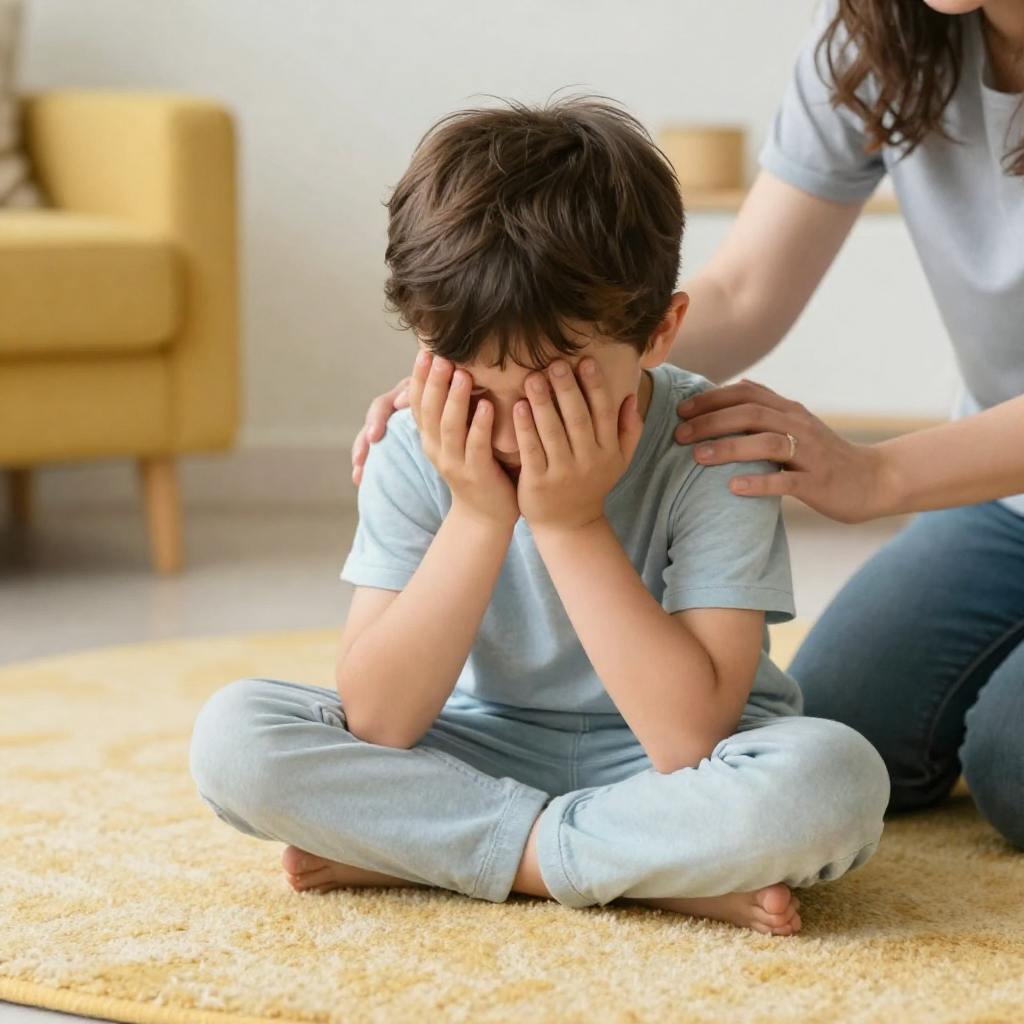
Even simple transitions, such as stopping a game, leaving the park, or moving to bath time, can trigger a fight, flight, or freeze response. Understanding this lets us respond with calmness and empathy, instead of frustration or punishment.
They’re not giving you a hard time—they’re having a hard time.
Environmental and Social Influences
Sometimes, the “problem” isn’t the child at all, it’s the environment. Noisy classrooms, unpredictable mornings, or overstimulating home environments can overwhelm a child’s nervous system. According to the Australian Institute of Family Studies, predictable routines and supportive environments reduce distress and improve emotional regulation.
Transitions are especially tricky. A shift from a preferred activity, like playing Minecraft, to something less preferred, like bath time, can feel like a crisis to a child who thrives on routine. Visual schedules, timers, or calm transition strategies can make a huge difference.
Unmet Needs and Skill Gaps
Every behaviour has a purpose: to gain something or avoid something. If a child hasn’t learned the skills to ask for a break, negotiate, or communicate frustration, they will use the best behaviour they have available.
Using a functional behaviour lens (Antecedent–Behaviour–Consequence analysis) can help parents see what drives behaviour rather than simply punishing it. This approach, used in Positive Behaviour Support, is research-backed and supported by Australian evidence.
Common Triggers Parents Often Overlook
Often, meltdowns are the final straw after a day of small challenges. Just like adults, children are affected by sleep, hunger, and stress. Even small disruptions—a broken pencil, a missed snack—can trigger intense reactions.
According to the Australian Institute of Health and Welfare, physiological stressors like sleep deprivation or overstimulation are strongly linked to behavioural dysregulation.
Look at the pattern, not the incident.
A child who seems to explode “out of nowhere” is often responding to multiple unseen stressors: fatigue, hunger, sensory overload, or emotional overwhelm.

How to Respond Effectively Using Positive Behaviour Support Principles
Focus on Understanding Before Reacting
When things are escalating, our first reaction is often to shut it down. But what if, instead, you paused and became curious? Asking yourself, “What is my child trying to tell me right now?” can be calming in itself and help you respond more effectively.
This is the essence of Positive Behaviour Support (PBS)—an approach that uses the best available research evidence to reduce challenging behaviours and improve a child’s quality of life. Working with a positive behaviour support practitioner can help you identify triggers, unmet needs, and practical strategies to support your child, turning moments of stress into opportunities for learning and connection.
Teach, Don’t Punish
Punishment may stop behaviour temporarily, but it doesn’t teach a child what to do instead. If your child hits in anger, we can teach alternatives: using words to express feelings, taking a deep breath, or seeking help from an adult.
The Australian Psychological Society confirms that children learn best through modelling, guided practice, and positive reinforcement, not punishment.
Connection before correction. Always.
Adjust the Environment and Use Reinforcement
Sometimes the solution is environmental:
- Morning battles? Visual checklists or routines help.
- Supermarket meltdowns? Headphones, quiet zones, or timing adjustments can help.
Positive reinforcement is critical. Even small improvements—pausing before responding, using words, or following a routine—should be noticed:
“I noticed you took a deep breath before asking for that toy back. That was really helpful!”
Over time, these micro-successes build confidence and trust.
Practical Parent Tools
In the moment:
- Get down to your child’s level
- Use fewer words
- Label the feeling: “That feels really hard”
Before the moment:
- Prepare for transitions
- Use visual routines
- Prioritise sleep, nutrition, and calm start-of-day routines
After the moment:
- Repair the relationship, don’t lecture
- Discuss alternative strategies when calm
- Celebrate small wins
When to Seek Additional Support
It’s okay to say, “I need help.” Signs you might need extra support include:
- Behaviour is increasing in intensity or frequency
- School or social engagement is affected
- Safety becomes a concern
In Australia, support may involve:
- GP or paediatrician
- Behaviour support practitioners via NDIS
- Parenting programs and early intervention services
Early intervention is backed by the Australian Institute of Family Studies, leading to better school, social, and emotional outcomes.
Supporting Positive Behaviour Is a Long-Term Process
Change isn’t linear. Some days feel like huge progress; others feel like backtracking. The goal isn’t perfect behaviour, it’s raising children who feel supported, listened to, and equipped to navigate life’s challenges.
When we focus on connection over control, we give our children a lifelong gift: the ability to regulate their emotions, solve problems, and interact with the world confidently.
You’re not aiming for perfect behaviour.
You’re building lifelong skills.
References
- Raising Children Network
- Australian Institute of Family Studies
- Centre for Community Child Health
- Australian Psychological Society
- NDIS Quality and Safeguards Commission
- Australian Institute of Health and Welfare