
Kiddipedia
Simple visual cues can help young children, educators and other adults quickly recognise a child’s food allergy—but a label is only one part of a much bigger allergy safety plan.
If your child has a food allergy, something as ordinary as packing their lunchbox can suddenly involve a lot more thought.
Which foods are safe? Has the label changed? Who will be supervising lunch? Will another child offer them a snack? What happens at a birthday celebration? Will a relief teacher know about their allergy? What about cooking activities, excursions or school camps?
For parents of young children, these questions can feel overwhelming.
With around two children in every school classroom living with a food allergy, safe identification and allergy awareness are increasingly important parts of creating safe, inclusive learning environments. For young children, particularly those who are still learning to read, recognising a written allergen name or deciphering complex ingredient information isn’t always straightforward. A simple, consistent visual cue can provide an additional way for children and the adults caring for them to recognise that a food allergy needs to be considered.
A clear, easy-to-recognise allergy label won’t answer all of them, but it can provide an additional visual cue that helps the adults around your child identify their allergy quickly.
This can be particularly useful for toddlers and younger children who are not yet confident readers and may not understand complicated ingredient names or be able to independently manage their allergy.
Australian allergy guidance recommends an allergy-aware approach, with risk-minimisation strategies tailored to individual children. This includes appropriate education, supervision, communication, food-management practices and individualised care plans.
So, think of an allergy label as one layer of the safety system—not the safety system itself.
Safety First: An Allergy Label Is Not an Allergy Management Plan
Before choosing colours, icons or stickers, there is one important thing every parent should know.
A visual allergy label cannot:
- diagnose an allergy;
- tell a child whether a particular food is safe;
- replace reading food labels;
- prevent cross-contact;
- replace an ASCIA Action Plan;
- replace an individualised allergy or anaphylaxis care plan;
- replace appropriate educator supervision;
- replace prescribed adrenaline where required;
- guarantee that another child won’t offer or share food.
For children with medically confirmed allergies, Australian guidance recommends that schools and children’s education and care services have individualised care plans that include the child’s current ASCIA Action Plan where applicable.
The current 2026 ASCIA Action Plans are medical documents completed by the child’s treating prescriber. They provide instructions for recognising and responding to allergic reactions and anaphylaxis.
Your child’s sticker is a visual identifier. Their medical plan is the medical plan.
That distinction is important.
Why Visual Allergy Identification Can Help
Young children cannot always read a food label, understand an ingredient list or explain their allergy to another child.
A simple, consistent visual system can help make an allergy easier for the adults around them to identify.
Australian Allergy Aware guidance recommends that children’s lunch boxes and water bottles are clearly labelled with the child’s name and that children and the wider school community are educated about food allergy, including why children should only eat their own food and should not share or offer food to children with food allergies.
The aim isn’t to make your child’s lunchbox look like a medical emergency kit.
It’s simply to make the important information easy to spot, easy to understand and consistent.
1. Choose a Simple, Clear Allergen Name
Complex medical terminology can be difficult for young children—and unnecessary when the aim is quick visual recognition.
Keep the wording simple and immediately recognisable. Use clear, familiar terms such as PEANUT, MILK or EGG, rather than filling a small label with technical ingredient names such as casein or albumin. This is particularly helpful in childcare and early learning environments, where educators may need to identify important allergy information quickly during busy meal and snack times.
The purpose of the label is to provide a quick visual cue—not to reproduce the detailed terminology found in medical documents or ingredient lists.
A short, clearly printed allergen name can be much easier to identify.
For example:
PEANUT
MILK
EGG
SESAME
However, there is an important distinction between your child’s personal visual label and the information found on food packaging.
For packaged foods in Australia, FSANZ requires specified allergens to be declared using prescribed names. These include wheat, fish, crustacean, mollusc, egg, milk, lupin, peanut, soy/soya/soybean, sesame and individual tree nuts, among others. Allergen information must be clearly declared when those allergens are present as ingredients, including components of food additives or processing aids.
That means your child’s personal label should be a clear communication aid, while food packaging should always be checked using the actual allergen information provided.
A useful rule for parents
Your child’s label can say “PEANUT”.
Your child’s food still needs to be checked every time.
And if your child’s healthcare professional uses a particular term to describe their confirmed allergy, keep the wording consistent with their medical information.
2. Choose High Contrast for Easy Recognition
Safety information isn’t particularly helpful if nobody can find it.
A label sitting among colourful lunchboxes, drink bottles, backpacks and food containers needs to be visually distinct.
Rather than concentrating on choosing a particular “magic” colour, focus on:
- strong contrast between the background and text;
- large, readable lettering;
- simple shapes;
- uncluttered design;
- consistent use of the same visual treatment.
A bright colour can be useful as an additional visual cue, but colour should never be the only way the allergy is communicated.
For example, don’t rely solely on:
RED = ALLERGY
Instead use:
RED + PEANUT + PEANUT SYMBOL
This means the warning can still be understood if the colour isn’t noticed, lighting is poor or someone doesn’t understand your family’s colour system.
Parent Tip
Think “easy to spot”, rather than “as bright as possible”.
The most effective-looking label isn’t necessarily the one with the most colour. It is the one where the important information can be identified quickly.
3. Add a Simple, Recognisable Pictogram
For a young child who is still learning to read, a picture can provide another layer of recognition.
A three-year-old may not be able to read PEANUT ALLERGY, but they may learn to recognise a particular symbol on their lunchbox.
You could use:
- a peanut graphic with a prohibition symbol;
- a milk carton with a clear warning symbol;
- an egg graphic;
- a wheat symbol;
- a sesame seed symbol;
- a simple shield containing the allergen name.
The key is simplicity.
Avoid detailed illustrations, decorative backgrounds and complicated medical graphics.
Pairing a simple pictogram with the written allergen name creates two ways of recognising the message.
Pairing a single word with an unambiguous graphic builds dual recognition over time. According to research on choosing safe foods, visual cues can help children become more involved in their own food-safety routines.
And this isn’t simply a design trend. The importance of combining visual information with clear written instructions is reflected in Australia’s current allergy resources. The 2026 ASCIA Action Plans have expanded the use of infographics to reinforce written information, with ASCIA noting positive feedback about the use of pictorial information in childcare and school settings.
A simple design might look like:
🥜 PEANUT ALLERGY
or
MILK ALLERGY
with a simple milk symbol.
The exact graphic matters less than making it clear, consistent and immediately recognisable.
You can easily build a simple, high-visibility symbol using a Canva logo generator to create consistent allergy identification stickers for water bottles, lunchboxes and lunch bags. Focus on recognisable shapes, such as a bold circle enclosing a crossed-out allergen symbol, to make the design easy to identify at a glance.
4. Create One Consistent Visual Identity
Once you’ve settled on a symbol, colour treatment and wording, keep it consistent.
The same visual identity could appear on:
- your child’s lunchbox;
- snack containers;
- water bottle;
- lunch bag;
- food containers;
- treat box;
- backpack;
- medication bag, where appropriate;
- other items routinely involved in food or allergy management.
The goal is to help your child and the adults around them make the connection:
“That’s my allergy symbol.”
For a young child, repetition matters.
The same word.
The same symbol.
The same basic design.
The same message.
You don’t need to reinvent the label every school term.
5. You Can Create a Custom Icon Yourself
You don’t necessarily need an expensive graphic designer to create a simple visual identifier.
An online design platform such as Canva can be used to create a basic, high-visibility design that can then be printed as stickers or labels.
For example, you could create:
- a red circle featuring a crossed-out peanut graphic;
- a milk carton icon with a prominent warning symbol;
- a yellow caution-style shield containing the allergen name.
The important part isn’t the software you use.
It’s the consistency of the finished design.
Once you have a design you like, save the original file so you can reproduce it if labels are lost, damaged or need replacing.
Keep it simple
Avoid filling the label with:
- long medical explanations;
- emergency instructions;
- multiple unrelated symbols;
- tiny text;
- decorative fonts.
The lunchbox label should communicate one important piece of information clearly.
6. Make the Label Durable
An allergy label is of little practical use if it peels off during the first dishwasher cycle.
Lunchboxes and drink bottles go through a lot:
- washing;
- dishwashers;
- spills;
- condensation;
- refrigeration;
- being thrown into school bags;
- being opened and closed dozens of times;
- rubbing against other containers.
Paper stickers and ordinary markers can deteriorate quickly.
If you’re making your own labels, look for materials designed for repeated exposure to moisture and handling, such as durable vinyl labels with protective laminate.
For fabric items such as backpacks or jackets, consider labels designed specifically for fabric and follow the manufacturer’s application instructions.
The real-world test
Before relying on a new label, put it through the kind of daily treatment it will actually receive.
Wash it.
Dry it.
Rub it.
Put it through the dishwasher if the container is dishwasher-safe.
Then ask:
Can I still clearly read the allergen?
If the answer is no, replace or redesign it.
7. Put the Label Where People Can Actually See It
Placement matters.
A beautifully designed allergy label hidden underneath a lunchbox isn’t much help when an educator is preparing food.
Think about where someone naturally looks when they pick up the container.
Useful positions can include:
- the front of the lunchbox;
- near the opening or latch;
- the front of food containers;
- the outer surface of a lunch bag;
- near the spout or body of a water bottle;
- another prominent area that remains visible when the item is being used.
You can use more than one label if appropriate.
Try the “three-second test”
Place the lunchbox on a table and ask another adult:
“What allergy warning can you see?”
Don’t explain where the label is.
Give them three seconds.
If they can’t find it, make it larger, simpler or more prominent.
This isn’t a medical test—it’s simply a practical way of checking whether your design is doing what you intended it to do.
8. Don’t Rely on Colour Alone
A bright colour can help attract attention, but colour shouldn’t carry the entire message.
Someone may:
- have difficulty distinguishing certain colours;
- encounter the lunchbox in poor lighting;
- see only part of the label;
- not know what your chosen colour means;
- simply overlook it.
Instead, combine several cues:
WORD + ICON + CONTRAST + CONSISTENCY
For example:
PEANUT ALLERGY
with a simple peanut symbol and strong contrast.
That way, the information doesn’t disappear if one visual element is missed.
9. Put Your Child’s Name on Their Lunchbox
Allergy identification and ordinary lunchbox identification can work together.
Australian Allergy Aware guidance recommends clearly labelling children’s lunchboxes and water bottles with the child’s name.
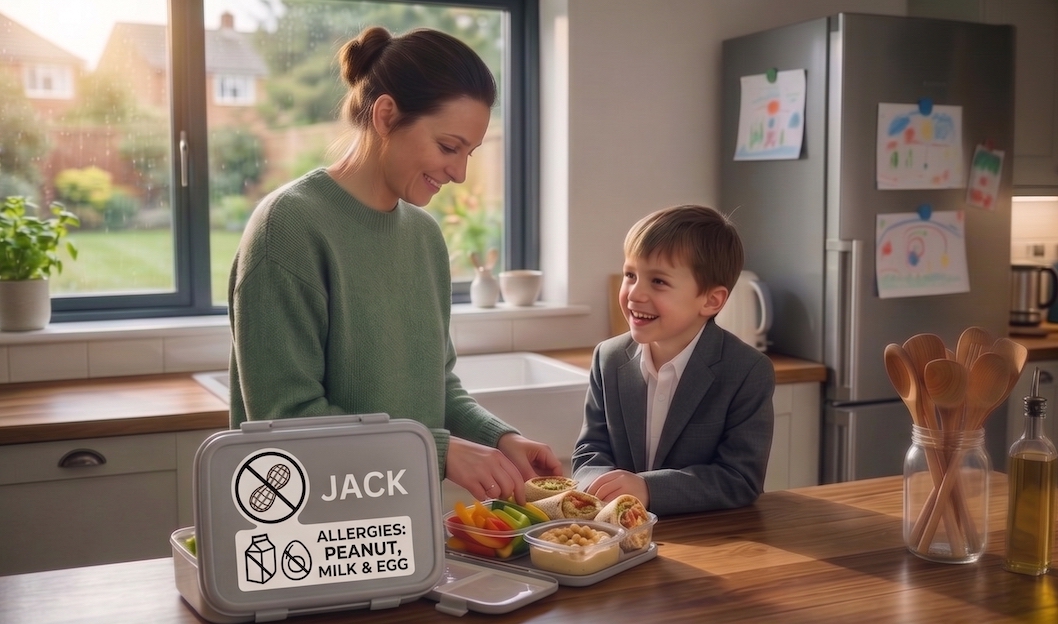
A simple design could therefore include:
JACK
PEANUT ALLERGY
This can make it easier for educators to identify both whose lunchbox it is and what important allergy information they need to know.
The name doesn’t replace the allergy information—and the allergy label doesn’t replace the child’s individual care plan.
They simply serve different purposes.
10. Teach Your Child What Their Allergy Symbol Means
A label works best when your child understands it too.
Even before they can read, you can begin teaching them:
“This is your allergy symbol.”
“This picture means peanut.”
“This is your lunchbox.”
“We don’t eat other people’s food.”
“If you’re not sure, ask a grown-up.”
Australian Allergy Aware guidance recommends age-appropriate education to help children understand food allergy and manage risk. It also recommends educating the wider school community about why children with food allergies should only eat their own food and should not share or offer food.
The conversation will look different at different ages.
Toddlers
Keep it simple.
Teach them:
- what their lunchbox looks like;
- what their allergy symbol looks like;
- not to swap food;
- to ask an adult before eating unfamiliar food.
Preschoolers
Start practising phrases such as:
“I can’t eat that.”
“I need to ask my teacher.”
“Is this safe for me?”
The aim isn’t to make a young child responsible for managing their own allergy.
It’s to begin building age-appropriate recognition and self-advocacy.
Early Primary School
As children develop, you can gradually introduce:
- recognising the allergen word;
- understanding that food labels need to be checked;
- asking before accepting food;
- identifying trusted adults;
- explaining their allergy to friends.
The amount of responsibility should always be appropriate to the child’s age and developmental ability.
11. The Most Important Rule: Don’t Share Food
For many parents, this is the conversation that needs repeating over and over again.
We don’t swap food.
We don’t take food from another child’s lunchbox.
We don’t accept food just because a friend says it’s safe.
If you’re not sure, ask a trusted adult.
Australian Allergy Aware guidance specifically recommends educating students and the wider school community about why children with food allergies should only eat their own food and should not share or offer food to children with food allergies.
This is particularly important for younger children who may not understand that a tiny amount of an allergen can still be dangerous.
12. Remember: Your Child’s Label Doesn’t Replace Food-Label Checking
This is one of the most important distinctions for parents.
Your child’s lunchbox label tells other people about your child’s allergy.
The food package tells you what is in the food.
Australian food labelling requirements were updated to make allergen information clearer and easier to find. Specified allergens must be declared using prescribed names, and a separate bold allergen summary beginning with “Contains” is required near the ingredient list for relevant packaged foods.
For example:
Contains milk
can appear as a separate allergen summary.
FSANZ also explains that precautionary statements such as “may contain” or “may be present” are voluntary statements used to indicate possible unintended allergen presence during manufacture and are not regulated by the Food Standards Code.
Australian Allergy Aware guidance advises that foods carrying precautionary allergen labelling such as “may contain” should not be provided to students allergic to that particular food.
Parent reminder
Check the label every time.
Don’t rely on:
- a product you’ve bought before;
- the colour of the packet;
- the brand name;
- “I’ve always given them this”;
- an old photograph of the ingredients;
- another parent’s reassurance.
Ingredients and manufacturing processes can change.
13. Understand Cross-Contact
Another reason an allergy label alone can’t protect a child is cross-contact.
A food doesn’t necessarily have to be intentionally included in a meal to create a risk for someone with a food allergy.
Cross-contact can happen through:
- shared utensils;
- preparation surfaces;
- containers;
- cooking equipment;
- hands;
- food crumbs;
- shared serving equipment.
Australian Allergy Aware guidance recommends thorough washing of kitchen equipment with hot soapy water and using clean/separate utensils when preparing food.
For younger children, risk can also arise when messy foods are eaten nearby.
Australian guidance notes that, depending on the child’s age and ability to manage their allergy, services may consider allergen-restricted areas where appropriate—for example, where messy foods such as grated cheese, egg or milk are being consumed.
This is why an allergy-aware environment is more realistic than expecting a single sticker to eliminate every risk.
14. What Should Childcare Have in Place?
If your child attends an early childhood education and care service, the conversation shouldn’t stop at the lunchbox label.
Australian Allergy Aware guidance recommends that children’s education and care services:
- obtain up-to-date medical information;
- develop individualised anaphylaxis care plans;
- include the child’s ASCIA Action Plan where applicable;
- train staff in prevention, recognition and treatment;
- train staff involved in food preparation and supervision;
- implement appropriate risk-minimisation strategies;
- provide age-appropriate allergy education;
- have an emergency response plan;
- practise emergency scenarios.
Ask your child’s childcare service:
Who knows about my child’s allergy?
Where is their medical information kept?
Who supervises meals?
How are food allergies communicated to relief staff?
What happens during cooking activities?
What happens during excursions?
How is medication accessed if required?
These conversations are just as important as the label on the lunchbox.
15. What Should School Have in Place?
The same principle applies once your child starts school.
The National Allergy Council’s current Australian guidelines recommend an allergy-aware approach, individualised care plans, staff training, communication, risk minimisation and emergency preparedness.
Schools should also communicate appropriate risk-minimisation strategies to staff, parents and the broader school community.
This doesn’t mean schools should promise to be completely “nut free” or “allergen free”.
Australian Allergy Aware guidance specifically says schools should not claim to be free of an allergen and instead recommends an allergy-aware approach involving multiple risk-minimisation strategies.
That is an important distinction for parents.
16. Don’t Forget Birthday Parties, Treats and Food Activities
Some of the trickiest situations happen outside ordinary lunchtime.
Think about:
- birthday cupcakes;
- lolly bags;
- classroom rewards;
- cooking lessons;
- science experiments involving food;
- cultural days;
- fundraising events;
- breakfast mornings;
- picnics;
- classroom celebrations.
Australian Allergy Aware guidance recommends discussing food-related activities with parents in advance and encourages non-food rewards where possible. It also provides for parents to supply a clearly labelled “treat box” for their child where appropriate.
It can feel awkward to ask questions about every celebration.
But you are not being difficult.
You’re planning ahead.
And the more predictable the system becomes, the easier it can feel for everyone—including your child.
17. Excursions, Camps and Sporting Activities Need Extra Planning
A familiar classroom routine can disappear when children leave school grounds.
A child may suddenly be:
- travelling on a bus;
- eating somewhere unfamiliar;
- attending a camp;
- participating in sport;
- visiting a restaurant;
- taking part in a cooking activity;
- spending time with staff who don’t usually teach them.
The 2026 Australian Best Practice Guidelines have been updated with resources covering off-site activities, excursions, sporting activities, camps and travel.
Before an excursion or camp, ask:
- Who is responsible for my child’s allergy management?
- Who has their medical information?
- Where will their medication be kept?
- What food will be provided?
- Who has checked the food arrangements?
- What happens if food is changed at the last minute?
- What happens during transport?
- Are relief staff or volunteers aware?
Your child’s labelled lunchbox can help with identification—but the wider plan needs to travel with them too.
18. Keep the Medical Plan Separate From the Label
It can be tempting to put lots of information on a lunchbox sticker:
PEANUT ALLERGY — ANAPHYLAXIS — GIVE ADRENALINE — CALL 000
But the more information you add, the less immediately readable the label can become.
Keep the visual identifier simple.
Your child’s medical instructions belong in their appropriate medical documentation.
The 2026 ASCIA Action Plan for Anaphylaxis is a medical document and is completed by the child’s prescriber. The current plan includes visual information to help communicate signs and actions clearly.
Think of it this way:
Lunchbox label:
“PEANUT ALLERGY”
Medical plan:
Detailed instructions for recognising and managing an allergic reaction or anaphylaxis.
Educator training:
How to put that plan into practice.
Each serves a different purpose.
19. Don’t Design Your Own Emergency Action Plan
A Canva template can be useful for creating a visual identifier.
It should not be used to create your own version of an emergency medical plan.
The 2026 ASCIA Action Plans are specifically designed as medical documents and are completed by the child’s prescriber.
If your child has been prescribed an adrenaline device, make sure their school or childcare service has the appropriate current medical documentation and follows its jurisdictional requirements.
If you’re unsure which plan your child needs, speak with their treating doctor or other appropriate prescriber.
20. Involve Your Child in the Design
Children can take an active, age-appropriate role in their safety routine.
Let your child:
- choose between two simple designs;
- help select an icon;
- practise recognising the symbol;
- help put the label on their lunchbox;
- practise saying the allergen name;
- practise asking a trusted adult before eating unfamiliar food.
The goal isn’t to make your child responsible for their own medical safety before they’re ready.
It’s about helping them become familiar with the visual cues and routines that surround their allergy.
For a preschooler, that might simply mean:
“That’s your peanut symbol.”
For an older child, it might become:
“What do you do if someone offers you food?”
“Who can you ask?”
“What do you look for on the packet?”
Age-appropriate education is part of Australia’s allergy-aware approach in both schools and children’s education and care services.
The 5-Part Visual Allergy Safety System
If you’re designing an allergy label for your child, remember these five elements:
1. WORD
Use a clear, easy-to-read allergen name.
2. ICON
Use one simple, recognisable visual.
3. CONTRAST
Make the warning easy to see against the background.
4. CONSISTENCY
Use the same visual identity across your child’s relevant belongings.
5. CONTEXT
Remember that the label sits within a much larger allergy management system.
The sticker supports the system. It doesn’t replace it.
Allergy Label Design Mistakes to Avoid
❌ Tiny text
If you need to hold the container close to your face to read it, it’s too small.
❌ Decorative fonts
Save the fancy typography for birthday invitations.
❌ Colour-only warnings
Always include readable text and, where useful, a symbol.
❌ Complicated graphics
A simple symbol is easier to recognise.
❌ Too much information
Don’t turn a lunchbox sticker into an emergency plan.
❌ Hidden labels
Don’t put the only allergy warning underneath the lunchbox.
❌ Inconsistent terminology
Keep the wording consistent with your child’s allergy information.
❌ Relying on the label alone
The label is an additional communication tool—not a substitute for medical management.
Myth vs Fact
| Myth | Fact |
|---|---|
| A bright allergy sticker is enough to keep my child safe. | A label is only one part of a broader allergy-aware safety system. |
| If the food looks the same as last time, it must be safe. | Food labels should be checked every time because ingredients and products can change. |
| A school can simply become “nut free”. | Australian Allergy Aware guidance recommends an allergy-aware approach with multiple risk-minimisation strategies rather than schools claiming to be allergen free. |
| My child should never be allowed to participate in food activities. | Food activities can be planned with appropriate risk-minimisation strategies and communication with parents. |
| My child’s allergy sticker can replace their medical plan. | An ASCIA Action Plan and individualised care plan have a separate medical and management role. |
| If another child says a food is safe, my child can eat it. | Children with food allergies should be taught not to accept or share food and to check with an appropriate adult. |
| An allergy label only needs to be visible to my child. | It should also be readily identifiable by the adults responsible for the child’s care. |
Your Parent Checklist
Before your child’s next school or childcare day:
- Is your child’s name clearly visible on their lunchbox and water bottle?
- Is the relevant allergen clearly identified?
- Is the text large enough to read quickly?
- Is there a simple visual symbol?
- Is the label high contrast?
- Are you using more than colour to communicate the warning?
- Is the label positioned somewhere adults can easily see it?
- Has the label been tested for washing and everyday wear?
- Does the wording remain consistent with your child’s allergy information?
- Does your child recognise their allergy symbol?
- Does your child understand not to share or accept other children’s food?
- Does your child know which trusted adult to ask?
- Have you provided your child’s required medical information to the service or school?
- Is the relevant ASCIA Action Plan current and available where required?
- Has an individualised allergy/anaphylaxis care plan been developed where required?
- Do educators know about your child’s allergy?
- Do staff responsible for food preparation understand the allergy?
- Have upcoming excursions, camps, celebrations or food activities been discussed?
- Have you checked food labels rather than relying on your child’s lunchbox label?
Frequently Asked Questions
Should I put an allergy sticker on my child’s lunchbox?
A clearly visible label can be a useful additional communication tool, particularly for young children. Australian Allergy Aware guidance recommends that children’s lunchboxes and water bottles be clearly labelled with the child’s name.
However, the sticker should not replace the child’s medical information, individualised care plan or other risk-minimisation strategies.
What should an allergy label say?
Keep it simple and easy to read.
For example:
PEANUT ALLERGY
or
MILK ALLERGY
The exact wording should reflect your child’s confirmed allergy and be consistent with the terminology used in their medical information.
Should I use a picture as well as words?
A simple pictogram can provide an additional visual cue, particularly for younger children who cannot yet read confidently.
Pair the symbol with the written allergen rather than relying on the picture alone.
Should the label be red?
It can be, but there is no need to make colour the only warning.
Prioritise strong contrast, simple typography, a clear allergen name and consistent visual design.
Can an allergy sticker replace an ASCIA Action Plan?
No.
An ASCIA Action Plan is a medical document used for responding to allergic reactions and anaphylaxis. Current 2026 plans are completed by the child’s prescriber.
A custom label is simply an additional visual identifier.
Should my child’s name be on the lunchbox?
Yes. Australian Allergy Aware guidance recommends that student lunchboxes and water bottles be clearly labelled with the child’s name.
Adding the allergy information separately can make both pieces of information easy to identify.
Do I still need to read food labels if my child’s lunchbox says “allergy”?
Absolutely.
The lunchbox label tells other people about your child’s allergy. Food packaging provides the ingredient and allergen information you need when deciding whether a particular food is appropriate.
Australian food allergen labelling requirements were introduced to make allergen information clearer and easier to identify.
What should my child do if another child offers them food?
Teach an age-appropriate routine such as:
Don’t eat it.
Don’t swap food.
Ask a trusted adult.
Australian Allergy Aware guidance specifically recommends educating children about not sharing or offering food to children with food allergies.
What is the difference between a food allergy and food intolerance?
They are not the same condition and should not be managed as though they are interchangeable.
ASCIA specifically notes that its anaphylaxis Action Plans are not intended for food intolerances.
If you’re unsure about your child’s diagnosis or management plan, speak with their healthcare professional.
Australian Resources for Parents
Australasian Society of Clinical Immunology and Allergy (ASCIA)
ASCIA is Australia’s and New Zealand’s peak professional body for clinical immunology and allergy specialists. Its resources include the current 2026 ASCIA Action Plans, allergy information and anaphylaxis guidance.
ASCIA – Action Plans and Allergy Resources
National Allergy Council / Allergy Aware
Allergy Aware provides Australian best-practice resources for schools and children’s education and care services, including risk minimisation, staff training, care plans, excursions and camps.
Allergy Aware – National Allergy Council
Food Standards Australia New Zealand (FSANZ)
FSANZ provides information about Australian and New Zealand food standards, including allergen labelling and the current plain English allergen labelling requirements.
The Bottom Line for Parents
When your child has a food allergy, it can sometimes feel as though every lunchbox, birthday party and school excursion comes with another thing to think about.
You don’t need a complicated sticker.
You need a clear one.
Choose a simple allergen name. Add an easy-to-recognise symbol. Use strong contrast. Make the label durable. Put it somewhere people can see it. Keep the same visual language across your child’s belongings.
Most importantly, use that visual system alongside the things that really underpin allergy safety: appropriate medical documentation, an individualised care plan where required, trained educators, sensible risk-minimisation strategies, food-label checking, supervision and age-appropriate education.
And teach your child the simple messages they’ll hear again and again:
Don’t share food.
Don’t accept food unless a trusted adult says it’s safe.
If you’re not sure, ask.
For parents, the goal isn’t to make the world completely risk-free. That’s not realistic.
It’s to build a safety routine that becomes familiar to your child and the people around them—so that their allergy is recognised, understood and taken seriously wherever their day takes them.
References
Australasian Society of Clinical Immunology and Allergy. (2026). ASCIA Action Plans for Anaphylaxis.
Australasian Society of Clinical Immunology and Allergy. (2026). Updated Best Practice Guidelines for anaphylaxis in schools and children’s education/care services.
Food Standards Australia New Zealand. (2025). Allergen labelling for consumers.
Food Standards Australia New Zealand. (2025). Food allergies.
National Allergy Council / Allergy Aware. (2026). Key principles for managing anaphylaxis risk in schools.
National Allergy Council / Allergy Aware. (2026). Manage anaphylaxis risk.
National Allergy Council / Allergy Aware. (2026). Key principles for managing anaphylaxis risk in children’s education and care.
National Allergy Council / Allergy Aware. (2026). Anaphylaxis management checklist for schools.
National Allergy Council / Allergy Aware. (2026). Anaphylaxis management checklist for children’s education and care services.