
kiddi
When you have a baby or toddler at home, getting out for a walk isn’t always as simple as putting on your shoes and heading out the door. Sometimes the weather gets in the way, your baby needs a feed, nap time doesn’t go to plan, or you simply can’t find a time that works around everything else.
For mums recovering after childbirth, parents managing an injury, or anyone helping a family member regain their mobility, walking at home can be one option worth considering. A treadmill means you can walk indoors without relying on the weather or finding time to head out. Whether it’s suitable, though, depends on your health, mobility and stage of recovery. After a C-section or other surgery, for example, it’s important to follow advice from your healthcare professional before returning to structured exercise.
But not all treadmills are designed for people who need extra support. Rehabilitation models may offer lower starting speeds, supportive handrails, accessible controls and emergency stop features that make them more appropriate for some people recovering from injury or living with reduced mobility.
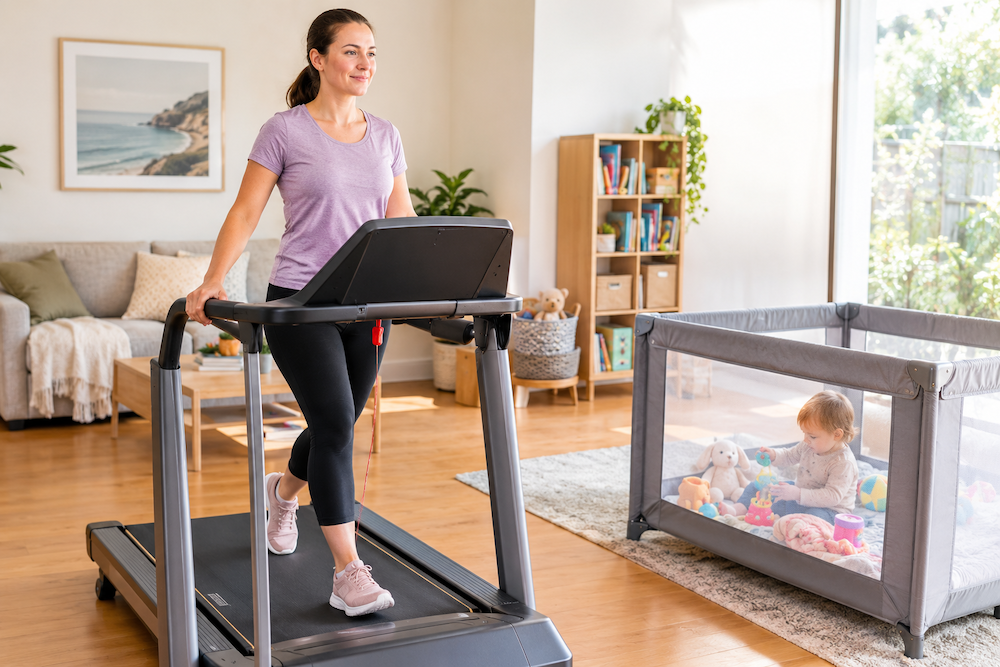
There’s also the practical question of using exercise equipment in a home where young children live. A treadmill needs to be positioned and secured so children cannot access it, and parents need to think carefully about supervision. A playpen may provide a separate space for a baby or toddler, but it isn’t a substitute for another responsible adult supervising a child while a parent exercises.
So, if you’re considering a rehabilitation treadmill for yourself or someone in your family, what features are worth looking for? When might professional guidance be needed, and what should you consider before setting one up at home?
Here’s a closer look at rehabilitation treadmill safety, the features that matter and what families should consider before choosing one.
Key Highlights
- Safety comes before speed: Emergency stops, suitable handrails, accessible controls and a stable design are important features to look for.
- The right treadmill depends on the person using it: Age, mobility, balance, medical conditions and rehabilitation goals all affect which equipment may be suitable.
- Young children need to be kept away from exercise equipment: Moving belts, mechanical components and accessible controls can pose risks, particularly for curious toddlers and preschoolers.
- Walking is only one part of falls prevention: Strength, balance, vision, medication reviews and home safety may also need attention.
- Get professional advice before buying: A physiotherapist can help determine whether a standard treadmill or specialised rehabilitation equipment is appropriate.
- Progress isn’t always about walking faster: Improving confidence, walking tolerance and independence in everyday activities may be more meaningful goals.
What Is a Rehabilitation Treadmill?
Rehabilitation treadmills are designed to support structured walking practice as part of a rehabilitation or mobility program. Depending on the model, they may offer features that improve access, stability and control, or allow walking practice under professional supervision.
If you’re looking at equipment for an older parent or grandparent, or helping a partner recover after an injury, it helps to understand what different treadmills offer before spending money on one.
Unlike many standard fitness treadmills, rehabilitation-focused models may have extended support rails, very low starting speeds, smaller speed adjustments or a body-weight-support system.
It’s worth knowing, though, that the label rehabilitation treadmill doesn’t automatically mean a machine has been clinically validated for every condition. Features and capabilities vary considerably between manufacturers and models.
There are several types to be aware of:
- Standard home treadmills: Primarily designed for general walking, jogging or running, with safety features that vary by model.
- Rehabilitation-focused treadmills: May have more accessible controls, extended rails or settings suited to slower, controlled walking.
- Clinical gait-training treadmills: Used in rehabilitation settings to practise walking under the guidance of appropriately trained professionals.
- Body-weight-support treadmills: Used with a purpose-designed harness and overhead support system to partially support a person’s body weight when clinically indicated.
These categories can overlap. A treadmill with long handrails, for example, isn’t necessarily equivalent to a specialised clinical gait-training system.
For families, the important question isn’t simply whether a machine is marketed for rehabilitation. It’s whether the equipment matches the person’s assessed needs, provides the right level of support and can be used safely in the home.
Why Walking Practice Matters During Recovery
Walking is part of everyday life. It helps us get around the house, visit friends, shop for groceries, attend family gatherings and keep doing the things we’re used to doing.
For a grandparent, being able to move around the house more comfortably might make daily life easier. For a parent recovering from an injury or operation, the goal might be to gradually regain the ability to manage everyday tasks.
When injury, surgery, illness or reduced mobility makes walking difficult, even familiar activities can take considerably more effort.
A structured walking program may help someone work towards improvements in walking tolerance, mobility and physical function. The right approach depends on the condition being treated, the person’s current abilities and the rehabilitation plan recommended by their healthcare team.
Why controlled walking can be useful
A treadmill provides a consistent walking surface, with the belt speed adjustable within the machine’s operating range. When it’s appropriate for the person using it, this can help them follow a structured walking program and monitor changes over time.
For someone rebuilding confidence, a predictable indoor environment may also feel more manageable than walking outdoors on uneven paths, where kerbs, slopes, weather and other people can introduce additional challenges.
However, a predictable walking surface doesn’t mean a risk-free environment. The moving belt creates its own hazards, particularly for someone who struggles to maintain balance or cannot respond quickly when their feet fall out of step.
There is another consideration when children live in the home. Young children may not understand the risks associated with moving equipment, so the treadmill needs to be positioned and used in a way that keeps them away from the belt and other moving parts.
A treadmill can be one part of a broader rehabilitation plan, but it isn’t automatically the right choice for everyone experiencing mobility difficulties.
What does Australian research tell us?
Australia’s updated Preventing Falls and Harm from Falls in Older People: Best Practice Guidelines, released in 2025, emphasise tailoring falls prevention to the individual. For older adults living in the community, recommendations include ongoing exercise that targets balance, mobility and strength, with additional support where required. [1]
An Australian-led position statement published in the Journal of Science and Medicine in Sport in 2025 also highlights the importance of progressive, ongoing exercise that includes functional balance and muscle-strengthening activities. It explains why people at increased risk of falling may need additional support to exercise safely and effectively. [2]
What this means for families: Walking practice may be helpful, but a treadmill on its own isn’t a complete falls-prevention program. The person’s wider needs, the home environment and the safety of everyone sharing that space all need to be considered.
Who Might Benefit From a Rehabilitation Treadmill?
Rehabilitation treadmills may suit some people who need structured walking practice. Whether one is appropriate depends on their health, functional ability and treatment goals.
This might become relevant if an older parent or grandparent moves into the family home, a partner is recovering from an injury, or someone needs support while regaining mobility.
Potential users may include people who are:
- Returning to walking after a period of reduced activity.
- Recovering from certain lower-limb injuries.
- Participating in a clinician-directed rehabilitation program after surgery.
- Working on walking endurance or gait as part of neurological rehabilitation.
- Looking for a controlled environment for a prescribed walking routine.
These are examples of situations where a treadmill might be considered, not a recommendation that everyone with these conditions should use one.
Recovering After a C-Section: When Is It Safe to Use a Treadmill?
Bringing a new baby home changes your daily routine, and recovering from a caesarean section means giving your body time to heal as well. Gentle walking is often encouraged as comfort allows, but returning to structured exercise needs to be gradual and guided by individual recovery.
For some women who need extra help with walking, a rehabilitation treadmill may offer adjustable speeds and supportive handrails. However, these machines aren’t routinely needed after a C-section. Before using one as part of recovery, it’s important to seek advice from a healthcare professional who can assess what’s appropriate at that stage.
The priority is allowing your body to heal rather than rushing back into exercise.
For more practical advice on recovery after birth, read our guide to top tips for your best caesarean section recovery.
What about recovery after hip or knee replacement?
Walking and other prescribed exercises can form part of rehabilitation after a joint replacement. The timing and type of exercise depend on the operation, the surgeon’s instructions, any weight-bearing restrictions, pain, wound healing and the person’s mobility.
A treadmill isn’t automatically the best option just because its speed can be controlled. Ask the treating physiotherapist whether it’s suitable, what support is needed and which movements or settings should be avoided at the current stage of recovery.
If you’re juggling childcare while supporting someone through recovery, being able to exercise at home may sound appealing. Even so, convenience shouldn’t take priority over the person’s rehabilitation needs or the safety of young children nearby.
What if someone has had a stroke?
Some people recovering from a stroke take part in specialist gait-training programs that may include treadmill walking or a body-weight-support system.
These programs are different from simply buying a treadmill for home use. The rehabilitation team needs to consider the person’s walking pattern, strength, balance, ability to follow instructions and need for physical assistance.
Family members can play an important role in supporting recovery, but providing specialist physical assistance requires appropriate guidance and training.
When might a conventional treadmill be unsuitable?
A standard home treadmill may not be appropriate for someone who:
- Cannot safely step onto or off the machine.
- Has significant balance difficulties or recurrent falls.
- Cannot maintain a safe walking pattern without physical assistance.
- Experiences unexplained dizziness or fainting.
- Has medical or surgical restrictions that affect exercise.
- Cannot reliably understand or operate the controls.
- Needs a level of body-weight support that the machine doesn’t provide.
In these situations, a physiotherapist may recommend supervised gait training, an appropriate support system or another form of exercise.
Start with an assessment of the person’s needs before buying equipment. That way, you’re less likely to spend money on a machine that isn’t suitable for their recovery.
The Most Important Rehabilitation Treadmill Safety Features
If you’re comparing treadmills for someone in your family, it helps to know which features are worth checking before looking at brands and prices.
Start with three questions: Can the person get on and off safely? Can they control or stop the machine? And does it provide the support their rehabilitation plan requires?
For households with young children, there’s a fourth question: Can the equipment be secured and used so children cannot access dangerous moving parts?
1. Emergency stop buttons
An emergency stop allows the user or supervising person to stop the treadmill quickly if something goes wrong.
Look for a clearly marked stop control that’s easy to reach and understand. Check where it’s positioned, whether it’s accessible from the intended walking position and what happens to the belt when it’s activated.
Not all emergency-stop systems work in the same way. Some require the user to press a button, while others rely on a separate safety key or clip.
What to check before buying: Ask the supplier to demonstrate the stop mechanism. Make sure the person using the treadmill can operate it safely, or that an appropriate supervisor can intervene.
Children shouldn’t be allowed to experiment with the controls or play with the emergency-stop mechanism.
2. Safety keys and clips
Many treadmills have a safety key that attaches to the machine and connects to a clip worn on clothing. If the key is detached, the mechanism is designed to stop the belt.
This can be useful if the user moves too far from the console, but it doesn’t replace handrails, supervision or an appropriate assessment.
Someone with limited hand function may also find the safety key difficult to attach or manage. Check that it can be fitted correctly and that the person understands how it works before each session.
A safety key alone isn’t enough to protect someone at significant risk of falling.
Keep loose clips and other small accessories out of reach of young children when the treadmill isn’t in use.
3. Extended handrails and support bars
Handrails give users something to hold while walking and may help with orientation and confidence. Extended rails can provide more options for hand placement than short front handles.
When comparing models, consider:
- Whether the rails extend along the walking area.
- Whether they’re securely fixed and positioned appropriately.
- Whether the user can grip them comfortably.
- Whether they allow safe access to the controls.
- Whether the design suits the person’s height, stride and mobility.
A rail that’s too far away, too low or difficult to grip may offer little practical support.
It’s also important to distinguish between handrails and equipment designed to support body weight. Handrails aren’t a substitute for a properly fitted gait-support harness when one is clinically required.
Think about the space around the treadmill, too. Toys, furniture and other household items shouldn’t obstruct access to the rails or the area needed to get on and off safely.
4. Body-weight support and rehabilitation harnesses
Some specialised systems use a harness connected to an overhead support structure. Depending on their design and configuration, these systems can partially support a person’s body weight during walking practice.
They may be suitable for selected rehabilitation needs when a clinician determines that supported gait training is appropriate.
A simple belt worn around the waist isn’t the same as a purpose-designed body-weight-support system. A belt shouldn’t be assumed to prevent falls, either.
If someone needs help staying upright or needs part of their body weight supported, get advice about suitable equipment and trained supervision before considering treadmill use.
5. Low minimum speed and small speed adjustments
The minimum speed matters when a rehabilitation program calls for very slow walking. Smaller speed increments can also make it easier to adjust the pace gradually.
However, the lowest available speed won’t necessarily suit everyone. Even slow belt movement can be difficult for someone with an inconsistent stride, trouble clearing their feet or difficulty coordinating their steps.
Ask the physiotherapist what operating range would be appropriate instead of choosing a model based only on its advertised minimum speed.
6. A suitable walking belt
The belt needs enough width and length to accommodate the person’s natural walking pattern without forcing them to concentrate constantly on staying centred.
A wider belt may help someone whose steps vary, but belt dimensions alone cannot guarantee safe walking.
Check the manufacturer’s actual measurements and consider the person’s height, stride length, gait pattern and support needs. Where possible, arrange a professional assessment of the equipment before buying.
7. Accessible controls and a clear display
Controls should be straightforward to understand and operate. Large, clearly labelled buttons may work better for some people than complex menus or small touchscreens.
Consider whether the user can:
- Start and stop the machine safely.
- Adjust speed without losing their balance.
- See the display without leaning forward.
- Reach the relevant controls while maintaining a stable position.
- Understand warning indicators or safety instructions.
A tablet holder, entertainment screen or advanced workout program may be useful, but these extras should come after the essentials.
In a home with young children, don’t leave the treadmill running unattended while turning your attention to childcare. A child’s sudden movement or a request for help can interrupt even a familiar routine.
8. Stable construction and appropriate weight capacity
The machine needs to be suitable for the user’s body weight and intended use, with securely fitted components and appropriate manufacturer support.
Check the stated weight limit, the stability of the handrails, the condition of the belt and the manufacturer’s servicing instructions.
A high weight capacity doesn’t mean a treadmill is clinically suitable for rehabilitation. It addresses just one aspect of whether the equipment is compatible with the user.
9. Deck access and step-up height
Getting on and off a treadmill can be one of the more challenging parts of using it.
A lower deck may make access easier for some people, but they still need a safe way to get onto the machine and position their feet before the belt starts.
Consider their ability to stand, turn, step over the frame and maintain balance while entering or leaving the walking area. If these movements are difficult, ask a physiotherapist or occupational therapist to assess the access arrangements.
10. Shock absorption and cushioning
Some treadmills have cushioned decks or other impact-management features. These can affect how the walking surface feels, but the amount of cushioning and the experience it provides vary between models.
It’s misleading to assume that a cushioned deck will prevent knee pain, protect the hips or reduce injury risk for every user.
Choose cushioning based on comfort and clinical suitability, rather than promises that it will prevent joint problems.
11. Maintenance and product safety
A treadmill also needs to be in good condition and installed correctly to be safe.
Before buying, ask about servicing, replacement parts, warranty coverage and the manufacturer’s safety instructions. Check that the model meets the applicable Australian product-safety requirements.
The Australian Competition and Consumer Commission provides a treadmill safety guide, which discusses hazards including entrapment and friction burns. [3]
For families, this is a reminder that choosing the right features is only part of the job. The machine also needs to be installed, used and maintained correctly, with young children kept away from moving parts.
Rehabilitation Treadmills Compared With Standard Treadmills
The difference between a conventional treadmill and a rehabilitation-focused model isn’t simply the price or the number of features.
If you’re considering equipment for an older relative or a parent recovering from an injury, the key question is whether the machine meets the user’s needs and can be accommodated safely at home.
| Feature | Standard home treadmill | Rehabilitation-focused equipment |
|---|---|---|
| Main purpose | General fitness and walking | May be designed for specific walking or rehabilitation needs |
| Handrails | Vary by model | May include extended support rails |
| Minimum speed | Depends on the model | May offer settings for slower walking |
| Controls | May include advanced programs | May prioritise simple, accessible operation |
| Body-weight support | Usually not included | Available on some specialised systems |
| Professional use | Depends on the setting | Some systems are designed for supervised clinical use |
| Suitability | Depends on the user and machine | Must still be assessed for the individual |
A rehabilitation-focused treadmill isn’t automatically safer for everyone. Its value depends on whether its features address the person’s actual needs.
Choosing a Treadmill for Someone With Limited Mobility
When mobility is limited, the best treadmill isn’t necessarily the one with the most advanced technology. It’s the one the person can use appropriately, with the level of support they need.
If you’re fitting rehabilitation around family life, it’s easy to focus on convenience. But the equipment needs to suit the person recovering, not just the space available or the time the family has to supervise.
Before comparing brands or prices, consider these questions.
Can the person get on and off safely?
Getting onto and off a treadmill can require more coordination than walking itself. If someone needs help transferring, both the machine’s design and the assistance available need to be assessed.
Can they maintain their walking pattern?
Consider whether they can clear their feet, maintain an appropriate stride and respond if the belt speed feels uncomfortable.
Can they operate the controls?
The controls should be reachable and easy to understand without requiring unsafe changes in posture.
Do they need a higher level of support?
Someone who needs assistance to remain upright may require specialist equipment or supervised rehabilitation rather than a conventional treadmill.
Does the machine fit the home?
Measure the intended space, allow for safe access and follow the manufacturer’s clearance requirements. Keep the surrounding area free of clutter and other obstacles.
If you have toddlers or preschoolers at home, also consider whether the treadmill can be placed somewhere they can’t freely access.
Why the walking belt dimensions matter
The belt needs to accommodate the person’s natural stride without forcing them to shorten their steps or walk too close to the edges.
Rather than relying on a universal measurement, compare the actual belt dimensions with the person’s height, stride and mobility needs. A physiotherapist may be able to advise on suitability if an injury or illness has affected their walking pattern.
How to Set Up a Safer Home Walking Environment
Bringing rehabilitation equipment into the family home means thinking about more than the person who’ll be using it.
Young children are curious. A moving belt, buttons, clips and exposed mechanical components can attract their attention, even if they’ve been told the equipment isn’t a toy.
Even a well-chosen treadmill can create hazards if it’s squeezed into a cramped or unsuitable space.
Before starting a prescribed home walking program, consider the following:
- Clear the surrounding space. Remove toys, loose objects, cords and anything else that could interfere with access.
- Use appropriate flooring. Follow the manufacturer’s instructions for a stable, level surface and suitable placement.
- Provide adequate lighting. The user needs to see the belt, controls and surrounding area clearly.
- Keep children and pets away. A moving belt and exposed mechanical parts can cause injury. Supervise young children closely and don’t allow them to play on or around the equipment.
- Check power and cables. Arrange electrical connections according to the manufacturer’s instructions and keep cords away from walking and transfer areas.
- Use suitable footwear. Follow the advice of the treating clinician and the equipment manufacturer.
- Keep emergency access clear. Don’t position the machine where furniture or other obstacles could delay assistance.
- Check the equipment before use. Look for visible damage, unusual belt movement or other problems identified in the manufacturer’s instructions.
- Establish a family safety rule. Make it clear that the treadmill isn’t a toy and children must stay away from it, whether the belt is moving or the machine is switched off.
- Consider physical barriers. Where appropriate, use a child-resistant barrier or secure room arrangement to prevent unsupervised access. Follow the manufacturer’s requirements and make sure the barrier doesn’t create an obstacle for the person recovering.
For people at increased risk of falls, home safety may require more than moving furniture. Australia’s 2025 community falls-prevention guidelines recommend tailored home-safety interventions for eligible older people at increased risk, including assessment by an occupational therapist where indicated. [1]
The aim is to make sure rehabilitation can take place without children accidentally entering an area where they could be injured.
Starting a Rehabilitation Walking Program: What Families Should Know
When someone is recovering, it’s natural to hope they’ll be able to do a little more each day. But trying to increase walking time too quickly can work against their recovery.
Rehabilitation isn’t a race, and more exercise isn’t always better.
The right starting point depends on the person’s diagnosis, fitness, symptoms, mobility and professional recommendations. There’s no single speed or session length that’s safe for everyone.
For families, it can help to agree on a routine that works around childcare and other responsibilities. Young children may interrupt plans, and that’s a reason to prioritise the prescribed program and safe supervision rather than trying to squeeze in a session at any cost.
Follow an individualised plan
Before using a treadmill for rehabilitation, discuss the plan with the treating physiotherapist or another appropriate healthcare professional.
The plan may cover:
- Whether treadmill walking is suitable at the current stage of recovery.
- The level of supervision or assistance required.
- Appropriate speed and session duration.
- Whether incline should be avoided or restricted.
- Which symptoms mean the session should stop.
- How progress will be reviewed.
Don’t change prescribed settings or increase the workload just because the previous session felt manageable.
What should progress look like?
Progress might mean walking a little longer, maintaining a more consistent stride, feeling less anxious about movement or completing an everyday task with greater independence.
It doesn’t always mean walking faster.
Where appropriate, a clinician may use measures such as walking speed, walking distance, balance assessments or functional mobility tests to track changes over time. These measures need to be considered in the context of the person’s condition and rehabilitation goals.
Families may also notice practical changes. Is getting around the house becoming easier? Is the person more confident moving between rooms? Are they managing daily activities with less assistance? Can they take part in family life more comfortably?
These observations can be useful when talking with the rehabilitation team, although they don’t replace a formal assessment.
When Should Someone Stop Exercising?
A rehabilitation program should include clear instructions about when to pause or stop.
Stop the session if the person becomes unsteady, develops new or increasing pain, feels faint or dizzy, experiences unusual breathlessness, or can’t maintain their prescribed walking pattern.
Follow the clinician’s advice about symptoms specific to the person’s condition. Seek urgent medical assistance for severe or sudden symptoms, including chest pain, fainting, severe breathing difficulty or new signs of stroke. In an emergency in Australia, call 000.
If a fall occurs, don’t rush to lift the person without considering whether they may be injured. Seek appropriate assistance, particularly if they have severe pain, a head injury or difficulty moving.
If you’re a parent, there’s another practical consideration: stop the session safely if a child unexpectedly enters the area or the person using the treadmill needs to respond to an emergency at home.
An emergency stop is useful, but it can’t prevent every injury. That’s why appropriate equipment, supervision and an individualised plan matter.
Questions to Ask a Physiotherapist Before Buying
If you’re researching a treadmill for an older parent, grandparent or partner recovering from an injury, take these questions to their next appointment.
- Is treadmill walking appropriate for their current condition and stage of recovery?
- Can they safely get on and off the machine?
- Do they need supervision, extended rails or a body-weight-support system?
- What minimum speed and operating range would suit their walking ability?
- Are there any restrictions on incline, duration or weight-bearing?
- Would another form of exercise be more appropriate?
- What symptoms should prompt them to stop?
- How should progress be measured and reviewed?
- Does the proposed model meet their specific rehabilitation needs?
- Would a home assessment by an occupational therapist be useful?
- How can the equipment be positioned to keep young children away from moving parts?
- What supervision arrangements are needed when the household is busy with childcare and other responsibilities?
These questions can help you avoid spending money on equipment that looks suitable online but doesn’t match the person’s needs.
Frequently Asked Questions
Can a rehabilitation treadmill speed up recovery?
A treadmill may support specific rehabilitation goals by providing a controlled setting for walking practice. However, it can’t guarantee faster recovery. Outcomes depend on the underlying condition, the person’s abilities, the rehabilitation program and other aspects of their care.
Are rehabilitation treadmills safe for seniors?
They may be suitable for some older adults, but safety depends on the individual and the equipment. People with significant balance difficulties, recurrent falls or difficulty transferring may need professional assessment, supervision or specialised equipment.
What treadmill features matter most for someone with balance concerns?
Accessible emergency stopping, suitable handrails, straightforward controls and an appropriate walking area are important considerations. Some people need a purpose-designed body-weight-support system. No single feature can guarantee that someone won’t fall.
Can someone use a treadmill after hip or knee replacement surgery?
Potentially, but only when it’s appropriate for their stage of recovery and consistent with their surgeon’s and physiotherapist’s instructions. Weight-bearing restrictions, pain, healing and mobility all influence the decision.
Is a safety key enough to prevent falls?
No. A safety key can stop the belt when its connection is disengaged, but it doesn’t provide physical support or guarantee that the user will remain upright.
Is treadmill walking enough to prevent falls?
Not necessarily. Australian falls-prevention guidance emphasises exercise that includes functional balance, mobility and strength, alongside other interventions tailored to the individual’s risks. A treadmill may be one part of a broader program. [1, 2]
Should someone with limited mobility use a treadmill alone?
That depends on their assessed abilities and the equipment. Someone who can’t safely maintain balance, operate the controls or get on and off independently may need supervision or an alternative rehabilitation approach.
How can families make a home treadmill safer for children?
Keep children and pets away from the moving belt and mechanical components, supervise young children closely and follow the manufacturer’s safety instructions. Don’t allow children to play on the treadmill, even when it’s switched off. Depending on your home, a secure barrier or restricted-access room may also be appropriate.
Can a parent use a rehabilitation treadmill while supervising young children?
It depends on the adult’s rehabilitation needs and the level of supervision required. A parent recovering from an injury shouldn’t assume they can safely supervise young children and operate a treadmill at the same time. If the prescribed program requires concentration or assistance, arrange for another responsible adult to supervise the children.
The Bottom Line: Supporting Recovery While Keeping Family Life Safe
When someone in the family is working to regain their mobility, finding equipment that makes recovery easier is understandable. But it’s worth checking that the machine will actually meet their needs before committing to a purchase.
For families with young children, that means considering how the treadmill will fit into the home, whether the person recovering can access and use it safely, and how children will be kept away from moving parts.
A rehabilitation treadmill may be useful when it suits the person’s needs and forms part of an appropriate exercise or rehabilitation plan. The most important features are the ones that address genuine safety and accessibility needs, not simply the ones that make a machine look more advanced.
Before buying, think about how the person will get on and off, whether they can maintain their balance, how quickly the belt can be stopped and whether they need a level of support that a conventional treadmill can’t provide.
It’s also worth remembering that falls prevention involves more than one piece of equipment. Strength, balance, vision, medications, home safety and individual health conditions can all affect a person’s risk.
If you’re considering a treadmill for a parent or loved one, talk with their physiotherapist about the most appropriate options before making a purchase. The right advice can help you choose equipment that supports safe movement, confidence and independence, while keeping the home safe for the children who live there, too.
This article provides general information only and is not a substitute for individual medical advice, diagnosis or treatment. Consult an appropriate healthcare professional before beginning or changing a rehabilitation exercise program.
References and Further Reading
1. Australian Commission on Safety and Quality in Health Care (2025). Preventing Falls and Harm from Falls in Older People: Best Practice Guidelines for Community Care in Australia.
Read the Falls Guidelines for Community Care.
2. Tiedemann A, Sturnieks DL, Burton E, Thom JM, Lord SR, Scott S, Sherrington C (2025). Exercise and Sports Science Australia updated position statement on exercise for preventing falls in older people living in the community. Journal of Science and Medicine in Sport, 28(2), 87–94.
Read the research record on PubMed.
3. Australian Competition and Consumer Commission (ACCC). Treadmills: A Guide to Using Sport, Exercise and Play Equipment Safely.
Read the ACCC treadmill safety guide.
4. Australian Government Department of Health, Disability and Ageing (2026). Australian 24-hour movement guidelines for adults (18–64 years) and older adults (65+ years).
Read the Australian Government guidelines and evidence report.
5. Australian Institute of Health and Welfare. Falls in older Australians: 2019–20 hospitalisations and deaths.
Read the AIHW report summary.