


kiddi
There’s something lovely about looking forward to a family holiday. The excitement of choosing somewhere new, imagining the experiences you’ll share and having a little time away from the usual routine can be just what everyone needs.
But let’s be honest for a moment. For many parents, getting away doesn’t necessarily mean getting a break.
There’s still the packing, the organising, remembering everyone’s belongings, working out where you’re going, keeping the children entertained, making sure everyone has eaten and trying to coordinate activities that keep the whole family happy. Sometimes, by the time you’ve organised everything, you’re wondering whether you need another holiday just to recover from the first one!
And that’s something worth thinking about when planning your next family getaway.
A family holiday should be enjoyable for parents too. While creating wonderful experiences for the children is important, parents deserve the opportunity to slow down, enjoy their surroundings, reconnect with each other and experience a little breathing space from everyday responsibilities.
This doesn’t mean spending the entire holiday doing nothing. It’s about finding a balance between adventure and relaxation, allowing everyone to enjoy themselves without feeling as though they need to squeeze every possible experience into the itinerary.
A European cruise, particularly one exploring the beautiful Adriatic coastline, can offer an appealing way to achieve that balance. With multiple destinations, comfortable accommodation, dining and entertainment available onboard, families can enjoy exploring different parts of Europe without constantly organising new hotels, transport and travel arrangements.
More importantly, with a little thoughtful planning, there can be room for something parents don’t always get enough of: genuine downtime.
Why Parents Need a Holiday That Actually Feels Like a Holiday
Parenting is rewarding, but it also involves an enormous amount of responsibility. Even when children are happily occupied, there’s often a parent somewhere thinking about what needs to happen next.
From school schedules, work commitments and household responsibilities to remembering appointments, organising meals and anticipating everyone’s needs, much of parenting involves constant planning and decision-making.
This invisible work is often referred to as the mental load of parenting. It’s the responsibility of remembering, organising, anticipating and coordinating all the little things that keep family life moving.
And unlike a workday, parenting doesn’t always come with a clearly defined finish time.
Australian research highlights just how demanding the experience can be. A recent Australian Institute of Family Studies report, drawing on data from the Household, Income and Labour Dynamics in Australia (HILDA) Survey, examined the experiences of parents with children aged 0–5.
The findings revealed that 56% of parents felt parenting was harder than they had expected, while 59% reported often feeling tired, worn out or exhausted from meeting their children’s needs.
These findings offer an important reminder that parental exhaustion is not simply a matter of having a busy week. The ongoing demands of caring for children can leave parents with relatively little opportunity to properly recharge.
This is one reason why time away can be valuable. Stepping outside familiar routines creates an opportunity to experience something different, spend time together and temporarily put some everyday responsibilities aside.
However, being away from home doesn’t automatically mean switching off.
Parents can find themselves carrying the same mental load into their holiday, only with different surroundings. Rather than organising school lunches, they’re organising excursions. Instead of preparing dinner, they’re researching restaurants. And rather than managing the usual household schedule, they’re trying to coordinate everyone’s holiday activities.
The trick is to plan a holiday that genuinely reduces some of those demands.
When a Family Holiday Becomes Another Job
We’ve all heard about the importance of making family memories, but there’s sometimes an unspoken expectation that a holiday needs to be filled with exciting experiences from morning until night.
Every attraction must be visited, every destination explored and every opportunity taken advantage of. After all, nobody wants to feel as though they’ve missed out.
But trying to fit too much into a holiday can have the opposite effect.
Victorian Government’s Better Health Channel highlights how the pressure to make the most of limited holiday time can lead people to organise overly busy itineraries. Rather than feeling refreshed, families can return home exhausted and disappointed.
Its advice is refreshingly simple: allow time to do nothing.
In fact, the resource specifically encourages holidaymakers to make room for slower experiences, whether that’s reading a book, enjoying a leisurely meal or simply relaxing without having somewhere else to be.
Better Health Channel – Holiday Stress
Australian research has also explored why family holidays don’t always provide the relaxation parents expect.
In a study titled Family Holidays – Vacation or Obli-cation?, researchers Elisa Backer and Heike Schänzel examined the experiences of 71 respondents from Victoria.
The study found that seemingly small accommodation shortcomings, such as inadequate laundry facilities or insufficient basic kitchen equipment, could create additional work for parents.
Interestingly, 35.2% of respondents reported that their stress levels were either unchanged or had increased following their last family holiday.
Although this was a relatively small study conducted in 2011, it highlights an important consideration: a holiday can still involve plenty of work if the arrangements don’t make everyday family life easier.
Backer & Schänzel – Family Holidays: Vacation or Obli-cation? (2013)
This is why choosing the right type of holiday matters. Rather than simply looking for somewhere beautiful to visit, parents should consider how much organising, travelling and decision-making will be involved once they arrive.
Sometimes the best holiday isn’t the one that offers the most activities. It’s the one that allows everyone to enjoy the experience without constantly rushing to the next thing.
Why a European Cruise Can Take Some of the Pressure Off Parents
One of the appealing things about cruising is that it brings many of the practical elements of travelling together in one place.
A European cruise can be a wonderful option for parents because it combines sightseeing, accommodation, dining and entertainment, while providing a familiar place to return to at the end of each day. When sailing the Adriatic, families can experience beautiful coastal scenery, historic towns and different European cultures, with some itineraries visiting multiple ports along the way. A cruise stopping at popular cities along the Adriatic coast can provide an opportunity to discover several destinations without constantly changing accommodation.
Instead of booking separate hotels in every destination, organising transfers and repeatedly unpacking suitcases, families can settle into their cabin and let the ship take them between ports.
This can make a considerable difference when travelling with children or older family members.
Think about how much time can be spent organising a conventional multi-destination holiday. There’s checking out of one hotel, arranging transport, navigating unfamiliar streets, finding the next accommodation and making sure everyone has everything they need.
With cruising, many of these arrangements are simplified.
Having one comfortable home base means parents can spend less time coordinating travel logistics and more time enjoying the places they’re visiting.
When sailing the Adriatic, families can experience beautiful coastal scenery, historic towns and different European cultures, with some itineraries visiting multiple ports along the way.
The region offers a particularly appealing combination of history, natural beauty, architecture and coastal experiences.
For families, it can be an opportunity to explore destinations they may have only previously imagined visiting, including Croatia and Montenegro.
Another advantage is that some coastal towns and attractions can be explored in a relatively short period. Depending on the port and excursion selected, families may be able to enjoy a few hours exploring before returning to the ship.
That flexibility can be especially helpful for parents who don’t want every day to become a marathon of sightseeing.
Of course, not every port is equally easy to explore. Walking distances, hills, cobblestones, weather and transport arrangements all need to be considered, particularly when travelling with younger children or older relatives.
The important thing is to choose experiences that suit the family rather than feeling obliged to see everything.
The Sea Days: An Opportunity to Slow Down and Reconnect
One of the most underrated parts of cruising can be the days spent at sea.
When families think about a European cruise, it’s natural to focus on the destinations. The historic towns, beautiful coastlines, famous landmarks and exciting excursions are often what inspire the booking in the first place.
But the days between destinations can be just as enjoyable.
Sea days offer an opportunity to enjoy the holiday without having to go anywhere.
Instead of waking up and immediately thinking about departure times, transport arrangements or what everyone needs to pack, families can enjoy a slower start to the day.
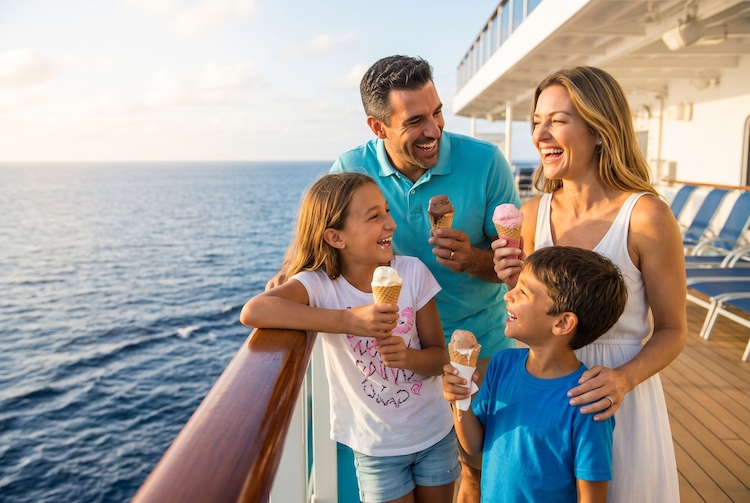
Perhaps it’s a leisurely breakfast overlooking the water, an afternoon by the pool, a quiet coffee together or simply enjoying the views from the deck.
For parents, these moments can provide something that everyday life doesn’t always allow: uninterrupted time to enjoy each other’s company.
It’s also an opportunity for couples to reconnect outside their usual parenting responsibilities.
When was the last time you sat down together without somebody asking for a snack, needing help finding something or reminding you about the next appointment?
Sometimes it’s the simple things that make a holiday memorable.
A quiet conversation, watching the sunset, sharing a meal or enjoying a little time together without needing to organise anything can be just as meaningful as visiting a famous attraction.
The onboard amenities can add to this experience, with many cruise ships offering swimming pools, spas, lounges, restaurants, entertainment and recreational facilities.
For parents who enjoy different activities, there may also be opportunities to spend some time pursuing individual interests before meeting up again.
For more inspiration, these ideas for what to do on cruise sea days provide examples of how families can enjoy the time between destinations.
The key is to remember that not every holiday day needs a plan.
Building Genuine Downtime Into Your Family Itinerary
A relaxing holiday rarely happens by accident. Sometimes it takes a little planning to make sure everyone has enough time to enjoy themselves.
One of the biggest mistakes families can make is filling every available hour with activities.
While it’s wonderful to explore new places, constant sightseeing can become tiring, particularly for younger children, older family members and parents who are already juggling everyone’s needs.
A more balanced approach is to alternate busier days with quieter ones.
For example, after an active shore excursion, consider spending the following sea day enjoying the ship’s facilities rather than booking another full day of activities.
You might also find that a few hours exploring a destination is enough. There’s no need to turn every port visit into an all-day adventure.
A little unstructured time can make a big difference.
Consider these simple ways to create more breathing space:
- Avoid overplanning: Choose a few experiences everyone is excited about rather than trying to fit everything into the itinerary.
- Allow slower mornings: Not every day needs an early start and a tightly scheduled breakfast.
- Protect family sleep routines: Travel can disrupt children’s usual sleeping patterns, so allow enough time for rest, particularly after busy days.
- Alternate activities: Combine sightseeing and adventure with quieter afternoons onboard.
- Allow individual time: One parent might enjoy a spa treatment while the other spends time exploring with the children.
- Make room for spontaneity: Sometimes the most enjoyable experiences are the ones that happen without a schedule.
- Don’t feel guilty about staying onboard: If everyone is enjoying a relaxing day, there’s no obligation to disembark simply because the ship has arrived somewhere new.
It is also worth considering that different family members may have different ideas about what relaxation looks like.
One parent might love exploring historic streets, while the other would happily spend an afternoon reading beside the pool. Younger children may need regular breaks, while teenagers might enjoy having more independence.
Rather than expecting everyone to enjoy every activity, allow some flexibility.
A successful family holiday isn’t about keeping everybody together every minute. It’s about making sure everybody has opportunities to enjoy it.
Making Time for Each Other: Why Shared Experiences Matter
Family holidays are about more than visiting new destinations. They’re also about the experiences that bring people together.
There’s something special about seeing a new place through your children’s eyes. Watching them discover something for the first time, ask questions about a different culture or become fascinated by a historic building can make the experience memorable for parents too.
Travel can introduce children to different ways of living, unfamiliar foods, languages, traditions and environments.
These experiences can provide natural opportunities for curiosity, conversation and learning beyond the classroom.
But the value of a family holiday doesn’t necessarily come from how many attractions you visit.
It can be the conversations over breakfast, laughing together during an excursion, discovering a favourite local food or watching the children become excited about something unexpected.
Australian Institute of Family Studies research into family relationships highlights the importance of meaningful conversations, emotional connection and supportive relationships within households.
In its Relationships Within the Family report, the majority of surveyed parents reported being satisfied or very satisfied with their relationships with their children. The research also explored the importance of meaningful conversations and mutual support within couple relationships.
Although the study does not establish that holidays themselves improve family relationships, it reinforces why making time for positive interactions and genuine connection matters.
Australian Institute of Family Studies – Relationships Within the Family
For parents, a holiday can provide an opportunity to step away from the usual distractions and spend time together without the constant interruptions of everyday routines.
And while children may remember the exciting destinations, parents might find that some of their favourite memories are the quieter moments in between.
Choosing a Cruise That Suits Everyone’s Needs
Not all cruise ships offer the same experience, so it’s worth spending time considering what matters most to your family before booking.
The biggest ship, the longest itinerary or the one with the most entertainment isn’t necessarily the best choice.
The right cruise is the one that suits the people travelling.
Start by considering the length of the cruise. A shorter itinerary may be more suitable for families who are new to cruising, while a longer journey might provide more opportunities to explore different destinations and enjoy the onboard experience.
Accommodation is another important consideration.
Look at the cabin configuration, sleeping arrangements and available space. Families travelling with younger children may prefer connecting cabins or accommodation that allows everyone a little extra room.
A balcony cabin may also appeal to parents who enjoy having somewhere quiet to sit and relax without needing to leave their room.
When comparing cruise lines, consider:
- Dining options: Look for flexible dining times, varied menus and options for different dietary requirements.
- Onboard entertainment: Consider whether the activities suit the ages and interests of your family.
- Children’s facilities: Check whether supervised children’s programs are available, including age restrictions and operating hours.
- Adult relaxation areas: Look for quiet lounges, spas and areas where parents can enjoy some time away from the busier parts of the ship.
- Accessibility: Consider lifts, walking distances, cabin access and mobility requirements.
- Medical facilities: Understand what medical assistance is available onboard.
- Overall atmosphere: Decide whether your family prefers a quieter ship or one with a lively entertainment program.
If travelling with elderly parents, comfort and accessibility become particularly important.
Look at the amount of walking involved, the availability of seating and whether the ship offers suitable facilities for anyone with mobility limitations.
It is also worth checking whether particular ports require passengers to use tender boats rather than walk directly off the ship. This can make a difference for people who have difficulty boarding smaller vessels.
Travelling With Grandparents: Making Multigenerational Holidays Work
For families travelling with grandparents, a cruise can provide an opportunity for different generations to spend meaningful time together.
There’s something special about grandparents sharing new experiences with their grandchildren. Whether it’s exploring a historic town, enjoying a meal together or simply spending time chatting on deck, these moments can become treasured family memories.
Multigenerational travel can also provide opportunities for children to learn more about their family’s history, traditions and experiences.
However, it’s important to remember that different generations may have different expectations.
Grandparents may prefer a slower pace, while younger family members might want to spend more time exploring. Parents may be balancing everyone’s needs while also trying to enjoy their own holiday.
A little communication before travelling can make a big difference.
Discuss the types of activities everyone would enjoy, consider mobility and energy levels, and avoid assuming that grandparents will automatically be available to supervise the children.
It can also help to plan some activities together and others separately.
For example, grandparents might enjoy a leisurely morning onboard while parents take the children on an excursion. Another day, everyone might explore a destination together.
The important thing is to allow everyone to participate in a way that feels comfortable.
For more ideas, take a look at Kiddipedia’s article on family. and travelling with kids and grandparents: tips for multigenerational family trips.
Choosing Shore Excursions Without Exhausting Everyone
Shore excursions are often a highlight of a European cruise. They provide opportunities to explore destinations, discover local culture and experience places that families may have previously only seen in photographs.
From wine tasting and cookery classes to scenic drives, historic walking tours and nature experiences, there’s usually a wide range of activities to consider.
The trick is choosing excursions that genuinely interest your family without making every day feel like a race against the clock.
Before booking, think about the length of the excursion, the amount of walking involved and whether it is suitable for everyone travelling.
A full-day sightseeing tour might sound exciting, but it may not be the best option for a family with young children or older relatives who tire easily.
Sometimes a shorter experience is much more enjoyable.
For example, a private tour guide can be a wonderful way to explore a city at a pace that suits your family. You can learn about the destination, discover local history and ask questions without necessarily following the same schedule as a large tour group.
Other enjoyable options might include:
- Scenic coastal drives.
- Exploring historic towns and local markets.
- Visiting beaches and enjoying the coastline.
- Sampling traditional local food.
- Taking a gentle nature walk.
- Visiting cultural and historical attractions.
- Enjoying a local cooking experience.
- Taking a boat trip to appreciate the surrounding scenery.
For parents, private tours can sometimes offer greater flexibility, particularly when travelling with children or elderly family members.
However, they can also cost more, so compare the benefits against the overall holiday budget.
Remember to check walking distances, accessibility, toilet facilities, weather conditions and the time required to return to the ship.
You don’t have to book an excursion at every port to make the most of a cruise. Sometimes wandering around a beautiful coastal town, enjoying a leisurely lunch and returning to the ship early can be the perfect way to spend the day.
Looking After Everyone’s Health and Safety While Cruising
While the excitement of planning a holiday can easily take centre stage, health and safety are important considerations, particularly when travelling with young children or older family members.
Cruise ships bring together large numbers of passengers in shared spaces, including restaurants, entertainment areas and swimming facilities. This means infectious illnesses can spread relatively easily.
NSW Health highlights the importance of taking sensible precautions before and during a cruise, including regular handwashing, being aware of symptoms and understanding what to do if someone becomes unwell.
The advice is particularly relevant for older travellers and people with certain underlying health conditions, who may be at greater risk of experiencing serious illness.
Before departing, parents should:
- Check that everyone’s vaccinations are up to date and seek advice about any additional travel vaccinations.
- Make sure prescription medications are available for the entire trip, with extra supplies where appropriate.
- Pack a small first-aid kit and any regularly used medications.
- Understand what medical services are available onboard.
- Check the cruise operator’s procedures for managing illness.
- Practise regular handwashing, particularly before eating.
- Encourage family members who become unwell to notify cruise staff.
Australian Government travel advice also highlights the importance of understanding the costs associated with medical treatment and potential evacuation from a cruise ship.
Travel insurance deserves particular attention.
Don’t assume that a standard travel insurance policy automatically covers cruising. Check that your policy specifically includes cruise travel, medical treatment onboard, medical evacuation, pre-existing conditions and the activities you intend to undertake.
For older family members, check the policy conditions carefully, including any medical exclusions.
The following Australian resources provide useful information before departure:
- NSW Health – Staying Healthy on a Cruise
- Australian Government – Smartraveller: Going on a Cruise
- Australian Government – Travel Insurance Coverage
A little preparation can help families feel more confident about their trip and avoid unnecessary surprises.
A Few Simple Ways to Make Sure Parents Enjoy the Holiday Too
It’s easy to spend so much time thinking about what the children will enjoy that parents forget to consider what they would like from the holiday themselves.
Before booking, take a moment to think about what a genuinely enjoyable break would look like for everyone.
Perhaps one parent loves exploring historical destinations, while the other would prefer a little more time relaxing onboard. Maybe the children are excited about swimming pools and entertainment, while grandparents would enjoy scenic sightseeing and leisurely meals.
All these preferences can be accommodated with a little planning.
Here are a few simple ways to make sure parents get something out of the holiday too:
1. Share the planning responsibilities
Don’t let one parent become responsible for organising every detail. Divide the research, bookings and preparation so that everyone has a say and shares the workload.
2. Schedule time for yourselves
If possible, make room for some adult-only time. This could be a quiet meal, a spa treatment or simply enjoying a coffee together while someone else spends time with the children.
3. Choose experiences you genuinely enjoy
Parents shouldn’t feel that every activity needs to revolve around the children. Choose destinations, excursions and experiences that interest the adults too.
4. Don’t try to see everything
It’s tempting to make the most of every destination, but constantly rushing can take away from the enjoyment. Choose a few highlights and allow time to appreciate them.
5. Give everyone some breathing space
Even the closest families need a little personal space. Allow children, teenagers and adults opportunities to enjoy their own interests.
6. Be realistic about your budget
Check what is included in the cruise fare and what costs extra. Drinks, speciality dining, internet access, shore excursions and onboard activities can all affect the final cost. Knowing this beforehand helps avoid financial stress during the holiday.
7. Let go of the pressure to make everything perfect
Not every day will go according to plan. Children might become tired, an excursion might not be quite what you expected or the weather might change your plans. That’s okay. Sometimes the best memories come from the unexpected moments.
The Best Family Holidays Leave Room for Everyone to Enjoy Themselves
Ultimately, a family holiday should be about enjoying time together, discovering new places and creating experiences that everyone can look back on fondly.
For parents, it should also provide an opportunity to step away from the everyday demands of family life and enjoy being part of the experience rather than simply organising it.
A European cruise exploring the Adriatic can offer a wonderful combination of sightseeing, cultural experiences, comfortable accommodation and opportunities to relax. With multiple destinations to discover and onboard facilities to enjoy, it can provide a convenient way to explore a beautiful part of the world without constantly changing hotels or coordinating every aspect of the journey.
But perhaps the most important part of planning a restorative family holiday is remembering that parents deserve to enjoy the holiday too.
You don’t need to visit every attraction, book every excursion or fill every moment with an activity. Sometimes a slow morning, a shared meal, a beautiful view or an afternoon doing absolutely nothing can be just as rewarding.
Because when everyone has room to relax, reconnect and enjoy themselves, a family holiday becomes more than a trip away.
It becomes a chance for the whole family, including the parents, to make memories worth holding onto.
You May Also Like To Read:
- Burping Your Baby
- How Do I Get My Child To Swallow A Tablet?
- Are Children Losing the Ability to Write by Hand? Why Australian Schools Are Reconsidering Pen and Paper
- Ever Come Home from a Holiday Needing Another Holiday? How to Make Family Travel More Relaxing
- What to Ask Yourself Before Welcoming a Foster Child


