
Kiddipedia
Edited extract from Sleep First by Dr Jemma King
Most sleep disorders don’t eliminate sleep entirely, but they corrupt it in ways that are equally devastating and far more common.
Some of the most common sleep disorders are sleep apnoea, REM sleep behaviour disorder, narcolepsy and sexsomnia, though there are many more.
These seemingly rare sleep disorder curiosities are actually common conditions affecting millions worldwide. Yet 80–90 per cent are reported to remain undiagnosed, their symptoms dismissed as stress, ageing, depression or laziness.
Sleep disorders don’t often announce themselves clearly. Instead, they present as fatigue, irritability, poor concentration and mood disturbance, mimicking dozens of other conditions, while the underlying sleep architecture deteriorates silently night after night.
Narcolepsy: When sleep attacks
Narcolepsy is a devastating neurological disorder that leads to overwhelming daytime sleepiness and sudden ‘sleep attacks’ where people instantaneously fall asleep with no warning.
Narcolepsy often begins in adolescence and is influenced by a combination of genetic susceptibility particularly around the brain’s master ‘stay awake’ switch (the orexin/hypocretin system), environmental stress and brain inflammation.
Stress plays a potent role in worsening the condition. The sudden loss of muscle tone (cataplexy) can be triggered by strong emotions, laughter, fear, embarrassment, temperature change or even work pressures.
Obstructive sleep apnoea: The silent saboteur
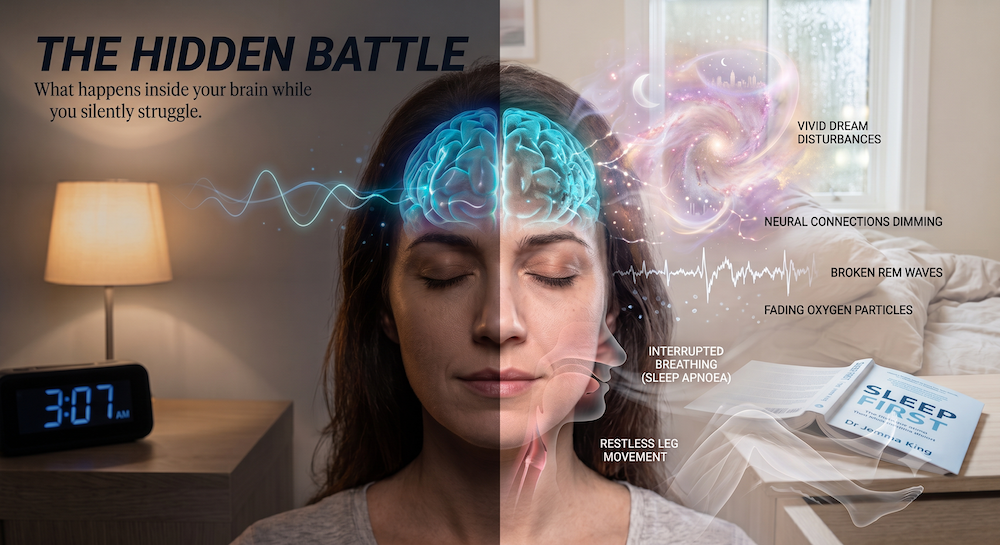
Obstructive sleep apnoea causes repeated breathing interruptions during sleep, sometimes hundreds of times per night, as the upper airway collapses and blocks airflow.
Each micro-death triggers a micro-awakening (you rarely remember these) as your brain jolts you awake enough to restart breathing. The result is fragmented sleep architecture, plummeting oxygen levels and a cascade of physiological stress responses.
The disorder occurs due to muscle relaxation during sleep. The soft tissues at the back of your throat (tongue, soft palate and uvula) naturally relax as you transition into deeper sleep stages. In people with anatomical vulnerabilities (narrow airways, large tongues or excess tissue from obesity), this relaxation causes complete or partial airway collapse.
Eventually, oxygen saturation drops low enough (often below 90 per cent) that your brain initiates an emergency arousal to reopen the airway. The sufferer gasps, breath resumes and they drift back towards sleep, and the cycle repeats.
REM sleep behaviour disorder
For people with REM sleep behaviour disorder (RBD), the temporary paralysis, or sleep atonia, that usual occurs during REM sleep doesn’t kick in.
Sleep atonia prevents us from acting on our dreams or hurting ourselves or someone else. But people suffering from RBD can unknowingly act out their dreams and speak while they sleep.
RBD symptoms range from subtle movements, such as small muscle twitches or quiet sleep talking to more dramatic actions, including loud shouting, flailing, punching, kicking, grabbing a bed partner or even leaping from the bed in response to a dream. The dreams associated with this disorder are often intense and violent.
Sleep talking, or somniloquy, often occurs during transitions between sleep stages. It can happen more during stressful periods and after drinking or taking medications. Though usually harmless, the words spoken can be emotionally charged or nonsensical.
Sexsomnia: When sleep crosses boundaries
Sexsomnia, a sleep disorder where people engage in sexual behaviours while asleep, represents one of the most challenging parasomnias to discuss, yet it’s far more common than most people realise. Sexsomnia belongs to the same family as sleepwalking, NREM parasomnias, which occur when part of your brain wakes up while another part remains deeply asleep.
During these episodes, people can masturbate, initiate sex with a partner, make sexual vocalisations, or engage in other sexual behaviours all while having little to no memory of the events afterwards. In fact, nearly all people with sexsomnia have complete amnesia for these episodes.
The prevalence remains unclear because many people are too embarrassed to report it, but sleep clinic populations suggest it’s surprisingly common. One study found that in 25 per cent of sexsomnia cases, the behaviour involved non-consensual sexual activity towards bed partners, raising serious forensic and legal issues.
Restless leg syndrome
Restless legs syndrome (RLS) keeps you painfully awake while your legs demand constant motion like an overtired toddler.
Around 5–10 per cent of people are reported to have an overwhelming night-time need to move their legs, usually with uncomfortable sensations like crawling, tingling, or aching deep in the muscles, making sleep nearly impossible.
Two main problems drive RLS: your brain’s dopamine system being disrupted and low iron in the brain. The brain’s dopamine system controls movement and how you process sensations. Iron is essential for activating the enzyme that helps make dopamine. Less iron means less dopamine, which worsens symptoms.
What is not commonly known is that your brain iron levels can be low even when blood tests look normal. That’s why many people with RLS look ‘fine’ on paper but show reduced iron in their cerebrospinal fluid or brain scans.
Moving your legs brings relief, but only while you’re actually moving. Stop, and the sensations come rushing back within seconds. People end up pacing, stretching or massaging their legs for hours each night.
Common thread
Sleep disorders share a dark talent for disguise. They present as failing marriages, treatment-resistant depression, early-onset dementia, and inexplicable exhaustion. All while the actual problem – fragmented sleep architecture, oxygen-starved brains, misfiring dopamine systems or paralysis that fails to activate – goes completely unnoticed.
These conditions hide in plain sight, dismissed as stress, ageing or personal failure, when the real culprit is a brain that’s forgotten how to sleep properly.
Today’s sleep disorders are diagnosable, treatable and far more common than anyone realises.
Edited extract from Sleep First by Dr Jemma King (Wiley, $36.95), available at all leading retailers.
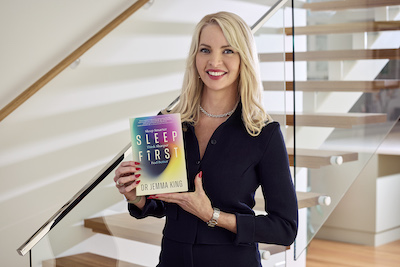 Dr Jemma King is a specialist in Behavioural and Organisational Psychology, with expertise in the psycho-physiological factors that influence effective leadership, stress, sleep, emotional intelligence and psychological safety. She holds a PhD in Human Behaviour and is recognised as an expert in Emotional Intelligence and performance under stress. Jemma is a Research Fellow at the University of Queensland School of Psychology and serves as a specialist external advisor to McKinsey & Company. Her extensive consulting experience includes working with organisations such as the Australian Defence Force, Special Operations Command, the Centre for Australian Army Leadership, the Australian Olympic Swim Team, Australian Government Solicitors and the Australian Institute of Sport.