
Kiddipedia
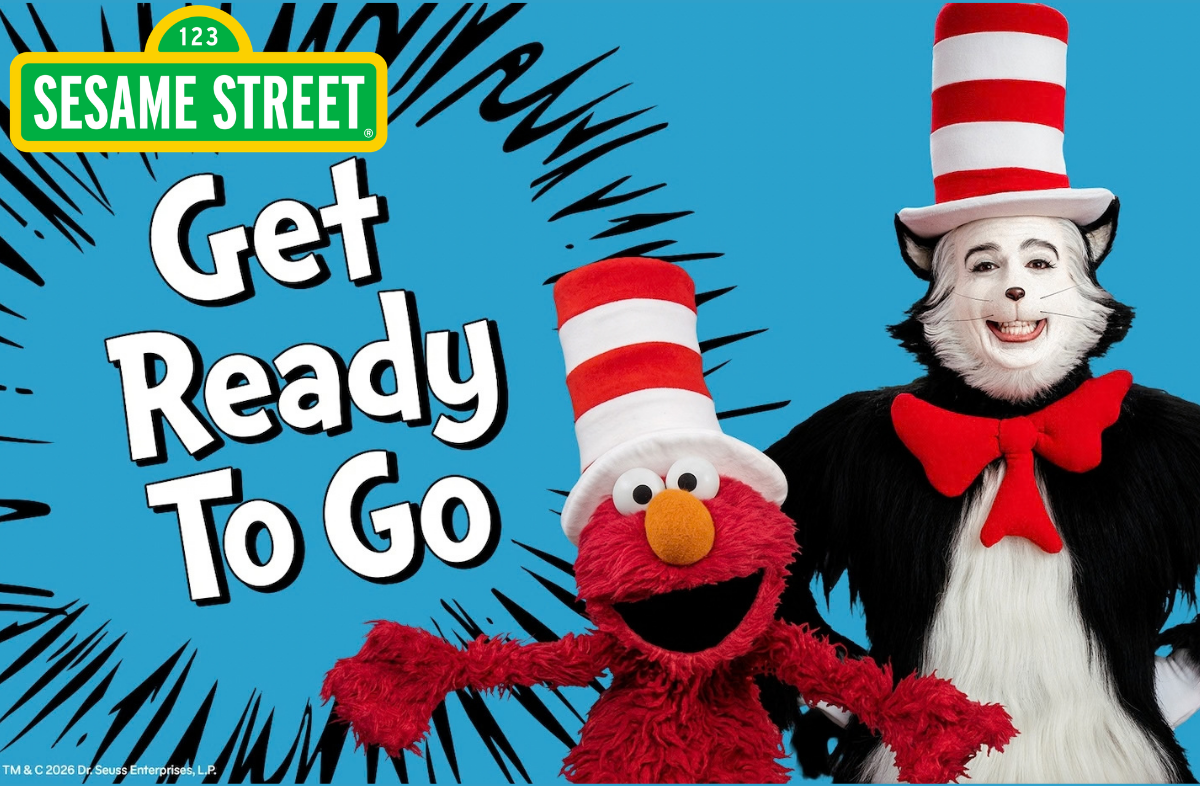
Elmo, Abby Cadabby, Cookie Monster and The Cat in the Hat come together for songs, ABCs, dressing and playful learning — but what can parents actually take from the screen experience?
If your preschooler has ever wanted to sing along with Elmo, practise their ABCs or get swept up in one of The Cat in the Hat’s wonderfully silly adventures, there is a good chance this new crossover will catch their attention.
For parents, though, the more interesting question isn’t simply whether The Cat in the Hat and Sesame Street are appearing together.
It is what children can actually take from the experience.
The new crossover brings together familiar characters, music, alphabet activities, dressing and simple problem-solving — all things that can provide opportunities for young children to talk, move, think, sing and play.
And that is where this crossover becomes particularly interesting.
Because when preschoolers watch something genuinely engaging, the learning does not have to stop when the video ends.
In fact, for young children, what happens after the screen goes off may be just as important as what happened while it was on.
At a Glance
- The Cat in the Hat, Elmo, Abby Cadabby and Cookie Monster appear together in a new YouTube crossover.
- Two new digital episodes have been released across the Sesame Street and Dr. Seuss YouTube channels.
- One episode focuses on getting dressed and preparing for different occasions.
- The other turns the alphabet into a missing-letter problem-solving game.
- A new song, “Get Ready to Go”, features The Cat in the Hat and the Sesame Street friends.
- Australian early childhood guidance supports play, conversation, singing, storytelling, movement and shared experiences as important parts of children’s development.
- Australian recommendations for preschoolers aged 3–5 include at least three hours of physical activity each day, including one hour of energetic activity, and no more than one hour of sedentary recreational screen time per day, with less being better. [1]
- The greatest value may come when parents use the videos as a starting point for conversation, movement, pretend play and real-world learning.
The Cat in the Hat Meets Sesame Street
There are some childhood combinations that just make sense — and The Cat in the Hat meeting Elmo, Abby Cadabby and Cookie Monster is certainly one of them.
For preschoolers, it is a chance to see some very familiar faces sharing the same playful world for the first time on YouTube. For parents, though, there is something a little more interesting going on beneath the silliness.
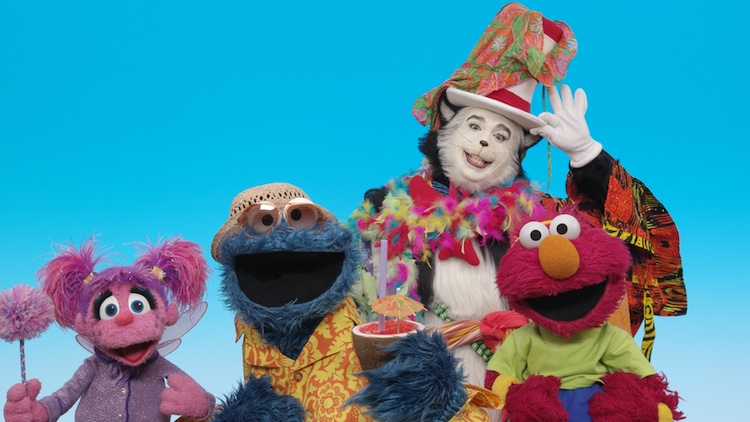
The crossover brings together two short videos with very different learning hooks: one turns getting dressed into a musical adventure, while the other turns the alphabet into a missing-letter mystery.
And that gives parents plenty to work with once the screen goes off.
The crossover was officially announced by Dr. Seuss Enterprises and Sesame Workshop on 30 September 2026, with the two digital episodes co-produced with Little Dot Studios. A new song, “Get Ready to Go,” also accompanies the crossover.
First up: getting ready becomes a song
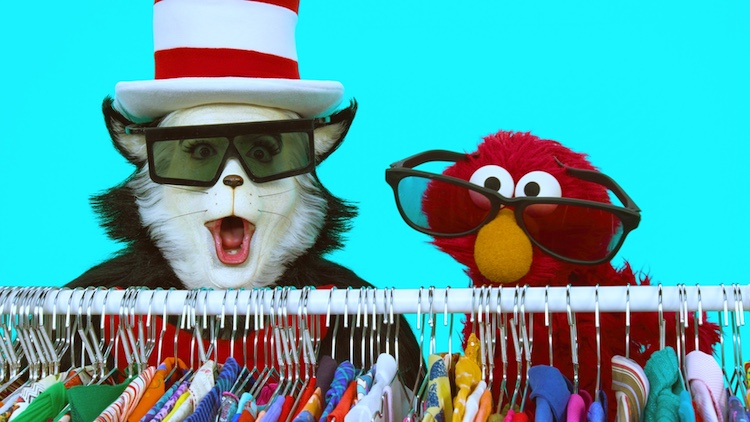
In “Get Ready to Go,” Elmo, Abby, Cookie Monster and The Cat in the Hat turn something most parents know all too well — getting a preschooler dressed and out the door — into a playful musical experience.
The characters get dressed from head to toe and explore different outfits for different occasions, from rainy days to fancy tea parties.
Watch “Get Ready to Go” with Elmo & The Cat in the Hat on YouTube
On the surface, it is simply a catchy song.
But for a young child, getting dressed can also involve sequencing, recognising clothing, making choices, remembering what comes next and developing independence.
That means parents don’t necessarily need to add anything complicated. You might simply ask:
“What do you think we need to put on first?”
Or, when the song finishes:
“Can you get your socks on by yourself?”
Suddenly, something that began as screen entertainment has become a reason to talk, move and practise a real-world skill.
Then comes an alphabet mystery
Over on the Dr. Seuss YouTube channel, things take a slightly more mischievous turn.
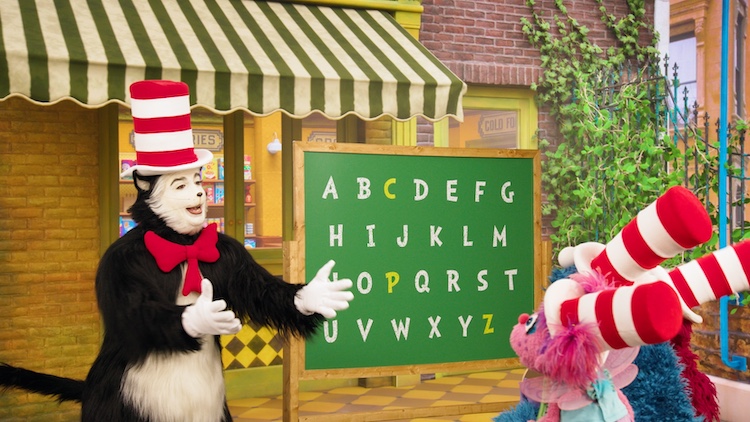
The Cat in the Hat becomes a substitute teacher for Elmo, Cookie Monster and Abby, who put on their “thinking caps” and get ready to tackle the alphabet.
Except there is a problem.
Some of the letters have disappeared.
Rather than simply singing through the ABCs, children are invited to work out which letters are missing, with The Cat in the Hat providing plenty of silly clues along the way.
Watch “Learn the ABCs with The Cat in the Hat and Sesame Street” on YouTube
That small change is worth noticing.
Instead of children only reciting the alphabet, the video gives them a reason to look, listen, remember and work something out.
And, again, parents can easily take the idea beyond the screen.
After watching, try leaving out a letter when you sing the alphabet together. Can your child spot what’s missing?
Or write three or four familiar letters on pieces of paper and ask:
“Which one disappeared?”
It doesn’t need to become a worksheet or a formal learning activity. For a preschooler, turning learning into a game is often the whole point.
Two videos. Two very different ways to play.
The clever part of this crossover is that the two episodes don’t ask children to learn in exactly the same way.
One encourages children to sing, move and explore getting dressed.
The other encourages them to listen, recognise letters and solve a simple problem.
Both are short, playful and built around characters children already know.
And that is where parents can make the most of them.
Watch together. Sing along. Ask a question. Let your child have a guess. Then turn the idea into something they can do themselves.
Because the most valuable part of a children’s program isn’t necessarily what happens on the screen.
It’s what happens after you turn it off.
Why Familiar Characters Can Make Learning Feel Like Play
There is a reason preschoolers can become completely absorbed by familiar characters.
Young children learn through relationships, repetition, imitation, play and active interaction with the people and world around them. The Australian Early Years Learning Framework recognises play-based learning and intentionality as important parts of early childhood learning. [3]
That does not mean that every educational-looking video automatically becomes a learning experience.
Rather, the value comes from what the child does with the experience.
A child who watches an alphabet song and then closes the screen may have enjoyed it.
A child who watches the same song and then starts looking for letters on cereal boxes, sings the alphabet while getting dressed, asks what sound a word begins with or creates their own missing-letter game is doing something quite different.
They are taking an idea from the screen and using it in the real world.
That is a much more interesting place for parents to focus their attention.
The Science Behind the Song
Music is particularly well suited to early childhood learning because it combines sound, rhythm, repetition, movement, memory and social interaction.
Australian research also provides an interesting perspective.
A University of Wollongong doctoral study involving children aged four and five examined a music program delivered through early childhood education settings in regional New South Wales. The research found improvements in aspects of phonological awareness, including sound matching, and highlighted the role of engagement, relationships, rhythm and children’s opportunities to participate in different ways. [4]
Research from Macquarie University has similarly explored the role of music and singing in Australian early childhood settings, highlighting how music experiences can support children’s participation, relationships and engagement. [5]
This does not mean that watching a song on YouTube automatically improves language or literacy.
That would be far too strong a conclusion.
The more defensible interpretation is that songs can create useful opportunities for children to practise listening, remembering, joining in, moving, anticipating what comes next and playing with language.
And parents can make those opportunities much richer.
Don’t Just Watch the Song — Sing It
If your child wants to watch “Get Ready to Go”, there is no need to sit silently beside them.
Join in.
Sing.
Move.
Point.
Ask questions.
Let your child take over parts of the song.
You might say:
“What do you think they are going to put on next?”
“Would you wear that on a rainy day?”
“What would you wear to Grandma’s house?”
“Can you get dressed before the song finishes?”
Suddenly, the video is no longer just something your child is consuming.
It becomes a shared interaction.
Raising Children Network recommends shared screen experiences where parents watch or play alongside children, talk about what is happening and encourage children to respond to what they see. [6][7]
This matters because young children learn through back-and-forth interaction.
The screen can provide the prompt.
You provide the conversation.
Why Repetition Is Not Necessarily a Bad Thing
If your preschooler wants to watch the same song for the 47th time, you may understandably wonder whether they could possibly get anything more from it.
They can.
Young children often use repetition to become familiar with words, sequences, routines and patterns.
The key is what happens around the repetition.
The first time, your child may simply watch.
The next time, they might sing along.
Then they may anticipate the next word.
Eventually, they may start performing the song themselves.
That progression — from watching to anticipating to participating — is worth noticing.
You don’t necessarily need to fight every repeat request.
Instead, occasionally change what you do around it.
The first viewing might simply be enjoyable.
The second could involve singing.
The third could involve movement.
The fourth could become a conversation.
And eventually you can turn the screen off and recreate the idea together.
The ABC Episode Is More Than Singing the Alphabet
The second crossover episode introduces another particularly useful early-learning concept: finding missing letters.
Alphabet songs are familiar to many preschoolers, but recognising the sequence of letters is only one part of early literacy.
The Australian Education Research Organisation (AERO) identifies alphabet knowledge, letter-sound knowledge, phonological awareness, oral language and communication as important components of early literacy development. [8]
That makes a missing-letter game interesting because it introduces a tiny problem to solve.
Instead of simply:
A, B, C, D, E…
the child has to think:
A, B, C, … what’s missing?
That small pause changes the task.
The child has to notice a pattern, hold information in mind and work out what should come next.
These are useful cognitive behaviours, even though a playful alphabet game should not be mistaken for a formal assessment of a child’s development.
Try This at Home: Make Your Own Missing-Letter Game
You don’t need worksheets or an educational app.
Write three or four familiar letters on pieces of paper.
For example:
A — B — C — E
Ask:
“Which one is missing?”
For a younger preschooler, keep the sequence short.
For a child who is ready for more of a challenge, add several letters or mix up the order.
You can also turn it into a movement game.
Put letters around the room.
Call out:
“Find the letter that comes after B!”
Your child has to run to it.
Now the activity combines letter recognition, movement and problem-solving.
And that is much closer to the kind of active, play-based learning encouraged within Australia’s early childhood framework. [3]
The Get-Ready Video Can Become an Independence Game
The dressing episode offers another opportunity that has very little to do with YouTube.
Getting dressed is a genuine developmental task.
For preschoolers, everyday routines can provide opportunities to practise sequencing, decision-making, independence, language and motor skills.
So after watching the characters get ready, try turning the idea into real life.
Ask your child:
“What do we need to get ready for preschool?”
Then let them make a little plan.
Perhaps:
- Underwear
- T-shirt
- Pants or skirt
- Socks
- Shoes
- Jumper
For a rainy day, ask:
“What would we need to add?”
Now your child is not simply naming clothes.
They are thinking about weather, sequence, choices and preparation.
It is a small example of how ordinary routines can become meaningful learning opportunities.
What Children Can Learn When Parents Join In
One of the strongest Australian recommendations around early childhood screen use is surprisingly simple:
If children are watching, parents should try to watch with them when possible.
The Australian Government recommends that if preschoolers have screen time, it should be educational and that parents and carers watch with children, talk about the content and use it as an opportunity to help children understand the world around them. [1]
Raising Children Network similarly highlights the benefits of shared screen time, including conversation, learning new words, interaction and connecting digital experiences with everyday life. [6]
So instead of asking only:
“Is this a good program?”
parents can ask:
“What can I do with this program?”
That is a much more useful question.
Screen Time: Where Does This Fit Into Australian Guidelines?
This is where a little balance matters.
The fact that content is educational does not mean unlimited screen time suddenly becomes recommended.
For children aged 3–5, Australian Government recommendations state that children should have at least three hours of physical activity across the day, including at least one hour of energetic play. They also recommend no more than one hour of sedentary recreational screen time per day, with less being better. Preschoolers should generally get 10–13 hours of good-quality sleep each day. [1]
The guidance also recommends avoiding screens before sleep and keeping screens out of children’s bedrooms. [1]
So if your child watches the crossover, think about the whole day rather than one video in isolation.
Has your child:
- been physically active?
- had time for imaginative play?
- talked and interacted with family?
- spent time outdoors?
- had quiet time?
- had enough sleep?
- had opportunities to read, draw, build and create?
A short, shared educational video can fit comfortably within a balanced day.
It should not replace the rest of the day.
Not All Screen Time Is the Same — But It Is Still Screen Time
There is a temptation to divide screen use into two categories:
“good screen time” and “bad screen time.”
Reality is more complicated.
A thoughtfully chosen educational program watched with a parent is different from hours of passive autoplay.
But even high-quality content still takes place on a screen.
Australian guidance therefore focuses not only on the content, but also on the amount of time, the context and what screen use may displace. [1]
That distinction is important.
A child singing along with a song, talking with Mum and then running outside to play a letter hunt has a very different experience from a child watching one video automatically roll into another for an extended period.
The content may begin the same.
The context does not.
The Power of Co-Viewing
Co-viewing does not mean you have to turn every episode into a lesson.
Please don’t.
Sometimes your child just wants to enjoy Elmo.
Sometimes they just want to laugh at Cookie Monster.
Sometimes The Cat in the Hat is simply silly.
That is okay.
Shared screen time can also be about connection and enjoyment.
But when a natural opportunity appears, follow your child’s lead.
If they point to a letter, talk about it.
If they start singing, sing with them.
If they ask why someone is wearing something, answer.
If they want to get up and dance, let them.
If they start pretending to be The Cat in the Hat, play along.
Australian guidance around play-based learning emphasises relationships, interaction, shared thinking, problem-solving, curiosity and children’s agency. [3]
You do not need to turn play into school.
You simply need to be available for the learning that naturally emerges.
What If My Child Doesn’t Sit Still?
This is worth saying because many parents quietly worry about it.
Your preschooler does not necessarily need to sit perfectly still and watch a video from beginning to end for the experience to have value.
Young children are active learners.
If your child sings while standing up, dances around the lounge room, runs over to grab a toy or acts something out, that may simply be how they engage.
The goal is not necessarily to produce a miniature cinema audience.
Australian early childhood guidance places considerable emphasis on active play, agency, exploration and learning through interaction. [1][3]
So if the song gets your child moving, that can be a positive opportunity.
Just remember that movement away from the screen is ultimately more valuable than keeping a child seated in front of it.
Make the Screen the Starting Point — Not the Destination
This may be the most useful way for parents to think about educational digital content.
The screen can introduce an idea.
Real life gives children the opportunity to use it.
The Cat in the Hat episode introduces missing letters.
You can play a missing-letter game.
The song introduces getting dressed.
You can let your child choose an outfit.
The characters sing.
You can sing together.
They solve a problem.
You can invent another one.
They use silly clues.
You can make up your own.
This approach turns passive viewing into something much more active.
Five Easy Ways to Extend the Crossover at Home
1. Go on a letter hunt
Choose one letter and look for it around the house.
Can your child find it on a book, food packet, toy or sign?
Ask what sound it makes if they know it.
2. Make a silly missing-letter game
Write a familiar sequence and remove one letter.
Let your child become the teacher and make one for you.
3. Create a “Get Ready” challenge
Give your child a simple dressing sequence and see whether they can work out what comes next.
4. Start a family song
Make up a silly song about brushing teeth, putting shoes on, packing a bag or getting ready for bed.
It does not need to sound good.
Your child will probably like it more if it doesn’t.
5. Turn off the screen and act it out
Give your child a hat, scarf or other safe dress-up item and let them invent their own character.
Ask:
“Where are we going?”
“What do we need?”
“What happens next?”
Now you have moved from watching a story to creating one.
Why Play Still Matters More Than the Screen
The Australian Early Years Learning Framework describes literacy broadly, encompassing language, communication, music, movement, storytelling, media and drama. [8]
That is important because early literacy is not simply about memorising letters.
It is also about children learning to:
- communicate ideas
- listen
- tell stories
- understand and use vocabulary
- notice sounds
- engage with symbols
- express themselves
- interact with others
- make meaning from experiences.
Play provides an environment where many of these skills can happen naturally.
ACECQA describes play-based learning as a context in which children can make decisions, solve problems, develop self-awareness, negotiate with others and think together. [3]
So if your child watches an alphabet video and then spends 20 minutes pretending their teddy bears are at school, that imaginative play is not a distraction from the learning.
It can be the learning.
What About Executive Function?
Another reason the crossover is interesting is that some of its activities naturally involve small elements of executive function.
Executive function refers to a group of cognitive processes involved in things such as managing attention, holding information in mind, controlling impulses, shifting between ideas and solving problems.
Australia’s new Preschool Outcomes Measure includes executive function as one of two national learning progression domains, alongside oral language and literacy. The 2026–27 initiative is being piloted nationally as an evidence-based formative assessment approach for preschool learning and development. [9]
That does not mean watching The Cat in the Hat will “build executive function” in a guaranteed or measurable way.
It means that activities such as:
“Which letter is missing?”
“What comes next?”
“What do we need to get ready?”
can provide playful opportunities for children to practise thinking, remembering and solving problems.
The difference is subtle — and important.
We should not oversell the science.
Sleep Matters Too
There is another part of the Australian guidance that can easily get forgotten when we talk about educational screen content: sleep.
Preschoolers aged 3–5 generally need 10–13 hours of good-quality sleep each day. Australian recommendations also advise avoiding screen time before sleep and keeping screens out of the bedroom. [1]
This is one reason a catchy song that your child loves may be better enjoyed during the day rather than becoming the final activity before bed.
Interestingly, Australian research from Macquarie University involving 32 preschool children in Sydney found that a daytime nap was associated with better performance on a task involving generalising newly learned letter-sound mappings, although the researchers did not find a nap benefit for explicit letter-sound knowledge. [10]
It is a small study and should not be overinterpreted.
But it is a useful reminder that learning does not happen in isolation from sleep and the rest of a child’s daily rhythm.
YouTube Safety: A Parent’s Checklist
The content itself is only one part of the equation.
Where and how your child watches it matters too.
The eSafety Commissioner provides specific guidance for parents using YouTube Kids, including tools that allow parents to:
- create child profiles
- choose age-based settings
- manually approve videos
- block videos
- set screen-time limits
- review viewing history
- disable autoplay. [11]
That last point is particularly useful for preschoolers.
Autoplay can turn one planned video into a much longer viewing session.
If you have chosen one crossover episode for your child, you may prefer to watch that episode intentionally rather than allowing an algorithm to decide what comes next.
The eSafety Commissioner also recommends that parents consider age appropriateness, privacy, platform settings, reporting tools and their child’s readiness for online experiences. [11]
A Simple YouTube Safety Checklist for Preschoolers
Before pressing play:
✓ Choose the video yourself
✓ Check that it is appropriate for your child’s age
✓ Consider using YouTube Kids and its parental controls
✓ Disable autoplay if appropriate
✓ Watch together where possible
✓ Keep the device in a shared family space
✓ Keep an eye on what appears after the selected video
✓ Stop if your child encounters something confusing or inappropriate
✓ Make sure screen time isn’t replacing sleep, movement or face-to-face interaction
This is not about making digital media frightening.
It is about helping young children experience it with an adult who can provide context and boundaries.
What About Advertising and Branded Children’s Content?
Parents are also right to think critically about the commercial environment surrounding children’s media.
Young children do not always understand the persuasive intent behind advertising, and Raising Children Network recommends avoiding content containing substantial advertising where possible. [7]
That makes it useful to distinguish between:
content your child enjoys
and
content designed to encourage your child to want something.
The Cat in the Hat and Sesame Street crossover is branded entertainment featuring well-known intellectual properties, so parents may reasonably decide whether it fits their family’s approach to commercial children’s media.
The important thing is to remain aware of the distinction.
A familiar character can be comforting, funny and educational.
It can also be a brand.
Parents can hold both ideas at the same time.
Myth vs Fact
Myth: Educational screen time doesn’t count as screen time.
Fact: It still counts. Australian recommendations for preschoolers aged 3–5 advise no more than one hour of sedentary recreational screen time per day, with less being better. [1]
Myth: If a video teaches ABCs, my child is learning to read.
Fact: Alphabet knowledge is one component of early literacy. Children also need opportunities to develop oral language, phonological awareness, vocabulary, communication and broader literacy skills. [8]
Myth: Rewatching the same episode is pointless.
Fact: Repetition can allow children to become increasingly familiar with language, sequences and patterns. What matters is the broader context and whether screen use is balanced with other activities.
Myth: Parents need to turn educational programs into lessons.
Fact: They don’t. Sometimes simply enjoying the experience together is valuable. Conversation, singing, play and curiosity can naturally extend the experience without turning family time into school.
Myth: If my child is moving around while watching, they aren’t paying attention.
Fact: Young children often learn through active participation. Movement, singing, imitation and pretend play can all be part of how children engage.
Five Questions Parents Can Ask While Watching
You don’t need to quiz your child.
Instead, try occasional open-ended questions.
1. “What do you think will happen next?”
Encourages prediction.
2. “Which letter is missing?”
Encourages attention to patterns and alphabet knowledge.
3. “Why do you think they chose that?”
Encourages reasoning and language.
4. “What would you wear?”
Connects the story with the child’s own experience.
5. “Should we make up our own one?”
Moves the child from watching to creating.
That final question may be the most powerful of all.
The Bigger Picture: What Parents Can Take From This Crossover
There is nothing wrong with letting children enjoy a beautifully made children’s program simply because it is fun.
Children need joy.
They need silliness.
They need songs.
They need stories.
They need characters they love.
And parents do not need to turn every minute of childhood into an educational opportunity.
But when a program naturally encourages language, music, movement, problem-solving and pretend play, there is an opportunity to extend that experience into everyday life.
The Australian evidence base consistently points towards the importance of relationships, interaction, play, language, movement and developmentally appropriate learning experiences. [1][3][8]
That means the most valuable question may not be:
“Is this video educational?”
It may be:
“What happens after my child watches it?”
Does your child sing?
Do they ask questions?
Do they look for letters?
Do they want to dress themselves?
Do they make up a story?
Do they pretend?
Do they get up and move?
Do they want you to join them?
If the answer is yes, then the screen may have done something useful: it sparked an experience that continued beyond the screen.
And that is where parents can make the biggest difference.
Beyond the Screen
The new Cat in the Hat and Sesame Street crossover is likely to be a hit with preschoolers because it brings together characters they already know, music they can join in with and simple challenges they can understand.
But you don’t need to treat it as a lesson.
Let your child enjoy it.
Sing the song.
Laugh at the silly bits.
Let them dance.
Talk about the letters.
Ask what they would wear.
Then, when the video ends, follow their curiosity.
Make up another game.
Find letters around the house.
Get dressed together.
Invent a silly song.
Read a book.
Go outside.
Build something.
Pretend.
Run.
Play.
Because for preschool children, learning is not confined to a screen.
The most valuable part of a children’s program isn’t necessarily what happens on the screen. It’s what happens after you turn it off.
Frequently Asked Questions
What is the new Cat in the Hat and Sesame Street crossover?
Dr. Seuss Enterprises and Sesame Workshop have released two new digital crossover episodes featuring The Cat in the Hat, Elmo, Abby Cadabby and Cookie Monster. The episodes are available through the Dr. Seuss and Sesame Street YouTube channels. [2]
What is the “Get Ready to Go” song?
It is a new song featuring The Cat in the Hat and the Sesame Street characters. The song encourages children to get dressed for different occasions.
What happens in the ABC episode?
The Cat in the Hat acts as a substitute teacher and helps Elmo, Abby and Cookie Monster solve a missing-letter challenge while singing the alphabet.
Is this appropriate for preschoolers?
The content has been created for preschool audiences, but parents should still consider their child’s individual needs and supervise online viewing where appropriate.
How much screen time should a preschooler have?
Australian Government recommendations state that children aged 3–5 should have no more than one hour of sedentary recreational screen time per day, with less being better. [1]
Should parents watch YouTube with preschoolers?
Australian guidance recommends shared viewing where possible, particularly when screen content is being used educationally. Talking about what children see can help connect digital experiences with the real world. [1][6]
Can watching an alphabet video teach a child to read?
An alphabet video can provide an opportunity to practise alphabet knowledge, but learning to read involves a broader range of skills, including oral language, phonological awareness and knowledge of letters and sounds. [8]
What can parents do after watching?
Try a screen-free extension: a letter hunt, missing-letter game, singing activity, dressing challenge, storytelling game, drawing activity or outdoor movement game.
Article Highlights
The Cat in the Hat and Sesame Street have crossed over for the first time on YouTube.
Elmo, Abby Cadabby, Cookie Monster and The Cat in the Hat appear together in two new digital episodes.
The new “Get Ready to Go” song turns getting dressed into a playful musical experience.
A second episode introduces a missing-letter alphabet game.
Australian early literacy guidance supports opportunities for alphabet knowledge, oral language, phonological awareness, storytelling, singing and conversation.
For preschoolers, the quality and context of screen use matter — not simply whether a program is labelled educational.
Parents can turn screen-based ideas into real-world play, movement, conversation and creativity.
Australian Research & References
[1] Australian Government Department of Health, Disability and Ageing. Recommendations for infants, toddlers and preschoolers (birth to 5 years). Updated March 2026.
[2] Sesame Workshop. Dr. Seuss Enterprises and Sesame Workshop Debut First-Ever YouTube Crossover Content Featuring the Cat in the Hat, Elmo, Abby and Cookie Monster. September 2026.
[3] Australian Children’s Education & Care Quality Authority (ACECQA). EYLF Practices: Play-based learning and intentionality.
[4] Cameron, A. Making Music Speak: The Role of the “Tuning In” Music Program in Developing Preschool Children’s Oral Language Skills. University of Wollongong doctoral thesis.
[5] Powell, S., & Waniganayake, M. (2022). Enriching the lives of children and families through music and singing: A professional learning journey with Orff Schulwerk at an early childhood centre in Australia. Musicworks, 27, 6–16.
[6] Raising Children Network. Sharing screen time and digital technology with children and pre-teens.
[7] Raising Children Network. Sharing screen time and digital technology with children: tips.
[8] Australian Education Research Organisation (AERO). Early literacy practice guide. Updated September 2026.
[9] Australian Government Department of Education. Preschool Outcomes Measure and national learning progressions.
[10] Wang, H.-C., Nation, K., Gaskell, M. G., Robidoux, S., Weighall, A., & Castles, A. (2022). Nap effects on preschool children’s learning of letter-sound mappings. Child Development, 93(4), 1145–1153.
[11] eSafety Commissioner. YouTube Kids: parental controls, age settings and safety guidance. Updated September 2026.
[12] Murdoch Children’s Research Institute. Research and guidance concerning children’s screen use, family interaction, sleep, physical activity and development.
About Dr. Seuss Enterprises L.P.
Founded in 1993, Dr. Seuss Enterprises is a global entertainment company. Its mission is to educate and entertain generations around the world by promoting and protecting the literary and artistic works of Dr. Seuss. The company creates content intended to support joyful learning and hopeful futures, with profits benefiting charitable organisations focused on causes including education, science, health, animal conservation and the arts.
About Sesame Workshop
Sesame Workshop is the global nonprofit organisation behind Sesame Street and many other educational initiatives. For more than 50 years, it has worked at the intersection of education, media and research to create experiences designed to support children’s learning, wellbeing and development around the world.