
Kiddipedia
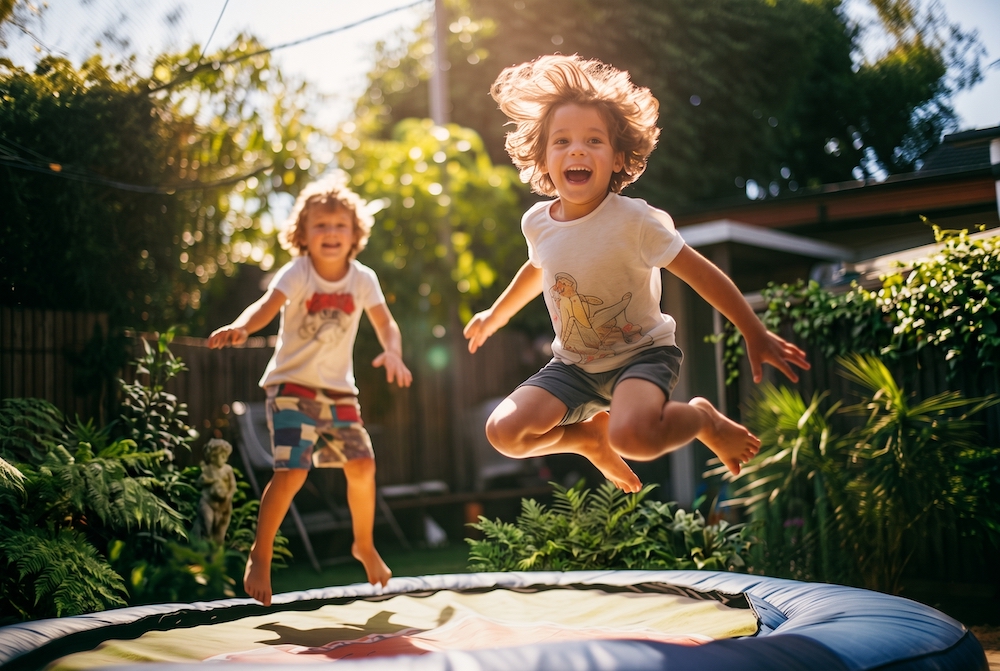
There is a reason children can bounce on a trampoline for what feels like forever.
To them, it is simply fun. They jump, wobble, laugh, try again and inevitably ask for “just five more minutes”.
But underneath all that bouncing, a child’s brain and body are working remarkably hard.
Every jump asks the body to coordinate muscles, joints, balance, vision and sensory information. A child has to judge where their body is in space, control take-off, respond to the movement of the mat and then organise their body for the next landing.
That doesn’t mean a trampoline is a magical piece of developmental equipment — it isn’t. Nor can it replace the many different ways children need to move, from running and climbing to swimming, throwing and simply exploring the backyard.
What it can do, however, is provide something that is increasingly valuable in busy family life: an easy, enjoyable reason for children to move.
And that matters.
Australian movement guidelines recognise that regular physical activity supports children’s physical, social, emotional and cognitive wellbeing, including healthy growth and development, stronger muscles and bones, confidence, concentration, coordination and movement skills. Importantly, activity doesn’t have to happen in one long session. Shorter periods of movement can add up across the day. [1]
So, what is actually happening when your child bounces?
It’s play to them. But their brain and body are working hard.
A jump might look simple from the outside.
Push down. Spring up. Come back down.
But the nervous system is constantly receiving information and making adjustments throughout the movement.
Your child’s muscles and joints provide information about body position and force. Their inner ear contributes information about movement and balance. Their eyes help them understand where they are in relation to the mat and everything around them.
The brain brings all of that information together and sends instructions back to the muscles.
Then it does it again. And again. And again.
This repeated practice is one reason active play can be so valuable during childhood.
Rather than sitting down and being told how to balance, children can experience balance through movement itself.
They don’t necessarily think:
I’m developing postural control now.
They think:
How high can I jump?
That distinction is important. Children learn a great deal through movement without experiencing it as formal exercise or “learning”.
What does bouncing actually do for a child’s developing body?
Trampolining shouldn’t be presented as a complete developmental programme. However, the movement involved in jumping and landing overlaps with several physical skills that are important during childhood.
1. Balance and postural control
The trampoline surface is continually moving beneath your child’s feet.
That means their body has to make small, rapid adjustments to maintain stability.
These adjustments involve the muscles around the legs and trunk, as well as information from the sensory systems involved in balance.
Australian Sport Australia describes stability and balance, coordination, strength, agility and reaction time as components of the physical domain of physical literacy. [2]
A child who is learning to stay upright while their body is moving is therefore practising something much broader than simply “jumping”.
They’re learning how to control a moving body.
2. Coordination
Jumping requires different parts of the body to work together.
The legs generate force. The trunk helps stabilise the body. The arms may move to assist balance. The eyes provide information about position and movement.
As children experiment with different movements, they have opportunities to practise coordinating these body parts.
That doesn’t mean a trampoline will automatically make a child coordinated.
But it can provide repeated opportunities to practise coordination in a playful environment.
3. Strength
Jumping and landing require muscles to repeatedly produce and absorb force.
The legs, hips and trunk all contribute to the movement.
Australian physical activity guidelines specifically recommend that children aged 5–17 include muscle- and bone-strengthening activities at least three days each week as part of their overall activity. Examples provided by the Australian Government include running, climbing, swinging on monkey bars, push-ups and other activities. [1]
Trampolining may contribute to the active movement children need, but it should be considered one part of a varied movement day, rather than a replacement for other strength-building activities.
4. Jumping and landing skills
There is an important difference between simply getting into the air and controlling your body when you come back down.
Children gradually learn to coordinate take-off, body position and landing.
Those movement experiences sit within the broader development of fundamental movement skills.
Australian research has long recognised fundamental movement skills such as jumping, hopping, balance, running, throwing and catching as important components of children’s movement development. Research involving Australian primary school children has also shown that mastery of these skills is far from universal, highlighting why opportunities to practise movement matter. [3]
A trampoline won’t teach every fundamental movement skill.
There is no substitute for throwing and catching a ball if you want a child to learn to throw and catch.
But repeated jumping provides one more environment in which a child can practise body control, stability and movement confidence.
The hidden sensory systems behind every bounce
One of the most fascinating things about movement is that your child isn’t relying on their muscles alone.
Several sensory systems are working together.
The vestibular system: your child’s internal movement detector
The vestibular system sits inside the inner ear and provides information about movement, acceleration and head position.
It contributes to balance and orientation — essentially helping the brain understand how the head and body are moving through space.
When a child jumps, lands and changes position, this system is receiving constantly changing information.
Proprioception: knowing where your body is
Proprioception is the body’s internal sense of position and movement.
It draws on information from muscles, tendons and joints.
It helps your child know where their limbs are without having to look at them.
That is why you can close your eyes and still know that your arm is above your head.
During jumping and landing, proprioceptive information helps the nervous system understand things such as joint position, movement and force.
And don’t forget vision
Vision is another important part of the equation.
A child jumping on a trampoline is constantly using visual information to judge:
- where the centre of the mat is
- where their body is positioned
- how far they have moved
- where another person is
- what is around them.
The brain doesn’t treat these systems as separate little compartments.
It integrates the information.
That integration is what allows movement to become increasingly controlled and purposeful.
The brain is learning from every bounce
This is where trampoline play becomes particularly interesting.
Your child isn’t simply repeating the same movement over and over.
The nervous system is continually receiving feedback.
A jump might be slightly too far to one side.
The next one might be too high.
A landing might feel unstable.
The child adjusts.
Then they try again.
This is part of the broader process of motor learning — the nervous system becoming better at organising movement through experience and practice.
That is one reason repetition matters in childhood movement.
But repetition alone isn’t the whole story.
Children also benefit from variety, exploration and opportunities to solve movement problems themselves.
What happens if I jump with my arms out?
What happens if I land more softly?
Can I stay in the middle?
Can I stop without falling?
These tiny experiments are part of how children learn what their bodies can do.
From movement skills to physical literacy
There is a bigger idea sitting underneath all of this that parents may not have heard much about: physical literacy.
The Australian Sports Commission describes physical literacy as the development of the skills, knowledge and behaviours that give people the confidence and motivation to lead active lives. It includes physical, psychological, social and cognitive elements. [4]
In other words, being physically literate isn’t simply being “good at sport”.
It includes:
- physical skills and fitness
- confidence
- motivation
- enjoyment
- social skills
- understanding how, why and when we move
- awareness of safety and risk.
That makes the goal of childhood movement much broader than producing future athletes.
It’s about helping children become people who feel comfortable, capable and motivated to move.
A trampoline can contribute to that experience when a child discovers:
I can do this.
I can jump further.
I can stay balanced.
I can learn a new movement.
I actually enjoy being active.
That feeling of competence can matter.
Australian research has found relationships between fundamental movement skill competency and children’s physical activity and fitness, while Australian physical literacy research increasingly takes a broader, whole-child view of movement competence. [3][5]
So, can trampoline play help children meet their daily activity needs?
It can contribute.
But it shouldn’t be treated as a magic number on the activity tracker.
For children aged 5–17, Australian guidelines recommend at least 60 minutes of moderate- to vigorous-intensity physical activity each day, with vigorous activity and muscle- and bone-strengthening activity included on at least three days each week. Children should also accumulate several hours of lighter physical activity across the day. [1]
For children aged 3–5, the recommendation is at least three hours of physical activity across the day, including at least one hour of energetic play. For children aged 1–2, the recommendation is at least three hours of energetic play across the day. [6]
And here’s the bit parents often need to hear:
It doesn’t all have to happen at once.
A child might:
- bounce for 10 minutes before school
- walk home
- play outside at lunchtime
- ride a bike after school
- spend 20 minutes on the trampoline before dinner
- run around with siblings on the weekend.
Movement can accumulate.
The Australian Government specifically notes that shorter sessions can contribute to the daily activity target for children aged 5–17. [1]
So the trampoline doesn’t have to become another activity parents have to organise.
It can simply be one more invitation to move.
What about screen time?
This is where the conversation gets much more realistic for modern families.
Most parents aren’t choosing between a trampoline and a screen in some perfectly controlled experiment.
We’re trying to get dinner made.
We’re answering emails.
We’re finishing homework.
We’re getting through the afternoon meltdown.
And sometimes the tablet is the thing that buys us ten quiet minutes.
There is no need to turn movement into another source of parental guilt.
Australian guidelines recommend that children aged 5–17 have no more than two hours of sedentary recreational screen time per day, while younger children have lower recommendations. They also emphasise breaking up long periods of sitting. [1][6]
The more useful approach is therefore not:
“Screens are bad. Go outside.”
It is:
“What can we offer children that makes moving more appealing?”
A trampoline can be one answer.
The secret may be that children don’t think of it as exercise
This is one of the reasons backyard equipment can work so well.
Children generally don’t need another adult telling them they should exercise.
They need opportunities to want to move.
A trampoline can turn movement into:
- a game
- a challenge
- imaginative play
- experimentation
- dancing
- jumping contests
- movement stories
- pretend play.
The Australian Sports Commission identifies fun and enjoyment as important drivers of ongoing participation in physical activity among children. [7]
That matters because the long-term goal isn’t for children to grudgingly complete their daily exercise quota.
It’s to help them develop a positive relationship with movement.
What happens when children make up their own games?
There’s another layer here that is easy to overlook.
A trampoline can become a setting for open-ended play.
One day it might be a spaceship.
The next day it becomes a jumping challenge.
Then it’s a stage for dancing.
Then an imaginary island surrounded by lava.
This kind of play can give children opportunities to make decisions, experiment with movement and create their own rules.
If siblings or friends are involved, there can also be opportunities for:
- communication
- turn-taking
- negotiation
- cooperation
- problem-solving
- conflict resolution.
These are all consistent with the broader social and cognitive dimensions of physical literacy described by the Australian Sports Commission. [4][8]
But there is an important safety distinction:
Social play does not mean children should bounce together.
When it comes to the trampoline itself, Australian safety advice is very clear: one child at a time.
Children can socialise, create games and take turns without sharing the jumping surface.
What trampolining can’t replace
This is worth saying plainly because no single piece of backyard equipment can provide everything a developing body needs.
Children need movement variety.
That means opportunities to:
Run.
Climb.
Jump.
Balance.
Throw.
Catch.
Kick.
Swim.
Cycle.
Scoot.
Dance.
Explore.
Different activities challenge the body in different ways.
A child who spends 20 minutes bouncing but never climbs, runs, throws or catches isn’t getting the full range of movement experiences they need.
Think of the trampoline as one item on the movement menu, not the whole menu.
Is there a recommended amount of trampoline time?
This is where it is important not to manufacture a number simply because parents like having one.
There isn’t a specific Australian guideline saying that children need, for example, 15, 20 or 30 minutes of trampoline use each day.
The Australian recommendations are about overall movement across the day, rather than prescribing a particular amount of time on a particular backyard product. [1][6]
So there is no need to turn the trampoline into homework.
Some days your child might bounce for five minutes.
Some days they may spend longer outside.
Other days they might prefer to ride their bike, play football or climb at the playground.
The bigger goal is regular movement and variety.
What does the research actually tell us about trampolines?
This is an important distinction.
There is strong evidence that regular physical activity is beneficial for children’s health and development.
There is also substantial Australian research around fundamental movement skills, physical literacy and active play.
But the evidence specifically demonstrating that a backyard trampoline independently produces broad developmental improvements is more limited.
That means it would be misleading to say:
“Research proves trampolining makes children smarter.”
Or:
“A trampoline improves sensory processing.”
Or:
“Every child needs one for healthy development.”
Those claims go beyond what the evidence can support.
A more scientifically honest conclusion is:
Trampoline play provides one form of active movement that can give children repeated opportunities to practise jumping, landing, balance, coordination and body control while contributing to their overall physical activity.
That’s still a pretty good reason to get outside and bounce.
A note about sensory processing
You may see trampolines promoted as a tool for “sensory regulation” or described as being therapeutic for children with developmental differences.
This area deserves some caution.
Movement activities can be incorporated into therapy in individual circumstances, and occupational therapists may use movement-based activities as part of broader therapeutic approaches.
But that does not mean that putting a child on a backyard trampoline is equivalent to occupational therapy.
Nor should parents assume that frequent bouncing will “fix” sensory difficulties.
If you’re concerned about your child’s development, coordination, balance, movement, behaviour or sensory responses, speak with your child’s GP or an appropriately qualified health professional.
A trampoline is play equipment first — not a medical treatment.
Safety changes the conversation completely
This is the part we cannot gloss over.
A trampoline can be fun and physically active while still carrying a genuine risk of injury.
The Australian Competition and Consumer Commission (ACCC) says thousands of trampoline-related injuries are reported each year in Australia. Injuries can include fractures, sprains, bruises, cuts, concussion and other injuries. [9]
Australian research gives us an even clearer picture.
A Queensland review of almost two decades of domestic trampoline injury data identified 10,726 trampoline-related injury episodes, including 10,353 children aged 14 years or younger. Children aged 2–7 accounted for almost 60% of the recorded childhood injuries in that dataset. The researchers also found that changes in trampoline design, including enclosure systems and impact protection, appeared to influence injury patterns over time. [10]
Another Australian study of children presenting to the Women’s and Children’s Hospital in Adelaide found that fractures were the most common injury, while falls from the trampoline accounted for more than a quarter of injuries in the study population. [11]
So the developmental conversation and the safety conversation need to sit side by side.
A trampoline can encourage movement. It can also cause serious injury if used incorrectly.
Both things can be true.
The five trampoline safety rules worth remembering
The ACCC’s current advice is refreshingly simple.
1. One child at a time
This is one of the most important rules.
Multiple children bouncing together creates the potential for collisions and unpredictable movement.
Australian injury research has identified multiple-user activity as an important risk factor, while Australian safety guidance specifically recommends one child at a time. [9][10]
It can be tempting to think:
“They’re siblings. They’ll be fine.”
But size and weight differences can make shared bouncing particularly unpredictable.
One at a time means one at a time.
2. Always supervise
Supervision doesn’t make a trampoline risk-free, but it means an adult is present to enforce the safety rules and respond when something goes wrong.
The ACCC recommends active supervision and particularly highlights the need for extra care with younger children. [9]
3. Use proper safety padding
The frame and springs should be appropriately protected.
Check the padding regularly and replace damaged or missing components.
4. Check the trampoline
Before children use it, look for:
- holes or damage to the mat
- damaged or deteriorated netting
- bent frame components
- damaged springs or attachments
- loose or unsecured components
- damaged padding
- structural deterioration.
Sunlight and weather can affect outdoor equipment over time, so a trampoline that was safe when it was installed isn’t necessarily safe forever. [9]
5. Keep the surrounding area clear
The ACCC recommends placing trampolines away from hazards such as walls, fences, trees and washing lines, with appropriate clearance around and above the equipment. It also recommends impact-absorbing material around the trampoline and a minimum overhead clearance of eight metres from ground level. [9]
Always follow the manufacturer’s installation instructions as well.
What about somersaults and flips?
This deserves more than a throwaway rule.
A child who has mastered bouncing may quickly decide they’re ready for something more spectacular.
And this is where the risk changes.
Flips, somersaults and other complex manoeuvres can increase the potential for awkward landings and serious injury.
The ACCC advises children to learn basic jumps and bounces before attempting more complex manoeuvres and warns that overconfidence can contribute to injury. [9]
For younger children in particular, parents shouldn’t interpret “supervision” as meaning:
“It’s safe if I’m standing there.”
Supervision reduces risk.
It doesn’t eliminate it.
What age is appropriate?
There isn’t one universal age at which every child becomes “ready” for every trampoline.
Children develop at different rates, and equipment manufacturers may have their own age, size and developmental recommendations.
The ACCC specifically advises parents to follow product guidelines for a child’s age, size and development. [9]
One point is particularly important:
Babies should not be placed on trampolines.
The ACCC warns that babies can suffer serious injuries from falls, pinching and crushing, including when they are near a trampoline being used by others. [9]
For toddlers and preschoolers, parents should be especially cautious and follow the manufacturer’s age and developmental requirements rather than assuming that a large backyard trampoline is appropriate simply because the child can walk and jump.
Choosing a trampoline: what should parents actually look for?
The design matters.
The ACCC recommends looking for:
- safety padding over the frame and springs
- a safety net
- appropriate construction
- age-appropriate design
- clear manufacturer instructions
- good installation
- adequate surrounding space.
It also recommends regularly checking and maintaining the trampoline. [9]
What about Australian Standards?
This is an area where wording matters.
AS 4989:2015 — Trampolines for domestic use — Safety aspects is the relevant Australian Standard referenced in Australian trampoline safety research and by manufacturers.
However, the ACCC currently states that there is no mandatory standard that suppliers and retailers must comply with for domestic trampolines. [9]
That means parents shouldn’t simply assume:
“It is sold in Australia, therefore it must meet the Australian Standard.”
Instead, ask the manufacturer or retailer specifically whether the product has been tested or independently certified against the relevant Australian Standard and what that certification covers.
That’s a much more useful question.
What about springless trampolines?
Springless designs can reduce children’s direct exposure to traditional metal springs and change the way the frame and jumping surface are constructed.
That can be a legitimate design consideration.
But springless doesn’t mean risk-free.
Falls, awkward landings, collisions and other mechanisms of injury can still occur.
So parents shouldn’t choose a trampoline based on one feature alone.
Look at the entire system:
mat + frame + enclosure + padding + installation + location + maintenance + supervision + how the trampoline is used.
Australian research supports this broader “whole system” approach to trampoline injury prevention. [10]
Australian brand Vuly, which designs and tests its trampolines in Brisbane, offers a springless option in the Thunder 2 pro trampoline It comes in three sizes, allowing families to choose a model that suits their available space and their child’s needs as they grow. Its jump mat also incorporates printed games designed to encourage children to keep moving, play and experiment as they bounce, adding an imaginative element to active backyard play.
Where should a trampoline go?
The backyard location matters more than many parents realise.
Before installation, consider:
- flat, stable ground
- clearance from fences and walls
- trees and branches
- clotheslines
- garden furniture
- play equipment
- overhead wires
- other hard or dangerous objects.
The ACCC recommends a minimum eight-metre overhead clearance and a clear area around the trampoline. [9]
The manufacturer’s installation instructions should always be followed where they provide more specific requirements.
And don’t forget Australian weather.
Strong winds can move outdoor equipment, so families should follow the manufacturer’s anchoring and severe-weather instructions.
Don’t forget maintenance
A trampoline is not a “buy it once and forget it” piece of equipment.
Outdoor equipment lives through:
sun + rain + wind + heat + humidity + repeated use.
Over time, components can deteriorate.
Make checking the trampoline part of normal backyard life.
Look at the:
- jumping mat
- frame
- enclosure
- padding
- connections
- springs or flexible components
- legs and braces
- stitching
- anchors.
If something is damaged, don’t simply tell the kids to be careful around it.
Repair or replace it according to the manufacturer’s instructions before the trampoline is used again.
How to make trampoline time part of real family life
The best movement routines are often the ones that don’t feel like routines.
You don’t need a laminated timetable on the fridge.
You could simply make outside time part of the rhythm of your afternoon.
Before school
A short burst of active play can get bodies moving before the day begins.
After school
Instead of going straight from the car to the couch, give children the option of a few minutes outside.
Before dinner
This can be a useful transition between school-day sitting and the evening routine.
On weekends
Let children decide what kind of movement they want to explore.
One day it might be bouncing.
The next it might be riding bikes.
The next it might be kicking a football around.
That flexibility is important.
The aim isn’t to make children exercise harder. It’s to make movement a normal part of family life.
Try movement “snacks”
One of the easiest ways to think differently about activity is to stop imagining exercise as one large block.
A movement “snack” might be:
5 minutes of bouncing.
10 minutes of dancing.
A walk around the block.
A game of catch.
A trip to the playground.
Riding scooters to the park.
For school-aged children, the Australian guidelines explicitly recognise that shorter sessions can add together across the day. [1]
For parents, that can make the 60-minute target feel much less intimidating.
A child’s movement menu
Instead of asking:
“Did my child exercise today?”
try asking:
“What kinds of movement did they experience?”
Jump
Trampoline, hopscotch, jumping games.
Run
Chasing games, football, tag.
Climb
Playground equipment, climbing structures.
Balance
Scooter, bike, balance activities.
Throw
Ball games, target games.
Catch
Tennis, football, backyard games.
Move to music
Dancing, action songs.
Explore
Walking, nature play, outdoor adventures.
This is much closer to the idea of physical literacy: helping children develop a broad relationship with movement rather than becoming obsessed with one particular activity. [4]
When your child isn’t enjoying movement
Not every child will love a trampoline.
Some children will be cautious.
Some may dislike the sensation of bouncing.
Some may prefer running.
Others may happily spend an hour building an obstacle course but refuse to join a formal sport.
That’s okay.
There is no single correct way to be an active child.
If a child consistently struggles with balance, coordination or age-appropriate movement, frequently falls, avoids particular movements, experiences pain, or you have broader concerns about their development, speak with your GP or an appropriately qualified health professional.
The goal isn’t to force a child to love a particular piece of equipment.
It’s to help them find safe, enjoyable ways to move.
What the evidence can — and cannot — tell us
This is perhaps the most important part of the whole conversation.
What we know
Regular physical activity is important for children’s physical and psychological health, development and wellbeing. Australian guidelines are based on a systematic review of scientific evidence. [1][14]
What we know about movement skills
Fundamental movement skills such as jumping, balancing, running, hopping, throwing and catching are important components of children’s movement development, and Australian research has demonstrated associations between movement-skill competency, physical activity and fitness. [3][5]
What we know about physical literacy
Physical literacy provides a broader framework encompassing physical, psychological, social and cognitive aspects of being active. [4]
What we know about trampolines
Trampolines can provide children with an enjoyable opportunity for active movement, but trampoline-specific research is dominated by injury surveillance and safety research, rather than long-term developmental trials.
What we shouldn’t claim
There isn’t enough evidence to say that owning a trampoline:
- guarantees better development
- improves intelligence
- treats sensory processing difficulties
- prevents developmental problems
- replaces organised sport
- replaces varied outdoor play
- is necessary for a healthy child.
And that’s okay.
Something doesn’t have to be a miracle developmental intervention to be valuable.
Sometimes the value is much simpler.
It gets a child outside.
It gets them moving.
And they actually want to do it.
Myth vs Fact
MYTH: A trampoline is just a way to burn off excess energy.
FACT: Jumping involves balance, coordination, postural control, muscular effort and repeated adjustments of the body.
MYTH: If the trampoline has a safety net, it is completely safe.
FACT: Safety nets can help reduce falls from the trampoline, but they don’t eliminate other injury mechanisms. Children can still fall awkwardly, collide with equipment or be injured during use. [9][10]
MYTH: More bouncing is always better.
FACT: Children need varied movement experiences, not one activity repeated endlessly.
MYTH: Children need one long exercise session every day.
FACT: For children aged 5–17, shorter periods of moderate-to-vigorous activity can contribute to the daily 60-minute recommendation. [1]
MYTH: A springless trampoline is risk-free.
FACT: Removing or relocating traditional springs may change some equipment hazards, but it does not eliminate risks associated with falls, awkward landings or collisions.
MYTH: Supervision makes dangerous tricks safe.
FACT: Adult supervision is important, but it doesn’t remove the injury risk associated with complex manoeuvres.
MYTH: A trampoline can provide everything my child needs physically.
FACT: Children benefit from a wide variety of movement experiences involving different skills and environments.
The bottom line for parents
A trampoline isn’t a shortcut to perfect development.
And it doesn’t need to be.
Its real value may be much more ordinary — and perhaps much more useful.
It gives children somewhere to jump, move, experiment, laugh and practise controlling their bodies.
It can contribute to the physical activity they accumulate across the day. It can give them opportunities to practise balance, coordination and jumping skills. It can become part of imaginative play and, when children take turns, part of social play too.
But the strongest reason to have one isn’t that it supposedly unlocks some special developmental advantage.
It’s that children are often more willing to move when movement feels like play.
And for busy families, there is something powerful about having an activity sitting right there in the backyard.
No booking.
No car trip.
No uniform.
No lesson.
Just a child who wants to bounce.
The important part is making sure that fun sits alongside good equipment, appropriate installation, active supervision and clear safety rules.
Because the goal isn’t simply to raise children who are active today.
It’s to help them grow into people who feel capable, confident and comfortable in their own moving bodies.
Key Takeaways
- Trampoline play can contribute to children’s overall physical activity, but it shouldn’t replace varied movement.
- Jumping gives children opportunities to practise balance, coordination, postural control and body awareness.
- The vestibular, proprioceptive and visual systems work together during movement.
- Physical literacy is broader than sporting ability and includes physical, psychological, social and cognitive development.
- Australian guidelines recommend at least 60 minutes of moderate-to-vigorous activity each day for children aged 5–17, with shorter periods able to contribute to the total. [1]
- Preschool-aged children need substantially more total movement across the day, with energetic play forming an important part of it. [6]
- There is not a specific Australian recommendation for how many minutes a child should spend on a trampoline.
- Trampolining carries a genuine injury risk, so one child at a time, supervision, safety padding, equipment checks and hazard-free surrounds matter.
- Australian research shows that trampoline injury patterns have changed alongside improvements in trampoline design and safety features, but injuries continue to occur. [10]
- A trampoline should be one part of a child’s movement menu, not the whole menu.
- The biggest win may be simple: when children enjoy moving, they are more likely to keep moving.
References
[1] Australian Government Department of Health, Disability and Ageing. (2026). Recommendations for children and young people (5 to 17 years): 24-hour movement guidelines.
[2] Australian Sports Commission. Physical literacy — Physical domain.
[3] van Beurden, E., Zask, A., Barnett, L. M., & Dietrich, U. (2002). Fundamental movement skills — How do primary school children perform? The ‘Move it Groove it’ program in rural Australia.
[4] Australian Sports Commission. Physical literacy.
[5] Cohen, K. E., Morgan, P. J., Plotnikoff, R. C., Barnett, L. M., & Lubans, D. R. Improvements in fundamental movement skill competency and their relationship with physical activity and cardiorespiratory fitness in children.
[6] Australian Government Department of Health, Disability and Ageing. (2026). Recommendations for infants, toddlers and preschoolers (birth to 5 years).
[7] Australian Sports Commission. Active 5–11: Insights into children’s participation, enjoyment and physical literacy.
[8] Australian Sports Commission. Social and cognitive domains of physical literacy.
[9] Australian Competition and Consumer Commission (ACCC) Product Safety. Trampolines guide.
[10] Eager, D., Zhou, S., & Barker, R. (2023). A Public Health Review into Two Decades of Domestic Trampoline Injuries in Children within Queensland, Australia. International Journal of Environmental Research and Public Health, 20(3), 1742.
[11] Chen, M., Cundy, P., Antoniou, G., & Williams, N. (2019). Children bouncing to the emergency department: Changes in trampoline injury patterns. Journal of Paediatrics and Child Health, 55(2), 175–180.
[12] Australian Government Department of Health, Disability and Ageing. Collection of evidence to inform Australia’s 24-hour movement guidelines.
[13] Australian Sports Commission. Physical Literacy Framework and resources for parents and families.
[14] Australian Government Department of Health, Disability and Ageing. Australian 24-hour movement guidelines for children (5 to 12 years) and young people (13 to 17 years): An integration of physical activity, sedentary behaviour and sleep.