
Kiddipedia
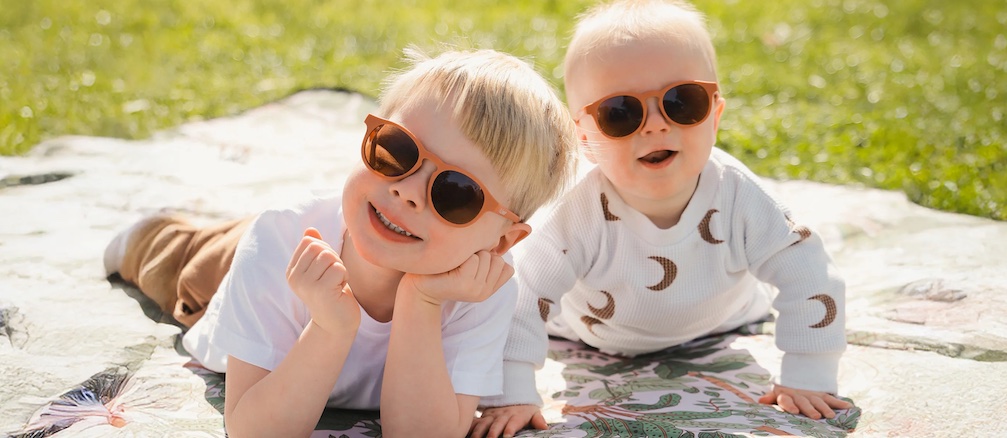
If your toddler is running around outside more than they’re sitting still, you’re already thinking about sun safety. And if you’re weighing up whether they actually need sunglasses at their age, you’re in good company. It’s one of the most searched sun-safety questions Australian parents ask.
The short answer: yes, from around 2 years old (and often earlier). But there’s a bit more to it than that, and getting the details right makes the difference between a pair that stays on and a pair that ends up under the pram.
Here’s what the evidence says, how to work out the right age for your child, and what to look for when you’re actually buying.
But there’s one important distinction worth making from the outset: there isn’t a medical rule that says a child suddenly needs sunglasses on their second birthday.
Australian eye-health and sun-safety organisations focus instead on reducing children’s exposure to UV radiation and using appropriate eye protection when they are outdoors, particularly when the UV Index reaches 3 or above.
So, if your toddler is happy to wear sunglasses earlier, there’s no reason to wait. And if they’re two and still treating their sunnies like a chew toy, don’t panic. The goal is to build the habit while continuing to use the other layers of sun protection that matter just as much.
Article Highlights
- Children’s eyes are particularly vulnerable to UV radiation, and reducing UV exposure throughout childhood matters for long-term eye health.
- There is no magic birthday when sunglasses suddenly become necessary. They can be introduced as soon as a child can comfortably manage them.
- Australian guidance recommends close-fitting, wraparound sunglasses that comply with the Australian/New Zealand standard.
- Categories 2 and 3 are appropriate general-purpose sunglasses categories for children; Category 4 is intended for very high-glare situations.
- Polarised lenses reduce glare but are not the same thing as UV protection.
- Darker lenses aren’t necessarily better at blocking UV.
- Sunglasses should complement, rather than replace, hats, shade, protective clothing and sunscreen.
- The best sunglasses are the ones that are safe, correctly fitted and comfortable enough that your child will actually wear them.
What the Research Says About Toddlers’ Eyes and UV
Toddlers are especially vulnerable to UV damage for one reason most parents don’t hear about: their eye lenses are still developing, and they’re clearer than adult lenses. That means more ultraviolet light passes straight through to the retina.
The science behind protecting children’s eyes from UV is well established. The Australian Radiation Protection and Nuclear Safety Agency (ARPANSA) explains that children are particularly at risk because UV radiation can penetrate deeper into the eye, potentially increasing damage to structures such as the lens and retina.
Long-term exposure to solar UV radiation is associated with eye damage including cataracts and other chronic changes to the eye, while excessive short-term exposure can cause acute problems such as photokeratitis — essentially a sunburn of the eye.
According to Cancer Council Australia, sun protection is recommended for children whenever the UV index is 3 or higher. In most of Australia, that’s every day from around September through March, sometimes 8am to 5pm. UV damage is cumulative. What toddlers absorb through their eyes now shows up decades later as cataracts, macular degeneration, and skin cancers around the eyelids.
The habit you build at 2 is the habit at 12. That’s the case for starting early.
There is an important Australian nuance here, though: UV protection shouldn’t be dictated by the calendar alone.
Australia is an enormous country, and UV levels vary according to location, season, time of day, cloud cover and other environmental conditions. Cancer Council Australia recommends following local sun-protection times whenever the UV Index reaches 3 or above.
That means a cool September morning in Melbourne, a winter day in Brisbane and a summer afternoon in Darwin can all present very different UV conditions.
And here’s something many parents discover the hard way:
UV doesn’t have to feel hot
A cool or cloudy day isn’t automatically a low-UV day.
UV radiation is invisible. Your toddler doesn’t need to be sweating, squinting in bright sunshine or complaining that it’s hot for UV exposure to be significant.
Check the UV Index rather than relying on the temperature or how sunny the sky looks.
Cancer Council Australia specifically recommends using the five SunSmart measures when UV reaches 3 or above: Slip, Slop, Slap, Seek and Slide.
Why Children’s Eyes Need Extra Protection From UV
It can be tempting to think of sunglasses as a nice extra for a sunny beach day.
They’re more than that.
ARPANSA states that reducing the amount of UV radiation reaching the eyes over a person’s lifetime is beneficial in reducing the risk of UV-related eye damage. Children are particularly important because their eyes are still developing and they have many decades of future UV exposure ahead of them.
Cancer Council Australia also recommends combining a broad-brimmed hat with close-fitting sunglasses, noting that together they can substantially reduce UV exposure to the eyes.
That doesn’t mean a toddler needs to spend their childhood indoors.
Quite the opposite.
Outdoor play is enormously important for children’s physical, developmental and visual health.
The aim isn’t to eliminate outdoor light. It’s to reduce unnecessary UV exposure while allowing children to enjoy being outside.
That distinction is particularly important when thinking about children’s eyesight and myopia. The Royal Australian and New Zealand College of Ophthalmologists (RANZCO) notes the importance of outdoor activity in childhood while also recommending appropriate UV protection when children are outdoors in high UV conditions.
In other words:
Get them outside. Just protect them while they’re there.
So, Is There Actually a Minimum Age for Sunglasses?
This is where the answer becomes a little more nuanced.
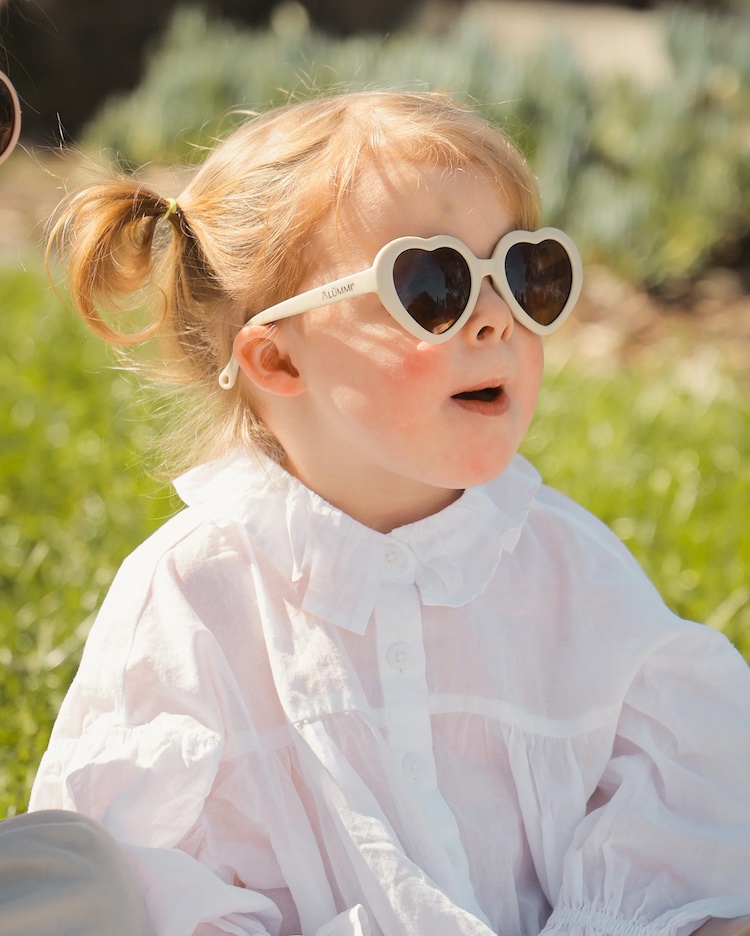
There isn’t a universally prescribed age at which every child should begin wearing sunglasses.
Cancer Council Australia advises that once children are old enough to manage wearing sunglasses, they should be encouraged to do so when exposed to UV radiation.
For babies and very young toddlers, the emphasis is on limiting direct sun exposure, shade, protective clothing and appropriate hats, with sunglasses introduced when practical.
So if your baby happily wears appropriately fitted sunglasses, there is no reason to wait until toddlerhood.
And if your two-year-old takes them off approximately 0.4 seconds after you put them on?
Welcome to toddlerhood.
The important thing is to keep offering them and make sunglasses part of the family’s outdoor routine.
Age Guide: When Toddlers Are Ready for Sunglasses
The 2-4 year age band is where most toddlers hit their stride with sunnies. Here’s a rough breakdown.
Age 2-3. Attention span is short and cooperation is patchy, but this is the sweet spot for building the habit. Keep sunglasses in the pram, the car, and the daycare bag. Introduce them as part of the same routine as putting on a hat.
Age 3-4. Toddlers this age start asking for their sunnies without prompting once the habit is in. This is the age where letting them pick the colour makes a real difference. Kids who choose their own gear wear it more.
Age 4-5. Around this point, many kids graduate from toddler sizing to a kids’ range. Head circumference is the check. If the toddler pair pinches at the temples or slides off the nose, it’s time to size up.
These age ranges are practical parenting guidance rather than medical milestones.
Some children will happily wear sunglasses at 12 months. Others won’t tolerate them until preschool. Temperament, sensory preferences, facial shape and the comfort of the frame can all make a difference.
Don’t turn sunglasses into a battle of wills.
The aim is a habit that lasts.
Why Toddler Frames Aren’t Just Adult Sunglasses Scaled Down
This is where a lot of parents get caught out. Cheap “kids sunglasses” from online marketplaces are often adult designs shrunk uniformly, which means the proportions don’t actually suit a toddler’s face. Bridges too wide, arms too long, lenses at the wrong angle for their eye position.
Proper toddler frames are engineered around toddler head shapes. Bridge width, temple length, and lens curvature are all specific to the age band. The result: the sunnies actually stay on, sit at the right angle for UV coverage, and don’t need constant readjustment.
A good example are the Australian-designed toddler sunnies from Lūmmi Bunny, which are sized specifically for 2-4 year olds and built with flexible frames that bend rather than snap when a toddler inevitably sits on them. Made in Melbourne for the way Australian kids actually live, which is mostly outside.
Whichever brand you choose, look for one that says “designed for 2-4 year olds” (or similar age-specific language). Not just “kids sunglasses”.
But here’s what matters more than the brand
Age-specific sizing is useful, but parents shouldn’t assume that an age label automatically guarantees the right fit.
Two children who are both three years old can have very different:
- head sizes
- nose bridge shapes
- face widths
- temple lengths
- sensory preferences
So use the stated age range as a starting point — then look at the actual fit on your child’s face.
What to Actually Check on a Toddler Sunglasses Label
Not all “kids sunglasses” are equal. A few things worth checking before you buy:
- 100% UV protection (up to 400 nanometres). This blocks both UVA and UVB rays and is the single most important spec on a lens for a toddler. Anything less and you’re paying for a fashion accessory, not eye protection.
- Category 3 polarised lenses. Category 3 is the density recommended for high-glare environments like the Australian coast. Polarisation cuts glare separately to UV protection – both matter.
- Independent testing. Reputable brands will tell you the lens has been tested by an independent laboratory (in Australia, EU, or elsewhere) rather than just self-declaring. If a brand can’t tell you how their UV claim is verified, that’s a flag.
- Frame safety. Non-toxic materials, no sharp edges, no small parts a toddler could pull off and swallow. Australian consumer law requires this but again, imports from unregulated marketplaces don’t always comply.
There is one important Australian standards point to add here.
In Australia, sunglasses and fashion spectacles are subject to a mandatory safety standard. The Australian Government’s Product Safety regulator states that sunglasses and fashion spectacles must meet the applicable requirements of the Consumer Goods (Sunglasses and Fashion Spectacles) Safety Standard 2017, which references AS/NZS 1067.1:2016.
ARPANSA explains that the Australian/New Zealand standard covers sunglasses in both adult and children’s sizes and includes requirements relating to UV and visible-light transmission, classification, labelling and other performance and safety requirements.
So when you’re standing in a shop — or scrolling through an online listing at 10pm after finally getting the kids to sleep — don’t judge a pair by how dark, expensive or cute it looks. Check the labelling.
What Does AS/NZS 1067.1:2016 Actually Mean?
The letters and numbers can look like meaningless standards-language when you’re a parent trying to buy a pair of sunnies.
In simple terms, AS/NZS 1067.1:2016 is the Australian/New Zealand standard covering sunglasses and fashion spectacles.
Australian guidance says sunglasses sold in Australia must meet the relevant mandatory requirements, and products complying with the standard should be labelled accordingly.
Look for information identifying:
- AS/NZS 1067.1
- the lens category
- the manufacturer or supplier
- relevant product information and warnings.
Don’t confuse sunglasses with fashion spectacles
This is particularly important.
Under the Australian standard, Category 0 and Category 1 products are fashion spectacles rather than proper sunglasses and provide limited protection.
Cancer Council Australia recommends Categories 2, 3 and 4 for sunglasses.
For everyday outdoor use, RANZCO’s current position statement on childhood myopia and UV protection identifies Categories 2 or 3 as providing adequate protection for children outdoors with high UV exposure.
Understanding Sunglasses Categories
| Lens category | What it means |
|---|---|
| Category 0 | Light tint/fashion spectacles; very limited glare reduction |
| Category 1 | Light tint/fashion spectacles; limited glare reduction |
| Category 2 | General-purpose sunglasses with good UV protection and good glare reduction |
| Category 3 | General-purpose sunglasses with good UV protection and high glare reduction |
| Category 4 | Very dark, special-purpose sunglasses for extreme glare; not suitable for road use |
For most children, Categories 2 and 3 are the practical everyday options.
Category 4 isn’t simply “better because the number is bigger”. It is intended for particular high-glare conditions and is not suitable for road use.
So if you’re choosing sunglasses for a toddler who spends time at the park, walking to childcare, playing in the backyard or going to the beach, a compliant Category 2 or 3 pair may be appropriate depending on the circumstances.
Polarised vs UV Protection: What’s the Difference?
This is one of the easiest things for parents to get confused about.
Polarised lenses and UV protection do different jobs.
| Feature | What it does |
|---|---|
| UV protection | Reduces the amount of ultraviolet radiation reaching the eyes |
| Polarisation | Reduces reflected glare |
| Lens tint | Reduces visible light entering the eye |
| Wraparound/close-fitting frame | Helps reduce light and UV entering around the sides |
A polarised lens can be very helpful around water, beaches, roads and other reflective surfaces, because it reduces glare.
But polarised does not automatically mean UV protected.
Likewise, a very dark lens isn’t automatically better at blocking UV.
ARPANSA, Cancer Council Australia and RANZCO all make this distinction clear.
The takeaway?
Look for appropriate UV protection and Australian-standard compliance first.
Treat polarisation as an additional feature for glare — not as proof that the sunglasses provide adequate UV protection.
Why Wraparound Sunglasses Can Make a Difference
You can have a perfectly compliant lens and still have UV entering from the sides.
UV doesn’t only arrive in a straight line from directly in front of your child.
It can be scattered through the atmosphere and reflected from surfaces such as water, sand, concrete and buildings.
This is particularly relevant in Australia, where toddlers spend plenty of time around beaches, pools, playgrounds and outdoor spaces.
Cancer Council Australia recommends close-fitting, wraparound-style sunglasses because they reduce peripheral exposure and reflected UV reaching the eyes.
So when you’re choosing between a pair that sits well away from the sides of the face and another that provides more coverage, the closer-fitting option may provide better overall protection.
Beach Days, Pools and Outdoor Play: When Glare Matters
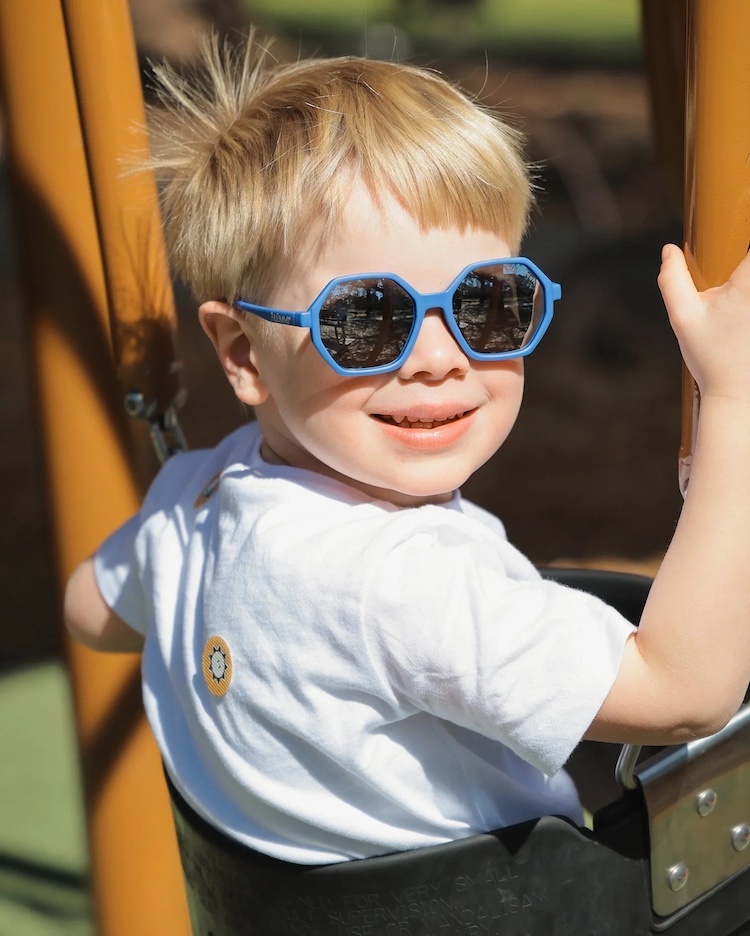
A toddler at the beach can be exposed to UV from more than one direction.
There is direct sunlight.
There’s UV scattered through the atmosphere.
And there is reflected UV from water and sand.
That combination can make sunglasses particularly useful during:
- beach days
- swimming-pool visits
- boating
- outdoor sports
- playground visits
- long pram walks
- outdoor festivals
- camping
- holidays
- backyard play.
ARPANSA specifically identifies water and other surfaces as sources of reflected UV.
And remember: shade helps, but shade is not a complete UV shield. Reflected and scattered UV can still reach a child sitting underneath a shade structure.
That’s why the best approach is a combination of measures.
Sunglasses Are One Piece of the Sun-Safety Puzzle
It’s easy to focus on the sunnies because that’s what this article is about.
But they’re only one part of the picture.
Cancer Council Australia’s SunSmart approach combines:
Slip on protective clothing.
Slop on SPF50 or SPF50+ broad-spectrum sunscreen.
Slap on a suitable hat.
Seek shade.
Slide on sunglasses.
For toddlers, a broad-brimmed, bucket or legionnaire-style hat can provide important additional protection around the face and eyes.
A hat and sunglasses work together.
One doesn’t replace the other.
And sunscreen isn’t intended to be a substitute for shade, clothing or a hat either.
The more practical way to think about sun safety is:
layer protection rather than relying on one product.
Signs Your Toddler’s Sunglasses Aren’t Fitting Properly
Even the right pair can be the wrong fit if you haven’t checked. Watch for these signals:
They slide down constantly. The nose bridge is too wide. Frame is sized for an older child.
They pinch above the ears. Temple arms are too short. Also often a sign the frame is too small overall.
Your toddler keeps pulling them off within seconds of putting them on. Could be attitude, or could be a genuine fit problem. Check the fit first before deciding it’s just protest.
They sit crooked on the face. Nose bridge shape isn’t right for your child. Some toddlers have flatter bridges; a rigid frame won’t fit as well as a flexible one that adjusts to the face.
Marks on the temples or nose after wearing. They’re too tight. Size up or switch to a flexible frame.
The 30-Second Toddler Sunglasses Fit Check
Before you buy, or after you’ve bought them, take a few seconds to check the actual fit.
1. Check the bridge
The sunglasses shouldn’t constantly slide down the nose.
2. Check the eyes
Your child’s eyes should sit reasonably centrally behind the lenses.
3. Check the temples
The arms shouldn’t dig into the sides of the head or press painfully behind the ears.
4. Check the sides
Look for excessive gaps around the sides of the eyes.
5. Check movement
Have your toddler walk, look down and move their head.
Do the sunglasses stay where they should?
6. Check comfort
After wearing them for a while, look for persistent pressure marks around the nose or temples.
A pair that meets every technical specification in the world isn’t much use if your child can’t comfortably keep it on.
What If Your Toddler Refuses to Wear Sunglasses?
Ah, yes.
The toddler sunglasses battle.
If your child immediately removes them, don’t assume you’ve bought the wrong product — although you might have.
Start by checking the fit.
Are they too tight?
Too heavy?
Sliding down?
Pinching?
Too loose?
Are the lenses making everything look strange?
Once you’ve ruled out comfort, turn the sunglasses into part of the routine rather than a confrontation.
Try these parent-tested strategies:
Let your child choose.
Give them two or three suitable options and let them pick the colour or style.
Wear yours too.
Children copy what they see us doing.
Put them on alongside the hat.
Make both part of the “we’re going outside” routine.
Try them at home first.
A child doesn’t need to encounter sunglasses for the first time at the beach when they’re already excited, hot and desperate to get moving.
Start small.
If they’re not used to them, short periods can help them adjust.
Praise rather than battle.
“Great job keeping your sunnies on” usually goes further than repeatedly saying “Leave them on!”
Check the fit again.
A child who hates sunglasses may be telling you something about the frame.
And if they take them off?
Put them back on when appropriate and keep modelling the behaviour.
The goal is consistency, not perfection.
Your Toddler Is Watching You
This might be one of the simplest tricks of all.
If Mum, Dad or another caregiver automatically reaches for sunglasses before going outside, your toddler learns that sunglasses are simply part of getting ready to go outdoors.
Raising Children Network recommends parents act as role models for sun-safe behaviour.
So put your own sunglasses on.
Put your child’s hat on.
Reach for the sunscreen.
And make it ordinary.
Because children don’t just learn sun safety from what we tell them.
They learn it from what they see us do.
What About Sunglasses at Childcare?
If your toddler attends childcare or preschool, it’s worth checking the centre’s sun-protection policy.
Some practical things parents can do include:
- label the sunglasses with your child’s name;
- keep a spare pair in their bag;
- check whether sunglasses are encouraged during outdoor play;
- make sure the sunglasses are comfortable enough for extended wear;
- ask educators how they manage sunglasses during outdoor activities;
- make sure sunglasses are used alongside the centre’s hat and shade policies.
Sun protection is particularly important because young children can spend a significant amount of their day outdoors at early childhood services.
Keep a Spare Pair
This isn’t glamorous advice.
It’s just practical.
Toddlers lose things.
They sit on things.
They throw things.
They leave things at the playground.
They sometimes hand their sunglasses to a very excited dog.
So if sunglasses have become part of your child’s routine, having a backup pair can save an enormous amount of frustration.
You might keep:
- one in the pram;
- one in the childcare bag;
- one at home;
- one with your beach gear.
The important thing is that every pair used for sun protection should still meet the appropriate requirements and fit your child properly.
Buying Toddler Sunglasses Online: What Should Parents Check?
Online shopping makes buying children’s sunglasses incredibly easy — but the product photograph isn’t enough to tell you whether a pair is appropriate.
Before buying, check:
☐ Is it actually labelled as sunglasses?
☐ Does the product reference AS/NZS 1067.1?
☐ Is the lens category clearly identified?
☐ Is the manufacturer or supplier identifiable?
☐ Does the seller provide clear information about UV protection?
☐ Is the product designed for your child’s size and age range?
☐ Are there any sharp edges or small detachable components?
☐ Can you return them if the fit isn’t right?
The Australian Government’s Product Safety regulator makes clear that children’s sunglasses are covered by the relevant mandatory safety requirements.
That means parents shouldn’t have to rely on a vague statement such as “UV400” or a product photograph showing a very dark lens.
Look for the actual product information.
Those Cute Novelty Sunnies Might Not Actually Be Sunglasses
This one catches parents out.
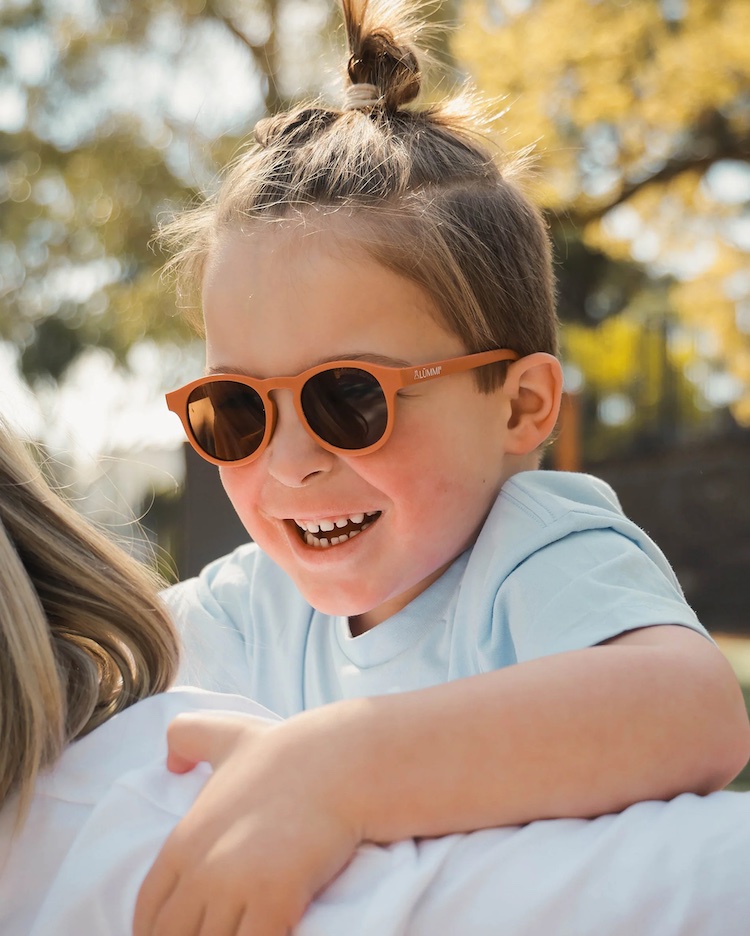
A pair of toddler glasses covered in dinosaurs, unicorns, cartoon characters or glitter may look like sunglasses.
But looking like sunglasses isn’t the same as meeting the requirements for sunglasses.
Cancer Council Australia specifically warns that sunglasses labelled as toys aren’t covered by the Australian sunglasses standard and shouldn’t be relied upon for sun protection.
Likewise, Category 0 and Category 1 fashion spectacles aren’t the same as proper sunglasses for sun protection purposes.
So if your toddler has a gorgeous novelty pair they adore, check what they’re actually classified as before relying on them outside.
Cute is a bonus. Compliance comes first.
Does Price Matter?
Here’s some good news for parents.
You don’t necessarily need to spend a fortune.
Cancer Council Australia and RANZCO both state that price shouldn’t be used as a measure of UV protection quality.
An expensive pair isn’t automatically safer than a more affordable pair.
Instead, prioritise:
Australian-standard compliance + appropriate lens category + UV protection + good fit + comfort.
Then worry about the colour.
What About Lens Colour?
Another common misconception is that darker automatically means safer.
It doesn’t.
The darkness or colour of a lens does not tell you how much UV protection it provides.
A dark lens without appropriate UV protection isn’t what you want.
That’s why the label and standard matter much more than whether the lenses look almost black.
Do Toddlers Need Polarised Sunglasses?
They can be useful, particularly in situations where there is lots of reflected glare.
Think:
- beaches;
- swimming pools;
- boating;
- bright pavements;
- outdoor environments with reflective surfaces.
But remember:
polarisation is about glare; UV protection is about UV.
A polarised lens still needs appropriate UV protection.
Do Toddlers Need Sunglasses on Cloudy Days?
Check the UV Index rather than the sky.
UV radiation can still be significant on cool or cloudy days.
Cancer Council Australia recommends following sun-protection measures whenever the UV Index reaches 3 or above.
So don’t make “it’s cloudy” your automatic signal that sunglasses and other sun protection can stay in the cupboard.
Do Toddlers Need Sunglasses in Winter?
Potentially, yes.
The need for UV protection isn’t determined simply by whether it’s summer.
UV levels vary across Australia and throughout the year.
The easiest approach is to check the UV Index for your location and follow the recommended sun-protection times.
This is particularly important in parts of Australia where UV levels remain high for much of the year.
Do Sunglasses Replace a Hat?
No.
Sunglasses and hats provide complementary protection.
A broad-brimmed hat helps shade the face, ears and neck, while sunglasses protect the eyes from UV entering through the front and sides.
Cancer Council Australia recommends using sunglasses together with a broad-brimmed hat as part of comprehensive sun protection.
Can My Toddler Wear Sunglasses All Day?
There isn’t a need to treat sunglasses as something that must be worn indoors.
They are primarily about reducing UV exposure outdoors.
For outdoor activities during periods when UV protection is recommended, appropriately fitted sunglasses can be worn as part of a broader sun-protection approach.
And remember: sunglasses should never be used as protection for looking directly at the sun.
Never let a child look directly at the sun, even while wearing sunglasses.
What If My Child Already Wears Glasses?
If your child wears prescription glasses, has a diagnosed eye condition or has particular visual needs, speak with your child’s optometrist about the most appropriate form of UV protection.
There may be prescription options or other approaches that provide both vision correction and UV protection.
This is one situation where an individual recommendation is more useful than simply buying a standard pair of toddler sunglasses.
When Should You Speak to an Optometrist?
Sunglasses are about prevention, but they aren’t a substitute for professional eye care.
Speak with your child’s optometrist or other appropriate health professional if you notice things such as:
- persistent light sensitivity;
- frequent squinting;
- consistently closing one eye in bright conditions;
- ongoing eye redness;
- complaints of eye pain;
- changes in vision;
- unusual eye appearance;
- difficulty seeing;
- an existing eye condition;
- or concerns about how your child’s eyes are developing.
And if your child already has prescription glasses, an optometrist can help you work out the most appropriate UV-protection option.
Toddler Sunglasses: Myth vs Fact
MYTH: My toddler is too young for sunglasses.
FACT: There isn’t a single birthday at which sunglasses become necessary. Australian guidance encourages children to use appropriate sunglasses once they’re old enough to manage wearing them, alongside other sun-protection measures.
MYTH: The darker the sunglasses, the better the UV protection.
FACT: Lens darkness does not determine UV protection.
MYTH: Polarised automatically means UV protected.
FACT: Polarisation primarily reduces glare. UV protection is a separate requirement.
MYTH: If my child wears a hat, they don’t need sunglasses.
FACT: Hats and sunglasses provide complementary protection.
MYTH: Expensive sunglasses provide better UV protection.
FACT: Price isn’t a reliable indicator of UV protection quality.
MYTH: Cloudy days don’t require sun protection.
FACT: UV can still be significant when the weather is cool or cloudy. Check the UV Index.
MYTH: All children’s sunglasses are basically the same.
FACT: Products differ in their compliance, lens category, construction, coverage, fit and comfort.
MYTH: If they look like sunglasses, they must protect against UV.
FACT: Toy and fashion-labelled eyewear shouldn’t automatically be assumed to provide appropriate sun protection.
Toddler Sunglasses Shopping Checklist
Before handing over your money, run through this list:
☐ Meets Australian/New Zealand requirements
☐ AS/NZS 1067.1 information is provided
☐ Appropriate lens category
☐ Good UV protection
☐ Close-fitting
☐ Wraparound or good side coverage
☐ Comfortable nose bridge
☐ No sharp edges
☐ No unsafe detachable small components
☐ Light enough for your child
☐ Correct size
☐ Stays in place when your child moves
☐ Your child is actually willing to wear them
That last one matters more than it sounds.
What Matters Most?
If all the technical information starts to feel overwhelming, come back to the basics.
1. Check the UV Index
Use your local UV information rather than guessing based on the weather.
2. Choose genuine sunglasses
Don’t assume toy or fashion eyewear provides the same protection.
3. Check the Australian standard
Look for appropriate Australian/New Zealand standard information and lens-category labelling.
4. Choose a close-fitting pair
Wraparound coverage can help reduce UV entering from the sides.
5. Make sure they’re comfortable
A pair sitting in the bottom of the pram isn’t protecting anyone.
6. Keep using the other sun-safety measures
Hat, clothing, shade and sunscreen all have their place.
Frequently Asked Questions
What age should a child start wearing sunglasses?
There is no universal age at which every child must start. Australian guidance recommends that once children are old enough to manage wearing sunglasses, they should be encouraged to use them when exposed to UV radiation. Some babies and younger toddlers can wear suitable sunglasses earlier.
Are sunglasses safe for toddlers?
Appropriately designed and compliant children’s sunglasses are intended for use by children. Parents should check the product’s Australian-standard information, lens category, construction and fit.
What category sunglasses are best for toddlers?
For general outdoor use, Categories 2 and 3 are commonly appropriate. Category 4 is intended for very high-glare situations and is not suitable for road use.
Are polarised sunglasses better for toddlers?
Polarised lenses can reduce glare, particularly around water and reflective surfaces. However, polarisation isn’t the same as UV protection, so both should be considered.
Are darker sunglasses better?
No. Darker lenses do not automatically provide greater UV protection. Check the product’s UV protection and Australian-standard information.
Do children need sunglasses on cloudy days?
If the UV Index is 3 or above, yes, sun protection is recommended even when the weather doesn’t feel particularly sunny.
Do sunglasses replace a hat?
No. Sunglasses and a broad-brimmed hat provide complementary protection.
Are expensive toddler sunglasses safer?
Not necessarily. Price isn’t a reliable measure of UV protection. Compliance, lens category, fit and construction are more important.
Why does my toddler keep taking their sunglasses off?
Check the fit first. They may be too tight, too loose, heavy, uncomfortable or poorly positioned. If the fit is good, introduce them gradually and model the behaviour yourself.
Should toddler sunglasses be wraparound?
Close-fitting, wraparound-style sunglasses are recommended by Cancer Council Australia because they provide greater coverage and help reduce peripheral UV exposure.
Can my child wear sunglasses with prescription glasses?
If your child needs prescription glasses, speak with their optometrist about the most appropriate UV-protection option.
The Takeaway
Toddler sun safety is one of the highest-ROI habits you can build for your child’s long-term eye health. Start around 2 (or earlier if your child is happy to wear them), pick a pair that’s actually sized for toddlers, and check for AS/NZS 1067.1:2016 certification so you know the UV protection is legit.
Everything else is optional. Get those basics right, keep the routine consistent, and by the time they’re at school your kid will be one of the ones actually keeping their sunnies on.
For most parents, though, it doesn’t need to become complicated.
You don’t need the most expensive pair. You don’t need the darkest lenses. And you certainly don’t need to win every toddler battle.
You need sunglasses that meet the appropriate Australian requirements, fit comfortably, provide appropriate UV protection and stay on your child’s face.
Then combine them with a hat, shade, protective clothing and sunscreen when UV protection is needed.
And if your toddler’s favourite pair ends up under the pram five minutes after leaving the house?
Pick them up, put them back on and keep going.
Sun-safe habits are built one ordinary day at a time.
Australian Evidence Base
This article is informed by Australian government agencies, cancer-prevention organisations, ophthalmology specialists and radiation-protection authorities, with a focus on evidence and recommendations relevant to Australian children and families.
Australian Radiation Protection and Nuclear Safety Agency (ARPANSA)
ARPANSA provides guidance on ultraviolet (UV) radiation, children’s eye protection, reflected UV, sunglasses, lens categories and the Australian/New Zealand Standard for sunglasses.
ARPANSA advises that children can be particularly vulnerable to UV exposure and recommends compliant sunglasses as part of broader sun protection, particularly when UV exposure is high.
Source: ARPANSA — Sun Protection Using Sunglasses
Cancer Council Australia
Cancer Council Australia provides evidence-based guidance on UV protection, children’s eye protection, sunglasses, lens categories, wraparound frames, polarisation and the Australian Standard.
Its guidance also explains why lens darkness and price alone are not reliable indicators of UV protection, and why sunglasses should be used alongside other sun-protection measures such as hats, clothing and shade.
Source: Cancer Council Australia — Eye Protection Fact Sheet
Cancer Council Australia — UV Index
Cancer Council Australia recommends using sun-protection measures when the UV Index reaches 3 or above, noting that UV radiation can still be significant on cool or cloudy days.
Source: Cancer Council Australia — UV Index
Cancer Council Australia — Sun Protection
Cancer Council Australia provides guidance on protecting children from UV exposure through a combination of sun-protection measures, including shade, protective clothing, hats, sunscreen and sunglasses.
Source: Cancer Council Australia — Sun Protection
Australian Government Product Safety
The Australian Government’s Product Safety regulator provides information about the mandatory safety standard for sunglasses and fashion spectacles sold in Australia, including requirements relating to applicable products and the Australian/New Zealand Standard AS/NZS 1067.1:2016.
Source: Australian Government Product Safety — Sunglasses and Fashion Spectacles Mandatory Standard
Royal Australian and New Zealand College of Ophthalmologists (RANZCO)
RANZCO provides specialist ophthalmology guidance on UV eye protection, including the importance of Australian/New Zealand standards, lens categories, wraparound protection and the fact that price, lens darkness and polarisation alone do not determine the level of UV protection.
RANZCO also provides guidance on progressive myopia in childhood, including the importance of outdoor activity while protecting children’s eyes from excessive UV exposure.
Sources:
RANZCO — UV Eye Protection Position Statement
RANZCO — Progressive Myopia in Childhood 2025
Cancer Council Australia — Sun Protection and Babies
Cancer Council Australia provides specific guidance for babies and young children, recommending protection from UV from an early age and the use of sunglasses when practical, alongside other sun-protection measures.
Source: Cancer Council Australia — Sun Protection and Babies