
Kiddipedia
Jenny Brown PhD
Introduction
Most parents understand the dangers of helicopter parenting. We know children need opportunities to become independent, solve problems and learn from mistakes. Yet when a child is anxious, struggling, unmotivated or unhappy, stepping back can feel almost impossible.
Everything in us wants to step in.
As parents, we’re wired to protect. Add today’s endless stream of parenting advice, expert opinions and mental health messaging, and many of us feel responsible not only for our children’s safety, but also for their happiness, confidence and emotional wellbeing.
But what if one of the most loving things we can do is sometimes step back?
This is the central idea behind what I call The Parenting Paradox: that truly loving our children often means stepping back rather than leaning in too tightly. Not because we care less, but because growth requires space.
Why Stepping Back Feels So Difficult
Today’s parents are raising children in an era of intensive parenting.
We’re encouraged to monitor, support, advocate, coach, validate and intervene. While much of this guidance is helpful, it can leave parents carrying an impossible burden. We begin to feel responsible for preventing every struggle and solving every problem.
When a child is distressed, anxious or facing setbacks, many parents experience a surge of anxiety themselves. We immediately start searching for answers:
- What should I do?
- How can I fix this?
- Am I doing enough?
- Have I missed something important?
The challenge is that our anxiety often disguises itself as care.
The more worried we become, the more likely we are to over-explain, over-monitor, over-remind and over-manage. We focus intensely on the child while paying little attention to what is happening inside ourselves.
From a Family Systems perspective, this is where relationships can become organised around anxiety rather than confidence. The more we focus on changing the child, the less attention we give to the one person whose behaviour we can actually influence—ourselves.
The Difference Between Support and Rescue
Stepping back doesn’t mean becoming detached.
Parents sometimes fear that giving children space means abandoning them. In reality, there is an important difference between support and rescue.
Support says:
“I believe you can work through this, and I’m here if you need me.”
Rescue says:
“This is too much for you. Let me take over.”
Children grow confidence when they experience themselves as capable. Every time we solve a problem they could have managed, we unintentionally communicate doubt in their capacity.
This doesn’t mean leaving children to fend for themselves. It means staying connected while resisting the urge to take ownership of challenges that belong to them.
As children mature, they need increasing opportunities to think, decide, struggle, recover and learn. They need parents who can tolerate seeing them uncomfortable (Yes, that’s really hard!) without immediately stepping in to remove the discomfort.
Giving Children Emotional Breathing Space
One of the most overlooked ingredients in healthy development is emotional breathing space.
When parents become overly focused on a child’s emotional state, children may look to their parents for reassurance before turning to their growing coping resources.
Sometimes children need space to discover:
- that disappointment is survivable
- that anxiety can be tolerated
- that mistakes can be repaired
- that setbacks are part of learning
- that they are stronger than they realise
Resilience isn’t built by removing every obstacle. It grows when children experience challenges and discover they can handle more than they thought.
As Bowen family systems scholar Michael Kerr observes, parenting involves a gradual process of parents separating appropriately from a child, which in turn supports the child’s growing independence.
The Parent’s Real Work
Over many years working with families, I’ve noticed that lasting change rarely comes from finding the perfect parenting technique.
The most significant shifts occur when parents redirect energy away from managing their child and toward understanding themselves.
This is often the harder task.
It requires asking different questions:
- What is this situation triggering in me?
- What fears are driving my reactions?
- Am I responding thoughtfully or anxiously?
- What is within my control, and what belongs to my child?
Parents have far more influence than they often realise. Not because they can control outcomes, but because they shape the emotional climate of the family.
When a parent becomes calmer, less reactive and more grounded, the whole family system begins to shift. Relationships become less intense. Children experience more room to develop their own strengths. Parents regain confidence in their ability to lead rather than manage.
Playing the Long Game
One of the greatest challenges for modern parents is tolerating slow progress.
We live in a culture that promises quick fixes. Parenting doesn’t work that way.
Many parents describe the process of stepping back as feeling like abseiling down a cliff face. Every instinct tells you to cling tightly to the rock. Leaning back feels wrong. Trusting the rope feels risky.
Yet this is often what growth requires.
When a child is struggling, parents naturally want certainty. We want reassurance that our efforts are working and that our child will be okay. But parenting is less about controlling outcomes and more about providing steady leadership over time.
The question is not whether our child is having a difficult day, week or season of life. The more important question is:
Am I parenting in a way that reflects my values and creates the conditions for growth over the long term?
When parents shift their focus from controlling outcomes to managing themselves, they often discover a surprising source of confidence. They no longer judge success by whether a child is happy, compliant or problem-free today. Instead, they measure progress by their capacity to stay calm, thoughtful and connected through whatever challenges arise.
The Paradox of Letting Go
The paradox at the heart of parenting is that children grow best when parents are neither absent nor over-involved.
They need our presence, but not our constant management.
They need limits based on what’s in our control,
They need our support, but not our rescue.
They need our confidence in them more than our worry about them.
As children grow, one of our most important tasks is gradually letting go—not of love or connection, but of the anxious belief that their future depends on our ability to manage every aspect of their lives.
When we step back from over-functioning, we create something precious.
Space.
And in that space, children discover their own strength while parents rediscover their confidence.
That may be one of the most loving gifts we can offer.
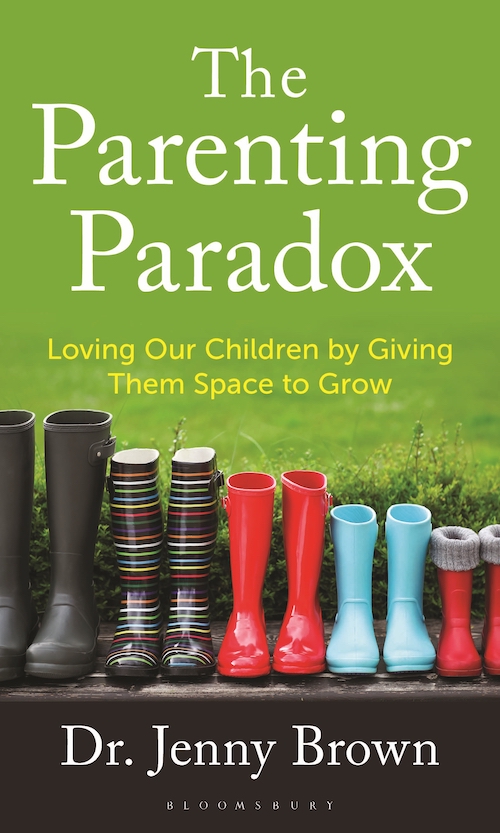
This is the paradox I explore in my forthcoming book, The Parenting Paradox: when parents stop making the child the project and instead focus on their own growth, children are often freed to grow as well. The goal is not to love our children less, but to love them with greater clarity—staying connected while easing our anxious grip. In doing so, we create the space both they and we need to become stronger, more resilient versions of ourselves.
These ideas are explored further in my forthcoming book, The Parenting Paradox (Brown, 2026).
About the author:
 Dr Jenny Brown is a family therapist, author and founder of the Parent Hope Project. Her new book, The Parenting Paradox, is a research-informed book for both parents and professionals, which challenges the anxious, child-focused culture shaping today’s families. https://www.jennybrown.info/