
Kiddipedia
There’s something special about an Aussie summer spent outdoors, especially when you have a pool in your own backyard. It’s where the kids can splash around, burn off some energy and make those lovely summer memories we all want them to have. But as much as we want to relax and enjoy the sunshine, having children around water means staying alert. Drowning can happen quickly, and even a child who is confident in the water can get into trouble. That’s why it’s important to have several layers of protection in place.
When it comes to keeping kids safe around the pool, a few things really matter: making sure the pool area is secure, keeping a close eye on the children, helping them develop their water skills and knowing what to do if something goes wrong. Here’s how to make poolside parenting a little easier this summer, without taking the fun out of it.
In This Article, You’ll Discover:
-
Your Seven-Point Pool Safety Checklist: At the end of the article, you’ll find seven essential checks to help protect children around water, prevent unsupervised pool access and reduce drowning risks.
- Active supervision that saves lives: Why children need an adult’s undivided attention around water, plus how to use a water-watcher system to prevent dangerous gaps in supervision.
- The limits of swimming ability: Why even confident young swimmers can drown and why swimming lessons never replace close adult supervision.
- Pool safety rules every child needs to know: Simple, clear boundaries to help reduce risky behaviour around water.
- Hidden dangers of inflatable pools and pool toys: Why shallow water can be deadly for young children, and why paddling pools must be emptied and stored safely after use.
- Sun protection and heat safety: How to reduce the risks of sunburn, UV exposure and overheating during summer swimming.
- What to do in a water emergency: The immediate steps to take if a child gets into trouble, including calling Triple Zero (000), checking their breathing and starting CPR when needed.
- Water hazards beyond the backyard pool: Essential precautions around baths, buckets, ponds and pools at friends’ homes or holiday accommodation.
- Your Seven-Point Pool Safety Checklist: A practical final check to help identify potential hazards and reinforce essential safety measures before children enter the water.
Why Pool Safety Deserves Our Attention
It’s easy to think that serious water accidents are something that happen to other families. But drowning can happen in familiar places, including our own backyards, which is why having a pool safety routine matters even when the pool looks perfectly safe.
According to the Royal Life Saving Australia and Surf Life Saving Australia National Drowning Report 2026, Australia recorded 313 drowning deaths across all age groups during 2025–26. Eleven of those deaths involved children under five, and 55% of the under-five drowning deaths occurred in backyard swimming pools. Around 80 children under five are also hospitalised each year following non-fatal drowning incidents. These figures are a reminder that drowning prevention needs to remain a priority, even as safety awareness improves.
Source: Royal Life Saving Australia — National Drowning Report 2026.
The figures don’t mean parents should be frightened of their own pool. They show why it’s worth building a few reliable safety habits into everyday family life.
The most effective approach is to use several layers of protection together. Royal Life Saving Australia’s Keep Watch program groups child drowning prevention into four key actions:
- Supervise: Actively watch children whenever they are in, on or around water.
- Restrict: Prevent unsupervised access to water with secure, properly maintained barriers.
- Teach: Help children develop water awareness and appropriate swimming and water safety skills.
- Respond: Know how to raise the alarm and respond to an emergency, including learning CPR.
These measures work together. Swimming lessons don’t replace supervision, a pool fence doesn’t replace active supervision when children are swimming, and knowing CPR doesn’t prevent a drowning incident from occurring in the first place.
Source: Royal Life Saving Australia — Keep Watch actions.
Start With a Secure Pool Area
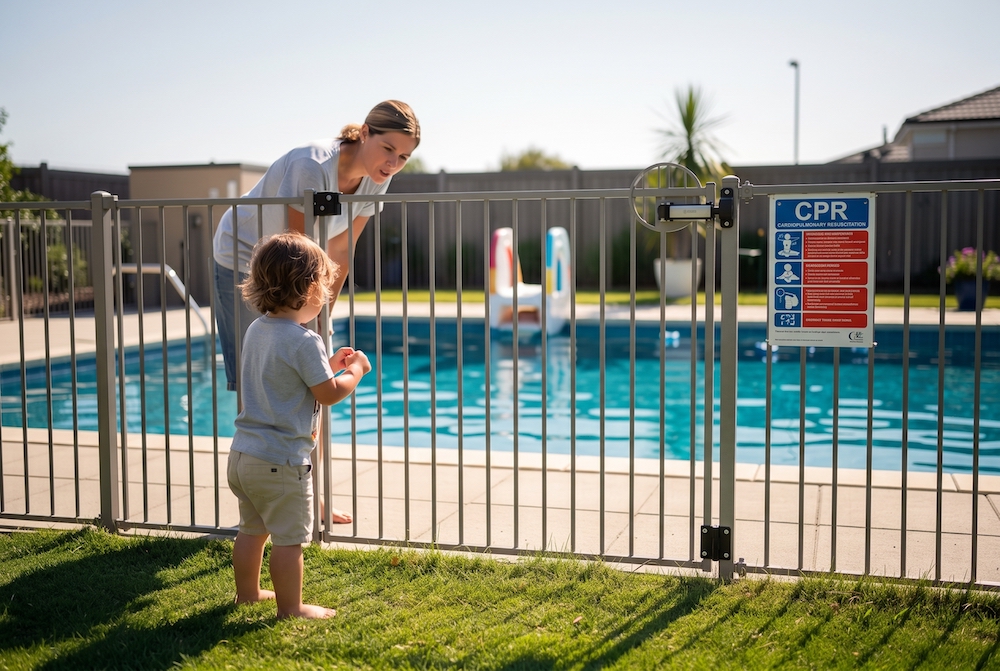
Before you get the pool ready for its first swim of the season, take a few minutes to check the fencing and surrounding area. A secure pool barrier is one of the most important ways to prevent young children from reaching the water when an adult isn’t there to supervise. If you have little ones at home, think of child safe pool fencing as an essential part of making your backyard safer.
It’s not enough for the fence to simply be there. It needs to meet the relevant safety requirements, be well maintained and have no obvious gaps or easy ways for children to climb over it. Check that the gate closes and latches properly every time, and resist the temptation to leave it propped open while you pop inside. We’ve all had moments when we’re trying to get a few things done at once, but even a quick trip inside can leave a child unsupervised around water.
It’s also worth taking a look at what’s sitting near the fence. Outdoor chairs, pot plants, toys and other items can give a curious toddler a handy boost to climb over the barrier. Keep the area clear, check for any damage and make sure everything is working as it should.
And if you have an inflatable or paddling pool, don’t leave it filled with water after the kids have finished playing. Empty it straight away and put it somewhere children can’t access it. Small amounts of water can still pose a serious drowning risk to young children.
Your Pool Barrier: Seven Things to Check
A quick look around the pool can help you spot problems that might otherwise go unnoticed. Make a habit of checking the following:
- The fence: Look for damaged panels, loose posts, gaps or other places where a child could get through.
- The gate: Check that it closes and latches properly every time. Don’t rely on a child to close it behind them.
- The latch: Make sure it is working as intended and that the gate cannot be easily opened by a young child.
- The fence line: Move chairs, pot plants, outdoor furniture, toys and other climbable objects away from the barrier.
- The ground and surrounding area: Check for changes caused by gardening, building work, erosion or objects that could compromise the barrier.
- Doors and access points: Check that any doors or other access points forming part of the pool barrier meet the applicable requirements.
- Maintenance and compliance: Arrange professional inspections and repairs when required, rather than relying solely on your own visual check.
This list is a practical starting point, not a substitute for a formal inspection or the applicable pool barrier standard. If you notice a fault, arrange to have it addressed promptly and keep children away from the affected area until the barrier is safe.
Do You Know Your State or Territory’s Pool Safety Rules?
Pool safety laws vary across Australia, so it’s important to check the rules that apply where you live rather than assume every state has identical requirements.
For example, in Victoria, pools and spas capable of containing water to a depth greater than 30 cm generally require a compliant safety barrier. Owners are also required to register applicable pools and spas with their local council and meet barrier inspection and compliance certification requirements. The rules cover many above-ground, relocatable and inflatable pools as well as permanent pools.
The details can depend on the type of pool, when it was installed and the relevant regulations. If you’re in Victoria, start with the Building and Plumbing Commission’s pool and spa safety barrier guidance and its pool and spa registration requirements.
If you live elsewhere, check with your state or territory building regulator and local council. Don’t assume a pool is exempt from barrier requirements simply because it’s portable, above ground or only used occasionally.
What About Inflatable and Paddling Pools?
It’s easy to think of a small paddling pool as harmless because it doesn’t hold much water. Unfortunately, young children can drown in very shallow water, and portable pools can be particularly risky when they’re left filled and accessible.
The Australian Competition and Consumer Commission (ACCC) warns that portable pools must carry specific safety warnings and that children need active adult supervision whenever they are in or around them. The applicable pool-fencing rules also need to be checked, particularly for portable pools capable of holding water to a depth of 300 mm or more.
After playtime, empty the pool completely, allow it to drain, and store it somewhere children cannot access it. Don’t leave it filled overnight or assume that turning it upside down or covering it makes it safe.
Read the ACCC’s Australian portable swimming pool safety guide before purchasing or setting up a portable pool.
Supervision Means Being Present
It’s easy to think that keeping an eye on the kids means being somewhere nearby while they swim. But there’s a difference between being around and actively watching what’s happening in the water. The good news is that poolside supervision doesn’t have to fall on one person all day. A little planning can make it easier for everyone to enjoy the afternoon while keeping the children safe.
One helpful pool safety tip is to nominate an adult as the dedicated water watcher. Their job is to focus on the children in the pool, rather than checking their phone, chatting with friends or getting distracted by other things happening around them.
If you’re having family or friends over, you can take turns being the water watcher so everyone gets a chance to relax. The important thing is that one adult is clearly responsible for watching the children at any given time.
If that adult needs to leave, even briefly, another adult must take over before they step away. Don’t assume someone else is watching just because there are plenty of people around. And if there’s no one available to take over, bring the children out of the pool with you.
It might seem like a small thing, but agreeing on who’s watching the kids can make a real difference. It takes the guesswork out of supervision and helps everyone enjoy pool time with greater peace of mind.
What Does Active Supervision Actually Look Like?
Active supervision means giving the children your full attention and being ready to respond immediately if something changes. It’s more than sitting somewhere nearby and occasionally glancing towards the pool.
In practice, that means:
- Keep your eyes on the children: Avoid distractions such as scrolling on your phone, reading, cooking or getting caught up in a conversation.
- Stay close enough to respond: Younger children, especially toddlers and preschoolers, need very close supervision. Royal Life Saving Australia’s Keep Watch guidance recommends staying within arm’s reach of children aged 0–4 when they are in or around water.
- Match supervision to the child: A child’s age, swimming ability, development, behaviour and the conditions all affect how closely they need to be watched.
- Keep supervising during transitions: Watch children when they enter the pool, climb out, move between the house and pool area or play near the water’s edge.
- Make handovers explicit: If another adult takes over, say so clearly. Don’t leave the children until the next person has acknowledged that they are responsible.
- Never assume someone else is watching: A busy backyard can create the impression that plenty of adults are keeping an eye on the children, when nobody has taken responsibility.
Older children and confident swimmers still need supervision appropriate to their age, ability and the situation. An older sibling should not be expected to take the place of a responsible adult supervising younger children around water.
Make the Water-Watcher System Work for Your Family
If you’re hosting a barbecue, birthday party or family get-together, agree on a simple water-watcher roster before swimming begins.
You could use a brightly coloured hat, wristband or other obvious marker to show which adult is currently responsible. When it’s time to change over, the outgoing and incoming adults should confirm the handover directly.
The water watcher should know exactly which children are in the pool and remain focused on them. If the supervising adult needs to answer the door, use the bathroom or attend to something else, another adult must take over first. If nobody is available, swimming stops until supervision can resume.
This isn’t about making family gatherings feel formal. It’s about avoiding the assumption that someone else has the children covered.
Don’t Assume Swimming Ability Makes Kids Safe
Swimming lessons are an important part of helping children become more confident and capable in the water. But even if your child can swim well, that doesn’t mean they’re safe without adult supervision.
A swimming lesson takes place in a controlled environment, which can be very different from what happens when a child gets tired, panics or finds themselves in unfamiliar water. A child who happily swims laps during a lesson may still struggle if something unexpected happens.
You can help your child build their skills and confidence by practising water safety together, always while actively supervising them. Talk about what to do if they feel tired, why they should stay within their abilities and why an adult needs to be watching whenever they’re in the water.
It’s also worth thinking about your own swimming ability. If it’s been a while since you last swam, refreshing your skills may help you feel more comfortable in the water. Just remember that being a capable swimmer doesn’t replace supervision or make every rescue safe to attempt.
Swimming Lessons Are One Part of the Picture
Swimming lessons can help children develop valuable skills, but they cannot remove every risk around water. A child may be comfortable swimming in a familiar pool yet struggle if they fall in unexpectedly, become exhausted or encounter unfamiliar conditions.
Water safety involves more than swimming from one side of the pool to the other. Depending on the child’s age and ability, useful skills may include learning how to enter and exit safely, recognising when they’re tired, following pool rules, understanding where they can swim and knowing how to call for help.
Parents can ask their child’s swimming instructor what skills they are currently learning and how those skills relate to the family’s usual swimming environment.
Don’t use a child’s swimming level as a reason to reduce supervision. Even confident swimmers can get into trouble, and the level of supervision should always reflect the circumstances.
Every Child Has Different Needs
Children don’t all develop water confidence and skills at the same pace. A child’s age, disability, sensory needs, medical circumstances, developmental stage or previous experiences may affect how they respond around water.
If your child needs additional support, speak with their swimming instructor or relevant health professional about suitable lessons, communication strategies and safety arrangements. Consider how the pool environment can be made easier for your child to understand, while maintaining appropriate barriers and adult supervision.
The goal isn’t to compare children or expect every child to reach the same milestones at the same time. It’s to understand what support your child needs and make sure the safety arrangements reflect it.
Give Kids Simple Rules
When the kids are excited to get into the pool, a long safety lecture probably won’t be the first thing they want to hear. Keeping the rules short, clear and consistent can make them easier to remember and follow.
Here are some simple pool safety rules you can introduce at home:
- No running around the pool.
- Always tell an adult before getting in.
- Don’t swim alone.
- Don’t push or dunk other children.
- Listen when the supervising adult says it’s time to get out.
- Don’t play dangerous breath-holding games.
The aim isn’t to make children afraid of the water. It’s to help them understand how to enjoy it safely and what’s expected of them.
You can also make these conversations part of everyday summer life. Explain why the pool gate needs to stay closed, why an adult must be nearby and what your child should do if they feel tired, uncomfortable or out of their depth. Repeating these messages in a calm, age-appropriate way can help them become part of your family’s usual pool routine.
And remember, children still need close supervision, even when they know and follow the rules. Safety rules support adult supervision; they don’t replace it.
Teach Children What to Do If Something Doesn’t Feel Right
Along with the usual pool rules, children can learn a few simple actions that may help them respond if they become uncomfortable or notice a problem.
Depending on their age, teach them to:
- Tell the supervising adult if they feel tired, frightened or uncomfortable.
- Get out of the water when asked, without arguing or delaying.
- Stay away from the pool unless an adult has said it’s time to swim.
- Call loudly for an adult if someone appears to be in trouble.
- Never jump into the water to rescue another person unless they are trained and it is safe to do so.
For younger children, keep the messages simple and repeat them regularly. Older children can learn more about recognising hazards, peer pressure and the importance of getting adult help.
Children should never be made responsible for managing a water emergency on their own. The adult’s job is to supervise and respond; the child’s role is to follow the safety rules and seek help.
Why Breath-Holding Games Aren’t Worth the Risk
Competitions to see who can stay underwater the longest, or repeated underwater swimming without adequate recovery, can create serious risks. These activities may encourage children to push beyond their limits, and dangerous events can occur without much warning.
Make it a family rule that children don’t compete to hold their breath underwater or practise prolonged underwater swimming. Encourage them to play games that don’t involve pushing their breathing limits, and step in if a game starts to become unsafe.
Be Careful With Pool Toys and Inflatables
Pool toys can make summer swimming even more fun, but it’s important not to mistake them for safety equipment. Inflatable rings, noodles and other flotation toys may help children play, but they can tip over, slip away or leave a child in a difficult position. Young children, particularly toddlers, can also struggle to get themselves upright again.
Keep actively supervising your children, whatever toys or flotation devices they’re using. This is especially important during swimming pool games and activities, when everyone is excited and the play can become a little boisterous.
If you’re taking inflatables to the beach, a lake or another open-water setting, take extra care. Wind and currents can carry them away from shore surprisingly quickly. Inflatables and pool toys are not a substitute for appropriate safety equipment, close supervision or knowing the conditions of the water.
Keep Toys Out of the Pool When Swimming Is Over
A floating toy left in the pool can tempt a young child to approach the water to retrieve it. Once everyone has finished swimming, remove toys and store them away from the pool area.
The same principle applies to balls, goggles and other objects that might end up in the water. If a child drops something into the pool, make sure an adult is supervising and helping them retrieve it safely.
When it comes to lifejackets and other flotation equipment, use products suited to the activity and follow relevant Australian safety advice. A pool noodle or inflatable ring is a toy, not a life-saving device.
Don’t Forget the Sun
When we think about pool safety, drowning prevention is naturally a priority. But Australian summer days bring another concern: the sun. It’s easy for children to spend hours playing in the water without realising how much sun exposure they’re getting.
Make sun protection part of your usual pool routine. Apply sunscreen as directed, encourage regular breaks from swimming and make sure the kids have access to shade and plenty of water to drink. Protective clothing, a broad-brimmed hat and sunglasses can also help reduce sun exposure when children are out of the pool.
Remember that sunscreen needs to be reapplied according to the instructions, including after swimming, sweating or towel-drying. And don’t wait until a child looks red or feels uncomfortable before taking a break.
A child can be having the time of their life in the pool and still end up sunburnt, overheated or dehydrated. Building sun protection and drink breaks into the day helps make summer swimming more comfortable and enjoyable for everyone.
Follow the Australian SunSmart Recommendations
Cancer Council Australia recommends using sun protection when the UV Index is 3 or above. Its five SunSmart steps are:
- Slip on protective clothing: Choose clothing that covers as much skin as practical.
- Slop on sunscreen: Use broad-spectrum, water-resistant SPF50 or SPF50+ sunscreen.
- Slap on a broad-brimmed hat: Choose a style that shades the face, ears and neck.
- Seek shade: Use natural or built shade where possible, particularly during periods of high UV.
- Slide on sunglasses: Choose sunglasses that meet Australian Standards.
For sunscreen to work as intended, apply it generously to clean, dry skin about 20 minutes before going outdoors. Reapply every two hours and immediately after swimming, sweating or towel-drying. Follow the product label and remember that sunscreen works best when combined with clothing, shade and other sun protection measures.
Water can reflect UV radiation, and shade alone may not block all exposure. A covered poolside area is useful, but it should be part of a broader sun protection routine.
Source: Cancer Council Australia — Sunscreen basics.
Don’t Confuse Sunburn With Heat Illness
Sunburn and heat-related illness are different problems, and one can occur without the other. A child who has been playing outdoors in hot weather may become overheated or dehydrated even if their skin isn’t visibly burnt.
Offer regular water breaks, provide opportunities to rest in a cool or shaded area, and pay attention to how children are feeling. If a child seems unwell, stop the activity and seek appropriate medical advice. If you suspect a serious heat-related emergency, call Triple Zero (000).
For babies and very young children, take extra care with direct sun exposure and overheating. Prioritise shade, protective clothing and a cool environment, and seek advice from an appropriate health professional if you’re unsure what is suitable for your child.
What About Water Hazards Outside the Pool?
A backyard pool isn’t the only place where young children can encounter water. Buckets, baths, ponds, water features, rainwater containers and other household items can also pose risks.
Young children can be drawn to water and may not recognise the danger. Keep buckets and other containers empty when they’re not in use, secure access to ponds and water features where appropriate, and supervise young children closely around baths and other water sources.
If you’re doing jobs around the house or garden, make sure children aren’t left alone near water while you turn your attention elsewhere. Small changes to the environment can help reduce the chance of a child reaching water unnoticed.
Don’t rely on the amount of water alone to judge whether something is safe. The child’s age, ability to get out and whether an adult is supervising all matter.
What to Do If a Child Gets Into Trouble in the Water
It’s something no parent wants to imagine, but knowing how to respond if a child gets into trouble in the water could save their life. Drowning can happen quickly and silently, so acting immediately is essential.
If you find a child struggling in the pool or submerged in the water, knowing what to do next matters. Try to stay focused, get help and follow these steps.
- Get the child out of the water as quickly and safely as possible. If you can reach the child safely from the poolside, pull them to safety. Use a reaching or flotation aid if needed. Avoid entering the water if doing so would put you in danger, as you could become a second casualty.
- Call Triple Zero (000) for an ambulance. Shout for help and ask another adult to call while you assist the child. If you are alone, call 000 as soon as you can, put your phone on speaker and follow the emergency call-taker’s instructions.
- Check whether the child responds and is breathing normally. Once they are out of the water, check for a response and look for normal breathing. If the child is unresponsive and not breathing normally, start CPR immediately. Do not delay CPR while trying to drain water from their lungs.
- Begin CPR and follow the emergency call-taker’s instructions. If you are trained in child or infant CPR, use your training. If you are unsure what to do, the Triple Zero call-taker can guide you. Use an automated external defibrillator (AED) if one is available, following its prompts and the operator’s instructions.
- Continue resuscitation until the child shows signs of life or emergency services take over. Follow the call-taker’s directions and keep going as instructed. If the child starts breathing normally but remains unresponsive, follow the operator’s advice, monitor their breathing and keep them warm.
- Get urgent medical assessment. A child who has experienced a drowning incident needs medical advice, even if they appear to recover. If they are unresponsive, have breathing difficulties or required CPR, call 000 and follow the emergency operator’s instructions.
Remember: You don’t need to be a medical professional to take action. Calling for help, getting a child out of the water safely and starting CPR when needed can make a life-saving difference. Consider learning child and infant CPR through a recognised Australian first-aid provider, and refresh your skills regularly.
A drowning emergency can be frightening, and it’s easy to freeze when someone needs help. Learning CPR and first aid before an emergency occurs can make a difference to how prepared you feel. Consider taking a recognised first-aid course and refreshing your skills regularly.
For Australian resuscitation guidance, refer to the Australian Resuscitation Council. For practical guidance on responding to a drowning emergency, see St John Ambulance Australia.
Never put yourself at serious risk trying to rescue someone. An untrained person entering the water can also become a casualty. Raise the alarm, call for help and follow emergency instructions.
Pool Safety When Visiting Friends or Booking a Holiday
Summer often means visiting family, spending weekends with friends or booking accommodation with a pool. When children are excited to swim somewhere new, it can be easy to assume the pool area is safe because it’s part of a home or holiday property.
Before the kids get in, take a moment to check the environment and establish the supervision arrangements.
- Find out where the pool and other water hazards are: Don’t assume children know which areas are off-limits.
- Check the barrier and gate: Look for obvious damage and confirm that access is appropriately restricted.
- Agree on who is supervising: Make sure a specific adult is responsible for watching the children.
- Explain the rules before swimming begins: Children may be unfamiliar with the pool, its depth or its surroundings.
- Remove distractions: Don’t let the excitement of a gathering lead everyone to assume someone else is watching.
- Keep checking throughout the visit: Supervision and access arrangements need to remain in place for the whole time children are around water.
If you’re staying at holiday accommodation, contact the owner or manager if you’re concerned about the pool barrier or access arrangements. Don’t allow children to swim until you’re satisfied that the necessary safety arrangements are in place.
Make Safety Part of the Summer Routine
Keeping children safe around the pool doesn’t have to mean putting a stop to the fun. Often, it comes down to a few sensible habits that become part of everyday family life.
Remember, safe barriers save lives around pools. A secure pool area helps prevent unsupervised access, clear rules give children boundaries, swimming lessons help them develop important skills, and active supervision means an adult is paying attention. Add sun protection to the mix, and you’re covering some of the key things to consider during a day by the pool.
No single measure can prevent every incident, which is why these precautions work best together. With a little preparation, consistent supervision and a few simple family rules, you can help make pool time safer while still enjoying everything an Aussie summer has to offer.
Your Seven-Point Pool Safety Checklist
Before the kids jump in, take a moment to work through these seven checks. You might like to save the list or use it as a reminder at the start of each swimming season.
-
Check the barrier: Is the pool fence secure, compliant and free from damage?
-
Test the gate: Does it close and latch properly every time?
-
Clear the surroundings: Have you moved toys, furniture and other climbable objects away from the barrier?
-
Choose the water watcher: Is one responsible adult clearly focused on the children?
-
Set the rules: Do the children know to ask before entering the pool and follow the supervising adult’s instructions?
-
Prepare for summer conditions: Are sunscreen, shade, protective clothing and drinking water available?
-
Know how to respond: Do the adults know how to call Triple Zero (000), where to find help and how to access current first-aid and CPR training?
This checklist is a practical reminder, not a guarantee that a pool is safe. Keep following the applicable regulations, maintain the barrier, supervise children actively and make sure emergency plans are understood.
The most important thing to remember is that pool safety works best when several protections are in place at the same time. A secure barrier, active supervision, water safety education and emergency preparedness all play a role in helping children enjoy the water more safely.
Australian References and Further Reading
The following Australian resources provide further information for parents. Regulations and safety guidance can change, so check the latest information before making decisions about pool compliance or emergency response.
- Royal Life Saving Australia. National Drowning Report 2026. Australian drowning statistics and prevention information.
https://www.royallifesaving.com.au/about/news-and-updates/news/2026/sep/313-lives-lost-to-drowning-as-new-report-highlights-persistent-risks-ahead-of-summer - Royal Life Saving Australia. Keep Watch Actions. Guidance on supervision, restricting access, teaching water safety and responding to emergencies.
https://www.royallifesaving.com.au/about/campaigns-and-programs/keep-watch/keep-watch-actions - Building and Plumbing Commission Victoria. Pool Safety Barriers. Victorian requirements and guidance on pool barriers.
https://www.bpc.vic.gov.au/resource-hub/safety-guides/pool-safety-barriers - Building and Plumbing Commission Victoria. Pool and Spa Registration Requirements. Victorian registration and compliance information.
https://www.bpc.vic.gov.au/home-owners/home-renovation-and-building-essentials/swimming-pools-and-spas/pool-and-spa-registration-requirements - Australian Competition and Consumer Commission (ACCC), Product Safety. Swimming Pools (Portable and Inflatable) Guide. Safety information for portable pools and paddling pools.
https://www.productsafety.gov.au/consumers/play-and-exercise-safely/use-sport-exercise-and-play-equipment-safely/swimming-pools-portable-and-inflatable-guide - Cancer Council Australia. All About Sunscreen: 101 Basics. Australian sun protection and sunscreen application guidance.
https://www.cancer.org.au/cancer-information/causes-and-prevention/sun-safety/sunscreen/basics - Australian Resuscitation Council. Current Australian resuscitation guidelines.
https://www.resus.org.au/ - St John Ambulance Australia. Rescuing a Drowning Person. Emergency response information.
https://stjohn.org.au/fact-sheet/rescuing-a-drowning-person/ - Better Health Channel, Victorian Department of Health. Water Safety for Children. Government health information for families.
https://www.betterhealth.vic.gov.au/health/healthyliving/water-safety-for-children - Life Saving Victoria. Water safety information and resources.
https://lsv.com.au/what-we-do/staying-water-safe - Kiddipedia. Pool Safety Tips from Olympic Swim Coach Laurie Lawrence.
https://kiddipedia.com.au/pool-safety-tips-from-olympic-swim-coach-laurie-lawrence/ - Kiddipedia. Family Fun: Swimming Pool Games and Activities for All Ages.
https://kiddipedia.com.au/family-fun-swimming-pool-games-and-activities-for-all-ages/ - Kiddipedia. Safe Barriers Save Lives.
https://kiddipedia.com.au/safe-barriers-save-lives/