
Kiddipedia
A dedicated play corner can turn an ordinary part of the home into a welcoming little space where children can play, explore, read and get creative. And while it might look like all you need is a comfy mat and a few favourite toys, there’s a little more to creating a space that works for your child and your family.
Comfort matters, especially when little ones spend so much time sitting, crawling, stretching and moving around on the floor. Choosing suitable flooring is one of the simplest ways to make the space more inviting. Playmats for soft play areas can provide a comfortable surface while helping define a play zone within a larger room.
But before choosing a mat, rearranging the furniture or buying yet another basket for all those toys, there’s a bigger question worth asking: what makes a space genuinely useful for a child’s play?
It’s easy to assume a great play corner needs attractive colours, plenty of toys and soft flooring. Yet a space can look wonderful and still be awkward to use. Toys might be difficult to reach, furniture may get in the way, or the mat might be comfortable for sitting but not quite right for how your child actually plays.
And let’s be honest, parents know how quickly a carefully arranged room can take on a life of its own. A few blocks become a construction site, a cushion becomes a mountain, and that lovely clear patch of floor you created is suddenly occupied by a game that makes perfect sense to your child but perhaps not to anyone else!
That’s not necessarily a problem to fix. It’s a reminder that children don’t experience a room in quite the same way adults do.
The best play corner isn’t simply a comfortable place to sit. It’s a space that makes different kinds of play possible, can adapt as your child develops, and fits into the everyday realities of family life.
Why the Design of a Play Corner Matters More Than Its Appearance
Have you ever noticed how a cardboard box can keep a child entertained long after the expensive toy that came inside it has been forgotten? Sometimes, it’s not about what an object is supposed to do, but what a child discovers they can do with it.
This connects with an idea used in environmental design research called affordances. In simple terms, affordances are the opportunities an environment offers for action. In a play setting, those opportunities depend on the relationship between the space, the materials available and the child’s own abilities, experience and interests.
For example, a low basket might allow a preschooler to choose toys independently but be difficult for a baby to reach. A wide, clear patch of floor might invite building or movement, while a smaller, enclosed corner could feel more appealing for pretend play or looking at books.
The same space can offer different opportunities to different children. That’s worth remembering when you’re deciding how to arrange your own play corner.
Australian researchers have investigated how the physical features of play environments influence children’s movement and play. Research involving Australian early childhood education settings has highlighted the importance of available space and environmental opportunities when considering physical activity and risk-taking. Research from Deakin University has also examined how infants and toddlers responded to changes in the physical features of a redesigned play space.
These studies were conducted in early learning settings rather than ordinary family living rooms, so their findings shouldn’t be treated as proof that a particular home layout will produce a specific developmental outcome. However, they offer a useful way to think about play spaces at home: the arrangement of a space can influence the opportunities children have to explore and move.
Sources: Little and Sweller, Macquarie University research on play environments and Morrissey, Scott and Wishart, Deakin University research on infants and toddlers in redesigned play spaces.
Try an Opportunity Audit Before Buying Anything
Before adding anything to your shopping list, take a look at the space you already have. Rather than asking whether it looks finished, ask what it allows your child to do.
Can they spread out a puzzle without sitting on top of the pieces? Is there room to move between the toy basket and the play surface? Can they reach appropriate toys without pulling on furniture? Is there somewhere to settle with a book when they’re ready for a quieter activity?
These little questions can help you work out what’s actually getting in the way.
If toys are difficult to access, a different mat won’t solve the problem. If furniture interrupts the available floor space, adding more storage could make things even more cramped.
Start by identifying the play opportunities you’d like to make easier. Then choose the mat, furniture and storage to support them. You may find that a few small changes are all you need.
Choose the Right Location
Start by choosing an area with enough room for your child to move freely. A corner of the living room, bedroom, nursery or family room can work beautifully. Ideally, choose somewhere away from sharp furniture edges, heavy foot traffic and objects that could become obstacles.
Natural light can make a play corner feel brighter and more pleasant. However, avoid placing the mat directly in strong sunlight if prolonged exposure could cause fading or material deterioration. Keeping the area easy for adults to see can also make supervision more convenient.
Think About How the Room Works Throughout the Day
Family rooms rarely have just one job. They might be a place to play in the morning, eat in the afternoon, relax in the evening and entertain visitors on the weekend.
If setting up the play corner means rearranging half the house every time the room needs to be used for something else, it might not be practical enough to last.
Instead of permanently claiming a section of the room, think about how the play area can fit in with the rest of the household. A mat that can be moved or stored may be more useful in a small home, while a stable, defined area might suit a family with a dedicated space.
There’s no universal rule about where a play corner belongs. The right location is the one that works with your family’s routine.
Notice the Boundaries Children Naturally Use
Children don’t always choose the middle of a room for play. They might gravitate towards the sofa, a wall, a low shelf or the edge of a defined space. These areas can provide a sense of enclosure or give children a convenient place to position their toys.
Australian research into children’s preferred play environments has explored how boundaries, edges and smaller spaces can influence the kinds of play children choose. Although research in school grounds cannot be transferred directly to a home, it challenges the assumption that the biggest, most open area is always the most appealing.
Read more: Australian research on children’s preferred natural settings in school grounds.
At home, this might mean that a modest corner beside the sofa works better than an expansive area in the middle of the room. Watch where your child naturally settles and how they use the space. More square metres don’t automatically mean better play.
Consider What’s Underneath the Mat
The floor itself is part of the decision, too. Tiles and timber can feel hard and cold when a child spends time sitting or crawling. Carpet may already offer some softness, but a mat can help define the play area and create a surface that’s easier to recognise as the child’s play zone.
It’s also worth checking how the mat interacts with the floor. A mat that shifts on a smooth surface or develops raised edges can become a trip hazard. A product that works well on one type of flooring may behave differently on another.
Look at the complete floor setup, not just the mat on its own.
Select a Comfortable Playmat
The playmat should suit your child’s age, activities and available space. Look for a surface that provides cushioning while remaining stable under movement. Comfortable playmats for soft play areas can make activities such as building blocks, drawing, reading and floor-based games more enjoyable.
For larger rooms, several interlocking pieces can be arranged to create a customised play zone. For smaller spaces, a single appropriately sized mat may be enough. Before choosing one, consider its thickness, texture, flexibility and overall construction.
Comfort Is More Than One Product Feature
When comparing mats, it’s tempting to use thickness as the main measure of quality. But thickness alone can’t tell you whether a mat will be stable, easy to clean, durable or suitable for a particular activity.
A surface that feels soft when you press it with your hand may behave differently under a moving child. The material might compress, the mat could shift, or the edges might lift when pushed against. These are practical things worth considering rather than assuming extra padding automatically makes a product better.
Think about how your child uses the floor. For quieter activities, you might prioritise a comfortable surface and easy cleaning. For a child who’s beginning to crawl or pull themselves up, stability and the way the mat interacts with nearby furniture deserve particular attention.
A playmat can make floor time more comfortable, but it shouldn’t be treated as a tested fall-protection surface unless the manufacturer specifically establishes that use.
Choose for the Activity, Not Just the Age Label
Age guidance is important, but children of the same age can have very different abilities and play preferences. A mat that suits one toddler may not work as well for another who is more physically active or uses the space differently.
Before choosing a mat, consider a few practical questions:
- Movement: Will the mat remain stable when your child shifts position, crawls or moves between activities?
- Construction: Are the edges, seams or joins likely to lift, separate or catch a foot?
- Surface: Is it suitable for the intended play, including sitting, building, reading or supervised floor-based movement?
- Maintenance: Can you clean the surface using methods you’ll realistically be able to keep up with?
- Storage: If the mat needs to be moved daily, is it light and manageable enough to use consistently?
- Product information: Are the materials, care instructions, age guidance and safety warnings clearly provided?
These considerations are often more useful than choosing a mat based on appearance alone.
Single-Piece, Interlocking, Foldable or Fabric-Covered?
There’s no one-size-fits-all answer here. Each design offers different advantages, depending on your space and how you use it.
Single-piece mats provide a continuous surface without joins between sections. Depending on their size and material, they may be simple to wipe down, although a large mat can be cumbersome to move or store.
Interlocking foam mats allow you to expand or change the shape of the play area. However, the joins need to remain secure, and individual pieces should be checked for separation, damage or loose fragments. Their modular design is useful only if the pieces stay in good condition and suit your child’s age and behaviour.
Foldable or roll-up mats can be handy when the living room needs to return to adult use at the end of the day. Check how the mat lies once opened and whether repeated folding or rolling affects its condition.
Fabric-covered or padded mats may offer a different feel underfoot, but care requirements can vary considerably. Check whether covers can be removed, what cleaning is permitted and whether the construction suits the intended activity.
Ultimately, it’s about balancing comfort, stability, maintenance, storage and how your family uses the room. A product that’s ideal for a permanent play area might not be the best choice for a household that packs everything away each evening.
What Should Parents Know About Foam Materials?
If you’ve researched foam mats, you may have come across concerns about formamide, a chemical associated with some EVA foam products.
In 2011, the Australian Competition and Consumer Commission and state and territory consumer product safety agencies tested 16 EVA foam products. The assessment concluded that the products tested did not expose children to unsafe amounts of formamide for their intended use.
That’s useful historical evidence, but it’s important to understand what it does and doesn’t tell us. The assessment concerned specific products tested at that time. It isn’t a certification of every foam mat currently sold in Australia, nor does it address every possible product-safety issue.
When buying any mat, check the product information, age suitability, care instructions and condition. If a product is damaged, breaking apart or missing essential safety information, don’t assume it’s suitable simply because it looks like another mat you’ve used before.
Sources: ACCC Product Safety — Testing of foam play mats finds no safety risk to children and ACCC — Product safety.
Create a Soft and Safe Environment
A comfortable play corner involves more than the mat itself. Once the flooring is in place, take a moment to look around the surrounding area for potential hazards. Keep electrical cords, fragile decorations, small objects and sharp-edged items away from the play zone. Furniture with rounded edges can work well around children’s spaces.
If you’re including a table or storage unit, make sure it’s stable and positioned so children have enough room to move around it. The mat should also remain flat and secure. Folded edges or loose sections can become tripping hazards, so check the surface regularly and reposition it when necessary.
Think About Changing Abilities, Not a One-Off Childproofing Job
A play area that works for a baby who isn’t yet mobile may become unsuitable just a few months later. Rolling, crawling, pulling up, walking and climbing all change what a child can reach and how they interact with furniture.
Rather than checking the space once and assuming the job is done, review it as your child’s abilities change. Get down to their level and look for things they can now reach, pull, climb or put in their mouth.
Secure furniture that could topple, including bookcases and storage units. Keep curtain and blind cords out of reach, and make sure the arrangement doesn’t allow a child to use furniture to access windows or other hazards.
Australian home-safety resources provide practical guidance on these risks:
- Kidsafe Victoria — TV and furniture tip-overs
- Kidsafe Victoria — Curtain and blind cord safety
- Kidsafe Australia — Home safety
A Soft Surface Doesn’t Make Every Activity Safe
A playmat can make the floor more comfortable, but it doesn’t make climbing on furniture, jumping from heights or other potentially hazardous activities safe. Ordinary playmats shouldn’t be assumed to provide impact protection.
This distinction matters because a product can be comfortable without being designed to protect against every type of fall.
Choose a surface for its intended purpose, remove hazards from the surrounding area and supervise according to your child’s age and activity. Keep toys appropriate for their developmental stage, especially where small or detachable parts could pose a choking risk.
It’s also important to keep a play corner separate from an infant’s safe sleeping arrangement. A soft playmat isn’t a substitute for an appropriate infant sleep surface.
Add Practical Storage Without Designing the Play Out of the Space
A simple storage system can also encourage children to put their toys away after playing. Leaving some open floor space is important, too. A play corner shouldn’t become so crowded with toys and furniture that children have little room to move.
Think About What Children Can Do With the Materials
A shelf full of toys isn’t necessarily more useful than a small selection of materials that can be used in different ways.
Australian research into loose-parts play — play involving materials children can move, combine and use in different ways — suggests that open-ended materials can create opportunities for construction, imagination, collaboration and creativity. A 2024 study involving Year 4 classes in an Australian primary school found that children and teachers responded positively to loose-parts play sessions, with reported benefits including opportunities for construction, creativity and social interaction.
The study took place in classrooms with older children, so its findings shouldn’t be presented as direct proof that a particular toy arrangement at home produces the same outcomes. However, it supports a useful design principle: materials that can be used in more than one way may offer different possibilities for play than toys with only one intended function.
At home, this might mean making room for suitable building blocks, pretend-play objects, drawing materials or other open-ended items alongside books and favourite toys. The right selection depends on your child’s age, interests and safety needs.
Research: Simoncini and Meeuwissen — Australian research on structured and unstructured loose-parts play.
Try Toy Rotation as a Practical Option, Not a Parenting Rule
If the corner is becoming crowded, you could try keeping some toys elsewhere and bringing them out when they’re useful. This can make storage easier and leave more room for play.
There’s no need to turn toy rotation into a strict system or assume fewer toys will automatically improve your child’s attention. The practical question is whether the current selection is manageable and whether your child can see, reach and use what’s available.
A few accessible baskets may be easier to maintain than an elaborate system with multiple labels and compartments. The best storage arrangement is the one your family can realistically use on an ordinary day.
Keep the Floor Available for Play
Storage should support the activity rather than dominate it. A child building a long train track, arranging pretend-play scenes or spreading out a puzzle needs room to work.
If every section of the mat is occupied by baskets, furniture or decorative accessories, the space may no longer serve its main purpose. Consider whether some items could be stored nearby and brought into the play area when needed.
The goal isn’t to keep every toy on display. It’s to make the right materials available without sacrificing the space children need to use them.
Make the Space Visually Inviting Without Overdesigning It
Colours, patterns and textures can help establish a playful atmosphere. You might choose a mat that complements your existing interior rather than making the play corner look disconnected from the rest of the room. Soft cushions, children’s books, lightweight blankets and simple decorative elements can add warmth.
A small reading basket or comfortable floor cushion can create a quiet section within the larger play area. Avoid excessive decoration, especially objects that could easily fall or break. Keeping the design simple can make the area both attractive and practical.
A Beautiful Room Isn’t Always a Useful Play Environment
There’s absolutely nothing wrong with wanting a play corner that looks good. It’s part of your home, after all! But it’s worth resisting the idea that every surface needs styling, every toy needs a matching container or the area must look finished before a child can enjoy it.
A room designed mainly for photographs may prioritise visual order over accessibility or flexibility. A more useful approach is to decide which elements genuinely help your family: perhaps a mat that complements the room, a basket of books and a clear area for construction.
Children also bring their own interests to a space. A favourite toy, an unusual collection of objects or a game that changes every day may matter far more to them than whether the colours coordinate.
Make the room welcoming for your child and workable for your household, rather than trying to create a showroom.
Design the Corner Around How Children Actually Play
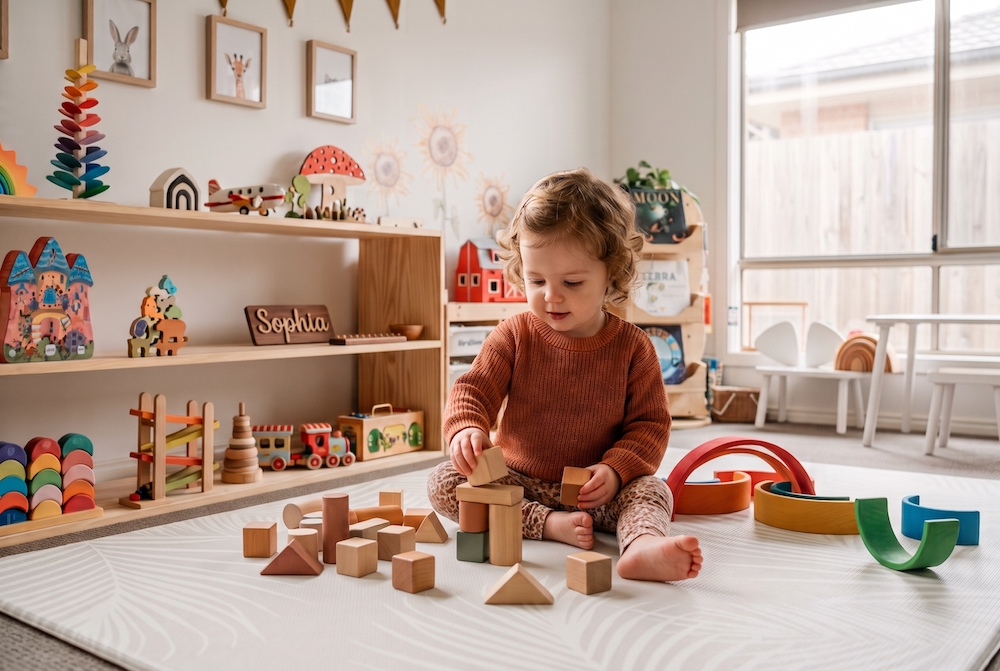
Think about how your child will actually use the space. If the area is mainly for building blocks, provide enough open floor space. For reading, add a small bookshelf and comfortable seating. For art activities, place a child-sized table nearby while keeping the floor area available for movement.
A flexible arrangement allows the same corner to support different activities throughout the day. This can make a smaller home feel more functional without requiring a separate playroom.
Understand the Difference Between Movement and Quiet Play
A play corner doesn’t have to keep children in one place. In fact, Australian physical activity guidance emphasises active play and opportunities for children to move throughout the day.
The Australian Government recommends supervised interactive floor-based play for infants, including tummy time while awake. For toddlers and preschoolers, the guidelines encourage varied physical activity spread throughout the day, including energetic play. A home play corner can support some of those opportunities, but it isn’t intended to replace outdoor activity or the wider range of movement children need.
Source: Australian Government — Recommendations for infants, toddlers and preschoolers.
This has a practical implication for your layout: leave enough space for movement where appropriate, and avoid filling the entire area with furniture or fixed activities. At the same time, provide a place for quieter play, such as reading or puzzles, when your child wants it.
For Babies: Create Opportunities to Explore While Awake
For babies, a play corner may provide a place for supervised floor-based activity, reaching and grasping, rolling and early movement. The arrangement should be adapted as their abilities change, with age-appropriate objects and close supervision.
Your baby doesn’t need elaborate equipment to make the area useful. Australian guidance focuses on opportunities for supervised floor-based play and movement, not on buying a particular type of mat or toy.
For Toddlers: Leave Room for Repetition and Experimentation
Toddlers often repeat activities over and over: stacking blocks, knocking them down, putting objects in a container and taking them out again. From an adult’s perspective, it can look as though very little is happening. For the child, that repetition is part of exploring what objects do and how actions change the result.
A useful play corner gives them room to repeat, rearrange and return to an activity without needing an adult to continually introduce something new.
For Preschool and School-Aged Children: Allow Projects to Evolve
Older children may want to build something that takes time, complete a puzzle, draw or set up imaginative games. A mat large enough to spread out materials can help, but think about how the project will be stored or moved when the family needs the room.
If a project can’t remain on the floor, a tray or nearby container may make it easier to move the materials without dismantling everything immediately. It’s a practical adaptation rather than a developmental requirement.
Let Your Child Help Shape the Space
As children grow, they can increasingly tell you what works and what doesn’t. Ask which toys they use most, whether they can reach what they need or where they’d like to keep a favourite book.
You can also learn a lot by observing their choices. If they repeatedly carry materials from the play corner to another part of the room, it may indicate that the activity needs more space or that the current arrangement doesn’t support how they want to play.
The Raising Children Network’s Australian guidance on child-led play recommends noticing children’s interests and following their lead rather than constantly redirecting the activity.
The space should be shaped around the child who uses it, not just the adult who arranges it.
A More Useful Way to Assess Your Play Corner
Rather than asking whether the space looks finished, observe how it works over several days. This is a practical way to identify problems that might not be obvious when the room is empty.
Consider the following questions:
- What does my child choose to do here? Notice whether the area supports their current interests or whether they regularly move elsewhere to complete an activity.
- What gets in the way? Look for crowded floor space, awkward storage, slippery surfaces or furniture that interrupts movement.
- Can my child reach suitable materials? Make appropriate toys accessible without creating climbing or pulling hazards.
- Does the setup suit my child’s current abilities? Reassess the arrangement as mobility, coordination and interests change.
- Can the room still function for the rest of the family? If the corner is difficult to pack away or blocks everyday movement, consider a more flexible setup.
- What could be removed rather than added? Sometimes the most useful improvement is more clear floor space, not another product.
This approach is more useful than trying to follow a perfect design formula. It treats the play corner as something you can adjust in response to how your child actually uses it.
Frequently Asked Questions
What Makes a Play Corner Effective for Children’s Play?
An effective play corner offers appropriate opportunities for children to move, explore and use materials independently where suitable. Its value depends on the child’s age, abilities, interests and the way the space is arranged. There’s no single layout or product that guarantees a particular developmental outcome.
What Should I Look for When Buying a Playmat?
Consider stability, surface construction, cushioning, ease of cleaning, storage, age suitability and the manufacturer’s product information. Check that the mat works with your floor and intended activities. Don’t assume greater thickness automatically means better safety or quality.
Are Interlocking Foam Mats a Good Choice?
They can be useful when families want to change the size or shape of a play area. However, the joins and individual pieces need to remain secure and in good condition. Check the age guidance, inspect for damage and ensure the mat doesn’t move or create raised edges during use.
Does a Playmat Support Child Development?
A mat can provide a comfortable surface for activities such as supervised floor play, building, reading and puzzles. The developmental value comes from the opportunities for play and interaction, not from the mat itself. Australian guidance emphasises varied movement and active play, while research on play environments explores how available space and materials can influence what children do.
How Can I Create a Play Corner in a Small Home?
Start by identifying the activities your child uses most. Choose a mat that fits without obstructing walkways, keep only the most useful toys nearby and use storage that can be moved easily. A flexible setup can work well when a living room needs to return to its usual purpose at the end of the day.
Do I Need to Buy Lots of Toys?
No. A play corner can start with a comfortable surface, some age-appropriate materials and enough space to use them. Open-ended materials can offer more than one way to play, and your child’s interests can guide what you make available. More products aren’t automatically better.
Making Room for Play That Matters
Creating a comfortable play corner doesn’t require a large room or complicated design. A suitable location, comfortable flooring, practical storage and a clutter-free arrangement can create an enjoyable environment for everyday play. Playmats for soft play areas can serve as the foundation of this space by providing a defined and comfortable surface for children to sit, crawl, play and explore.
With thoughtful organisation and regular cleaning, even a small corner can become a welcoming part of the home that supports both active play and quieter moments.
The difference is in how you approach the space. Instead of trying to create a perfect little playroom, think about what your child wants to do, what the room currently makes possible and what gets in the way.
Sometimes the answer will be a suitable mat. Sometimes it’ll be moving a basket, clearing a patch of floor or putting fewer toys within reach. The best solution is the one that makes play easier without creating unnecessary work for the family.
A good play corner isn’t defined by how it looks on the day you set it up. It’s defined by how well it supports the play your child actually wants to do.
Australian References and Further Reading
- Australian Government Department of Health, Disability and Ageing. Recommendations for infants, toddlers and preschoolers (birth to 5 years).
https://www.health.gov.au/topics/physical-activity-and-exercise/physical-activity-and-exercise-guidelines-for-all-australians/recommendations-for-infants-toddlers-and-preschoolers-birth-to-5-years - Australian Competition and Consumer Commission (ACCC). Testing of foam play mats finds no safety risk to children. Published 18 October 2011.
https://www.productsafety.gov.au/about-us/product-safety-news/news/testing-of-foam-play-mats-finds-no-safety-risk-to-children - Australian Competition and Consumer Commission (ACCC). Product safety.
https://www.accc.gov.au/consumers/stay-protected/product-safety - Kidsafe Australia. Home safety.
https://kidsafe.com.au/home-safety/ - Kidsafe Victoria. TV and furniture tip-overs.
https://www.kidsafevic.com.au/home-safety/tv-and-furniture-tip-overs/ - Kidsafe Victoria. Curtain and blind cord safety.
https://www.kidsafevic.com.au/home-safety/curtain-and-blind-cord-safety/ - Little, H., & Sweller, N. Affordances for risk-taking and physical activity in Australian early childhood education settings. Macquarie University research record.
https://researchers.mq.edu.au/en/publications/affordances-for-risk-taking-and-physical-activity-in-australian-e-2/ - Morrissey, A.-M., Scott, C., & Wishart, L. Infant and toddler responses to a redesign of their childcare outdoor play space. Deakin University research record.
https://dro.deakin.edu.au/articles/journal_contribution/Infant_and_toddler_responses_to_a_redesign_of_their_childcare_outdoor_play_space/20903410 - Simoncini, K., & Meeuwissen, K. (2024). ‘Don’t hog, share and just let your imagination flow’: Lessons from structured and unstructured loose parts play in middle primary school classrooms. Australian Educational Researcher.
https://researchprofiles.canberra.edu.au/en/publications/dont-hog-share-and-just-let-your-imagination-flow-lessons-from-st/ - Raising Children Network. Child-led play: Benefits and activities.
https://raisingchildren.net.au/school-age/play-media-technology/getting-play-started/letting-your-child-lead-play