
Kiddipedia
There is something wonderfully ordinary about cooking with your children.
Flour ends up on the bench. Someone spills the milk. The measuring cup disappears. A little too much cheese somehow makes its way onto the pizza. There may be an argument about who gets to stir, who gets the biggest piece and whether pineapple belongs anywhere near dinner.
And yet, somewhere amongst the mess, something much bigger is happening.
Your child is learning how food works. They are learning to measure, plan, problem-solve and make decisions. They are beginning to understand what goes into the food they eat, how meals are put together and how much effort it takes to feed a family.
They are also learning something that is difficult to teach from a worksheet or a classroom: how to look after themselves.
Cooking is not simply about producing dinner. It is a practical life skill that draws together nutrition, mathematics, literacy, science, creativity, responsibility, independence and family connection.
Australian parenting guidance also recognises that cooking with children can introduce them to different foods, support healthy eating habits, build maths and vocabulary skills, teach family traditions and prepare them for cooking for themselves later in life.
And perhaps most importantly for parents, cooking can create those everyday moments when you are together without having to manufacture a conversation.
Because sometimes the best conversations with our children happen when we are doing something together rather than sitting down and asking them to talk.
Article Highlights
- Cooking is a life skill: Help children develop the practical skills, confidence, independence and responsibility they need to eventually feed themselves and make informed choices about food.
- Build food literacy and healthier habits: Give children hands-on experience with ingredients, nutrition, flavours, textures, portions and food preparation, helping them become more familiar with a wider variety of foods.
- Turn pizza night into more than dinner: With the Kenwood My Pizzeria Indoor Pizza Oven reaching up to 400°C and cooking pizza in around three minutes, families can create and customise their own pizzas together — giving children the chance to choose, experiment, get involved and take pride in something they’ve made themselves.
- Know what goes into the meal: Cooking at home gives families greater control over ingredients, oil, salt, sugar, sauces, portions, freshness and cooking methods, while allowing meals to be adapted to suit the family.
- Turn favourite foods into homemade family meals: From pizza and burgers to tacos, fried rice, pasta and chicken, fakeaway can transform foods children already enjoy into opportunities to cook, customise and eat together at home.
- Turn the kitchen into a learning space: Cooking naturally introduces maths, literacy, science, fine motor skills, creativity, planning, organisation and problem-solving through real-world experiences.
- Learn that mistakes are part of learning: Burnt food, missing ingredients and recipes that don’t quite work can help children develop resilience, flexibility and problem-solving skills.
- Build confidence and agency: Giving children genuine, age-appropriate jobs in the kitchen helps them experience decision-making, contribution, achievement and growing independence.
- Learn about money, planning and food waste: Shopping, comparing prices, budgeting, meal planning, batch cooking, using leftovers and making the most of ingredients can teach children valuable lessons about money, resources and sustainability.
- Learn essential food safety: Cooking provides an opportunity to gradually teach children about hygiene, safe food storage, cross-contamination, knives, heat and safe cooking practices.
- Create connection and conversation: Cooking side by side can provide natural opportunities for talking, laughing, sharing and spending meaningful time together, without the pressure of a formal conversation.
- Pass on family traditions and memories: Favourite recipes, cooking rituals, cultural foods and family meals can become a way of passing stories, traditions and memories from one generation to the next.
- Raise capable kids: The ultimate goal isn’t to raise a little chef. It’s to raise a child who knows how to nourish themselves, make choices, solve problems, contribute to family life and confidently find their way around a kitchen.
Cooking Is More Than Dinner — It Is a Life Skill for the Future
Think about what happens when a child grows into a teenager, leaves home, moves into a share house, heads to university, starts working or eventually has a family of their own.
At some point, someone has to answer a very basic question:
“What are we going to eat?”
Knowing how to cook means having more choices than simply opening a packet, ordering takeaway or relying on someone else to prepare every meal.
A child who has gradually learned their way around a kitchen can eventually:
- read and follow a recipe
- understand basic ingredients
- use kitchen equipment safely
- prepare simple breakfasts and lunches
- make a balanced meal
- cook for other people
- plan meals
- shop for ingredients
- compare prices
- use leftovers
- adjust recipes
- understand portions
- store food safely
- clean up afterwards
- and make a meal from whatever happens to be available.
Those skills can become increasingly valuable as children become teenagers and young adults.
The goal isn’t to turn a six-year-old into a chef. It is to gradually build capability.
A toddler might wash vegetables. A preschooler might measure flour. A primary-school child might make scrambled eggs with supervision. A teenager might plan dinner, shop for the ingredients and cook the entire meal.
Over time, the message changes from:
“Mum or Dad cooks the food.”
to:
“I know how to feed myself.”
That is independence.
Cooking Builds Food Literacy — Helping Children Understand What They Are Eating
Food literacy is about much more than knowing whether something tastes good.
It involves developing the practical knowledge and confidence to understand, choose, prepare and use food.
Cooking gives children an opportunity to see ingredients before they become a finished meal.
They can see that a tomato becomes sauce.
That flour can become bread.
That eggs can become scrambled eggs, muffins or part of a cake.
That vegetables can be roasted, steamed, stir-fried or blended.
That beans and lentils can become part of a meal.
That a handful of ingredients can become something completely different once heat, time and preparation are involved.
This matters because Australia’s dietary data continues to show significant gaps between what children are eating and the recommendations.
The Australian Institute of Health and Welfare reports that 96% of Australian children and adolescents aged 2–17 did not meet the recommended daily vegetable intake in 2022. More recent national dietary data also shows that discretionary foods accounted for 35% of children’s and adolescents’ daily energy intake in 2023.
That does not mean children need to be lectured about “good” and “bad” foods.
In fact, cooking provides a much more useful opportunity.
It allows children to learn that food can provide different nutrients, textures, flavours and levels of nourishment — without turning eating into a moral judgement.
The Australian Dietary Guidelines recommend a wide variety of nutritious foods from the five food groups: vegetables and legumes, fruit, grain foods, lean meats and alternatives, and milk, yoghurt, cheese and alternatives, along with plenty of water.
A child who regularly helps prepare meals begins to encounter those food groups in a practical way.
They are not simply hearing that vegetables are important.
They are chopping them, stirring them, tasting them, cooking them and seeing how they fit into real meals.
Cooking Can Also Help Take the Pressure Out of Fussy Eating
For parents of a fussy or selective eater, the kitchen can become more than a place to prepare dinner. It can become a low-pressure environment where children gradually become more familiar with foods they may currently refuse.
Fussy eating and food neophobia — a reluctance to try unfamiliar foods — are common during childhood, and research suggests that children’s acceptance of foods can change through repeated, positive exposure. Systematic review evidence has found that repeated exposure to fruit and vegetables can increase acceptance in young children, although there is no magic number of times a child needs to encounter a food, and some foods may simply remain unpopular.
Cooking can make those encounters feel very different from being told to “just try it”. A child might wash a carrot, tear lettuce, stir a sauce, smell herbs, mix ingredients, choose between two vegetables, help make a pizza or watch a familiar ingredient change as it cooks. They may touch a food without eating it, smell it without tasting it, or taste a tiny amount and decide they don’t like it. All of those experiences can contribute to becoming more familiar and comfortable around food.
There is emerging evidence specifically around hands-on cooking and food acceptance. One small study found that repeated exposure to fruits and vegetables through hands-on cooking was associated with increased preferences for the target foods, while broader research suggests cooking programs can improve children’s cooking knowledge, confidence and self-efficacy. However, the evidence does not support promising that cooking will automatically make a child eat more vegetables or eliminate fussy eating.
And perhaps most importantly, the goal isn’t to pressure a child into eating something they don’t like. Pressure can turn food into a battleground, particularly when parents are already worried about whether their child is eating enough. Instead, cooking can give children opportunities to look, touch, smell, prepare and eventually taste foods at their own pace. The experience becomes about curiosity and participation rather than whether they cleaned their plate.
For some children, that might mean a vegetable eventually makes it onto their plate. For another, it might simply mean they are willing to handle it or have it sitting beside a familiar food. Progress doesn’t always look like eating the broccoli. Sometimes it starts with being willing to be around it.
Over time, these small experiences can help children develop a broader relationship with food — one where unfamiliar ingredients aren’t automatically rejected before they have had a chance to discover what they are, how they are prepared and whether they might actually enjoy them.
When You Cook at Home, You Know What Is Going Into the Meal
One of the simplest advantages of cooking at home is control. You know what is going into the meal — from the oil, salt and sauces to the vegetables, bread or wraps, proteins and cooking method. You can choose wholegrain options, legumes, fresh ingredients and leaner proteins, and adjust recipes to suit your family.
That doesn’t mean every homemade meal is automatically healthier, but home cooking gives families greater control over ingredients, preparation methods and portions.
For families managing food allergies or intolerances, that control can be particularly important. Preparing food at home can make it easier to know exactly which ingredients have been included and adapt recipes around a child’s individual dietary needs. Involving children in preparation can also gradually teach them to take an active role in understanding what is in their food, rather than relying entirely on someone else to check it for them.
As children grow, they can learn to read ingredient lists, recognise allergens, ask questions about food and understand that seemingly simple foods can contain unexpected ingredients. For children with diagnosed food allergies, cooking at home does not replace their healthcare management plan, and families still need to consider cross-contact and allergen contamination.
It is also an important part of food literacy. Children can learn how to read labels, identify ingredients, check allergens and understand storage instructions, while beginning to recognise the difference between cooking with individual ingredients and relying heavily on highly formulated convenience foods.
This isn’t about teaching children to fear additives. Food Standards Australia New Zealand (FSANZ) assesses food additives and food-related risks, and additives have a regulated role in our food supply.
It is about helping children understand what they are actually eating — and recognising that when you cook at home, you have more say over the recipe, and your child can learn why that matters.
Fakeaway: When the Foods Kids Love Become Family-Made Meals
There is a reason “fakeaway” has become such an appealing idea for families.
Children don’t suddenly stop loving pizza, burgers, tacos, fried rice or chicken because we would like them to eat more vegetables.
It is not that Australians have lost their appetite for pizza; Australia ranks fourth globally for pizza consumption, behind only Norway, the United States and Canada.¹ The pizza is still getting the green light; it is the price, wait and delivery roulette that are becoming harder to swallow.
So instead of making favourite foods the enemy, why not bring them into the kitchen?
A homemade pizza can become an opportunity to add vegetables.
A homemade burger can include salad and a leaner protein.
Tacos can become a build-your-own meal with vegetables, beans, meat, avocado and yoghurt.
Fried rice can become a way of using leftover rice and vegetables.
A chicken burger can be prepared using a different cooking method and served with salad.
A toasted sandwich can become an easy lunch children eventually learn to make themselves.
This is the fakeaway mindset.
Cooking Is Maths, Literacy, Science and Problem-Solving in Disguise
One of the beautiful things about cooking is that children don’t necessarily realise how much learning is taking place.
They are simply making dinner.
Maths
Cooking naturally introduces:
- counting
- fractions
- measurement
- weighing
- volume
- ratios
- multiplication
- division
- timing
- temperature
- portioning
- scaling recipes up or down.
“What happens if we need to feed eight people instead of four?”
“Half a cup is how much?”
“If we have three pizzas and six children, how many slices might everyone get?”
These are real-world mathematical problems with an immediate purpose.
Literacy
Recipes require children to read, interpret and follow instructions.
They learn words such as:
- teaspoon
- tablespoon
- combine
- whisk
- knead
- fold
- simmer
- bake
- grate
- dice
- rest.
They also learn that the order matters.
Reading comprehension becomes something they can actually use.
Australian parenting guidance specifically identifies recipe reading as a way children can build vocabulary, while measuring and counting support early numeracy.
Science
The kitchen is also a small science laboratory.
Why does yeast make dough rise?
What happens when butter melts?
Why does an egg change from liquid to solid?
Why does bread brown?
Why does pasta soften?
Why does oil behave differently from water?
Why does a sauce thicken?
Children can watch physical and chemical changes happening in front of them.
Problem-solving
And then there are the inevitable disasters.
The cake doesn’t rise.
The dough is too sticky.
The sauce is too salty.
Someone forgets an ingredient.
The pizza burns.
There isn’t enough cheese.
The recipe says one thing and the child has done another.
These moments can be frustrating, but they can also teach children something enormously valuable:
mistakes are information.
What happened?
Why did it happen?
Can we fix it?
What could we change next time?
That is problem-solving.
Cooking Builds Confidence, Responsibility and Agency
There is a huge difference between watching someone do something and discovering:
“I can do this myself.”
Children need opportunities to experience that feeling.
Cooking provides them naturally.
At first, the task might be tiny:
“Can you wash these carrots?”
Then:
“Can you measure the flour?”
Then:
“Can you stir this?”
Then:
“Can you make the salad?”
Eventually:
“Can you make lunch?”
Every completed task adds another little piece of competence.
I helped.
I contributed.
I succeeded.
I know how to do this.
That sense of agency matters.
Cooking also teaches responsibility. Children begin to understand that meals don’t simply appear. Someone has to plan them, buy ingredients, prepare them, cook them and clean up afterwards.
Giving children genuine jobs — rather than pretending they are helping while the adult does everything — allows them to experience responsibility in an age-appropriate way.
And yes, sometimes that means letting them make mistakes.
Cooking Teaches Children About Money, Budgeting and the Cost of Feeding a Family
There is another lesson sitting quietly in the kitchen:
food costs money.
With the cost of living continuing to put pressure on Australian households, helping children understand the economics of food can become a genuinely useful life skill.
ABS data showed that meals out and takeaway food prices increased 3.5% in the year to December 2025, while overall food and non-alcoholic beverage prices rose 3.4%.
Children don’t need a lecture about inflation.
They can learn through everyday decisions.
Give them a shopping list.
Compare two products.
Look at the price per 100g.
Work out how many people a packet will feed.
Ask:
“We have $25. What could we make for four people?”
Suddenly mathematics becomes budgeting.
Cooking can teach children to think about:
- price
- value
- portion size
- meal planning
- supermarket specials
- cheaper substitutions
- seasonal produce
- batch cooking
- leftovers
- freezing
- food waste.
They might discover that a meal doesn’t have to contain expensive ingredients to be satisfying.
Beans, lentils, eggs, pasta, rice, oats, vegetables and leftovers can all become useful building blocks.
And perhaps one of the most important lessons is this:
being able to cook gives you more control when money is tight.
Cooking Can Help Children Understand Food Waste and Sustainability
A child who learns that food costs money may also begin to understand why throwing it away matters.
Consider what happens to a roast chicken.
Dinner tonight.
Chicken sandwiches tomorrow.
Perhaps fried rice the next day.
Or soup.
Leftover vegetables can become:
- an omelette
- frittata
- pasta
- soup
- fried rice
- pizza toppings.
Overripe bananas can become banana bread or muffins.
Stale bread can become breadcrumbs.
This is practical sustainability.
Cooking can also open conversations about seasonal produce, packaging, shopping only for what you need and using food before it spoils.
Children learn that food doesn’t magically appear in the fridge — and it doesn’t disappear without consequence either.
The Kitchen Can Become One of the Places Your Child Opens Up
Sometimes the most valuable part of cooking has nothing to do with the food.
It is the conversation.
Parents often discover that children talk more freely when they are not being directly questioned.
You might be driving.
Walking the dog.
Gardening.
Washing the car.
Doing craft.
Or standing together at the kitchen bench making dinner.
There is no guarantee that a child will suddenly reveal their deepest thoughts because you handed them a wooden spoon.
But shared, low-pressure activities create natural opportunities for communication.
Australian family research has found that family meals can provide opportunities for connection and communication, while Australian parenting guidance highlights shared meals as important times for families to catch up, talk and listen.
The kitchen can offer something particularly useful: side-by-side time.
You don’t necessarily have to look directly at each other.
You are both doing something.
And sometimes a child who doesn’t want to answer:
“How was school?”
will casually tell you what happened while they are rolling pizza dough.
That is not a parenting technique that needs to be forced.
It is simply an opportunity.
The Ordinary Moments May Become the Memories
Years from now, your child probably won’t remember every Tuesday-night dinner.
But they may remember Grandma’s recipe.
Dad’s homemade pizza.
Mum’s pasta sauce.
Sunday pancakes.
Friday-night fakeaway.
The cupcakes you made for a birthday.
The Christmas biscuits that always came out slightly wonky.
The flour on the bench.
The arguments about who got to stir.
The first meal they made entirely by themselves.
These ordinary rituals can become part of a family’s emotional history.
And one day, your child may be standing in their own kitchen making the same meal.
Maybe they’ll change the recipe.
Maybe they’ll make it better.
Maybe they’ll tell their own children:
“This is what Grandma used to make.”
That is more than cooking.
It is family history being passed forward.
Cooking Passes Family Stories From One Generation to the Next
Food carries culture.
Recipes can carry migration stories, celebrations, traditions, memories and identity.
A dish might be connected to a grandparent.
A particular spice might remind someone of home.
A birthday cake may be made the same way every year.
A family might have a Sunday breakfast ritual or a Christmas recipe that appears only once a year.
When children participate in those traditions, they are not simply learning ingredients.
They are learning where some of their family stories came from.
Cooking can become a bridge between generations.
Don’t Aim for Perfect — Aim for Participation
This might be the hardest part for parents.
Because cooking with children is usually slower, messier and less efficient than doing it yourself.
There will be flour.
There will be spilled milk.
There will be ingredients dropped on the floor.
There will be too much sauce.
There will be disagreements.
There will be dishes.
And sometimes there will be a meal that simply doesn’t work.
But the kitchen can be cleaned.
The bench can be wiped.
The flour can be swept up.
The opportunity to build independence is harder to recreate.
That doesn’t mean children should be forced to participate or that every family meal needs to become a cooking lesson.
Some days everyone is exhausted.
Some nights takeaway is exactly what the family needs.
And that’s okay.
The goal isn’t perfection.
It is participation over time.
Give children choices where possible.
“Do you want capsicum or mushrooms?”
“Would you like to make the salad or help with the pizza?”
“Would you like to measure or stir?”
Allow them to explore.
Avoid turning every meal into a battle.
Don’t pressure them to taste something they aren’t ready to taste.
And try not to label foods as morally “good” or “bad”.
The bigger lesson is that food can be enjoyed, prepared, shared and understood.
Food Safety Is Part of Becoming Independent
Learning to cook also means learning how to cook safely.
Food safety is not something children need to master all at once. It can be introduced gradually as their skills develop.
Children can learn to:
- wash their hands before preparing food
- keep benches and utensils clean
- wash fruit and vegetables appropriately
- keep raw and ready-to-eat foods separate
- understand why raw meat needs careful handling
- use knives appropriately for their age and ability
- understand hot surfaces
- use ovens and stovetops with appropriate supervision
- store leftovers correctly
- understand refrigeration
- recognise when food may no longer be safe to eat.
FSANZ advises keeping potentially hazardous foods at 5°C or colder, keeping hot food above 60°C, and paying particular attention to cross-contamination between raw and ready-to-eat foods. It also recommends cooking minced or rolled meats, including hamburgers, to 75°C in the centre.
These aren’t simply rules for children.
They are life skills for anyone who prepares food.
What Children Can Learn in the Kitchen at Different Ages
Every child develops differently, so age ranges should be treated as a guide rather than a checklist.
Toddlers
Toddlers can begin with simple, supervised jobs such as:
- washing vegetables
- stirring
- tearing lettuce
- sprinkling toppings
- transferring ingredients
- counting pieces of food
- choosing between two ingredients.
The task matters less than allowing them to participate.
Preschoolers
Preschool children can often help with:
- measuring
- pouring
- mixing
- kneading
- using cookie cutters
- washing produce
- choosing ingredients
- helping set the table.
Primary School
As skills develop, children can begin to:
- follow simple recipes
- use kitchen scales
- prepare simple foods
- learn basic knife skills with supervision
- use selected appliances safely
- assemble lunches
- make simple snacks and meals.
Older Primary School Children
With appropriate supervision, children can increasingly learn:
- breakfast preparation
- lunch preparation
- stovetop cooking
- oven use
- meal planning
- food storage
- cleaning and kitchen organisation.
Teenagers
This is where cooking can really become a life skill.
Teenagers can progressively take responsibility for:
- planning meals
- writing shopping lists
- grocery shopping
- budgeting
- preparing complete meals
- making school or work lunches
- using leftovers
- adapting recipes
- cooking for other people
- cleaning the kitchen afterwards.
The aim is not that they can make a restaurant-quality meal.
The aim is that they can look into a fridge, work out what is available and feed themselves.
RECIPE:
Homemade Fakeaway: Easy Family Pizza
Pizza is one of the easiest places to start because children can become involved at almost every stage.
Easy Family Fakeaway Pizza
You will need
- Pizza bases or homemade pizza dough
- Tomato passata or pizza sauce
- Grated mozzarella
- Capsicum
- Mushrooms
- Corn
- Cherry tomatoes
- Ham, chicken or another preferred protein
- Pineapple, if your family is firmly in that camp
- Fresh herbs
- Optional chilli for adults
Method
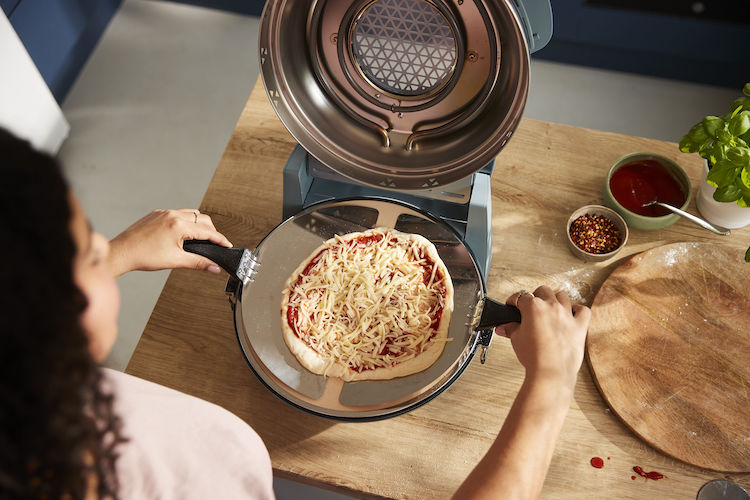
Spread the sauce over the base.
Let everyone choose their toppings.
Add the cheese.
Cook until the base is crisp and the cheese is melted and bubbling.
And then comes the important part:
let the children admire their creation before they eat it.
They made that.
Build-Your-Own Family Fakeaway Pizza
For families with strong opinions about toppings, individual pizzas can solve a surprising number of arguments.
Set out bowls containing:
- tomato sauce
- mozzarella
- chicken
- ham
- mushrooms
- capsicum
- olives
- pineapple
- corn
- spinach
- tomato
- roasted vegetables
- herbs.
Give each family member their own base.
Then let them build.
This turns dinner into part meal, part activity.
Children practise choice-making, portioning, creativity and food preparation while parents get to sit back and watch the combinations unfold.
And if one child wants mushrooms while another believes mushrooms are an unforgivable crime?
Everyone gets their own pizza.
Pizza Night Gets a Makeover: Introducing Kenwood My Pizzeria
For families who love the idea of homemade pizza but find the time and equipment involved a barrier, there is another option.
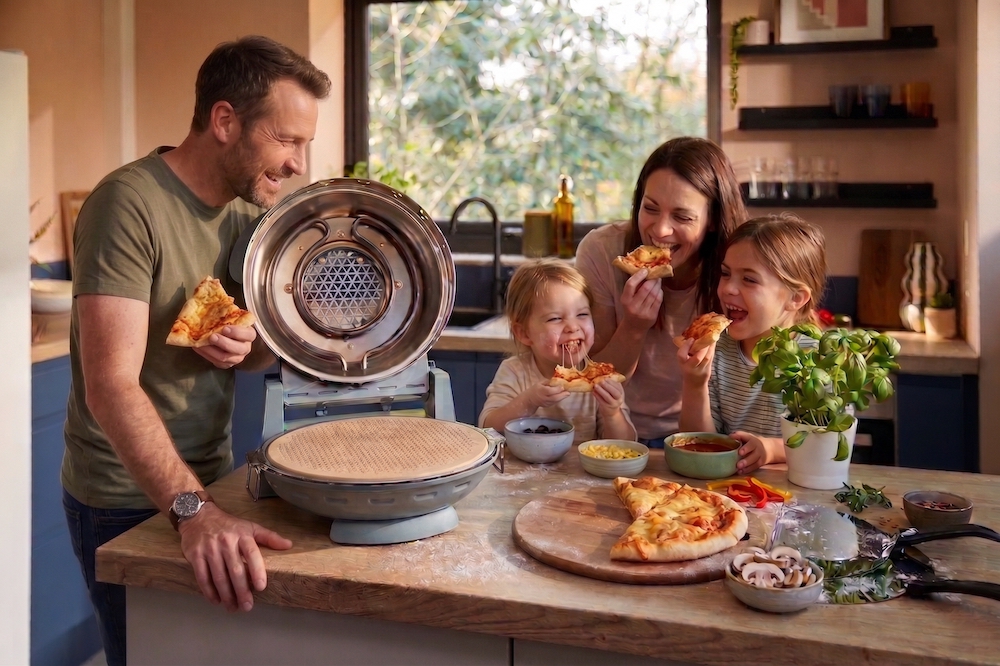
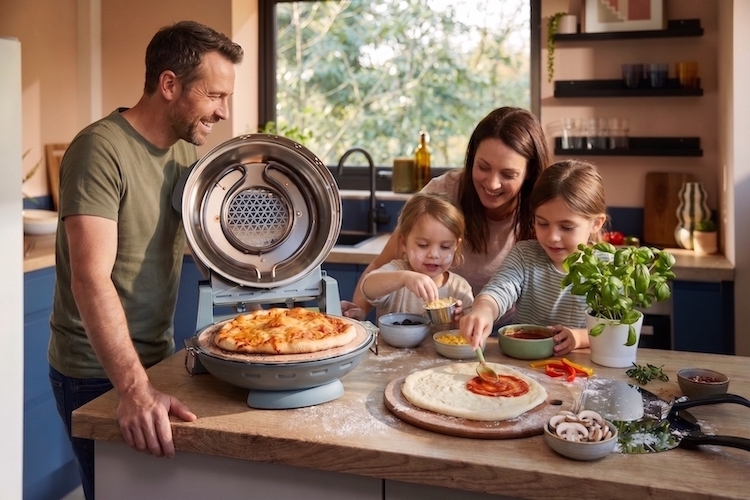
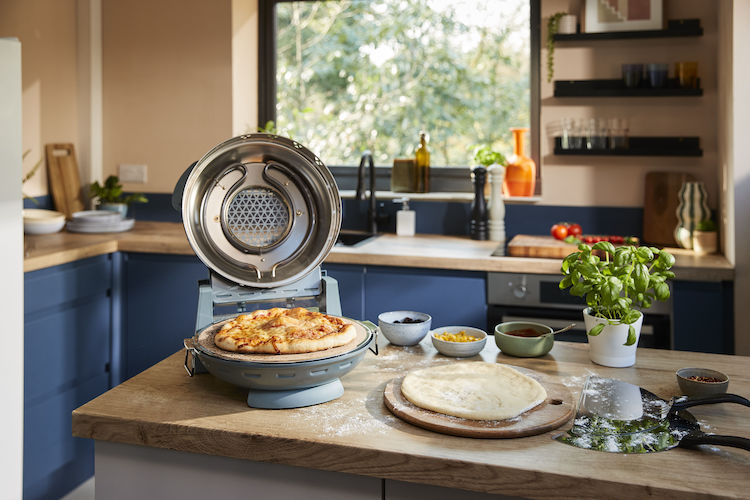
The Kenwood My Pizzeria Indoor Pizza Oven is designed to bring high-temperature pizza cooking into the home, giving families another way to enjoy pizza night without relying on takeaway.
Kenwood Australia currently lists the My Pizzeria at $159 including GST. Because retail pricing can change, families should check the current price before purchasing.
The compact benchtop oven reaches 400°C and is designed to cook pizza in around three minutes, with the manufacturer describing approximately 10 minutes of preheating. It uses dual-sided heating elements and a removable 30cm ceramic pizza stone to create high heat from above and below.
That makes it particularly interesting for the homemade fakeaway idea.
It also addresses one of the biggest barriers to making pizza at home: time. Kenwood’s research found that almost one in four Australians (24%) identified time as the main barrier to making great-quality pizza themselves. With approximately 10 minutes of preheating followed by around three minutes of cooking, My Pizzeria offers a quicker, indoor option for families who want pizza on the table without the wait that can come with ordering in.
What Makes the Kenwood My Pizzeria Different?
The My Pizzeria has been designed as a compact indoor alternative to a traditional outdoor pizza oven.
According to Kenwood, it features:
- 400°C high heat
- dual-sided heating elements
- a removable 30cm ceramic pizza stone
- a ClearView viewing window
- two simple controls for time and temperature
- stainless-steel pizza peels
- a compact design for storage
- the ability to cook homemade, chilled or frozen pizza
- use beyond pizza, including flatbreads, quesadillas and s’mores.
Kenwood says the ceramic stone naturally seasons with use, while the viewing window allows users to monitor the pizza without opening the oven and losing heat.
At approximately 18.5cm high and 4.7kg, the appliance is also designed to be moved and stored rather than permanently occupying an outdoor space.
For apartment dwellers, renters or families without the space or inclination for a traditional gas or wood-fired pizza oven, that compact format may be particularly appealing.
Why Pizza Could Be the Perfect Family Cooking Project
Why Pizza Could Be the Perfect Family Cooking Project
Pizza has an advantage that many other meals don’t.
Everyone can make it differently.
One child might want chicken and cheese.
Another might choose tomato, capsicum and mushrooms.
Someone else may want nothing but cheese.
And an adult might create something considerably more adventurous.
This makes pizza a natural opportunity for agency.
And it seems Australian pizza preferences can be surprisingly individual. Kenwood’s research found that 32% of Australians disagree over pizza toppings at least sometimes, while 70% would rather make individual pizzas or several different varieties than share a single pizza.
Suddenly, letting everyone make their own isn’t just a fun activity — it can also take some of the negotiation out of family dinner.
Children are not simply being told what dinner is.
They are participating in creating it.
They can choose their toppings, decide how much of each ingredient they want, experiment with combinations and take ownership of the meal they are helping to make.
For younger children, that might be as simple as spreading the sauce or sprinkling cheese. Older children can chop suitable ingredients, assemble their pizza and begin thinking about how different flavours work together.
There is also something satisfying about watching a collection of simple ingredients become something they have created themselves.
It gives children a genuine sense of contribution — and that can be a powerful part of learning to become more independent.
They are participating in creating it.
They can decide.
They can experiment.
They can learn what combinations work.
They can discover that too much sauce can make a base soggy.
They can learn that vegetables release moisture.
They can see how cheese melts.
They can learn how heat changes dough.
And when the pizza comes out of the oven?
They get immediate feedback.
“I made this.”
Part Dinner, Part Activity
Kenwood’s launch research provides an interesting snapshot of the changing takeaway conversation.
The company says its national research found 32% of Australian households were ordering takeaway or delivery less often than 12 months earlier, while another 11% reported that they did not order takeaway at all. Among respondents discussing their most recent pizza order, Kenwood reported that 30% had spent $50 or more.
And the cost isn’t the only frustration. That $50+ family pizza order can also come with the uncertainty of waiting for it to arrive hot, crisp and on time, with the possibility of a pizza arriving cold, soggy or later than expected.
As Abby Lord from Kenwood puts it, “Pizza night should be fun, easy and, most importantly, hot.” The idea behind My Pizzeria is to make that experience easier to create at home, without the wait, delivery fees or restrictions that can come with ordering in.
Because this research was commissioned by Kenwood, those figures should be understood as brand-commissioned research rather than independent national government statistics.
The same research reported that 24% of respondents identified time as the main barrier to making good-quality pizza themselves. It also found that 32% disagreed over pizza toppings at least sometimes, while 70% preferred individual pizzas or several varieties rather than sharing one pizza.
Those findings fit neatly with something many parents already know:
children like having a say in dinner.
And when everyone gets to create their own pizza, dinner can become an activity rather than another job that needs to be completed.
The Bigger Picture: Raising Children Who Know How to Feed Themselves
The real value of teaching children to cook has very little to do with whether they can make the perfect pizza.
It is about what happens along the way.
They learn to measure.
They learn to read.
They learn to plan.
They learn to wait.
They learn that heat changes food.
They learn that mistakes can be fixed.
They learn that food costs money.
They learn that leftovers can become tomorrow’s lunch.
They learn that other people have different tastes.
They learn to contribute.
They learn to clean up.
They learn about food safety.
They learn to make choices.
They learn that meals don’t simply appear.
And, slowly, they begin to understand:
“I can do this myself.”
That might be one of the greatest gifts we can give our children.
Because one day, the kitchen won’t be ours.
They will have their own kitchen.
Their own shopping list.
Their own budget.
Their own family.
And perhaps, when they are standing at their own bench making the meal they once made beside us, they won’t just remember the recipe.
They’ll remember being there with us.
The flour.
The laughter.
The arguments over toppings.
The slightly burnt pizza.
The Friday nights.
The conversations we didn’t even realise were important at the time.
And maybe that is the real beauty of teaching children to cook.
We think we are teaching them how to make dinner.
But we’re actually teaching them how to nourish themselves, contribute to others, solve problems, make choices and carry a little piece of home with them wherever life takes them.
Australian References & Further Reading
Australian Government Department of Health, Disability and Ageing. The Australian Dietary Guidelines. The Guidelines provide evidence-based recommendations for the types and amounts of food Australians should eat.
Australian Government Department of Health, Disability and Ageing. Healthy eating at home and out. Guidance covering healthy shopping, cooking methods, meal planning, family meals and takeaway choices.
Australian Institute of Health and Welfare (AIHW). Diet. National data on children’s and adults’ dietary patterns, discretionary food consumption and fruit and vegetable intake.
Australian Institute of Health and Welfare (AIHW). Australia’s health – Food and nutrition. National information about children’s diets, discretionary foods and nutrition.
Food Standards Australia New Zealand (FSANZ). Food safety basics. Guidance on hygiene, cross-contamination, cooking temperatures, refrigeration and safe food storage.
Food Standards Australia New Zealand (FSANZ). Preparing and cooking food. Practical food-safety guidance including safe handling and cooking temperatures.
Raising Children Network. Cooking with kids and teens. Australian parenting guidance on the developmental, practical and family benefits of cooking with children.
Raising Children Network. Easy cooking activities for kids: 3–6 years. Guidance on cooking as a way to develop early numeracy, literacy, social and practical skills.
Raising Children Network. Family mealtimes: why they’re important & how to make them fun. Australian guidance on family meals, connection, communication and modelling eating behaviours.
Litterbach, E., Campbell, K., & Spence, A. Family meals with young children: An online study of family mealtime characteristics among Australian families with children aged six months to six years. Deakin University research repository.
Australian Bureau of Statistics (ABS). Consumer Price Index, Australia, December 2025. National data on food, meals out and takeaway price movements.
Kenwood Australia. My Pizzeria Pizza Oven. Manufacturer specifications and product information, including 400°C heating, approximately three-minute pizza cooking, ceramic stone, viewing window and current Australian pricing.
Kenwood-Commissioned Research
The Australian consumer research referenced in this article was commissioned by Kenwood and conducted by Pureprofile among 1,020 Australian adults aged 18 and over. Data was collected between 17 and 20 August 2026. Percentages have been rounded to the nearest whole number, and base sizes vary by question.
The research is cited in the article as Kenwood-commissioned research and should be understood in that context.
¹ Australia’s global pizza consumption ranking is based on 2024 per-capita consumption data published by World Population Review.
Where to Buy the Kenwood My Pizzeria
If pizza night has inspired you to bring a little more cooking, creativity and family fun into the kitchen, the Kenwood My Pizzeria Indoor Pizza Oven is available from a range of major Australian retailers.
Kenwood My Pizzeria | RRP $199