

Kiddipedia
By Dr Tim Hopkins, Emergency Veterinarian, SASH Northern Beaches
Spring means sunny days, more time outdoors, and more adventures with our four-legged family members. Parents are usually thinking about sunscreen and hayfever this time of year, but there’s another spring danger that’s easy to miss: paralysis ticks. These tiny parasites can make a happy, healthy dog or cat seriously sick.
Most of us check the obvious spots, like along a dog’s back or a cat’s neck. But new research shows paralysis ticks often hide in places owners rarely think to look, which means pets can be carrying a dangerous tick without anyone noticing.
Where ticks really like to hide
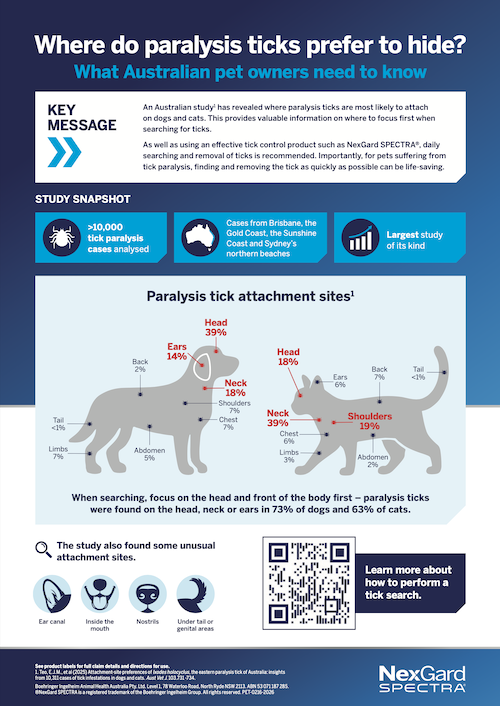
An Australian veterinarian study looked at more than 10,000 tick cases in dogs and cats to find out exactly where ticks attach. The results were surprising. Ticks can turn up:
- Inside the mouth, on the gums or tongue
- Inside the nostrils
- Deep inside the ear canal
- Around the eyelids
- Underneath the collar
- Between the toes
In fact, most paralysis ticks were found around the head, neck and ears – 73% on dogs and 63% on cats. That’s really useful to know, because it tells us exactly where to look first during a tick check.
Why paralysis ticks are so dangerous
A paralysis tick releases a toxin that can cause paralysis of the body and respiratory muscles. As it spreads through the body, pets can become wobbly and weak and eventually have trouble breathing.
The scary part is how fast it happens. A pet can seem completely fine in the morning and be seriously unwell by that evening. Without urgent vet treatment, tick paralysis can be fatal.
As an emergency veterinarian at SASH Northern Beaches, one of Australia’s largest specialist and 24/7 emergency vet hospital networks, our teams have already seen a 29% surge in tick paralysis cases.
Real pets, real recoveries
Halley’s fight for life
Halley, a much-loved family dog, went from happy and healthy to critically ill in just a few hours. After she became weak and wobbly, her family rushed her to the vet, where she was diagnosed with tick paralysis. Halley spent three nights in intensive care before she was well enough to go home, and she’s made a full recovery. Her story is a great reminder that every minute counts when tick paralysis strikes.
Gummy’s remarkable recovery
Gummy the cat became weak and started struggling to breathe, which quickly turned into full respiratory failure. She needed seven days of intensive care, including help from a breathing machine. Thanks to her amazing vet team, Gummy pulled through and is back home with her family.
Bronson’s winter surprise
Bronson’s family thought ticks were only a summer problem, but he developed tick paralysis in the middle of winter. It’s a good reminder that in many parts of Australia, paralysis ticks can be active all year round.
Signs every family should watch for
Kids are often the first ones to notice when a pet seems ‘not quite right’. Keep an eye out for:
- Weakness or wobbliness
- Trouble standing or walking
- A change in their bark or meow
- Vomiting or retching
- Breathing harder than usual
- Coughing or breathing difficulties
- Not wanting to eat
- Seeming unusually tired or flat
If you notice any of these signs, get to a vet straight away – don’t wait to see if it gets better.

A simple family tick-check routine
Alongside using an effective tick prevention product such as NexGard SPECTRA®, a daily tick check is one of the best things a family can do. Try this simple routine together when checking for ticks:
- Gently move your fingertips (‘finger walk’ them) through the coat at the level of the skin, over every aspect of your pet feeling for any bumps.
- Start at the head and neck – check the mouth and ears.
- Continue down the front legs to the paws, checking between the toes and underneath the paws.
- Search the chest, belly, back, tail and hind legs.
- Remove the collar and check underneath it.
- If your pet has a long coat, consider clipping the coat (including the head and tail) during periods of increased risk (particularly spring and summer) to make searching for ticks easier.
For more information on ticks and to learn more about how to perform a tick search visit Tick Check | NexGard® Range
Prevention beats treatment
Daily tick checks matter, but they’re not a substitute for year-round tick prevention – yes, even throughout winter. This is especially important for families travelling with pets, since tick paralysis can happen anywhere paralysis ticks are found, not just at home.
A spring reminder for families
Spring is a wonderful time to get outdoors with your pets. Stay a step ahead of paralysis ticks by making tick checks part of the daily routine and keeping up effective, year-round tick prevention – it’s a small habit that can make a huge difference to your pet’s safety.
 About Dr Tim Hopkins
BVSc (Hons I), MSc(Wild Animal Health), MRCVS
Dr Tim Hopkins graduated from the University of Sydney in 2007 with First Class Honours and completed his internship at SASH in 2008. He then moved to the UK, working for two years as a general practice and emergency veterinarian in Central and South-West London.
In 2011, Tim completed his Master of Science in Wild Animal Health at the Royal Veterinary College. From 2012 to 2015, he worked as a wildlife veterinarian at the Institute of Zoology – the research arm of the Zoological Society of London – studying diseases that threaten wildlife populations.
Tim returned to Australia in 2016, working in emergency hospitals in Adelaide and at the RSPCA in Canberra. These days, he shares his home with Betsy, a very affectionate rescue greyhound who loves scritches and sleeping.