

Kiddipedia
As our children head back to school this week for the 2026 school year, if you are a parent of a child with ADHD, it is common that you may feel a mix of hope, worry, and determination. You might be thinking: Will my child be understood this year? Will they get the help they need? If so, it’s important to know that these feelings are normal, you’re not alone, and your awareness is already a crucial part of supporting your child.
It’s a great reminder that ADHD isn’t about laziness or defiance; it’s a neurodevelopmental difference that affects how children regulate attention, emotions, impulses, and energy [1]. Research and practical experience with families show that children thrive when adults provide consistent structure, intentional support, and empathy throughout their day [2].
This guide combines what we know from decades of research, expert clinical practice, and everyday experiences of families navigating school and home life. It’s designed to give you concrete strategies, realistic examples, and insights you can trust, not hearsay or prescriptions, to help your child succeed across school, home, and hobbies.
1. Understanding ADHD: The Foundation of Everything
The single most powerful tool you have is understanding how ADHD affects your child personally.
ADHD impacts the brain’s executive functions, the skills used to plan, start tasks, maintain focus, control impulses, manage emotions, and switch between tasks [3]. Research shows these skills typically develop 2–3 years later in children with ADHD, which means what may look like defiance or inattentiveness is often a sign of developmental delay in self-regulation [4].
Framing behaviour as a skill that’s still developing, rather than willful misbehaviour, reduces shame and allows children to approach challenges with confidence [5].
Whole-Child Perspective: Skills that are challenged at school, like planning, emotional control, and focus, are the same skills needed at home and in hobbies. Supporting these across contexts helps your child build confidence and competence that transfers into every part of life [6].
2. Partnering with Schools Effectively
Strong collaboration between families and schools is one of the most reliable predictors of positive outcomes for children with ADHD [7].
Successful partnerships are built on:
- Sharing your child’s strengths and what strategies work at home
- Naming challenges early and working together on solutions
- Maintaining regular communication
- Documenting and reviewing agreed adjustments
Your insight as a parent is vital. Teachers bring classroom expertise, and when these perspectives meet, your child receives consistent, informed support.
3. Classroom Adjustments That Make a Difference
Research consistently demonstrates that small, targeted adjustments can have a substantial impact on engagement, behaviour, and learning for children with ADHD [8].
Evidence-based supports include:
- Preferential seating to reduce distractions
- Clear, concise instructions, both written and verbal
- Breaking tasks into smaller, manageable steps
- Providing extra time on tasks and assessments
- Scheduled movement breaks
- Fidget or sensory tools
- Visual reminders and schedules
- Quiet spaces or noise-reducing headphones
- Alternative ways to show knowledge (oral, visual, or hands-on projects)
Consistency Across Settings: Applying these adjustments not just at school but in extracurricular activities reinforces skills and confidence [9].
4. Teaching Executive Function Skills
Executive function is the foundation for independence, yet many children with ADHD are not explicitly taught these skills [10].
Parents can support development by:
- Organising materials and tasks with the child daily
- Using colour-coding and visual aids
- Breaking assignments into clear, step-by-step instructions
- Practising time awareness with timers
- Embedding routines at home for predictability
Practical Home Practice: Everyday tasks, like packing bags, planning meals, or organising playdates, are opportunities to strengthen executive function safely [11].
5. Homework Without Conflict
Homework often creates tension, but with intentional strategies, it can be a positive learning experience [12].
Approaches include:
- Predictable routines and dedicated spaces for work
- Short, focused sessions rather than long stretches
- Body-doubling: working near an adult for accountability
- Incorporating movement or short breaks
- Emphasising task initiation over perfection
- Open communication with teachers about workload concerns
After-School Decompression: Children often need a brief transition period to recharge after school before starting homework. Movement, quiet time, or play can reduce frustration and improve focus [13].
6. Supporting Emotional Regulation and Social Skills
Children with ADHD experience emotions more intensely and may take longer to recover from frustration or disappointment [14].
Strategies for parents include:
- Validating emotions before problem-solving
- Teaching vocabulary to label feelings
- Recognising early signs of stress
- Supporting friendships through guided practice and reflection
- Celebrating persistence, effort, and resilience
Child Voice and Self-Advocacy: Encourage children to express what helps them during challenges and what successes they are proud of [15]. This fosters self-awareness and confidence.
7. Building on Strengths
Children with ADHD often bring creativity, energy, empathy, and originality [16].
Support strategies include:
- Identifying and nurturing interests and talents
- Sharing strengths with teachers to shape learning approaches
- Encouraging hobbies and passions outside the classroom
- Explaining ADHD as a difference rather than a deficit
Hobby Support: Select activities that match your child’s energy and interests. Provide guidance to instructors and help your child navigate frustration or boredom, fostering resilience and enjoyment [17].
8. Positive Behaviour Supports
Punitive strategies are less effective and may increase stress [18].
Evidence-based approaches include:
- Clear, consistent expectations
- Positive reinforcement
- Teaching alternative skills and coping strategies
- Calm, reflective responses after incidents
- Coordinated behaviour plans across home and school
Children behave better when they feel understood, supported, and capable.
9. Professional and External Supports
Some children benefit from additional expertise, including:
- Psychological assessments
- Occupational therapy
- Speech or social skills support
- Medication under medical guidance [19]
Sharing relevant reports helps ensure consistency across home and school.
Regression and Stress: Children with ADHD may temporarily lose skills during periods of stress or transitions. Recognising these signs and adjusting expectations helps protect mental health [20].
10. Home Environment and Parent Wellbeing
A supportive home environment strengthens regulation and learning [21].
Key strategies:
- Consistent sleep, nutrition, and exercise routines
- Predictable yet flexible daily structure
- Built-in decompression time after school
- Modelling calm problem-solving
Parent Self-Care: Maintaining your own well-being supports your child’s development. Seeking guidance, building networks, and prioritising rest and mental health are part of effective parenting.
Primary vs Secondary School: How Support Evolves
Primary School
- Strong scaffolding and predictable routines
- Regular parent–teacher communication
- Movement and visual supports in learning
- Explicit instruction in social and emotional skills
Secondary School
- Support for the organisation across subjects
- Explicit teaching of self-advocacy skills
- Adjusted workload with maintained curriculum expectations
- Emotional regulation support during transitions
- A trusted staff contact for check-ins
Support should adapt as independence grows, rather than disappear [22].
School Meeting Checklist
Before the meeting:
- Reflect on your child’s strengths and challenges
- Gather reports or assessments
- Identify strategies that work at home
During the meeting:
- Discuss current classroom supports
- Confirm realistic adjustments
- Ask how support will be monitored
- Identify a key contact at school
- Agree on ongoing communication
- Use parent-friendly language to advocate effectively
After the meeting:
- Request a written summary
- Set a review date
- Follow up if supports are not implemented
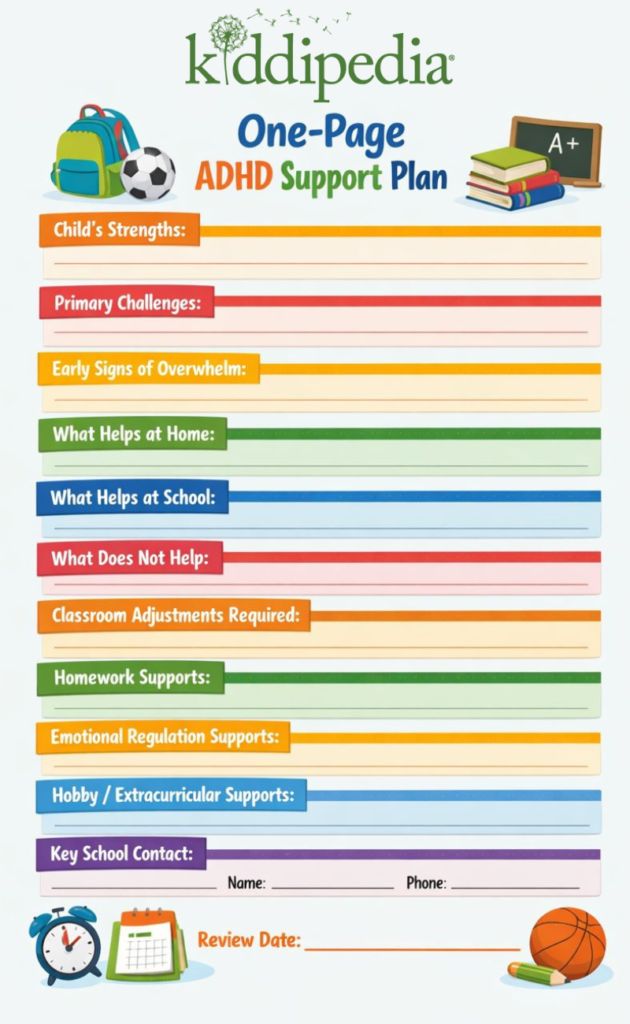
A Final Word, Parent to Parent
You’re not here to “fix” ADHD — you’re here to walk alongside your child, guiding them as they build skills, confidence, and self-belief. Progress won’t always be linear, and that’s normal. With consistent support, empathy, and intentional strategies, children with ADHD don’t just manage school — they learn, grow, and thrive [23].
You’re doing important work. Your awareness, persistence, and love are already making a difference.
References
- American Psychiatric Association. (2022). DSM-5-TR.
- Barkley RA. (2020). Taking Charge of ADHD. Guilford Press.
- Brown TE. (2013). A New Understanding of ADHD in Children and Adults. Routledge.
- Sonuga-Barke EJ et al. (2015). Executive function development in ADHD. Neuroscience & Biobehavioral Reviews, 55, 43–57.
- Daley D, Birchwood J. (2010). ADHD and parent interventions. Child and Adolescent Mental Health, 15(4), 201–207.
- Abikoff H, et al. (2013). School and after-school interventions for ADHD. Journal of Attention Disorders, 17(3), 223–235.
- Evans SW, et al. (2018). Parent-teacher collaboration and ADHD outcomes. School Mental Health, 10, 63–77.
- DuPaul GJ, Stoner G. (2014). ADHD in the Schools. Guilford Press.
- Zentall SS. (2005). ADHD in extracurricular contexts. Psychology in the Schools, 42, 667–678.
- Willcutt EG, et al. (2012). Executive function in ADHD: meta-analysis. Biological Psychiatry, 71, 78–85.
- Gathercole SE, Alloway TP. (2008). Working memory and life skills. Psychology Press.
- Power TJ, et al. (2006). Homework interventions for ADHD.