

Kiddipedia
Safer Internet Day 2026: A Parent’s Guide to Helping Kids Stay Safe, Confident, and Resilient Online
In this article, you’ll discover:
-
The Purpose of Safer Internet Day: Why this global initiative matters for your family.
-
Social Media and Mental Health: How screens can affect mood, anxiety, sleep, and self-esteem.
-
Spotting Digital Overload: Recognising addictive games, compulsive app use, and emotional attachment to devices.
-
Talking Openly About Online Life: Practical strategies for honest, judgment-free conversations with your child.
-
Setting Healthy Screen Boundaries: Guidance for balancing online activity with offline play and rest.
-
Encouraging Offline Play and Learning: Hobbies, creative activities, and real-world friendships that build resilience.
-
Research-Backed Parenting Strategies: Evidence-based approaches to guide, protect, and empower your child online.
February 10 is Safer Internet Day, a global day supported by eSafety in Australia. As parents, this day is worth taking note of, not just as a headline, but as a real reminder that we don’t have to navigate the digital world alone. Screens, social media, and online games are part of our children’s everyday lives, and this day is a chance to pause, reflect, and take small, meaningful steps to help our kids stay safe, confident, and resilient online.
Safer Internet Day isn’t just a global campaign — it’s a chance here in Australia to connect with other parents, experts, and communities, and think about practical ways we can empower our kids while guiding them through digital spaces. From cyberbullying to the pressures of social media, from managing online identities to teaching healthy device habits, this is about real steps that actually make a difference in our children’s online lives.
The internet connects our kids to learning, creativity, friends, and the wider world — but it comes with risks. Having honest conversations, guiding with empathy, and setting clear, fair boundaries can help our children enjoy the benefits of technology while staying safe, confident, and supported.
Why This Matters Now: Australia’s New Social Media Age Law
Unless you’ve been living under a rock, you’ve probably heard about Australia’s Online Safety Amendment (Social Media Minimum Age) Act 2024, which makes it illegal for children under 16 to have accounts on major social media platforms like TikTok, Instagram, Facebook, Snapchat, X, YouTube, and more. Platforms must take reasonable steps to prevent under-16s from creating or keeping accounts, or face fines of up to ~$49.5 million AUD. The law came into effect on 10 December 2025 (eSafety.gov.au)
It has been noted that addiction to social media can be so deeply embedded in the minds of children under 16 that some struggle to follow the new law. Some have found ways around platform safeguards, including AI-based facial age estimation technology used during account verification.
Parents, if your child is in this situation, please take note: we understand that you just want to see your children happy, and it may feel like being on their devices makes them content. But there is a reason this law was passed. Young people under 16 are not breaking the law if they still have an account, it’s the platforms that can be fined.
Our goal here is to highlight the psychological effects online activity can have on young hearts and minds, so you can better understand what’s happening and support your children with care and guidance.

A Tragic Example of Extreme Digital Impact
WARNING – DISTRESSING CONTENT:
You’ve probably heard warnings about social media and screen time, but the heartbreaking story of three sisters, Nishika (16), Prachi (14), and Pakhi (12), who tragically died by suicide after each jumped from their balcony after their father confiscated their mobile phones, serves as a stark, extreme example of how digital engagement can affect young minds.
- The girls are reportedly suspected to have become “addicted” to an online game and were recently “denied access” to a phone
- “This should not happen to any parent or child,“ their dad said, adding, “I was not aware of the game, or I would have never let them play it.”
Over the years, the sisters had developed a deep attachment to mobile phones and online content, particularly Korean culture, including dramas, music, and an online Korean ‘love game.’ Their father had recently taken their phones out of concern for their excessive use and growing obsession.
In the early hours of 4 February 2026, the sisters jumped from the ninth‑floor balcony of their home. Authorities found a handwritten note expressing their distress, including messages such as “Sorry, Papa” and declarations of their love for Korean culture. Diaries and writings on their bedroom walls suggested feelings of isolation, emotional pain, and fixation on their online world.
Police are investigating the exact content and games the girls were accessing. Authorities are also highlighting broader concerns, including digital dependence, adolescent mental health, and the emotional needs of children in the online age. While no single app or game has been identified as a direct cause, this tragedy is a stark reminder for parents—especially those with children under 16—to monitor online habits, maintain open conversations about digital boundaries, and be mindful of the emotional impact social media can have.
Suicide and self-harm are complex issues involving many factors beyond a single event. If this story raises distressing feelings, please know that support is available, reach out to professionals if needed.
What Research Really Shows About Social Media’s Effects on Children
🧠 1. Mental Health Risks: Anxiety & Depression
Heavy or problematic social media use is linked with higher rates of anxiety, depression, and psychological distress in children and teens. (Twenge et al., 2018; Keles et al., 2020)
Signs parents might notice:
-
Mood changes or irritability after screen use
-
Withdrawal from family or offline friends
-
Preoccupation with social media interactions
Even small amounts of problematic use can affect children’s mental wellbeing, especially when online activity becomes emotionally immersive.
😴 2. Sleep & Daily Rhythm Disruption
Devices and social media can keep children scrolling late into the night, disrupting natural sleep cycles. Blue light from devices suppresses melatonin, making it harder to fall asleep. (Cajochen et al., 2011)
Signs we notice as parents:
-
Trouble waking up in the morning
-
Irritability, low concentration, or fatigue
Sleep isn’t just about rest — it underpins mood, learning, and resilience.
💭 3. Identity, Comparison & Self‑Worth Struggles
Children’s brains are wired to seek social approval. Social media amplifies comparison, often with highly curated, “perfect” content. (APA, 2022)
Signs to watch for:
-
Low self-esteem
-
Obsession with likes or followers
-
Frustration when posts don’t get attention
🧠 4. Addiction‑Like Patterns & Emotional Impact
Some children develop compulsive or addictive behaviors, feeling distressed when not using social media. This pattern is =associated with higher risk of anxiety, depression, and even self-harm ideation. (Washington Post, 2025)
Emotional attachment to online content is real. Gentle guidance, empathetic conversations, and shared strategies are key to helping children manage these feelings.
👥 5. Social Connection & Skills — The Double‑Edged Sword
Social media can support creativity and identity exploration, but it doesn’t teach face-to-face communication, empathy, or conflict resolution skills (NCBI, 2022)
Children may feel socially connected online, yet struggle with real-life conversations and relationships.
🚸 6. Exposure to Harmful Content & Misleading Information
Young children are vulnerable to cyberbullying, misinformation, and inappropriate content. Emotional regulation and critical thinking are still developing, which can leave children overwhelmed. (NCBI, 2022)
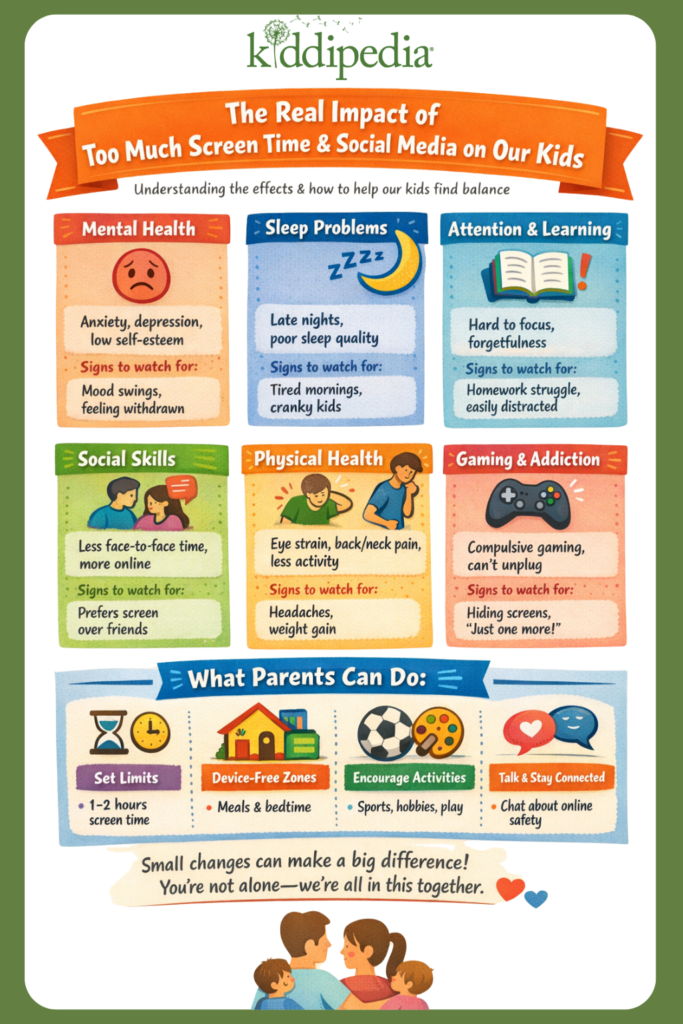
Practical Tips for Parents: Supporting Your Child Online
✨ 1. Set Boundaries
-
Device-free meals and bedrooms
-
Tech curfews before bedtime
-
Screen time limits based on age
🤝 2. Talk Openly
-
Ask how content makes them feel
-
Discuss online identity and real-life vs digital life
🧠 3. Teach Digital Literacy
-
Help children understand algorithms and misinformation
-
Encourage critical thinking about content
🌳 4. Encourage Offline Life
-
Sports, hobbies, creative play, family time
-
Reinforce self-worth outside of social media
💬 5. Model Healthy Use
-
Children notice your habits
-
Show balance with your own device use
🧑⚕️ 6. Seek Support
-
If your child shows withdrawal, anxiety, or sleep disruption, reach out to a GP, school counsellor, or child psychologist
Supporting Children Online: Practical Tips Every Parent Can Use
We can all agree that the online world opens incredible opportunities for our kids to learn, create, and connect — but let’s be honest, it can also feel overwhelming, and sometimes even a little scary. This Safer Internet Day, we’re sharing practical, research-backed tips delivered like advice from a fellow parent who really understands, so you can feel confident guiding your children safely and positively through their digital lives.
1. Understanding Online Risks
-
Children’s understanding of online risks develops with age; tailor your approach.
-
Tip: Learn the common dangers your child may face at their age.
-
Practical Steps: Parental controls, workshops, weekly check-ins on online activity
2. Helping Kids Think Critically Online
-
Encourage questioning of what they see online to build problem-solving skills and digital resilience.
-
Tip: Ask them to evaluate content before believing it.
-
Practical Steps: Play games that teach spotting misinformation, and discuss articles together
3. Balancing Screen Time
-
Guided, mindful screen use can support learning and social skills.
-
Tip: Mix screen time with offline activities intentionally.
-
Practical Steps: Clear limits, tech-free times, alternatives like board games or outdoor play
4. Guiding Kids to Safe Online Spaces
-
Age-appropriate, interactive content reinforces learning and creativity.
-
Tip: Help kids explore fun, educational apps and sites.
-
Practical Steps: Curated safe lists, educational programs, privacy checks
5. Talking Openly About Online Life
-
Frequent, casual conversations build trust and emotional security.
-
Tip: Ask about favorite apps, games, and content.
-
Practical Steps: Listen without judgment, reassure your child it’s okay to seek help
6. Setting Online Boundaries
-
Clear, flexible boundaries teach self-regulation.
-
Tip: Explain rules with reasons, not just restrictions.
-
Practical Steps: Discuss safe info sharing, respecting privacy, handling friendships responsibly
7. Spotting and Preventing Cyberbullying
-
Active parental involvement builds resilience.
-
Tip: Check in regularly about online interactions.
-
Practical Steps: Teach signs of bullying, encourage reporting, and provide emotional support
8. Finding Reliable Resources
-
Trusted, evidence-based guidance helps parents stay informed.
-
Tip: Stick to credible sources.
-
Practical Steps: Bookmark sites, follow eSafety updates, and avoid unverified blogs
9. Encouraging Responsible Digital Behaviour
-
Teach empathy, ethics, and thoughtful online interaction.
-
Tip: Praise responsible online behaviour.
-
Practical Steps: Discuss etiquette, celebrate safe sharing, and reinforce privacy
10. Supporting a Safer Internet for Everyone
-
Community involvement strengthens online safety.
-
Tip: Share knowledge with other parents.
-
Practical Steps: Join school programs, advocate for privacy regulations, share experiences
Final Thought — You’re Not Alone
Parenting in the digital age isn’t easy. The risks are real, but with empathy, compassion, open communication, and consistent guidance, our children can navigate social media safely and healthily. Safer Internet Day reminds us that even small steps — a conversation, a boundary, a shared moment online- make a huge difference.
References
- Australian Institute of Family Studies. (2022). Children and digital technology: Impacts on wellbeing and development. https://aifs.gov.au
- Australian Psychological Society. (2023). Technology, screen use, and mental health in children and adolescents. https://www.psychology.org.au
- Cajochen, C., Frey, S., Anders, D., Späti, J., Bues, M., Pross, A., … Stefani, O. (2011). Evening exposure to light-emitting screens affects circadian physiology and cognitive performance. Journal of Clinical Endocrinology & Metabolism, 96(7), 2053–2060.
- Jones, L. M., & Mitchell, K. J. (2016). Defining and measuring youth digital literacy. Journal of Adolescent Research, 31(4), 459–481.
- Keles, B., McCrae, N., & Grealish, A. (2020). A systematic review: The influence of social media on depression, anxiety, and psychological distress in adolescents. International Journal of Adolescence and Youth, 25(1), 79–93.
- Kowalski, R. M., Giumetti, G. W., Schroeder, A. N., & Lattanner, M. R. (2014). Bullying in the digital age: A critical review and meta-analysis of cyberbullying research among youth. Psychological Bulletin, 140(4), 1073–1137.
- Livingstone, S., & Haddon, L. (2009). EU Kids Online: Final report. London School of Economics and Political Science. http://www.eukidsonline.net
- Livingstone, S., Mascheroni, G., Dreier, M., Chaudron, S., & Lagae, K. (2022). EU Kids Online: Latest insights into children’s online experiences. London School of Economics. http://www.eukidsonline.net
- McCauley, K., & Davis, K. (2021). Developing digital resilience in children: Evidence-based strategies for parents and educators. Computers & Education, 165, 104132.
- Odgers, C. L., & Jensen, M. R. (2020). Annual research review: Adolescent mental health in the digital age. Journal of Child Psychology and Psychiatry, 61(3), 336–348.
- Odgers, C. L., & Jensen, M. R. (2023). Digital media and youth mental health: Key findings and policy recommendations. Child Development Perspectives, 17(2), 112–119.
- Patchin, J. W., & Hinduja, S. (2010). Cyberbullying and self-esteem. Journal of School Health, 80(12), 614–621.
- Ribble, M. (2015). Digital citizenship in schools: Nine elements all students should know. International Society for Technology in Education.
- Subrahmanyam, K., & Šmahel, D. (2011). Digital youth: The role of media in development. Springer.
- Twenge, J. M., & Campbell, W. K. (2018). Associations between screen time and psychological well-being: Evidence from a national survey of US adolescents. Preventive Medicine Reports, 12, 271–283.
- eSafety Commissioner. (2026). Social Media Minimum Age and Online Safety. Australian Government. https://www.esafety.gov.au