

kiddi
Sydney families living with disability often end up managing a “team” of people and services long before it feels like a proper support network.
The tricky part isn’t finding a support service—it’s building the right mix of services that work together, reduce admin, and protect the household’s energy.
To help you streamline your search, we’ve identified four essential pillars of support—and the local Sydney providers leading the way—to help your family thrive.
This guide breaks down four essential service types that tend to make the biggest difference, plus how to choose them, common pitfalls, and a simple 7-14 days plan to get momentum.
What a “support network” actually means under the NDIS
A strong support network is not “more providers”; it’s a coordinated set of NDIS supports that covers daily living, stability, safety, and progress toward goals.
It helps when responsibilities are clear: who does what, how information is shared, and what happens when circumstances change.
It also means having at least one “fallback” option for the supports that can’t fail (like personal care coverage, school pick-ups, or overnight arrangements).
Service 1: Support Coordination to keep the plan usable
The foundation of any successful NDIS plan is the relationship you have with your primary provider.
This is the “home base” for your support. A high-quality NDIS service provider in Sydney does more than just tick boxes; they act as a partner in your growth.
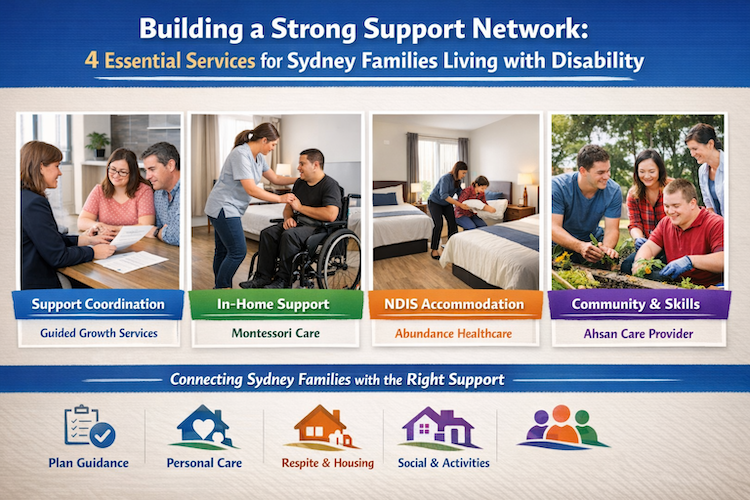
If the plan feels hard to translate into action, a good next step is to start with a simple “network map” of who’s involved, what’s missing, and what needs stabilising first—then contact Guided Growth Services for support coordination as a reliable NDIS provider.
Operator Experience Moment
One pattern that shows up quickly is how families underestimate the coordination load until supports start changing at once—new school term, carer availability shifts, or a health flare-up.
When the admin spikes, it’s rarely the “big” decisions that cause stress; it’s the small handoffs (missed notes, mismatched rosters, unclear responsibilities) that break the week.
Service 2: In-home supports that protect routines
In-home supports are the backbone for many households because they stabilise the daily rhythm: getting ready, meals, hygiene, and keeping the home workable.
This can include personal care support and also household tasks, depending on what’s reasonable and necessary under the plan.
Montessori Care brings a unique philosophy to top-quality home care services in Sydney. Based on the Montessori method, their approach focuses on what people can do, rather than what they can’t.
This is particularly effective for individuals who value their independence and want to remain active participants in their own lives.
A useful rule of thumb is to protect “non-negotiable” times first (mornings, school runs, evenings) and add flexible hours later once routines are reliable.
Service 3: Accommodation pathways for short, medium, and long-term stability
Accommodation supports can look very different depending on needs and the plan, ranging from short stays/respite to medium-term options during transitions, through to long-term supported living arrangements.
This is an area where families benefit from thinking in scenarios: “What if we needed a safe short stay next month?” and “What would be required for a longer-term change?”
This is where specialised accommodation becomes a critical part of your support network. Abundance Healthcare Group provides essential NDIS accommodation in Sydney, ranging from short-term “respite” stays to medium and long-term solutions.
The right service here is the one that can explain constraints plainly—availability, eligibility, compatibility, and what the decision timeline realistically looks like.
Service 4: Community access and capacity-building supports that create a bigger life
A support network isn’t only about getting through the day; it’s also about building skills, confidence, and social connection.
Community access supports can help with participation in local activities, transport training, structured outings, and building independence in familiar environments.
Rather than letting the house become a source of stress, many Sydney families are utilising NDIS funding for “Assistance with Daily Life.” Ahsan Care Provider specialises in these NDIS household tasks options, ensuring that the physical environment of the home remains a sanctuary rather than a chore list.
Capacity-building supports (where funded) can target practical goals like improving daily living skills, strengthening communication approaches, or building routines that reduce distress.
The best outcomes usually come from choosing activities that are genuinely motivating, not just “good for them” on paper.
Common mistakes families make when assembling supports
Trying to start everything at once, which overwhelms the household and makes it hard to tell what’s working.
Choosing on friendliness alone rather than reliability, fit, and clear service boundaries.
Not clarifying who owns communication (for example: does the support worker report to the family, a team leader, or the coordinator?).
Letting schedules evolve without documentation, so every change becomes a negotiation.
Assuming “available now” automatically means “right for us,” especially for high-impact supports like personal care or accommodation.
Common questions we hear from Australian families
Q1) How do we know which service to start with if everything feels urgent?
Usually, the best starting point is the support that prevents immediate breakdown—often morning/evening routine coverage or coordination when multiple providers are involved. Next step: write a one-page “week map” and circle the top two pressure points. In most Sydney households, travel time and roster consistency are the first practical constraints to plan around.
Q2) What should we ask a provider before committing?
In most cases, you’ll want to ask about continuity (who shows up), communication (how updates happen), and contingencies (what happens when someone cancels). Next step: send the same five questions to every shortlist option so comparisons are fair. It depends on where you are in Australia, but in Sydney especially, suburb coverage and peak-hour travel can affect reliability.
Q3) Can we use multiple providers for the same type of support?
It depends—sometimes splitting providers creates flexibility, but it can also create confusion if roles overlap or communication is unclear. Next step: assign one “lead” for each support type and document responsibilities in writing. In most cases across Australia, clear boundaries prevent double-booking and billing issues.
Q4) How often should we review the support network once it’s running?
Usually, a light review every two weeks at the beginning helps you stabilise quickly, then monthly once things feel predictable. Next step: set a recurring calendar reminder and keep a simple log of what’s working and what’s not. In most Sydney settings, term changes, staffing availability, and transport demands can trigger the need for quicker adjustments.