


kiddi
A little wooden house in the backyard might not look like much to an adult, but to a child, it can become an entire world. One day it’s a bustling cafe serving mud cakes, the next it’s a pirate ship, a secret clubhouse or a quiet hideaway where they can escape with their favourite books.
Few backyard purchases offer quite the same opportunities for imaginative play, creativity and childhood adventures as a cubby house. But before choosing one, there is more to consider than its colour, design or whether it comes with a slide.
From your child’s age and developmental needs to backyard space, materials, Australian weather conditions and safety features, choosing the right cubby house involves a little planning. It’s also worth understanding how these little backyard retreats can encourage children to explore, experiment, socialise and develop independence through play.
Whether you’re considering a simple ground-level playhouse or an elaborate raised clubhouse complete with climbing walls and monkey bars, here’s what Australian parents should know before buying.
Key Takeaways
- Choose an age-appropriate design: Consider your child’s age, physical abilities, confidence and developmental needs.
- Think beyond appearance: A cubby house can provide opportunities for imaginative, social and independent play.
- Measure your backyard: Allow sufficient room around the structure for climbing, sliding, movement and safe access.
- Prioritise safety: Check ventilation, door openings, guardrails, ladders, structural stability and potential entrapment hazards.
- Choose suitable materials: Consider timber, plastic, weather resistance, UV exposure and ongoing maintenance.
- Think about Australian conditions: Shade, drainage, extreme heat, rain and wind can all influence where and how a cubby should be installed.
- Plan for the additional costs: Include delivery, assembly, anchoring, ground preparation, softfall and maintenance.
- Keep checking its condition: Regular inspections, cleaning and repairs help keep the cubby safe and enjoyable.
Why Cubby Houses Are More Than Just a Backyard Playhouse
Ask a child what they would do with their very own cubby house and you’ll probably receive a rather enthusiastic list of possibilities.
It might become a shop, a school, a restaurant, a spaceship or a secret hideaway where only the most trusted friends are allowed.
But beneath all those imaginative adventures is something particularly valuable: children learning through play.
A cubby house provides a space where children can make decisions, create their own rules, invent characters and develop imaginary situations. They decide what happens, who gets involved and how their little world operates.
The Australian Government’s Belonging, Being and Becoming: The Early Years Learning Framework for Australia (EYLF V2.0) recognises play-based learning as an important part of children’s learning and development.
The framework explains that play gives children opportunities to discover, create, improvise, imagine, ask questions, solve problems and develop relationships with others.
A cubby house can provide a lovely environment for these experiences to unfold naturally.
The developmental benefits of imaginative play
When children transform a simple cubby into an imaginary world, they are doing considerably more than keeping themselves entertained.
Cognitive development and problem-solving
Imagine three children setting up a pretend cafe. Someone needs to be the chef, another takes the orders and someone else decides what goes on the menu.
They must organise their ideas, make decisions, remember what happens next and work out how their little business will operate.
These everyday play experiences provide opportunities to practise problem-solving, planning, flexible thinking and creativity.
Language and communication
Pretend play often involves plenty of conversation.
Children explain their ideas, create stories, ask questions, negotiate roles and develop their own imaginary conversations.
Whether they’re taking orders in a pretend restaurant or teaching a make-believe classroom, they’re practising communication and storytelling in a meaningful context.
Social and emotional development
When siblings or friends share a cubby, they encounter opportunities to practise sharing, cooperation, turn-taking and negotiation.
Of course, there might also be the occasional disagreement about who gets to be the pirate captain!
Learning to work through these little disagreements is part of developing social understanding and emotional skills.
Independence and decision-making
Having a space they can help organise and personalise gives children opportunities to exercise choice and develop a sense of ownership.
They might decide where the furniture goes, which toys belong inside or what rules apply to their imaginary clubhouse.
These seemingly small decisions allow children to practise independence and develop confidence in expressing their ideas.
The important thing is to let children lead their play. Parents don’t need to turn every activity into a learning exercise. Sometimes the greatest value comes from simply allowing children the freedom to decide what happens next.
Australian reference: ACECQA – Play-based learning and intentionality.
Why Outdoor Play Matters for Children’s Health and Wellbeing
A cubby house can also encourage children to spend more time outdoors, particularly when it’s somewhere they genuinely enjoy visiting.
Outdoor play provides opportunities for children to move their bodies, explore their surroundings and experience different textures, sounds and natural environments.
Climbing, crawling, walking, running and playing games around a cubby can contribute to the development of balance, coordination, spatial awareness and physical confidence.
The Australian Government’s 24-Hour Movement Guidelines recognise the importance of physical activity, reduced sedentary behaviour and adequate sleep throughout childhood.
For example:
- Children aged 1–2 years: At least three hours of physical activity spread throughout the day.
- Children aged 3–5 years: At least three hours of physical activity throughout the day, including at least one hour of energetic play.
- Children aged 5–17 years: At least 60 minutes of moderate to vigorous physical activity each day, alongside several hours of light physical activity.
A cubby house is not a substitute for all the movement children need, but it can form part of a varied outdoor play environment.
There are also opportunities for children to develop an appreciation of nature. A garden bed beside the cubby, a collection of interesting leaves or watching insects move through the garden can encourage curiosity about the natural world.
And sometimes, after a busy school day, children simply need somewhere to play without an organised activity, timetable or adult deciding what happens next.
Australian reference: Australian Government – 24-Hour Movement Guidelines.
Start With Your Child’s Age
When you set out to buy a cubby house, start with who will use it.
A toddler needs something low, with a wide entrance, easy access and no high platforms. A school-aged child may love a raised cubby with a ladder, slide or climbing wall.
Think ahead too, since children grow quickly between three and eight. A ground-level cubby might suit a three-year-old now, but a raised design with additional features may hold their interest for longer as they grow.
However, age recommendations should never be the only consideration. Children’s physical abilities, confidence, coordination and individual developmental needs vary.
Toddlers (1–3 years)
For younger children, simplicity is often best.
Look for:
- Ground-level designs.
- Low entrances and wide openings.
- Smooth surfaces and rounded edges.
- Easy access for parents.
- Good visibility from the outside.
- Minimal climbing requirements.
- Simple features that encourage pretend play.
Toddlers are naturally curious and may not recognise potential hazards, so close adult supervision is essential.
Preschoolers (3–5 years)
Preschoolers often enjoy more elaborate imaginative play.
A cubby with windows, doors, a small veranda or a play kitchen can become the setting for all sorts of adventures.
Consider:
- Space for role-playing.
- Interactive features.
- Small tables and chairs.
- Dress-up accessories.
- Opportunities to play with siblings or friends.
- Age-appropriate climbing and movement features.
Primary school children (5–8 years)
Older children may enjoy a more adventurous design.
Raised platforms, slides, climbing walls and additional play features can provide more opportunities for movement and imaginative games.
Consider:
- Space for friends and siblings.
- More elaborate clubhouse designs.
- Age-appropriate physical challenges.
- Creative accessories.
- Opportunities for cooperative play.
Always check the manufacturer’s recommended age, maximum user weight and capacity.
Older children (8+ years)
Some children continue enjoying their cubby house well beyond the early primary years, particularly when it can be adapted as their interests change.
A larger design might become:
- A reading nook.
- An art and craft space.
- A clubhouse.
- A garden retreat.
- A creative studio.
- A place to catch up with friends.
The trick is choosing something that can evolve rather than become quickly outgrown.
Choosing a Style: What Type of Cubby House Is Right?
Cubby houses come in all sorts of shapes, sizes and designs. The best option depends on your available space, your child’s age and the type of play you want to encourage.
Ground-level cubby houses
Ground-level cubbies are easy for little ones to get in and out of, and simple for parents to supervise.
They are generally a practical choice for younger children and smaller backyards.
Their lower height also means there are fewer elevated features to consider, although doors, openings, stability and surrounding hazards still need attention.
Raised cubby houses
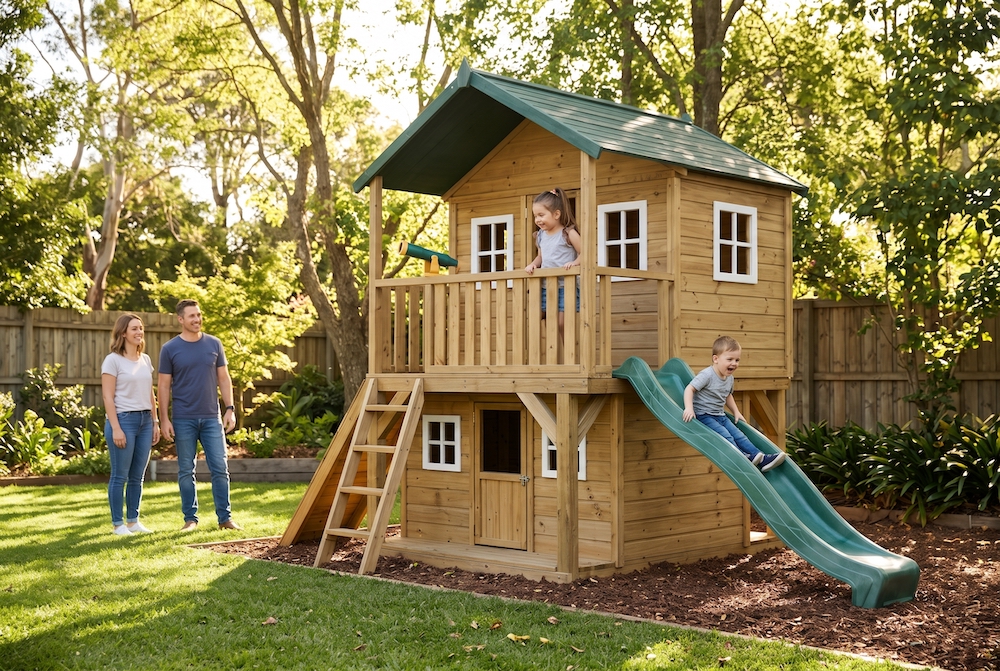
Raised cubbies sit on a platform, often with a ladder, slide or climbing wall.
They add a little adventure and can free up space underneath for a sandpit or storage area.
However, elevated designs require particular attention to fall protection, guardrails, ladder access, structural stability and suitable impact-absorbing surfaces.
Two-storey and combination designs
Two-storey and combination designs, which may include slides, rock-climbing walls, monkey bars or swings, turn a cubby into a full play centre.
They suit larger yards and families with children of different ages.
Before choosing one, consider whether all the features will genuinely be used and whether your backyard has enough room for safe movement around each activity.
Modular and adaptable designs
Some cubbies can be extended with additional accessories or play equipment.
These may be worth considering if you want something that can change as your children grow.
Check that any additional components are specifically designed for the model and can be installed without compromising its structural integrity.
Checking Size and Space
Measure the yard before choosing a cubby.
Note the footprint of the cubby itself, plus clear space around it for climbing, sliding and running.
If the design has a slide, allow room at the bottom for children to land and move away.
A cubby that looks compact in a product photograph can take up considerably more room once its ladder, slide and surrounding clearance are included.
Planning for smaller backyards
Not every family has a large backyard, and that doesn’t mean a cubby house is out of the question.
Consider:
- Compact ground-level cubbies.
- Vertical designs that use space efficiently.
- Smaller playhouses with multifunctional features.
- Designs incorporating storage.
- Cubby houses that fit into an existing garden layout.
A smaller, thoughtfully positioned cubby can be a better choice than a large play centre that leaves little room for other activities.
Think about access and installation
Think about access too.
Plan a clear path from the house so children can get there easily, even in wet weather.
Check that the boxed parts will fit through your side gate or house, and that there is space to assemble the cubby on site.
Also consider whether delivery vehicles can access the property and whether the assembly area is reasonably level.
Where Should You Position a Cubby House?
The location can make a considerable difference to how comfortable, practical and safe a cubby house will be.
Ideally, position it somewhere that allows children to enjoy their play while remaining visible to supervising adults.
Consider the following:
Visibility: Choose a position where you can see the cubby from the kitchen, living room or another frequently used area.
Swimming pools and water: Keep cubbies away from swimming pools, ponds and other water hazards. Never assume a cubby will provide protection against access to water.
Driveways: Avoid placing the cubby near vehicle access areas or somewhere children might unexpectedly run into a driveway.
Trees and branches: Avoid locations beneath unstable branches or trees that may drop limbs.
Fences and retaining walls: Position the cubby so nearby structures cannot be used to climb onto its roof or gain additional height.
Ground conditions: Choose stable, level ground with suitable drainage.
Access: Allow enough room for adults to reach the structure for cleaning, supervision and maintenance.
The Royal Children’s Hospital Melbourne recommends considering how children might misuse play equipment, including climbing onto the roof of a cubby house. It’s a useful reminder that children don’t always use equipment in the way adults expect.
Australian reference: Royal Children’s Hospital – Safety: Backyards and Playgrounds.
Materials and Weather: Timber or Plastic?
Most backyard cubbies are made from timber or plastic. Take note that outdoor wooden cubbies are not automatically weatherproof or UV-protected. Always check the actual product specifications, including any protective coatings and UV-stabilised plastic components.
Both materials have advantages, and the right choice depends on your budget, climate, preferred appearance and willingness to maintain the structure.
Timber cubby houses
Timber looks natural and can be painted to match the house or garden.
It can also be personalised with different colours, decorative features and accessories.
However, timber needs regular care to stay in good shape.
Consider:
- The type and quality of timber.
- Whether it has been treated for outdoor use.
- The quality of the protective finish.
- Its resistance to moisture and rot.
- Whether it is prone to splintering.
- The manufacturer’s recommended maintenance schedule.
Also check what preservatives or timber treatments have been used and whether additional coatings are required before children use the structure.
Plastic cubby houses
Plastic is easy to clean, light and generally low maintenance.
It can be a convenient option for smaller backyards or families who want something easier to move if they change the layout of the yard later.
However, plastic may fade or deteriorate over time in strong Australian sunlight.
Check whether the material is UV-stabilised and whether the manufacturer provides information about outdoor exposure and temperature limitations.
Timber versus plastic: At a glance
| Consideration | Timber | Plastic |
|---|---|---|
| Appearance | Natural and traditional | Bright and contemporary |
| Maintenance | Painting and sealing may be required | Generally easier to clean |
| Weather exposure | Requires suitable protection | UV deterioration can occur |
| Customisation | Usually easy to paint | More limited |
| Weight | Often heavier | Generally lighter |
| Assembly | Can require more construction | Often simpler, model dependent |
| Longevity | Depends on timber and maintenance | Depends on plastic quality and exposure |
Neither material is automatically the better choice. Construction quality, appropriate outdoor suitability and regular maintenance matter more than simply choosing timber or plastic.
Understanding Australian Weather and Material Durability
Australia’s climate can be particularly demanding on outdoor play equipment.
A cubby house that looks fantastic when first installed may deteriorate more quickly if it is exposed to harsh sunlight, heavy rain or strong winds without appropriate protection.
Consider your local conditions.
Strong sunlight and UV exposure
Prolonged exposure can cause plastic to fade and some materials to become brittle. Paint and protective coatings can also deteriorate.
Rain and humidity
Moisture can contribute to timber swelling, rot, mould and deterioration, particularly where water becomes trapped around floors, joints or roof connections.
Coastal environments
Salt exposure can accelerate corrosion of metal fittings, screws and other components.
Extreme heat
Enclosed cubbies can become uncomfortably hot during summer. Roofing, plastic components and metal fixtures can also become hot to touch.
Wind
Raised structures and cubbies with large exposed surfaces need appropriate anchoring, particularly in windy areas.
In very sunny areas, place the cubby where it gets some afternoon shade, which helps keep it cooler inside and protects the finish.
Safety Features to Look For
A cubby house should be somewhere children can enjoy exploring, imagining and playing. But before buying, it’s worth spending time checking the safety features rather than relying on attractive product photographs.
The Australian Competition and Consumer Commission (ACCC) provides specific guidance about cubby houses and children’s play tents.
Importantly, the ACCC states that there is no mandatory Australian safety standard specifically for cubby houses and tents.
That doesn’t mean parents should overlook safety. It means it’s particularly important to check the design, construction and manufacturer’s information.
Look for:
- Rounded edges and smooth surfaces.
- No exposed nails, screws or sharp fittings.
- Secure railings on raised platforms.
- Stable ladders and climbing structures.
- No gaps where fingers, heads or limbs could become trapped.
- Doors that open easily from the inside.
- Adequate ventilation.
- Suitable age and weight recommendations.
- Secure anchoring and stable construction.
- Appropriate clearance around slides and climbing equipment.
Ventilation and doors: An important safety consideration
This is an area parents should pay particular attention to.
The ACCC warns that children can become trapped inside cubby houses if doors cannot be easily opened from the inside. Inadequate ventilation can also create a suffocation risk.
Its guidance recommends:
- Adequate ventilation through walls, covers or doors.
- Doors that can be easily opened from inside.
- A 1.5 cm gap at the hinged side of cubby house doors.
- No dangerous gaps or openings where children can become trapped.
Make sure ventilation openings remain unobstructed, particularly when positioning the cubby near a wall or fence.
Avoid adding locks or latches that could prevent children from getting out independently.
Guardrails, ladders and climbing features
Raised cubbies require additional attention.
Check that guardrails are secure and appropriate for the platform height. Look for stable ladders, suitable handholds and properly fitted climbing features.
The Royal Children’s Hospital Melbourne advises that play equipment higher than 1.5 metres is not suitable for children under five years of age. Its backyard safety guidance also recommends that equipment height should not exceed 2.5 metres.
These are important considerations when comparing elevated designs.
Also remember that children may attempt to climb onto the roof, railings or other parts of the structure, so consider the entire environment rather than just the intended climbing route.
Understanding Australian playground standards
You may come across references to Australian Standards when researching cubby houses.
These include:
- AS 4685: Playground equipment and surfacing.
- AS 4422: Playground surfacing specifications, requirements and test methods.
- AS/NZS 8124.6: Safety of toys – swings, slides and similar activity toys for indoor and outdoor family domestic use.
However, these standards cover different equipment and applications. They should not be treated as interchangeable or automatically applicable to every domestic cubby.
Ask the retailer whether the particular product has been independently tested, which standards apply to its components and whether supporting documentation is available.
Australian references: ACCC – Cubby Houses and Tents Guide and Kidsafe Victoria – Australian Playground Standards.
Understanding Fall Zones and Impact-Absorbing Surfaces
Underneath raised cubbies and slides, use a suitable impact-absorbing surface to help reduce the severity of injuries if a child falls.
Hard surfaces such as concrete, pavers and compacted soil are particularly unforgiving.
The Royal Children’s Hospital recommends soft-fall material beneath swings, slides and climbing equipment. Its guidance specifies a minimum depth of 300 mm for woodchips in the playground context.
However, not all soft surfaces provide the same protection.
Consider:
- The height from which a child could fall.
- The manufacturer’s recommended fall protection.
- The depth and condition of loose-fill material.
- Whether the surface becomes compacted.
- Whether drainage is adequate.
- Whether the material needs regular topping up.
Ordinary grass should not automatically be considered a certified impact-absorbing playground surface.
If you’re installing a raised cubby, check what surface is appropriate for its height and design rather than assuming a patch of lawn will be sufficient.
Sun Protection and Heat Management
A cubby house might be a wonderful place to play, but it can become surprisingly hot when exposed to direct sunlight.
This is particularly important during Australian summers.
A few simple considerations can make the space more comfortable:
- Position the cubby where it receives some natural shade.
- Consider a suitable shade sail or other shade structure.
- Check the temperature inside before children enter.
- Be mindful of hot roofs, metal fixtures and plastic surfaces.
- Encourage regular water breaks.
- Make sure children have access to shade when playing outdoors.
Remember that shade does not eliminate UV exposure. Follow the SunSmart approach, including sun-protective clothing, a suitable hat, sunscreen and sunglasses when appropriate.
The Cancer Council recommends using shade and protective clothing as part of a broader sun protection approach.
Australian reference: Cancer Council Australia – Sun Protection.
Indoor Versus Outdoor Cubby Houses
Some smaller designs are made specifically for indoor use, while others are constructed to withstand outdoor conditions.
Before buying, check whether the model is intended for the environment where you plan to use it.
Indoor cubbies
Indoor designs can be useful for apartments, smaller homes or families without a suitable backyard.
They may provide a dedicated space for pretend play, reading and creative activities.
Check:
- Stability and floor protection.
- Suitable dimensions for the room.
- Door and window safety.
- Ventilation.
- Safe positioning away from heaters and electrical hazards.
- Whether the materials are appropriate for indoor use.
Outdoor cubbies
Outdoor designs need to withstand exposure to the elements.
Check for weather-resistant construction, suitable protective finishes, drainage, ventilation and appropriate anchoring.
Do not assume an indoor cubby can safely be used outdoors. Materials such as MDF can swell or deteriorate when exposed to moisture unless specifically designed and rated for that environment.
Buying a Second-Hand Cubby House
A second-hand cubby house can be an attractive option for families wanting to save money, but it’s important to inspect it carefully before purchasing.
Facebook Marketplace, Gumtree and local community groups often feature used outdoor play equipment.
Before handing over your money, check:
- Whether the product has been recalled.
- Whether the original manufacturer and model can be identified.
- Whether assembly and safety instructions are available.
- Whether all original components are present.
- Whether the timber has cracks, rot or splinters.
- Whether screws and bolts are missing or corroded.
- Whether ladders, platforms and railings are secure.
- Whether slides and climbing attachments are damaged.
- Whether previous modifications have compromised the structure.
- Whether suitable anchoring equipment is available.
If the structure has been dismantled, ask whether all the original parts and fittings have been retained.
A cheap cubby can become an expensive project if substantial repairs or replacement components are needed.
The ACCC recommends checking second-hand cubbies for recalls, safe-use instructions and the condition of all components.
Delivery, Assembly and Finishing
Check what is included before ordering, such as floors, windows, slides and anchor kits.
Lifespan Kids mentions standard metro delivery on its website, for example, but always check the current delivery terms, geographical exclusions and any additional charges before placing an order.
Find out:
- Whether delivery is included.
- Whether the cubby arrives in flat-pack form.
- Whether assembly is included.
- How long assembly is likely to take.
- Whether you will need a second adult.
- Which tools are required.
- Whether the ground needs preparation.
- Whether additional anchoring equipment is needed.
- Whether any parts require painting or sealing.
Some cubbies arrive pre-painted, while others need painting or sealing once assembled.
Plan a weekend for this, and use a suitable child-safe, outdoor-rated paint or stain that is compatible with the material and recommended by the manufacturer.
Follow the product’s instructions for application, drying and curing times before children use the structure.
Painting can also be a fun family project, with children helping to choose colours or decorate the door, provided they are kept away from wet paint, tools and potentially harmful products.
Preparing Your Backyard Before Installation
Before assembling the cubby, spend a little time preparing the area.
A suitable installation site should be stable, level and free from obvious hazards.
Consider:
- Clearing rocks, exposed roots and garden debris.
- Checking ground levels.
- Ensuring appropriate drainage.
- Removing overhanging hazards.
- Preparing the recommended impact-absorbing surface.
- Checking access for delivery.
- Allowing sufficient assembly space.
- Locating underground services before digging for anchors.
Follow the manufacturer’s installation instructions carefully, particularly when securing the structure to the ground.
For larger installations or significant landscaping work, check whether additional site or planning requirements apply.
Making the Cubby a Favourite Spot
The cubby itself is only the start.
A few simple touches can make it the spot children want to be in after school and on weekends.
Add a small table and chairs, a basket of dress-up clothes or a box of play kitchen items.
A chalkboard on the wall or a set of curtains turns it into a shop, a cafe or a classroom.
Rotating the toys every few weeks keeps it feeling fresh.
Encourage imaginative play without taking over
Sometimes the best thing parents can do is provide a few simple resources and let children decide what happens next.
Try:
- A collection of dress-up clothes.
- Toy food and kitchen accessories.
- Notebooks for pretend orders and menus.
- Old magazines for creative projects.
- A basket of books.
- Chalkboards for drawing and writing.
- Building blocks and construction toys.
- Puppets and soft toys.
You don’t need to fill every corner with expensive accessories. Open-ended materials often give children more opportunities to invent their own games.
Bring a little nature into the space
A small garden bed out the front can turn the cubby into something even more special.
Children might enjoy planting flowers, growing herbs or watching butterflies visit the garden.
A small collection of leaves, pinecones and interesting natural objects can also inspire conversations and creative activities.
Just make sure plants are suitable for a children’s play area and avoid poisonous or irritating varieties.
Keep garden chemicals, fertilisers and sharp gardening tools securely stored away.
Create a quiet reading nook
A cubby house doesn’t always need to be somewhere children run around and make lots of noise.
For some children, it can become a quiet retreat.
A few cushions, a basket of picture books and a comfortable seating area can create a lovely little reading space.
It’s also somewhere children can enjoy quiet imaginative games or spend time with a sibling or friend.
Make the cubby inclusive
Children have different physical, sensory and developmental needs, and the right environment can make a difference to how comfortably they participate in play.
Consider:
- Ground-level access.
- Wider entrances where possible.
- Clear pathways.
- Stable flooring.
- Comfortable seating.
- Shade and temperature control.
- Adaptable play accessories.
- A quieter space for children who prefer less stimulation.
A cubby house doesn’t need to be elaborate to be welcoming. Small adjustments can make it more accessible and enjoyable for a wider range of children.
Involve children in creating their space
Involve children in setting it up.
Let them choose a name for the cubby, help paint a sign or plant a small garden bed out the front.
Children who help create the space are often more likely to feel a sense of ownership and connection to it.
Picture two families.
One with a three-year-old chooses a ground-level cottage cubby, paints it in bright colours and adds a small garden bed out the front.
Another with a six- and eight-year-old chooses a raised cubby with a slide and climbing wall, and turns the space underneath into a sandpit.
Both families have chosen something different, but each has created a little backyard environment that reflects their children’s ages, interests and personalities.
Keeping the Space Tidy and Safe
A little organisation helps keep the cubby enjoyable and reduces potential hazards.
Avoid heavy items on high shelves, keep sharp tools and garden chemicals well away, and check inside for spiders or insects before little ones climb in, especially after it has been closed up for a while.
In Australian backyards, it’s sensible to check for:
- Spider webs and egg sacs.
- Ant nests.
- Wasps and other stinging insects.
- Accumulated leaves and garden debris.
- Signs of rodents or other pests.
- Snakes in areas where they are prevalent.
Avoid leaving food scraps inside, and keep the surrounding area reasonably clear.
If you find a potentially dangerous animal, don’t encourage children to approach or handle it. Seek appropriate professional assistance where necessary.
Looking After a Cubby House
A little regular care keeps a cubby safe and looking good.
Check bolts and screws every few months, look for splinters or loose boards, and clear out leaves, spider webs and toys that might attract pests.
For timber cubbies, repaint or reseal as the finish wears, depending on the weather, timber type and manufacturer’s recommendations.
Lightly sand any rough patches first, using appropriate protective equipment, and choose a calm, dry weekend so the paint can cure properly before children play inside again.
Top up softfall under slides and platforms as it thins, following the recommended depth and material specifications.
A simple seasonal maintenance routine
Autumn
- Remove fallen leaves and garden debris.
- Check the roof and drainage.
- Look for loose fixings.
- Inspect timber for water damage.
Winter
- Check for moisture, mould and rot.
- Look for rusted fittings.
- Check anchoring after periods of strong wind.
- Make sure doors and windows operate properly.
Spring
- Inspect paintwork and protective coatings.
- Check for splinters and damaged timber.
- Clean windows, doors and surfaces.
- Inspect ladders, slides and climbing features.
Summer
- Check for heat damage and UV deterioration.
- Inspect plastic components.
- Check shade and ventilation.
- Make sure the surrounding softfall remains suitable.
What should you check during a safety inspection?
Pay particular attention to:
- Loose bolts, screws and fixings.
- Splintering timber.
- Cracked or damaged components.
- Loose railings.
- Unstable ladders.
- Damaged slides.
- Sharp edges.
- Blocked ventilation.
- Door hinges and finger entrapment points.
- Worn impact-absorbing surfaces.
- Signs of rust, rot or mould.
If a component is damaged, stop children using the affected part until it has been properly repaired.
Regular inspections are particularly important after storms, strong winds or periods of heavy rain.
Understanding the True Cost of a Cubby House
When comparing cubby houses, it’s easy to focus on the advertised purchase price.
But the actual cost can be quite different once everything is included.
Remember to budget for:
- The cubby house itself.
- Delivery fees.
- Assembly or installation.
- Ground preparation.
- Anchoring equipment.
- Suitable impact-absorbing surfaces.
- Paint and protective coatings.
- Shade structures.
- Landscaping.
- Replacement parts.
- Ongoing maintenance.
A cheaper cubby isn’t necessarily the best value if it requires extensive repairs or additional safety modifications.
Look at the overall quality, durability, installation requirements and expected maintenance before making your decision.
Common Cubby House Buying Mistakes to Avoid
A little preparation can help prevent some disappointing and potentially expensive purchasing decisions.
Choosing based on appearance alone: A beautiful cubby isn’t necessarily the most suitable one for your child’s age, abilities or backyard.
Forgetting the surrounding space: Remember that slides, ladders and climbing features require additional clearance.
Overlooking ventilation: Enclosed playhouses need adequate ventilation and doors that children can open from inside.
Assuming grass provides adequate fall protection: Check the recommended impact-absorbing surface for elevated equipment.
Ignoring Australian weather conditions: Sun, rain, humidity and wind can all affect materials and longevity.
Not checking delivery and assembly requirements: A large flat-pack cubby may require more space, tools and time than expected.
Buying without checking the specifications: Always check age recommendations, weight limits, product suitability and assembly instructions.
Forgetting ongoing maintenance: Timber, plastic and metal components all need periodic inspection.
Frequently Asked Questions
What age is appropriate for a cubby house?
There isn’t one age that suits every cubby house. Some ground-level designs are suitable for younger children, while raised cubbies with slides and climbing features are generally intended for older children.
Always follow the manufacturer’s age and weight recommendations and consider your child’s individual abilities and confidence.
Are cubby houses good for children’s development?
They can provide valuable opportunities for imaginative, social and independent play.
Children may use them to create stories, practise communication, solve problems, negotiate with friends and explore different roles.
The Australian Early Years Learning Framework recognises play as an important context for children’s learning and development.
Do cubby houses encourage imaginative play?
Yes, a cubby can provide a dedicated environment for pretend play.
Children may turn it into a shop, school, restaurant, clubhouse or secret hideaway. Providing a few open-ended toys and accessories can help encourage creativity without dictating how they should play.
Are raised cubby houses safe for toddlers?
Raised cubbies require particular care because of the risk of falls.
Consider a ground-level design for younger children and always check the manufacturer’s age recommendations. The Royal Children’s Hospital advises that equipment higher than 1.5 metres is not suitable for children under five.
Do cubby houses need softfall underneath?
Elevated cubbies, slides and climbing equipment need appropriate impact protection.
The correct surface depends on the equipment, fall height and manufacturer’s instructions. Ordinary grass should not automatically be considered sufficient protection.
Can a cubby house go on pavers or concrete?
It can be installed on a suitable hard surface if the manufacturer’s installation requirements are met and the structure is securely anchored.
However, hard surfaces can increase injury severity if children fall. Provide appropriate impact-absorbing protection around climbing and sliding areas, taking account of the equipment’s fall height.
How much space should you leave around a cubby house?
This depends on the design and its features.
Measure the actual footprint, then account for slides, ladders, climbing equipment, access and surrounding fall zones.
Follow the manufacturer’s recommended clearance rather than relying on the dimensions of the cubby alone.
Should a cubby house be anchored to the ground?
Raised or larger cubbies should be secured according to the manufacturer’s instructions.
Appropriate anchoring helps prevent movement and instability, particularly during strong winds.
Are timber or plastic cubby houses better?
Both have advantages.
Timber offers a natural appearance and greater customisation, but requires maintenance. Plastic is generally easier to clean and move, although prolonged UV exposure can affect its appearance and condition.
The best option depends on your budget, backyard, local climate and maintenance preferences.
How do you protect a timber cubby house from rain?
Choose a timber cubby designed for outdoor use, follow the manufacturer’s recommendations for protective coatings and ensure the structure has suitable drainage.
Regularly inspect the roof, floor, joints and timber for signs of moisture damage.
How often should a timber cubby house be resealed?
There isn’t a universal timeframe.
It depends on the timber, protective finish, sunlight exposure, rainfall and manufacturer recommendations. Inspect the coating regularly and reapply when it begins to deteriorate.
Do cubby houses get too hot in summer?
They can, particularly when enclosed and exposed to direct sunlight.
Position the cubby where possible in a shaded area, maintain ventilation and check internal temperatures and surfaces before children play.
How do you keep spiders out of a cubby house?
Regularly remove spider webs, leaves and other debris. Inspect corners, underneath furniture and around windows and doors.
Keep the surrounding area tidy and avoid storing items that attract insects or other pests.
Can you buy a second-hand cubby house?
Yes, but inspect it carefully.
Check for recalls, missing components, structural damage, splinters, rust, loose fittings and previous modifications. Ask for the original assembly instructions and manufacturer information where possible.
Do you need council approval for a cubby house?
In Victoria, the Building and Plumbing Commission states that cubby houses and play equipment used for children’s play do not require a building permit.
However, other planning, property or site restrictions may still be relevant, particularly for larger or unusual structures. Check with your local council if you are unsure.
Can a cubby house be used indoors?
Some smaller designs are made specifically for indoor use.
Check the manufacturer’s specifications before purchasing. Outdoor cubbies may be too large or unsuitable for indoor use, while indoor designs may not withstand rain or moisture.
How long does it take to assemble a cubby house?
This depends on the size, design and complexity of the structure.
A smaller plastic playhouse may take considerably less time than a large timber cubby with a raised platform, slide and climbing wall.
Check the manufacturer’s estimated assembly time and whether additional help or tools are required.
What should you put inside a children’s cubby house?
Keep it simple and let children decide what they enjoy.
Popular options include a small table and chairs, pretend kitchen accessories, dress-up clothes, books, cushions, chalkboards and storage baskets.
Avoid heavy furniture, sharp objects and anything that could obstruct doors or ventilation.
Ready to Buy a Cubby House?
Before you buy a cubby house, match the style and height to your child’s age, measure the yard and plan the space around it.
Choose weather-resistant materials and check the safety features, including ventilation, doors, guardrails, ladders and appropriate fall protection.
Then plan for assembly, painting, anchoring and regular checks.
Most importantly, think about the kind of space your child will enjoy. It doesn’t need to be the biggest, most expensive or most elaborate design. Sometimes a simple little house, a few cushions and a collection of toys are all it takes.
Because years from now, your child might not remember how much the cubby cost or what brand it was. But they may remember the mud cakes, the secret passwords, the afternoons spent playing shop and the countless adventures that happened in their very own little backyard world.
And isn’t that what childhood is all about?
Australian References and Further Reading
The following Australian sources support the developmental, physical activity, safety and practical information discussed throughout this article.
- Australian Competition and Consumer Commission (ACCC) – Cubby Houses and Tents Guide. Product design, ventilation, door safety, entrapment and second-hand cubbies.
- Australian Children’s Education and Care Quality Authority (ACECQA) – Information Sheet: EYLF Practices – Play-based Learning and Intentionality. Research-informed guidance on play, imagination, agency, problem-solving and learning.
- ACECQA – Approved Learning Frameworks. The Early Years Learning Framework for Australia V2.0.
- Australian Government Department of Health, Disability and Ageing – 24-Hour Movement Guidelines for All Australians. Physical activity, sedentary behaviour and sleep recommendations.
- Royal Children’s Hospital Melbourne – Safety: Backyards and Playgrounds. Play equipment, falls, installation, supervision and impact-absorbing surfaces.
- Kidsafe Victoria – Australian Playground Standards. Australian Standards relating to playground equipment and surfacing.
- Cancer Council Australia – Sun Protection. Shade, protective clothing, sunscreen and outdoor UV protection.
- Victorian Building and Plumbing Commission – Landscaping. Victorian building permit information for cubby houses and children’s play equipment.
- Australian Bureau of Statistics – Children’s Physical Activity, Screen Time and Sleep. Australian data on children’s movement, screen time and sleep.
Editorial note: Safety standards and building requirements can change. Parents should check current manufacturer instructions and relevant Australian government guidance before purchasing and installing play equipment.


