
Kiddipedia
As we are steadily approaching the end of the year, many of us are eager to find a unique and thoughtful thank-you gift as a token of appreciation to our beloved teachers who help our children feel safe, welcome and ready to learn throughout the year. However, that said, I am a big fan of supporting the fact that the best thank-yous don’t come with a price tag or an expectation.
Upon reflection, there are some preschool moments that stay with you. The educator who gently takes your child’s hand when they don’t want you to leave. The person who knows just how to settle them after a difficult morning. The familiar face who tells you they’ve made a new friend, tried something for the first time or finally felt confident enough to join in.
As parents, we don’t always see what happens during the day. But when our children come home feeling happy, supported and proud of themselves, we get little glimpses of the care and encouragement they’ve received.
So, when the end of the year arrives or a special occasion gives families a reason to say thank you, it’s understandable that parents want to do something thoughtful for the people who have played such an important part in their child’s preschool experience.
The tricky part can be organising a group gift. Not every family has the same budget, not everyone knows every staff member, and what begins as a lovely idea can quickly become uncomfortable if people feel pressured to contribute.
A thank-you should make educators feel appreciated, not leave parents feeling obliged to spend money. With a little thought, parent groups can recognise the whole team, involve the children and make sure every family feels welcome, whether they contribute financially or not.
Why the Relationships Educators Build Matter
Before having children, I always thought preschool was primarily about teaching our children their ABCs, how to count, recognise colours and shapes, and giving them the basic educational building blocks they would need before starting school. And while these things are certainly part of early learning, now being a parent, I’ve come to realise that preschool is about much more than keeping children busy until home time, and there is something much bigger happening beneath the surface.
From a neurological perspective, the early years are an incredibly important period for brain development. During this time, children’s brains are developing rapidly, building connections that support how they learn, communicate, manage their emotions, respond to others and make sense of the world around them. Victoria’s Early Years Learning and Development Framework recognises these early experiences as fundamental to children’s developing identity, wellbeing, learning and communication.
In fact, the Australian Education Research Organisation (AERO) explains that executive function and self-regulation develop through children’s everyday experiences and interactions. These important skills help children direct their attention, hold information in their memory, manage impulses, respond to their emotions, adapt to changing situations and work through problems. In other words, it’s not just about what children know; it’s also about developing the skills their brains need to use that knowledge.
Think about what happens when a child has to wait for a turn, remember the rules of a game, work through a disagreement, listen to someone else’s ideas or keep trying when something feels difficult. These may seem like little everyday moments, but they give children opportunities to practise attention, memory, flexible thinking, emotional regulation and problem-solving. With guidance, encouragement and repeated opportunities, these skills gradually become stronger.
Through play, conversations, friendships and secure relationships with educators, children are also learning to recognise and express their feelings, build confidence, develop empathy, become more independent and understand that other people have thoughts and feelings of their own. These experiences matter because early learning is not just about academic preparation; it’s also about developing the social and emotional foundations children need to participate, build relationships and navigate the world around them.
So, while learning the alphabet and counting to ten are valuable, preschool is also laying the foundations for something much more fundamental: helping children develop the emotional, social, cognitive and communication skills they will draw on throughout their lives.
Start With a Simple, Voluntary Collection
As a parent group, before choosing a gift, agree on a budget that feels comfortable and make it clear that contributing is entirely optional.
This matters. Families are managing different household expenses, childcare fees, groceries, rent or mortgage payments and all the other costs that come with raising children. A contribution that seems small to one household may be difficult for another.
Australian Bureau of Statistics living-cost data provides a useful reminder that household expenses vary and change over time. No family should have to explain its financial circumstances to take part in a preschool thank-you.
A parent organising the collection could send a simple message:
“We’re organising a small thank-you for the preschool team to recognise everything they’ve done for the children this year. Contributions are completely optional, and there is no expected amount. Families are also welcome to contribute a message or their child’s artwork instead.”
A few ground rules can prevent awkwardness:
- Keep contributions voluntary, with no suggested minimum.
- Don’t publish a list of who has or hasn’t paid.
- Keep individual amounts private.
- Include every child in the group thank-you unless their family asks otherwise.
- If less money is collected than expected, choose a smaller gift rather than asking families to contribute more.
- Agree in advance how any leftover money will be handled.
The important thing is that a child isn’t made to feel different because their family couldn’t or didn’t contribute. A thank-you is about the educators, not the size of the collection.
For further context, see the Australian Bureau of Statistics – Selected Living Cost Indexes.
Remember the Whole Preschool Team
It’s easy to think first of the educator who greets your child each morning or spends the most time in their room. But a preschool relies on many people to create a welcoming, safe and supportive environment.
Before organising a gift, ask the preschool director for an up-to-date staff list. Consider whether the thank-you should include relief educators, assistant educators, room leaders, inclusion support professionals, educational leaders, administrators, cooks and other staff who contribute to the children’s day.
Some people may work across different rooms or days, while others may rarely have direct contact with parents. That doesn’t mean their contribution is any less worthwhile.
ACECQA’s National Quality Standard recognises the importance of respectful relationships with children and collaborative partnerships with families. Acknowledging the wider team is a practical way to recognise that preschool care is a shared effort.
The fairest approach is to recognise the people who contribute, not just the people parents happen to know best.
A Shared Award or a Personal Thank-You?
A group award can be a lovely way to recognise the team’s collective effort without singling out a favourite educator. For example, a crystal recognition award could be engraved with a message such as:
“With heartfelt thanks to our preschool team for the kindness, patience, encouragement and care you give our children. You help make preschool a place where little people feel welcome, supported and ready to learn.”
Check whether the service would like to display the award somewhere staff across different shifts can see it.
Personal notes can make the gesture even more meaningful. Rather than writing the same general message for everyone, parents could mention something specific they have noticed:
- “Thank you for helping our child feel confident enough to walk into preschool with a smile.”
- “We appreciate the patience and encouragement you showed when making new friends wasn’t easy.”
- “Thank you for celebrating the little milestones that meant so much to our family.”
- “Your kindness during those difficult drop-off mornings made a world of difference.”
A note might also thank an administrator for patiently answering questions, a cook for accommodating a child’s dietary needs, or a support professional for helping a child take part in activities.
One parent can coordinate the messages to make sure nobody is overlooked. The aim isn’t to compare staff members or decide who deserves the most praise. It’s to make sure the people being thanked feel included.
If the group would like to arrange a morning tea or brief presentation, check with the director first. Ask what would suit staff and when it would cause the least disruption. Keep attendance optional and make sure anyone who cannot attend receives the same recognition.
Choose a Gift the Team Can Actually Enjoy
A thoughtful present doesn’t need to be expensive. In fact, checking what staff can accept and what they would genuinely use is often more considerate than buying something elaborate.
Preschools and early childhood services may have different workplace policies about gifts, vouchers and their value. A discreet question to the director before purchasing anything can save an educator the uncomfortable task of declining a present they aren’t permitted to accept.
If vouchers are allowed, agree on how they will be distributed. If the intention is equal recognition, make sure staff working different days or shifts are not unintentionally overlooked.
For food hampers or shared treats, check allergies, dietary needs, storage arrangements and staff preferences. A hamper that arrives when only part of the team is working may not be shared fairly.
Other ideas include:
- A personalised thank-you booklet: Bring together short messages from families.
- Children’s artwork: Frame a collaborative picture or display.
- A shared morning tea: Keep it simple and check that staff are happy with the arrangement.
- A team keepsake: Consider a small engraved item for the staffroom.
- A plant: Choose something manageable for a shared space.
- A preschool memory book: Include children’s drawings, messages and photographs only where appropriate permissions are in place.
- A book for the preschool library: A story chosen for the children’s collection can be a useful shared gift.
- An appreciation certificate: Recognise the whole team with a message from families.
Some gifts are best avoided. Expensive personal presents may exceed workplace limits; perfume and strongly scented products may not suit everyone; alcohol may be inappropriate; and food should never be purchased without checking allergies and dietary requirements. Highly personal gifts, presents that create comparisons between staff, or items that require ongoing care can also put educators in an awkward position.
Before spending the money, agree on what will happen if there is a surplus. Let families know the final amount collected and how it was used, without identifying individual donors.
Let the Children Be Part of Saying Thank You
One of the loveliest parts of a preschool thank-you can be hearing what the children remember.
A child might talk about the educator who helped them make a friend, comforted them when they were sad or showed them how to use the paintbrushes. Another might remember a favourite story, a funny moment or the person who helped with a tricky zip.
These little details can make a thank-you feel personal in a way that an expensive gift sometimes cannot.
Try asking your child:
- “Who helped you when you felt a little bit sad?”
- “What’s something new you learned at preschool?”
- “Who helped you make a friend?”
- “What’s something that makes you smile when you arrive?”
- “Is there something you’d like to say thank you for?”
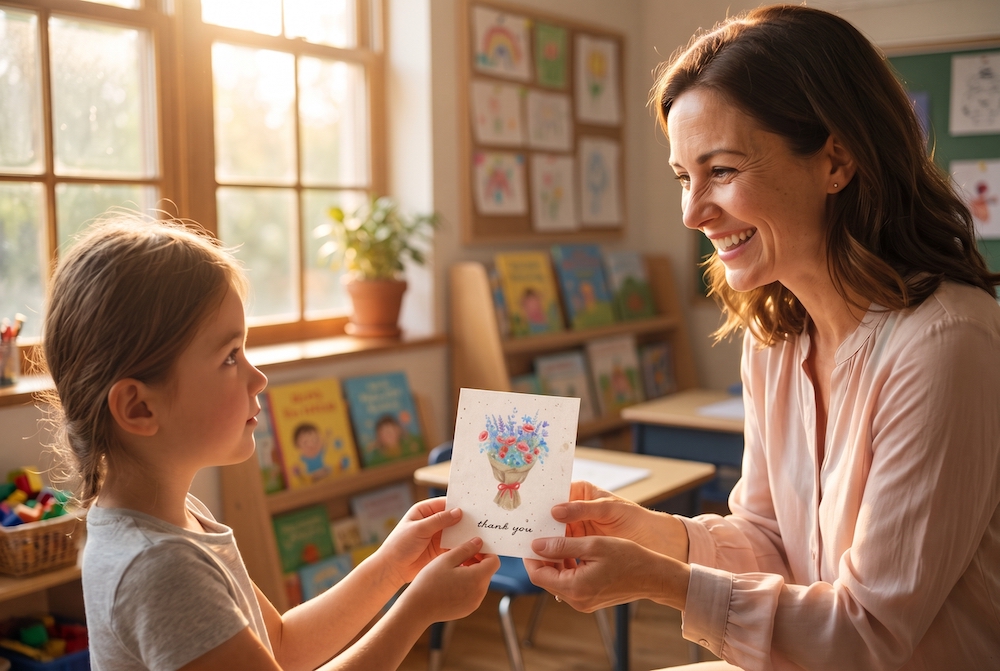
Children could draw a favourite preschool memory, dictate a short message, contribute to a group artwork or help make a simple thank-you card.
Some children will happily talk about their experiences; others may prefer pictures, gestures or another way of communicating. There is no need to turn the activity into a formal lesson or expect every child to produce a perfect message.
The Early Years Learning Framework V2.0 recognises children’s agency, communication, relationships and connections with their communities. An age-appropriate thank-you activity can give children a natural opportunity to think about the people who help them and the relationships they value.
Let children take part in a way that feels comfortable for them. Their own words and drawings are more than enough.
Make Sure Every Family and Child Feels Included
Preschool communities bring together families with different cultures, languages, traditions, abilities and financial circumstances. Not everyone will celebrate the same occasions or feel comfortable joining in with the same activities.
A group thank-you should leave room for those differences.
For example, a family might prefer to send a message in its home language. A child who communicates through pictures, signs or assistive communication should have the same opportunity to contribute as a child who enjoys writing or speaking. And some families may simply choose not to take part.
Practical ways to make the gesture inclusive include:
- Offer non-financial ways to participate.
- Allow messages in families’ preferred languages.
- Make children’s activities accessible and age-appropriate.
- Avoid assumptions about cultural or religious celebrations.
- Respect families who choose not to contribute or participate.
- Never single out a child because their family has not contributed money.
ACECQA’s Inclusive Practice Framework and Early Childhood Australia’s Code of Ethics provide Australian guidance on inclusion, respect and meaningful participation.
The simplest test is this: would every child feel welcome to be part of the thank-you, regardless of their family’s circumstances or the way they communicate?
Protect Children’s Privacy When Making Keepsakes
Photo books and videos can seem like wonderful ways to capture a year of preschool memories. But before including photographs or identifiable information, check the service’s policies and make sure the appropriate permissions are in place.
Don’t assume that permission to take a photograph for one purpose also means it can be shared in a group gift, displayed publicly or posted on social media. Be particularly careful about including photographs of other people’s children.
Australia has also strengthened child-safety requirements around digital devices and images in early childhood education and care. From 27 February 2026, changes to the Education and Care Services National Law and National Regulations restrict the use of personal digital devices in education and care services and place limits on how children’s images can be captured, stored and shared. Some jurisdiction-specific commencement arrangements and exceptions apply, so services should follow the requirements that apply to them.
If you are planning a photo-based gift, ask the director how to handle images safely. Don’t independently take photographs at the service or request copies of children’s images without checking the approved process.
A keepsake should be something educators can enjoy without compromising a child’s privacy or safety.
See ACECQA’s guidance on the safe use of devices in education and care services.
When Parents Don’t Agree on the Gift
Anyone who has organised something for a group of families knows that getting everyone to agree can be harder than expected.
One parent might suggest an expensive hamper, another might prefer vouchers, while someone else thinks a handwritten card is plenty. Different opinions are normal. They don’t need to turn a kind gesture into a source of tension.
A few simple ground rules help:
- Agree on the budget first. Decide what feels affordable before choosing a present.
- Keep the decision collaborative. Invite suggestions, but don’t let one or two people make every decision.
- Respect different financial circumstances. Nobody should have to explain why they aren’t contributing.
- Avoid popularity contests. Recognition should not depend on which educator is best known to the parent group.
- Keep the purpose in perspective. The aim is to say thank you, not to organise the biggest present.
If the conversation starts becoming complicated, the parent coordinating the collection could bring it back to basics:
“We want everyone to feel comfortable, so let’s keep the thank-you simple, affordable and completely voluntary. It’s about recognising the team, not how much anyone spends.”
A Simple Plan to Keep Everything on Track
You don’t need a committee or weeks of complicated arrangements. One parent can coordinate the practical details, provided the group has agreed on the plan.
| When | What to organise |
|---|---|
| Three to four weeks before | Agree on the idea, budget and preschool gift policy. |
| Two to three weeks before | Send one private invitation explaining that contributions are voluntary. Confirm the staff list. |
| One to two weeks before | Collect children’s drawings, family messages and other contributions. |
| One week before | Purchase the agreed gift and confirm delivery or presentation arrangements. |
| Presentation day | Deliver the gift or hold the short gathering, recognising the relevant staff. |
| Afterwards | Thank families collectively and share a simple account of the money collected and spent. |
Keep communication straightforward and avoid creating extra work for educators. A coordinated delivery is usually easier than several separate surprises during busy drop-off and collection times.
Don’t Wait for a Special Occasion to Say Thank You
End-of-year celebrations and appreciation days are lovely opportunities to recognise educators, but the people supporting our children deserve to hear it throughout the year, too.
It could be a quick thank-you after a difficult drop-off, a message acknowledging the patience an educator showed during a challenging week, or a few words about the confidence you’ve noticed growing in your child.
And appreciation works both ways. Listening to educators, respecting their professional knowledge and communicating openly when your child needs extra support all help build the relationships that matter.
ACECQA’s National Quality Standard, particularly Quality Area 6, highlights the importance of respectful relationships with families and collaborative partnerships that support children’s learning, inclusion and wellbeing.
A gift is one way to express appreciation. Being respectful, approachable and willing to work together is another.
Sometimes, the most meaningful thing a parent can say is simply:
“I noticed what you did for my child, and it made a difference. Thank you.”
Frequently Asked Questions
How much should parents contribute towards a preschool gift?
There is no set amount. Agree on a modest budget and make it clear that contributions are voluntary. Families should never feel pressured to give a particular amount.
Do all parents need to contribute to a group gift?
No. Children should not be excluded from a collective thank-you because their family hasn’t contributed financially. Families can offer a message, artwork or another non-financial contribution, or choose not to participate.
What are thoughtful gifts for preschool educators that don’t cost much?
Handwritten notes, children’s drawings, a personalised booklet, a framed group artwork or a collective appreciation certificate can all be meaningful without requiring a large budget.
Should relief educators and support staff be included?
Where appropriate, yes. Ask the director for the current staff list and consider relief educators, administration staff, inclusion support professionals, cooks and other team members who contribute to children’s daily experiences.
Can preschool educators accept gift vouchers?
That depends on the service’s workplace policies and organisational requirements. Check with the director before purchasing vouchers, particularly if you are planning individual gifts.
How can young children take part in thanking their educators?
Children can draw pictures, share favourite memories, dictate a message, contribute to group artwork or talk about something an educator helped them learn. Keep it voluntary, age-appropriate and enjoyable.
A Thank-You That Feels Good for Everyone
Organising a preschool thank-you doesn’t have to be complicated, expensive or stressful. A shared card, a few thoughtful messages from children or a modest gift can be enough to let educators know their efforts haven’t gone unnoticed.
For parents, it’s often the small things that make the biggest difference: the reassuring smile at the door, the patience during a difficult morning, the encouragement to try again and the genuine happiness when a child reaches a new milestone.
Those moments matter to families. And the people who help make them possible deserve to know they’re appreciated.
The best thank-you is one that recognises the educators, respects every family’s circumstances and makes every child feel included.
Has this article been helpful? In that case, take a moment to explore some of our other insightful content.
Australian Research and References
The following Australian sources support the article’s discussion of educator-child relationships, early learning, family partnerships, inclusion, workforce context, household living costs and child safety.
1. Australian Children’s Education and Care Quality Authority (ACECQA). Information Sheet: EYLF Principles – Secure, Respectful and Reciprocal Relationships. Explains the research underpinning relational pedagogy and its importance for children’s learning, development and wellbeing.
2. ACECQA. National Quality Standard. Outlines expectations for relationships with children, staffing arrangements and collaborative partnerships with families.
3. Australian Government Department of Education. Belonging, Being and Becoming: The Early Years Learning Framework for Australia V2.0. The national learning framework for birth to five years, including its principles, practices and learning outcomes.
4. ACECQA. Quality Area 6 – Collaborative Partnerships with Families and Communities. Guidance on respectful relationships and partnerships between services, families and communities.
5. Early Childhood Australia. Code of Ethics and Ethical Principles. Professional ethical guidance for early childhood educators and their relationships with children, families and colleagues.
6. Jobs and Skills Australia (2024). The Future of the Early Childhood Education Profession. Australian workforce research examining the early childhood education profession, including attraction, retention and professional development.
7. Australian Bureau of Statistics. Selected Living Cost Indexes, Australia. Australian household living-cost data providing context for why voluntary contributions need to be sensitive to different family budgets.
8. ACECQA. Inclusive Practice Framework. Australian guidance supporting inclusive participation in early childhood education and care.
9. ACECQA. Safe Use of Devices in Education and Care Services. Guidance on child-safe practices and the requirements governing digital devices and children’s images in early childhood settings.
Evidence note: The EYLF and ACECQA resources draw on research and professional standards concerning children’s development and educator-child relationships. Jobs and Skills Australia provides workforce evidence, while ABS data provides household cost context. These sources do not establish that parent-funded gifts improve educator retention or wellbeing; gift suggestions in this article are practical recommendations, not claims of proven research outcomes.