
Kiddipedia
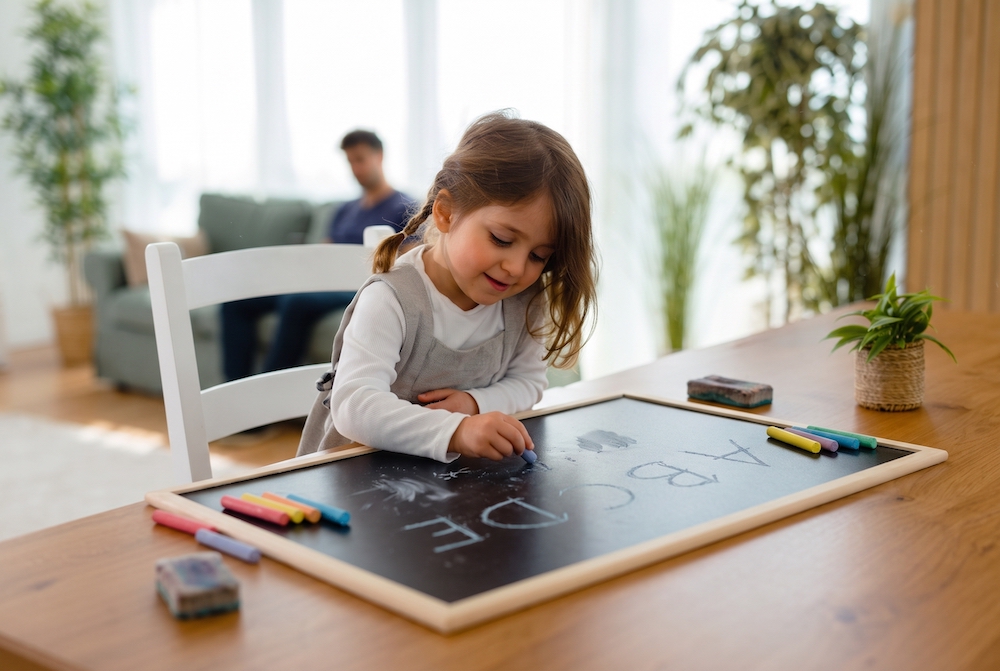
As handwriting returns to the NAPLAN spotlight, an education academic from CQUniversity is proposing a surprisingly simple way to give young children a stronger start in writing – chalk and slate.
Remember the excitement of writing your name for the first time? Or the hours spent drawing, practising letters and rubbing them out before having another go?
For today’s children, those experiences are increasingly sharing space with keyboards, tablets and touchscreens. But could one of the simplest tools from an earlier generation still have something valuable to offer young learners?
With Australian education ministers agreeing that Year 5 NAPLAN writing tests will return to pen and paper from 2028, Dr Ragnar Purje believes it is time to look further back – to the humble chalk stick and handheld slate.
He argues that introducing chalk and slate into Prep and Year 1 classrooms could help children develop the all-important foundational skills needed to become confident, capable writers.
It’s an interesting proposition, particularly at a time when there is renewed concern about children’s writing abilities. The 2026 NAPLAN results showed a slight increase since 2023 in the proportion of students needing additional support in writing.
For Dr Purje, the conversation needs to go beyond how children’s writing is assessed. It also needs to consider how we teach children to write in the first place.
“Writing is not simply a matter of putting words on a page. It is a complex skill involving the brain, body, eyes and hands, as well as the holistic development of fine and gross motor coordination.
“We cannot expect children to become accomplished writers without first teaching them the physical skills that underpin handwriting.
“Chalk and slate offer a simple, practical and inexpensive way to introduce these skills, allowing children to practise, make mistakes, erase and try again.”
Why handwriting is back in Australia’s education spotlight
For parents watching their children grow up in a world where so much happens on a screen, the return to pen and paper might seem a little unexpected.
Children use computers at school, tablets at home and digital devices for everything from researching school projects to communicating with friends. Learning to use technology confidently is certainly important. But there’s another skill that deserves just as much attention: being able to put a thought into words using a pen or pencil.
Typing and handwriting are not interchangeable skills. Both involve learning, coordination and practice, but they place different demands on children.
On 2 November 2026, Australian education ministers agreed that Year 5 NAPLAN writing assessments would return to handwritten completion from 2028, subject to further advice from the Australian Curriculum, Assessment and Reporting Authority (ACARA) about feasibility, costs and workload.
Ministers also requested advice about potentially returning handwritten writing assessments for Years 7 and 9, as well as handwritten numeracy assessments for Years 3 and 5.
The decision is part of a wider national conversation about the role of digital devices in schools and whether students are getting the right balance between screen-based learning and traditional classroom skills.
A national Schools Digital Detox Taskforce has also been established to investigate screen use and advise governments on further action. This doesn’t mean computers and tablets are being pushed out of classrooms. Technology still has an important place in education. The question is whether it is being used purposefully, without taking time and attention away from other essential learning.
The 2026 NAPLAN results add further context. ACARA reported that national results remained broadly stable, with a slight increase since 2023 in the proportion of students needing additional support in reading and writing. Around two-thirds of students achieved Strong or Exceeding proficiency across the tested domains.
Of course, NAPLAN can only tell us so much. It is one measure of student achievement, not a complete picture of a child’s abilities, creativity, confidence or potential. Every child has their own strengths, and a test result cannot capture everything they bring to the classroom.
Nevertheless, the results provide an opportunity to look more closely at whether children are receiving the foundational teaching and practice they need.
For parents, perhaps the bigger question isn’t whether children should be using technology. It’s whether they’re also getting enough opportunities to develop the skills that a keyboard or touchscreen can’t teach in quite the same way.
The science of handwriting: What’s actually happening when children learn to write?
If you’ve ever watched a young child try to write their name, you’ll know it can take quite a bit of concentration.
There’s the pencil to hold, the letters to remember, the movements to work out and the challenge of getting everything onto the page. Sometimes the letters are backwards, sometimes they look a little wobbly, and sometimes a child is so busy concentrating on making the letters that there’s very little attention left for anything else.
And that’s perfectly understandable. Learning to write is a surprisingly complex process.
Behind every letter is a combination of physical, visual, cognitive and language skills working together.
Children need to recognise the shape of a letter, remember how to form it, coordinate their fingers and hands, control the movement of their writing implement and position the finished letter correctly on a surface.
At the same time, they’re beginning to understand that letters represent sounds, sounds combine to form words and words can communicate thoughts, feelings and ideas.
That’s a lot of learning happening in what can look like one very simple activity.
Fine motor development plays an important role. These are the small, controlled movements involving the fingers and hands that allow children to grip a pencil, adjust pressure, draw shapes and form letters.
But handwriting doesn’t depend on little fingers alone. Children also need postural stability, shoulder and arm control, wrist positioning and hand-eye coordination to manage the physical demands of writing.
Visual-motor integration is another important part of the process. Put simply, it’s the ability to coordinate what the eyes see with what the hands are doing. A child needs to recognise a letter’s shape and then reproduce it through controlled movements.
These skills develop gradually through experience, demonstration and opportunities to practise. They don’t suddenly appear when a child starts school, and they certainly don’t develop at exactly the same pace for everyone.
It’s also why everyday activities such as drawing, painting, building, threading and playing with playdough can be so valuable long before children begin formal handwriting lessons.
Those seemingly simple moments of play are giving children opportunities to explore movement, coordination and control – skills they’ll draw on when they eventually pick up a pencil.
Why handwriting automaticity matters
One of the most important concepts in handwriting development is automaticity.
It sounds like a technical term, but the idea is something most of us recognise from learning a new skill. At first, we have to think carefully about every movement. With practice, those movements become more familiar and eventually require much less conscious effort.
Think about a child learning to write their name. Initially, they may need to stop after every letter, think about which direction to move the pencil and carefully work out where the next letter belongs.
With practice, those movements can become increasingly familiar and fluent.
Why does that matter? Because writing involves much more than forming letters.
Children might be thinking about what they want to say, which words to use, how to spell them, how to put a sentence together and how to organise their ideas into a story. That’s quite a lot to juggle, particularly when they’re still getting comfortable with the physical act of writing.
If forming every letter requires considerable conscious effort, it can compete for the attention and working memory needed for those other tasks.
Working memory is the brain’s ability to temporarily hold and work with information. It has limited capacity, so reducing the effort required for basic handwriting movements may leave more mental resources available for composing and expressing ideas.
This doesn’t mean that automatic handwriting will automatically make a child a better storyteller or guarantee stronger literacy outcomes. Writing is a much bigger picture, involving spelling, vocabulary, language, planning, sentence construction and revision.
However, developing fluent handwriting can remove one of the physical barriers that makes writing more demanding for beginner writers.
As children become more proficient at forming and understanding letters, they can devote less mental effort to handwriting and more to composing complex sentences, developing stories and expressing higher-order ideas.
“Once handwriting becomes automatic, children have greater capacity to focus on what they want to say, rather than concentrating solely on how to form the letters,” he said.
“Writing, erasing and writing again is not wasted effort. It is how children practise, improve and develop confidence in their abilities. Repetition is one of the keys to knowledge.”
It’s an important distinction. The goal isn’t simply to have children produce neat letters. It’s to help them reach a point where handwriting becomes less of a hurdle, allowing them to concentrate more on the ideas they want to share.
What Australian research tells us about children’s writing
There’s more to this conversation than a fond look back at how children used to learn. Australian educational research is also helping us understand the many different skills involved when children put their thoughts on paper.
A 2026 study led by researchers including Edith Cowan University’s Dr Anabela Malpique examined the writing performance of 544 Australian Year 2 students across 47 classrooms.
The researchers investigated how factors such as handwriting automaticity, spelling, executive functioning, children’s attitudes towards writing and classroom teaching practices related to writing productivity and composition quality.
The findings highlight that writing performance is influenced by much more than the ability to put words on a page. Foundational transcription skills, including handwriting and spelling, sit alongside the cognitive and language processes involved in creating written work.
Another Australian study, published in Contemporary Educational Psychology in 2024, examined the relationship between executive functioning, handwriting automaticity, keyboarding automaticity, spelling and written composition in the same-sized cohort of 544 Year 2 students.
The researchers found that handwriting automaticity and keyboarding automaticity were both associated with the relationship between children’s executive functioning and their writing composition.
In other words, becoming more proficient at both physical handwriting and typing can support the processes involved in producing written work.
This is particularly important because it challenges the idea that children must choose between traditional handwriting and digital literacy. Both skills have a place in modern education.
Australian research also highlights something parents and teachers might sometimes overlook: children need to be shown how to write, not simply given a pencil and expected to work it out.
The Australian Education Research Organisation (AERO), in its evidence review Writing and Writing Instruction, identifies handwriting and spelling as foundational components of writing. Its review explains that effective handwriting instruction can improve handwriting fluency, writing quality and the amount children are able to write.
The review highlights the value of regular instruction, demonstration, practice and feedback. It also makes an important distinction: foundational handwriting skills need to be taught alongside sentence construction, planning, drafting, revising and the development of ideas.
After all, being able to form a letter is one thing. Knowing what to do with those letters – and how to turn them into something meaningful – is another.
Could chalk and slate help children develop stronger handwriting?
Dr Purje argues that introducing chalk and slate into Prep and Year 1 classrooms could give children a simple, accessible way to practise the physical skills involved in writing.
For some parents, the idea might bring back memories of old-fashioned schoolrooms. For others, it may be something their children have never experienced.
Either way, there’s something appealing about giving children a simple writing tool that lets them experiment, make a mark, rub it out and try again.
So what might chalk and slate actually offer?
1. Children can practise without worrying about making mistakes
One of the most appealing features of a slate is that children can write something, erase it and start again.
For a beginner writer, this can make experimentation feel less intimidating. Rather than worrying about making a permanent mark in an exercise book, children can explore letter shapes, practise movements, erase their attempts and have another go.
That freedom to experiment can be particularly helpful when a child is still finding their confidence. Not every attempt needs to be perfect, and sometimes knowing that a mistake can simply be rubbed away makes it easier to keep trying.
2. A different tactile experience
Chalk feels different from a pencil or whiteboard marker. Children can experience the resistance of the chalk against the slate and see the marks appear as their hands move.
It provides another sensory experience during writing practice.
Multisensory teaching approaches can be useful when introducing letters and other foundational skills. However, there is currently insufficient direct Australian research to establish that chalk and slate produce better handwriting outcomes than other writing materials.
3. Opportunities to practise controlled movements
Using chalk involves gripping an implement, controlling pressure and coordinating hand movements.
These are all relevant to handwriting development, although the same underlying skills can also be practised with pencils, crayons, markers and other appropriate writing tools.
4. Immediate visual feedback
Children can see what they’ve produced straight away. They can compare their letters with an example, notice where a shape looks different and try again.
For a child learning to write, being able to see the result of their movements can make practice more hands-on. They can experiment, make adjustments and gradually become more familiar with forming letters.
5. A low-cost, reusable classroom resource
There are practical advantages for schools, too. Unlike disposable whiteboard markers, chalk doesn’t dry out in the same way and can continue to be used even when broken into smaller pieces.
Slate surfaces are also reusable, making them a potentially economical option for short classroom activities.
Of course, chalk and slate aren’t without limitations. Chalk can create dust, break easily and may not suit children with certain sensory or respiratory sensitivities. Schools would also need to consider safe storage, cleaning and age-appropriate equipment.
It’s important to be clear about what the evidence does and doesn’t tell us. The strongest argument for chalk and slate isn’t that they’re necessarily better than every modern alternative. It’s that they could provide another practical way to make handwriting practice accessible, enjoyable and repeatable.
Why explicit handwriting instruction still matters
Dr Purje believes handwriting needs to be explicitly taught through demonstration, modelling and regular practice.
He highlights the importance of developing the correct tripod grip – holding a writing implement between the thumb and index finger, supported by the middle finger – as a foundation for efficient handwriting.
For a child just starting out, being shown how to hold a pencil, where to begin a letter and which way to move can make the process much easier to understand.
The NSW Department of Education’s handwriting guide for parents highlights several important elements of early handwriting development, including posture, pencil grip, letter formation and the development of fine motor skills.
Children benefit from seeing adults demonstrate how to form letters, including where to begin and which direction to move. They also need opportunities to practise these movements with appropriate guidance.
For younger children, that might mean starting with simple straight lines, circles, curves and patterns before moving on to recognisable letter shapes.
It’s worth remembering, though, that children’s grips develop over time. While the tripod grip is commonly taught, a functional, comfortable grip is ultimately more important than forcing every child into exactly the same position.
Regular practice matters, but it needs to be purposeful and appropriate for the child’s developmental stage. Long periods of repetitive writing are unlikely to help if a child becomes tired, frustrated or disengaged.
Good handwriting instruction isn’t simply about asking children to write the same letter over and over. It’s about showing them how, giving them opportunities to practise and helping them improve.
Why fine motor skills begin developing long before school
Handwriting preparation doesn’t suddenly begin when a child starts Prep.
Long before children are asked to form letters on a page, they’re developing many of the physical skills that will eventually help them do just that.
Think about all the things little hands get up to during the day: squeezing playdough, building towers, turning pages, picking up tiny objects, painting pictures and making a glorious mess with craft supplies.
These everyday activities provide opportunities to develop coordination, dexterity and control.
The good news is that parents don’t need expensive educational equipment or complicated exercises. Many of the activities children already enjoy can help build the skills that later support handwriting.
Some activities parents can encourage include:
- Playdough and modelling clay: Rolling, squeezing, pinching and shaping helps children practise controlled hand movements.
- Drawing and colouring: Using crayons, pencils and markers gives children opportunities to experiment with different movements and levels of pressure.
- Painting: Large brushes and vertical painting surfaces encourage arm movement and coordination before children progress to smaller, more controlled movements.
- Building blocks: Connecting and separating pieces encourages finger control and hand coordination.
- Threading activities: Using appropriately sized beads and string provides opportunities to practise precision and dexterity.
- Sand and outdoor play: Drawing shapes and letters in sand gives children another tactile way to explore movement.
- Child-safe craft activities: Cutting, sticking and manipulating materials can support developing hand skills.
These activities don’t need to become formal lessons. In fact, children often learn through play without even realising they’re developing skills that will eventually help them in the classroom.
Sometimes, the simplest way to support early learning is to give children the time, space and freedom to explore.
Is the traditional tripod grip always necessary?
The tripod grip is commonly taught during the early years because it can provide a comfortable and effective way to control a pencil.
But if you’ve ever watched a group of children drawing or writing, you’ll know that not every little hand holds a pencil in exactly the same way.
Children don’t all develop identical grips. Some use slightly different finger positions and can still produce clear, efficient handwriting without discomfort.
Parents should be mindful of whether their child can hold and control a writing implement comfortably, rather than becoming overly concerned about the precise appearance of their grip.
If a child consistently experiences pain, fatigue, excessive pressure, difficulty controlling the pencil or significant frustration with writing, it may be worth discussing this with their teacher or seeking advice from an occupational therapist.
The aim is to help children develop handwriting that is functional, legible and comfortable. It’s not about making every child’s grip look identical.
Handwriting versus typing: Why children need both
With so much discussion about screen time and technology in schools, it’s easy to fall into the trap of thinking handwriting and typing are competing approaches to learning.
But our children are growing up in a world where both skills matter.
Handwriting gives children opportunities to develop letter formation, controlled movements and fluency using a physical writing implement.
Keyboarding develops a different set of skills, including locating letters, coordinating finger movements and using digital tools to create and edit text.
The Australian research involving Year 2 students demonstrates why both deserve attention. Handwriting automaticity and keyboarding automaticity were associated with children’s ability to produce written compositions.
The Australian Education Research Organisation also emphasises the importance of teaching typing and providing opportunities for students to compose using digital tools, alongside handwriting instruction and handwritten composition.
So perhaps this isn’t really a choice between old and new. Children need the opportunity to develop both sets of skills, with the right approach at the right stage of their learning.
The goal shouldn’t be to replace technology with chalk and paper. It should be to ensure children develop the foundational skills to use both confidently.
When children find handwriting difficult
While some children seem to take to writing quite naturally, for others it can be a much more challenging experience.
A child might struggle to hold a pencil comfortably, become tired after writing just a few words or find it difficult to get their letters to look the way they want them to. They might also have difficulty with spacing, coordination or organising their writing on a page.
Some children develop fine motor skills more slowly, while others may experience difficulties with coordination, visual-motor integration, pencil control or the physical demands of sustained handwriting.
Children with developmental coordination difficulties or other learning and developmental differences may need additional time, support or adjustments.
It’s important not to assume that a child who struggles with handwriting simply isn’t trying hard enough. What looks like a straightforward writing exercise to an adult can involve considerable concentration and physical effort for a beginner.
If handwriting consistently causes pain, distress, significant fatigue or interferes with a child’s ability to participate in classroom activities, a conversation with their teacher is a good starting point. An occupational therapist or other appropriate professional may be able to assess the difficulties and recommend practical support.
For some children, assistive technology and alternative ways of recording their ideas are also important. Developing handwriting skills should never mean denying a child the tools they need to communicate and learn.
The important thing is to understand what is making writing difficult and find ways to help each child participate, learn and express themselves.
10 simple ways to help your child develop handwriting skills at home
You don’t need a stack of worksheets or a cupboard full of educational resources to give your child opportunities to develop their handwriting skills.
In fact, some of the best opportunities can be found in everyday activities. A little creativity, a few simple materials and a willingness to join in can turn practice into something children actually look forward to.
Here are 10 ideas to try at home.
1. Introduce chalk and slate
Give your child a small slate and some suitable chalk. Encourage them to draw shapes, practise letters, write their name and erase their efforts before trying again.
2. Draw in the sand
Whether you’re at the beach, in a sandpit or using a shallow tray of sand at home, encourage children to trace shapes and letters with their fingers or a suitable stick.
3. Get creative with playdough
Make little balls, roll long shapes, pinch small pieces and create letters. It’s a fun way to practise hand movements without the pressure of formal writing.
4. Experiment with painting
Let children paint large shapes and patterns before progressing to smaller brushes and more detailed movements.
5. Try chunky crayons
Chunky crayons can be easier for some younger children to hold while they explore drawing, colouring and making different shapes.
6. Practise tracing
Start with simple lines, circles, waves and curves. These movements provide opportunities to develop control before children begin forming letters.
7. Make writing meaningful
Invite your child to help write a shopping list, make a birthday card or leave a little message for someone in the family.
8. Turn letters into a game
Make letters using sticks, blocks, leaves or other safe materials. Children can also try identifying letters in everyday surroundings.
9. Encourage drawing and storytelling
Ask your child to draw a picture and tell you the story behind it. As their writing develops, they can begin adding their own words and sentences.
10. Celebrate the effort, not perfection
Encourage your child to experiment, make mistakes and have another go. Celebrate their progress rather than expecting every letter to look perfect.
The most important thing is to keep these activities enjoyable. Children are more likely to develop a positive relationship with writing when they have opportunities to explore, create and express themselves without feeling constantly corrected.
And remember, the aim isn’t to turn every afternoon into a handwriting lesson. A little encouragement and a few enjoyable opportunities to practise can be enough to keep those skills developing.
What should parents expect as children learn to write?
One of the easiest things to do as a parent is compare our child’s progress with someone else’s. But when it comes to handwriting, it’s worth remembering that children develop at different rates.
Some are keen to write their names before they start school, while others need more time to become comfortable with holding a pencil and forming letters. Neither experience tells the whole story.
The Australian Curriculum’s National Literacy Learning Progression describes how handwriting and keyboarding develop throughout the primary years.
In Foundation, children begin experimenting with writing implements, producing simple handwriting movements and forming recognisable letters.
By Year 1, the progression includes correctly forming letters, leaving spaces between handwritten words and positioning letters and words on a line.
Across Years 1 and 2, children continue developing consistent letter size, spacing and fluency. As they move through primary school, they’re expected to develop increasingly efficient handwriting while also building keyboarding skills.
These are educational progressions, not a reason to compare one child against another. A child’s development should be considered in the context of their individual needs, learning experiences and progress over time.
If you’re unsure whether your child is progressing as expected, speak with their classroom teacher. They can help explain what they’re observing, how your child is developing and whether additional support would be helpful.
Why practice, repetition and encouragement matter
There will probably be a few interesting moments along the way as your child learns to write.
Letters might look a little wobbly, words might run together and sometimes the pencil seems to have a mind of its own. A child might be delighted with one attempt and frustrated with the next.
That’s all part of learning.
Children need opportunities to practise, receive feedback and gradually improve their skills. They also need encouragement to keep going when something feels difficult.
The important distinction is between purposeful practice and pressure.
Repetition can help children become more familiar with letter formations and improve their control, but it should be supported by clear instruction and opportunities to use those skills in meaningful writing.
A child who is encouraged to write a little note, draw a picture or create a story is also learning that writing has a purpose beyond completing a classroom exercise.
And here’s something parents can sometimes forget when we’re keen to help: not every piece of writing needs to be corrected.
Sometimes, the best thing we can do is show an interest in what our child has written. Ask them about their picture, let them tell you the story or simply celebrate the fact that they’ve had a go.
Those small moments of encouragement can help children feel that their ideas matter, not just how neatly they’ve managed to write them.
Could traditional teaching tools have a place in modern Australian classrooms?
Dr Purje is not suggesting schools abandon computers or other digital learning tools. Rather, he believes technology should complement, not displace, the foundational teaching of handwriting.
There are also practical advantages. Chalk does not dry out and can continue to be used even when broken, offering a low-cost alternative to disposable whiteboard markers and reducing classroom plastic waste.
With writing once again on the national education agenda, Dr Purje believes it is time to reconsider whether some of the simplest yet increasingly overlooked teaching tools could offer significant advantages.
“Perhaps we need to stop looking to increased technology use to solve every educational challenge and rediscover the value of getting the fundamentals right.
“As coaches are noted to say when problems arise, it’s time to get back to the basics.
“Sometimes, the way forward begins with a piece of chalk, a small slate and the opportunity for a child to write, erase, practise and repeat.”
There’s something rather lovely about the simplicity of this idea. A child, a piece of chalk and a little space to practise might not seem like a revolutionary approach to education. But perhaps that’s precisely why it’s worth considering.
We don’t need to choose between the tools of yesterday and the technology of tomorrow. Children need the opportunity to learn, practise and become comfortable with the skills that will help them communicate throughout their lives.
Whether it’s chalk and slate, pencils and paper or carefully selected digital tools, children need time, guidance and encouragement to become confident writers.
Perhaps the real lesson isn’t about going backwards. It’s about making sure we don’t lose sight of the fundamentals while moving forwards.
Australian research and further reading
The following Australian sources provide further information about handwriting development, writing instruction, classroom learning and the national education context.
Australian research and peer-reviewed studies
- Malpique, A. et al. (2026). The Contributions of Student-Level and Classroom-Level Factors for Australian Grade 2 Students’ Writing Performance. Written Communication, 43(1), 41–76. Read the peer-reviewed research.
- The Contributions of Executive Functioning to Handwritten and Keyboarded Compositions in Year 2 Children (2024). Contemporary Educational Psychology, 77, 102272. Read the research.
- Edith Cowan University (2026). The Writing is on the Wall – Are Kids Ditching Pens for Keyboards? Read the Australian university research summary.
Australian education authorities and evidence-based guidance
- Australian Education Research Organisation (AERO). Writing and Writing Instruction. Read the evidence review.
- Australian Curriculum, Assessment and Reporting Authority (ACARA). NAPLAN 2026 National Results. Explore the national results.
- Australian Government Department of Education. National Assessment Program – Literacy and Numeracy. Read about NAPLAN.
- Australian Government Department of Education. The Australian Curriculum. Explore the national curriculum.
- NSW Department of Education. Handwriting: A Guide for Parents, Carers and Families. Read the practical handwriting guide.
- Australian Education Ministers Meeting (2 November 2026). Communiqué – Education Ministers Meeting. Read the official announcement.
- Australian Government Department of Education (5 November 2026). Digital Detox in Schools, Curriculum Reform and the Establishment of a Teaching and Learning Commission. Read the announcement.
Research note: Australian studies support the importance of handwriting automaticity, explicit instruction and regular practice. They do not establish that chalk and slate are superior to pencils, paper or whiteboards. Further comparative research would be needed to demonstrate that particular advantage.