Play:
Play for a young baby may just be talking to them while you change their nappy or sitting next to them on the floor while they have a kick around. You are their favourite toy and if you’re smiling and talking happily, they will love that even more.
Communication:
In the early days and weeks, communication can be a form of early play. Newborn babies already have the ability to hold a gaze with you for short periods of time and will sometimes copy your facial expressions, including poking out their tongue if you do. Over the first few weeks their communication will move into verbal cooing where your baby will hold good eye contact with you and when they stop, they will leave a pause for you to talk back and then they will often coo or ‘talk’ back at you again. This is a conversation, and most parents will play along instinctively, this tells your baby that you are interested in what they are trying to tell you and their feelings and that you love them. At first these interactions will only last for short periods but over time this will grow, and the conversations will become longer with many back and forth conversations. By 8 weeks old many babies are gurgling, cooing, and giggling at times, parents love this.
Singing:
Babies love hearing your voice singing, even if you don’t think you have a good voice, your baby will love it. You can sing anything you like and if you’ve forgotten the words to nursery rhymes, try watching a children’s TV show to remind yourself, the words will most likely come flooding back. You can try rocking your baby to the beat and using actions to make it more fun.
Smiling:
By 6 weeks of age most babies have started smiling, in the beginning you may only notice them when they are sleeping or content but by 6 weeks most will smile while looking into your eyes in response to your smile. Most babies will do this when you are smiling at them and talking in a high-pitched voice, being more animated than usual helps as well. This is a very special moment when parents often feel like all the hard work you have been doing is appreciated, and you are getting something back for all your efforts.
Getting Outdoors:
Take your baby outside, let them see and hear what is going on, trees, gardens, cars driving. A walk in the pram is a chance to see new things and to learn. Nature is important for all of us to be part of sometimes and the fresh air is good for us all.
Reading:
Babies enjoy books, it is never too early to start reading to your baby. They will enjoy this quiet time with you, adding this into the bedtime routine can work well. Sit your baby on your lap with the book towards them, you don’t have to read all of the words, you can point to pictures and tell them about what you can see or point to animals and make their noises. We want your baby to think books are fun and a nice time to spend together. Board, fabric, or bath books are a great option for young babies as they can’t damage them as easily and they usually don’t have too much text on each page.
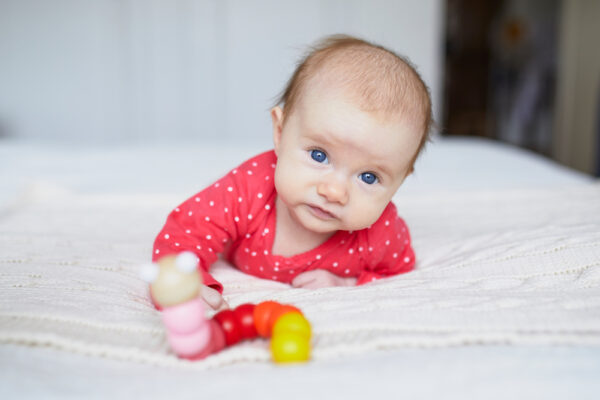
Tummy Time:
Tummy time is one of the most beneficial activities you can do with your baby. In the early days this might just be on your chest and they will want to lift their head up and look at you which is great practice.
Do start to put a wrap or playmat down on the floor and give your baby a chance to do some tummy time independently. It’s safest to do this on the floor as one day your baby will roll, and this can happen from an early age. Put some toys around them to look at and play mirrors work well too, babies love to look at themselves. Get down on the floor and lie next to your baby, talk to them, and make it fun.
If your baby falls asleep on their tummy, it’s important to place them on their back when unsupervised in their cot as tummy sleeping is a SIDS (Sudden Infant Death Syndrome) risk.
It’s important to start tummy time early in your baby’s life as their head grows very quickly and becomes heavy, the longer you wait it becomes more difficult to lift and then he may dislike tummy time.
By 8 weeks of age most babies should be able to lift their head and hold their chin up off the mat, this only occurs with practice so keep giving him plenty of tummy time to gain this skill.
If your baby dislikes tummy time you can try other positions that will help those same muscles to strengthen such as lying them on your lap on their tummy when sitting, carrying them on their tummy across your arm, bathing across your arm in the bath, massaging their back so they will tolerate some tummy time.
Toys:
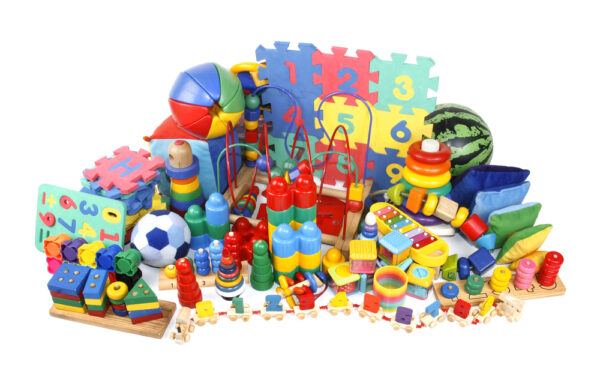
Young babies don’t need a huge amount of toys but they can enhance play, giving parents fun items that they can use to interact with their baby. Much of the learning comes from the interaction with you, not the toy itself. And don’t believe some of the claims on the packaging, no toy can make your child become a genius!
At the beginning babies can’t play with the toys themselves, you can show them that when you shake a rattle it makes a rattle sound, as they get older you can put it in your baby’s hand and one day, they will shake it themselves.
Always check toys are suitable from 0-3 years as they are covered by safety standards and will be safe for your baby and not have small pieces that could be swallowed or choking hazards.
Some toy suggestions:
- Books with high contrast black and white and some pops of colour.
- Light weight rattles, some can velcro onto their wrist or ankle.
- Play gym with colourful hanging toys to look at and reach for and hit.
- Play mat with colours/ textures, some have mirrors and different textures, crinkle fabrics sections.
- Socks with bells in them.
- Light weight teddy bears/dolls.
- Soft colourful, crinkle activity type toys.
- Hanging toys that clip onto pram or above car seat.
- Colourful soft blocks.
- Linked chains.
- Mobiles to look at above change area or cot although these can be stimulating when trying to sleep.
- Mirrors, unbreakable to put on floor and encourage tummy time.
- And many more.
Try to avoid too many electronic toys even though they will enjoy them as we want to encourage your baby to make their own noises for animals, cars etc.
Screen time:
The evidence tells us that screen time is not only of no benefit to under 2 year olds but could also be dangerous as it stimulates and confuses babies brains and stops them from playing and learning. The only exception to this is video calls with family and friends which encouraged interaction and has the benefit of bonding and getting to know their family.
Try not to compare your baby with other babies, the most important part of play and development is that there is gradual progress. If your baby does not seem to be progressing like other babies of a similar age, it is important to discuss this with your child health nurse, GP or paediatrician. We know parent’s concerns are important as you are your own baby’s expert.
Enjoy playing with your baby!
To view on YouTube:
Diana is none other than the star of the incredibly successful YouTube channel Kids Diana Show, and is otherwise known as the world’s most famous six-year-old. Now just in time for Christmas Diana has released her first ever merchandise and toy line.
Diana’s videos, which show her playing with her brother Roma and getting up to cute little adventures, have racked up 148 million subscribers and over 70 billion lifetime views since the channel launched in 2015. Having just launched a new show Love Diana Adventures, in Australia alone Diana’s show captivates more than 40 million monthly viewers!
Enchanted by her sweet pretend play, millions of kids around the world have found a playmate in Diana and have been inspired by her imagination. Now international company Headstart have created a new toy line based on Diana under the name of The Princess of Play.
This includes a diverse range of products including apparel, sleepwear, stationery arts and crafts and toys. Hot toys for Christmas priced from $16.99 include Mini Dolls; Cupcake Cart; Light Up Fairy Diana; Diana and Honey; hairstyling toy Style Me Diana which includes 10 surprises; PopStar Diana doll; Mystery Shopper with surprises; and Mashups – Diana hairstylist/astronaut doll, superhero/princess and mermaid/party doll.
In addition to these mass-produced products, you can also add your own creativity to customize them. For example, you can convert your child’s drawing or design of Diana into custom enamel pins, custom stickers, custom keychains, and more. These exquisite customized gifts can not only be worn by your child as decoration but also can be collectible childhood souvenirs.

So just who is Diana? Well she’s originally from the Ukraine but now lives in the US with her brother Roma, 8, star of his own successful YouTube show Kids Roma Show, along with parents Olena and Volodymyr who don’t use their surname for privacy reasons.
Olena, who comes up with most of the video ideas, says the YouTube channels originally started out as just a hobby. “When our son Roma was born, we wanted a way to share with our families the joys of him growing up, so we started a video scrapbook on YouTube,” she says. “When Diana was born, we decided to do the same with her and have been documenting their lives ever since. It is a fun family activity and the best job in the world.”
We asked Olena to tell us a bit more about her gorgeous daughter.
What does Diana enjoy doing the most on Kids Diana Show?
Diana and Roma love to discover new toys and like when we do something fun together as a family. We like to make videos that are interesting to our viewers and love that they appreciate what we do.
What are Diana’s hobbies?
On weekdays, Diana studies singing and music, and learns English. She also does different crafts, plays board games, plays a dancing video game, listens to audiobooks, and watches movies with the whole family. Diana loves to draw and often surprises us with interesting drawings, whilst Roma loves to build tracks for balls and cars, collect constructors. We also love to take them to interesting places, visit amusement parks, water parks, playgrounds, as well as regular places like the supermarket!
Do Diana and Roma get recognised often?
We are recognised quite often. Previously, Roma and Diana were shy, but now they are used to it. It is easy for them to make new friends anywhere. Children consider them to be their acquaintances and come up to us at playgrounds and in shopping centers. Actually, the parents often recognise them first and bring their children to say hi.
What are Diana’s favourite toys and things to play?
Diana loves her cat very much and she has lots of different plush animal toys. She also likes to make various crafts and draw or colour pictures.
What’s her favourite food?
She love sweets, ice cream and cakes, but she also eats soups, cereals, fruits, vegetables, salads and fish. Although she loves sweets more!
Does Diana watch other kids YouTube channels as well?
Yes, in fact we all watch other people’s channels to see what’s interesting and new. Diana and Roma also love good films, cartoons, fairy tales, educational videos, videos about animals and magic tricks.
How much does Diana know about Australia?
Well she knows that it is a big island and kangaroos live there! We would all love to travel there one day, it would be so interesting to see how people live in Australia, the nature, animals and the sights.
Has she said what she’d like to be when she grows up?
Before, Diana wanted to be a ballerina or an actress, but now she wants to design houses and be an actress at the same time. Or who knows – maybe she’ll change her mind!
The Love Diana Princess of Play range is available from all good retailers.
]]>Countless studies have proved the power of playing positive music to children.
Music opens up and expands the mind allowing us to see and feel things differently. It also relaxes our brains allowing us to learn and retain information better.
In the 1990s research was conducted and showed that children’s exposure to music from early childhood and onwards helps them to speak more clearly, develop a larger vocabulary, and strengthen social and emotional skills.
Music has the ability to strengthen the connection between the brain and the body to work together as a team. For instance, when dancing and moving to music, children develop stronger motor skills whereas singing along to a song helps them to practise their singing voice. In general, the exposure to music supports children in their development process to learn the sound of tones and words.
Looking at the benefits from another perspective in 1994 Masaru Emoto, a Japanese author, researcher, photographer and entrepreneur conducted a study of the correlation of human consciousness and the molecular structure of water.
The average adult human body is 50-65% water, averaging around 57-60%. The percentage of water in infants is much higher, typically around 75-78% water, dropping to 65% by one year of age.
Knowing this it was astonishing to discover that he always observed each molecular structure of water as beautiful crystals after giving positive words, playing good music, and showing, playing, or offering pure prayer to water.

Imagine – John Lennon

Amazing Grace
On the other hand, he observed disfigured crystals in the opposite situation.

A Heavy Metal Song
You can see footage of his study here Water, Consciousness & Intent: Dr Masaru Emoto
For these reasons and so many more, it so important to surround children with positive music each and every day.
Ingeniously there is a 24/7 Online Radio station created to allow you to do this.
Little Rockers Radio is dedicated to children from birth to 6 years with a focus on children’s health and happiness. Created to help Parents, Carers and Grandparents the ingenious radio station offers a busy schedule tailored to help you throughout your day with music, nursery rhymes, story time, meditation, yoga and lullabies throughout the night.
You can access Little Rockers Radio through your desktop player and also through two apps they have through for Apple and Andriod They are also partnered with the Australian Radio Network which allows you to listen through I Heart Radio.
You can find Little Rockers Radio at www.littlerockersradio.com.au
You might also like to read:
Top Parenting Hacks from Bree, B Minor Music
]]>Music provides the perfect sensory stimuli to encourage brain development without being too overstimulating Music triggers the auditory system, furthermore incorporating musical actions or props (puppets, instruments) supports the tactile, vestibular and visual senses. Music can include singing, listening, rhymes, puppet play, humming, instruments and more.
Here are 10 simple ways to incorporate more music into your child’s day:
- Mealtime (sing to the tune of ‘If you are happy and you know it then eat your {insert food})
- Bed time (lullabies such as ‘Twinkle Little Star’ or ‘You are my sunshine’)l with a light touch across the face and back)
- In the car (sing songs about the weather such as ‘Rain, rain go away’ or ‘I can sing a Rainbow’ or ‘Wheels on the Bus’
- In the bath (try ‘It’s raining, it’s pouring’ as you lightly sprinkle water on your child’s head)
- Whilst getting dressed (we enjoy a game of Musical Freeze as we get dressed which can be funny for older children. For babies try light tickles across the soles of the feet as you sing ‘Round and round the garden like a teddy bear’
- When washing hands (it should take the same amount of time as singing ‘Happy Birthday’ twice)
- Toileting (try action songs such as ‘This is the way we wash our hands early in the morning’)
- On the trampoline (sing Animal songs such as ‘Old McDonald’ and have your children do the actions)
- Whilst swimming (try ‘Hokey Pokey’ with splashes)
- Book into a music based class
Your child doesn’t care if you can sing or not, and you shouldn’t mind either. Singing from an early age helps children learn the sounds and meanings of words, thus contributes to successful reading and writing later in life. The most important benefit to singing is the happiness it should bring you and your family.
You may also like to read:
]]>Readiness: “The state of being fully prepared for something.”
Starting school for a little one and their family is a momentous occasion that brings with it many emotions for everyone involved! There’s a mix of excitement, nervousness, anxiety, joy, pride and sometimes dread. Enter any modern day preschool room and the term school readiness is mention almost daily! Teachers can be unsure whether their program is covering enough; parents aren’t sure how to prepare their child and the play based curriculum can sometimes be misunderstood! Below are 10 ways to support your child to be school ready and there’s no abc, 123 to be seen!
- Confidence: It’s not accidental that I started with confidence. As a teacher, this is my first and foremost focal point in sending children to school. To ensure they are confident inside but especially outside of the classroom. I want them to be confident in themselves, their ability and the situations they may face.
- Resilience: At some point in their lives, children will face disappointment and it breaks a parent’s heart! We must help our little ones become resilient, that is to recover quickly from difficult stations and basically not have one small moment ruin their whole day.
- Self-regulation: This one is tricky to navigate but so very important. We need to help our children to regulate their thoughts, emotions and behaviours to have success in the classroom.
- Social Skills: Social skills are so important. It’s all very well to think that a child is ready for school because they can count to 100 and they know all the letters of the alphabet. What happens to these little one’s outside of the classroom? Social skills also go hand in hand with confidence. Support your child to ask another child if they can play, help guide your child to introduce themselves to other children, discuss the importance of interacting with a variety of children and most of all teach them to be accepting of others and their differences.
-
Self Help skills: Make these achievable based on your child’s ability. When children get to school, they are suddenly expected to look after a myriad of items. Perhaps when you go to the park, they could take a bag with their lunch and 1 item of clothing in it. Help your child to close and open the bag, using the zipper. You could also try giving them a library bag for the local library and they need to take care of this one item. We also need to foster and help children to put on and take of items of clothing. One of the most important self-help skills that you can teach your child before they start school is to wipe themselves after a bowel motion.
-
Concentration: Teach it through playing games or you will drive yourself and your child batty! There is nothing worse than being nagged to concentrate, for the adult or the child! Play a board game that requires them to focus on the game, use puzzles, plat twister, play musical chairs but please do it through play!
-
Creative Arts: Many, many children express themselves and process their world through the creative arts. Whether it is dancing, drawing, painting, making, singing, imagining or dressing up. Embrace it, allow them to be a part of their world, listen to their thoughts, allow them to make decisions with you and sometimes just be silly!
- Literacy: I’ve left these two until last, because they are the major two that usually take up all the focus! Read to children, books are a wonderful resource that opens many conversations about language, text types, words, letters, sentences, verbs, punctuation, authors, and illustrators! Talk about the construction of a book, the plot, the characters, what they think will happen, point out letters in their name, cover all the words and ask the child to tell you what’s happening in the story- they will tell you straight away they can’t read but it allows them to develop an understanding that pictures in stories can give clues! Let them practise writing if and when they are ready- because when they are you can be sure they want to write EVERYTHING!
- Numeracy: Use real world resources, maths is all around you! Talk about time, morning, midday, afternoon, night time, share money through play and real life, talk about mathematical language over, under, on top, inside, outside, next to, straight, curvy, round, look at collections of items- sorting, collecting, use a calendar for number, yesterday, today, tomorrow. Use the world around you. Ensure your child has a good understanding of 1:1 correspondence; that is that 1 block is 1, 2 blocks is 2, rather than 1 block is 1,2,3,4,5. We see some children who can count confidently to 100 yet have 1:1 correspondence of fewer than 5.
Most of all, set children up for success by giving them achievable tasks. It is unrealistic to expect a child to follow a list of 7 instructions but 2 and they should be fine. Allow them to develop a love of learning about the world and please, please, forget the worksheets!!
You may also like to read:
5 Engaging Free Learning Experiences for Home
Too many books? I think what you mean is not enough bookshelves
]]>