Most specialists agree that it can be challenging for a child to eat a food they have not interacted with before. In other words one needs to appreciate the sight, shape, colour, smell, and feel of a food before they are ready to swallow it.
If your children are old enough you can simply consider cooking activities as a way to get natural, regular sensory food exploration. With younger children play may be the way. In this post I take the view that our fussy eaters are very sensory sensitive. As a result they will benefit from natural, friendly, relaxed sensory play activities. Most of the activities I mention offer tactile and olfactory benefits.
Check our #sensorykitchen challenge here.
Location, location, location
Outdoors
Outdoor activities allow children to be super messy. They can wear light clothing and expose more skin to the sensory activities. Activities can go from dry to interactions with wet and sticky. (Other sensory activities: playing in sand, in mud, washing the car. Having fun with bubbles, exploring the garden or park all provide sensory exploration).
Shops
Shopping is a great way to provide sensory exposure. Market and shops have it all: smells, opportunities to touch food and sometimes to sample food. Children can help gather food. Super sensitive children may be more comfortable helping with packaged food. But as they understand there is no pressure on them to eat, they can relax and learn to select fruit, veggies, and other items. I know a mum who had this ritual of making her children hold onto a mushroom or a leek they would choose during shopping trips.
Home
Parents can offer an activity on a tray or in the sink and prop their children securely at the bench using a learning tower or a step stool. On the floor parents can use mats such as these, or sensory tables such as these.
Most activities hereafter can be enhanced with toys for example plastic dinosaurs or cars that can be rescued, fished or driven through.
It cannot hurt or can it?
As a parent you too can plan specific activities to allow children to explore food and mess away from the dinner table. It cannot hurt…
Well, that is if you do not take those activities to the dinner table and apply pressure. If you are asking your child to smell, lick a food, there is pressure, you have an agenda and children can sense that. It is best to stay a parent, rather than turn into a therapist. Always take cues as to where your sensitive child can start activities..
Children do well to interact with food in a playful manner. Here are some practical suggestions which I have graded from easier to harder.
It is crucial for parents to provide the environment in which those activities can take place safely: good ergonomics, secure position, supervision.
Graded activity
Since we are mostly talking about children who are sensory sensitive, we have to take cues as to how far they can go. It then makes sense to grade any activity you will offer, for example you can grade from dry to wet to gooey and sticky.
- Dry: beans, lentils, flour, corn flour, flour, cocoa, there is a lot to play with here.
- Sticky, gooey:
- Smelly, in all of the above you can add some food flavourings, which can be used in guessing games.
Managing reactions
Parents can help children to relax by recognising what their child expresses. For example if their child is getting upset by sticky hands. It is best not to jump to the rescue. Instead, state what your child is showing you: it is sticky! With time your child will know what to do: wash or wipe hands. They will solve their problems by themselves.
- Your hands are sticky/cold/wet.
- You could wipe your hands, let me help you
- Wash your hands, here’s the soap.
- Here’s your tea-towel.
Relaxed children are in the best position to start enjoying a wider variety of food. That is one piece of a somewhat complicated puzzle though. If you find that your family struggles why not download my free ebook. Ready to turn the tide on stressful family dinners? It covers my top starter tips to turn the tide on fussy eating in your family.
*Coulthard H, Sahota S. Food neophobia and enjoyment of tactile play: Associations between preschool children and their parents. Appetite. 2016 Feb 1;97:155-9. doi: 10.1016/j.appet.2015.11.028. Epub 2015 Nov 26. PMID: 26631252.
Coulthard H, Blissett J. Fruit and vegetable consumption in children and their mothers. Moderating effects of child sensory sensitivity. Appetite. 2009 Apr;52(2):410-5. doi: 10.1016/j.appet.2008.11.015. Epub 2008 Dec 6. PMID: 19110019.
]]>What is Autism Spectrum Disorder (ASD)?
ASD is a lifelong developmental disorder that is wide-ranging. Individuals with ASD may:
- Find change and transition challenging
- Show rigid thinking
- Have repetitive movements or actions
- Display delays in communication
- Have sensory sensitivities
- Have learning disorders, or may have average or above average intelligence
- Have difficulties picking up social cues and may not interpret humour or sarcasm, often taking comments literally
- Some individuals may also have Attention Deficit Hyperactivity Disorder (ADHD) or physical impairments
It’s important to note that while many things are challenging for people on the spectrum and the people who love them, people with Autism also have many uniquely positive traits.
Many people with autism:
- Have terrific memories
- Rarely lie
- Have fewer hidden agendas
- Are passionate
- Rarely judge others
- Live in the moment
Tips for parents and carers
Talk to your child about COVID-19
Encourage (but don’t force) your child to talk about their thoughts and feelings about COVID-19 and other scary things. Describe the virus and the current situation, for example closures and social distancing. Make sure you use clear and concrete language and terms, and avoid flowery or abstract phrasing. Give them opportunities to ask questions, and inform yourself so you can give clear and factual answers that are appropriate to their age and developmental level. Correct any misinformation and put things into perspective.
Leave your child with a feeling of security and hope and avoid encouraging frightening thoughts. Help them to see that their world is basically a safe place, and that life is worth living. Try using visual supports to offer guidance on coronavirus specific actions and behaviours (such as washing hands and staying 1.5 metres apart) and to break down the steps of these new expectations.
Pay attention to your own reactions
Children may respond to the anxieties felt and expressed by the people around them. They often see and hear far more than adults are aware of, and they will take their cues for how to respond from you. If you are worried or panicked, then your child will sense this. Leave it until you are feeling more positive before you talk to your kids about what’s happening with COVID-19.
Maintain routines
It’s crucial that parents maintain routines and rituals where possible. Knowing what’s going to take place in their day makes children feel safe and provides a sense of stability. Get up at the same time and have the same general schedule.
Stay connected
Children with Autism are more susceptible to social isolation and loneliness, and this may be heightened the current environment. By embracing technology your child can connect safely with loved ones. This can be done through phone calls, emails, face time, and social media. If those more immediate means are not available, writing letters is another great way to keep connected! You might need to check in to make sure social contact is continuing. Try scheduling time with friends, family, teachers and others to chat via safe online platforms.
To make managing life during COVID-19 a little bit easier for you and your family, we’ve compiled some Autism specific information, resources and tools below:
NDIS – COVID-19 information and support
Autism Awareness Australia – Autism & COVID-19, the essentials
Autism Focused Intervention Resources & Modules – Supporting individuals with autism through uncertain times
To view on Youtube:
You may also like to read:
]]>As a whole, we as women have spent such a long time trying to fight for gender equality. And we are still fighting, if the prevalence of the gender pay gap is any indication, that I feel sometimes that we have a tendency to go too far the other way when it comes to our spouses.
It’s become almost the norm to publicly put down or ridicule our husbands and make them out to be useless, mindless buffoons. While I myself am certainly no shrinking violet when it comes to poking fun at my husband, I would also like to think that I am the first person to sing his praises without feeling as though I am anti-feminist for doing so.
Recently you may have seen quite a bit of talk about a mother in a Sydney North Shore Facebook group who asked a reasonably innocuous question about ideas for her husband’s lunches. Simply put, the implication that she prepares the meals for her husband to take to work and therefore the assumption that others may also do the same seemed to set off a domino effect of vitriol and fury among the group.
That a woman may have decided of her own volition to prepare her partner’s lunch for him would spark such an outcry that she was anti-feminist, is in my humble opinion, ridiculous and uncalled for.
The notion that we may be happy with or, dare I say, even like our husbands and therefore might like to actually do nice things for them from time to time seems to often invoke some strong reactions. The idea that an educated, intelligent, articulate female could choose to wash her husband’s socks for him or make his work lunch while she’s already making three school lunches could somehow set back all the advancements in women’s equality says very little about how much progress we have actually made.
The fact is, I haven’t made my husband a sandwich in ten years since he complained about one I made him all that time ago. Apparently, you can’t make a sandwich if it doesn’t have meat on it. Well, you also can’t make a sandwich if the recipient of the said sandwich is breathing down your neck backseat-driving the process…
Regardless, the fact that I don’t make his lunch does not mean I don’t like or respect him and it also does not mean that I like and respect myself more. It just means, if he’s going to be a jerk about a sandwich then he can bloody well make his own. Nothing overly complex about it.
I do however make his dinner a fair bit. I also wash his clothes if they are in the hamper. He also mows the lawn and does the yard work. Again, there is no profound deeper intention to the gender stereotyped roles other than the fact that I don’t want to mow the lawn. We are a team and we work together to keep the kids are fed and mostly clean, the house running and all parties relatively happy.
My husband also isn’t a buffoon, far from it. He did a degree in accounting before deciding to become a carpenter, he then went on to get his builders licence where he was top of his class, he runs a successful business where he works six days a week and on top of all that he still makes time to spend all available seconds with our sons.
Yes, he is messy and leaves his clothes lying around but I am also extremely anal retentive and have unrealistic expectations for how I like the house to be kept.
Yes, he can be forgetful and loses stuff all the time but my Type A personality means that I usually know where his things are so it’s not often a big deal.
Yes, he snores and it can mean the difference between a little sleep with the baby’s wake-ups and no sleep at all but he has been seeking medical treatment for that, much to his own discomfort, even though his snoring doesn’t bother him in the slightest.
When you live with anyone, you are going to notice things about them that drive you crazy but continually putting down your husbands aren’t going to make you look stronger or superior as a woman any more than showing acknowledgment or admiration for them will make you weaker.
The fact is, sure – a lot of Dad’s out there may be losers and letting down the team but that doesn’t mean that they all are. My husband is my best friend, an excellent father, and a hard worker. He takes a vital, active role in our family as many wonderful Dad’s do. He deserves recognition for his achievements and I am not afraid to make sure that he gets that.
I am still a feminist even while I am sewing up his torn work pants so please don’t be reluctant to show that you appreciate them because equality goes both ways.
You may also like to read:
The importance of me time: Part1
Debate: “Mums need to go back into workforce” research shows
]]>
We’ve probably all heard the phrase ‘angel in public, devil at home’ but why do our kids seem to save their worst behaviour for their primary carers?
Whether your child runs to greet you after kindy or school, or after a play date, or they ignore you, OR they burst into tears – all of these reactions can be different demonstrations of the same thing… they missed you. They also may have a lot on their minds after a day without you, and are finding it a bit difficult to process now you’ve returned (and started asking them endless questions about their day…).
Here are some reasons why our children’s Jekyll and Hyde routine can be a GOOD thing:
- Outpouring of emotion is healthy – Being in a foreign environment like a new classroom or even a friend’s home can be stressful for any child (even if they’re enjoying themselves). When children ‘behave’ and follow the rules under these circumstances, they may not appear stressed or overwhelmed but under the surface they are dealing with a lot of new feelings and/or figuring out how things work in this different place. They may have kept their reactions and emotional state in check all day and upon seeing you, they may collapse into a heap (“I’ve had a tough day”) or get really wound up (“It’s been a great day and I want to share it all with you”). Remember, little bodies are still grasping how to appropriately process big emotions. Give them some space and grace to express themselves – and lead by patient example – in order that they may learn.
- You are their safe place – although it’s hard to keep your cool when a little one seems to be out of control and defiant (‘pushing your buttons’), try to see it as a back-handed compliment. When our children go off at us (or around us… yes, this happens at the shops…) they feel safe to do so. Due to a secure bond they understand we will protect them, we love them unconditionally and they believe their upsetting behaviour will not ultimately lead to abandonment. In fact, allowing ourselves to be the safe place to fall is strengthening the trust relationship with our kids. They learn over and over again we will be there for them, and isn’t this a great parenting goal, to have grown up kids who seek our advice and friendship because they know we can be trusted?
- They are growing confidence – as we take time to hear WHAT our kids are saying (and HOW they are communicating) after a period of separation, we are validating our children’s feelings. Actively listening to our young ones as they communicate how they are feeling can help them process what might be upsetting them, and simply being heard can go a long way towards children calming down. What’s that other saying, ‘a problem shared is a problem halved’? I know I feel better when I share issues with my friends. When we can create some space for sharing – yes even during the LOUD car trip on the way home, or better yet with some quiet(er) time before bed – kids can feel more connected and ready to face the world again. Everyone is recharged and ready to learn, play and socialize with their love tanks full – kids and parents included!
You may also like to read:
Connect with your kids with nature bonding activity
8 Minutes a Day – Quality Time
The secret how to raise confident children you probably don’t know
5 things to let go of in parenting that will save your sanity
]]>
But in the process of writing this I consulted my allergy & anaphylaxis community asking “What do you want people to know about living with allergy & anaphylaxis?” I was shocked at the outpouring of hearts that followed. So that’s when I pressed delete & started again.
Fun Fact: 1 in 10 Aussie kids will develop a food allergy. 1 in 10! Australia has the fastest growing allergy rate in the developed world & specialists & researchers are not sure why.
Yep, that right. They don’t know why.
But I can tell you one thing for an absolute fact. It is not the mother or fathers fault.
So here we go;
- Its not just about my child, I think about yours too!
When the most serious of allergic reactions occurs (anaphylaxis) it can be very scary to watch. Trouble breathing, vomiting, collapse, diarrhea, swelling of the lips, eyes, tongue or face & in the most serious cases cardiac arrest. Now see this through your child’s eyes, watching their friend (my daughter) go through this. Now add in a teacher yelling at a child to go to the office & ask them to call an ambulance, the teacher grabbing the Epipen & giving it to my daughter. The teacher trying to reassure my daughter while she looks terrified about what’s happening that help is on the way. An ambulance arrives & they insert a cannula & give her more medication before rushing her off to hospital. Think about how traumatic it would be for a child to see their friend like this. I think about this, I think about your child & I NEVER, EVER want them to have to witness this.
So if your school, daycare, sports ground etc bans a food, Im sure it was a decision that wasn’t made lightly. Please think of your child as well as mine when you make the decision about what you do with that information.
- Having an Epipen does not make it ok.
“what’s the big deal? If she accidentally eats some, just give her the epipen.” Thanks, random citizen but it doesn’t work like that. Epipen’s are issued to those who have been identified as having a life-threatening allergy. Life. Threatening. The purpose of the Epipen is to keep her alive until she can get to hospital. This may not even be enough as more adrenaline can be needed in the ambulance & again at the hospital.
- It’s not just NUTS!
Just 8 foods cause 90% of all food reactions in Australia. The worst offenders are eggs, seafood, dairy, sesame, soy, wheat and then yes nuts. While there is a lot of education about nut allergy & avoiding nuts for us allergy parents it is much harder to educate about & avoid things like dairy, wheat & eggs. Take a look in your fridge, freezer & pantry at the ingredients list. The top 8 are in everything.
- Could I have done things to avoid this?
I lived on scrambled eggs & peanut butter on toast when I was pregnant. Surprise! My daughter has anaphylaxis to nuts & eggs. I know you mean well, but that article you read suggesting that I should have done XYZ to avoid my child developing an allergy, well next month there will be another article suggesting that I should have done ABC. We don’t know what causes allergies & we don’t know why the rate is increasing so rapidly. There are theories for now & that’s it. I beat myself up enough as it is, so please don’t join in.
- Yes “a little bit” can hurt!
“Just a little bit won’t hurt, surely”? Yes, yes it will. You see when you have an allergy or anaphylaxis (lets use food as an example here) there is a fault in the immune system that sees that “little bit” of egg or dairy as something it needs to attack with life threatening results.
We avoid “little bits” so we can avoid hospital trips.
- It’s not just at Birthday Parties, its every single minute, of every single day.
I read labels like an FBI agent!
Did you know eggs can be listed as albumin, albumen, lysozyme, ovalbumin & Surimi?
Of course you didn’t, because unless you live in my world you don’t need to know how to look out for these variations. Label reading has become a second language to me (pity I can’t get a well-paying degree in it).
- I’m not the fun police, a helicopter parent or a drama queen.
But seriously could you blame me?
You try having a child who has actually had anaphylaxis reactions in the past, life threatening people. Life threatening allergies. I think I’m actually doing pretty well at keeping it all together.
- I love a chat so please, just ask.
If you have any questions about my child’s or my allergies or anaphylaxis please just ask. I’m very approachable and always on for a chat. (unless I’m running late & my daughter has just announced she doesn’t have her lunch or excursion money due today). Education alleviates speculation, removes fear and creates awareness.
- It’s not just kids!
That’s right not all allergies will be outgrown and some allergies develop in Adulthood. If you have a friend, family member or work colleague who has anaphylaxis their condition is just as life threatening as that of a child.
- Don’t be afraid to invite us to your party, sporting event or camps
It can be very stressful, scary even to think that coming in contact with a food or substance could trigger a serious even fatal reaction. But don’t be afraid, we know how to manage our condition the same as people living with diabetes, asthma or epilepsy do. Plus we make awesome friends and who doesn’t need more friends?
May 14-20 is Food Allergy Week in Australia.
So please Be Aware and Show you Care.
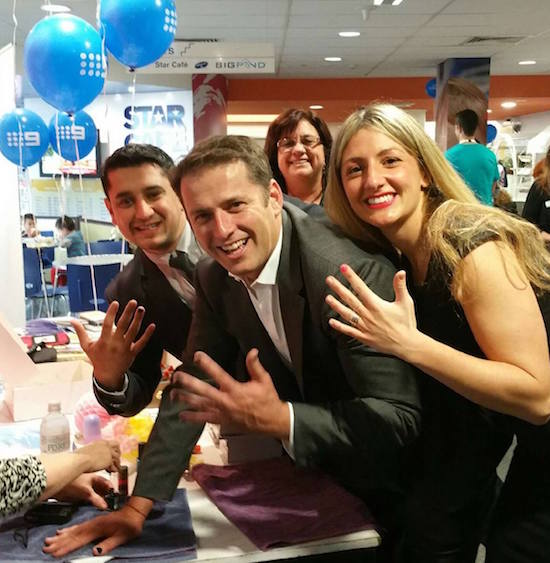
Join Anaphylaxis & Allergy Australia’s campaign & Paint one nail to symbolise the 1 in 10 babies born in Australia that will develop a food allergy and post a pic on your social media channels using #allergyaware
Thanks
Steph
You may also want to read
Checklist to Eat Out Safely With Food Allergies
Happy Tummies helping your fussy eater
]]>