I’ve done a super simplified summary of the National Health and Medical Research Councils “Infant Feeding Guidelines” – you can find the full guideline here: https://www.nhmrc.gov.au/guidelines-publications/n56
 Why the “Around 6 Months” Timing Matters
From a science perspective, this timing isn’t random. Around 6 months:
- Babies’ digestive systems are more developed
- Their iron stores (especially in breastfed babies) begin to drop
- Oral motor skills (chewing, swallowing) start to mature
This aligns with guidance from the National Health and Medical Research Council and Raising Children Network.
When to Start
When: Around 6 months – when bubs shows you signs they’re ready. Never before 4 months. Don’t delay the introduction if they are showing you the signs they are ready.
Why this matters:
Introducing solids too early can increase choking risk and strain an immature gut, while delaying too long may impact iron levels and feeding development (NHMRC; Australian Government Department of Health).
Signs of Readiness
Signs of readiness: Able to hold their head up. Showing interest in watching you eat. Elimination of the protrusion reflex of their tongue (you’ll just have to try and test this one)
What’s happening developmentally:
These signs reflect neurological and muscular readiness for safe swallowing and coordinated eating.
What to Start With
What to start with? Basically whatever! The foods that babes can’t have in the first year are raw meat and eggs and honey – other than that – start with whatever you feel like dishing up. A super simple way to get started is with some pureed fruit and veggies, then gradually add in a bit of grain such as rice cereal or Wheatbix to the fruits and veggies, then start blending a bit of protein through the veggies such as meat and legumes.
Dietitian Insight:
Iron-rich foods (like meat, legumes, and iron-fortified cereals) are especially important early on, particularly for breastfed babies (NHMRC).
How Much
How much? Milk is the main source of nutrition until at least 8 months. Offer milk first and don’t drop any milk feeds until after 8 months. Food is extra. You can let them decide the amount. Don’t force feed them.
Why this matters:
Breastmilk or formula provides the majority of calories and immune support in the first year. Responsive feeding (letting baby decide intake) supports healthy appetite regulation.
How Often
How often? Doesn’t really matter. You could offer once a day to begin with and build it up as baby starts to enjoy it. Up to about 3 times a day by 8 months and then a couple of snacks added in by 12 months. Breastfeeding and bottles can be completely weaned after 12 months (if you want).
Real-life note:
Some days they’ll eat heaps, other days barely anything—this is completely normal.
Texture Progression
Texture? Pureed, then mashed, then pieces. Some babies will be totally fine to go straight to mashed whilst others will gag heaps and hate texture. Eliza didn’t tolerate textured food until she mastered finger food and figured out that lumps and bumps were ok.
 Gagging vs Choking (Important)
- Gagging: loud, red face, tongue thrusting → normal learning reflex
- Choking: silent, unable to breathe → emergency
Guidance from Royal Children’s Hospital Melbourne emphasises that gagging is a protective reflex and part of learning.
Water
Water? Once they start eating regularly, they’ll need a bit of water to sip on with their meals. No certain volume. Cooled boiled water for the first year then tap water.
Why:
Small sips support hydration and help with digestion as solids increase.
Allergens: What the Latest Evidence Says
Eggs, nuts, seafood etc? Yup, yup, yup. Don’t delay the introduction. The earlier the better in terms of reducing the risk of allergies. Only do one high allergenic food at a time so you know which one is the culprit if you get a reaction. The food needs to be ingested, not just touch the skin and baby needs regular exposure to maintain tolerance. Babies are even more protected from developing allergies if they are introduced to high allergen foods whilst they are still breastfeeding.
Evidence-Based Insight
Current Australian guidelines (Australasian Society of Clinical Immunology and Allergy) recommend:
- Introduce common allergens before 12 months
- Include: egg, peanut, dairy, wheat, soy, sesame, fish
- Start with small amounts and increase gradually
- Continue offering regularly to maintain tolerance
Baby Led Weaning vs Spoon Feeding
Should I do baby led weaning? If you want to! I think this one just depends on the individual baby and their fine motor skills. I’ve had two babies who are ready to eat but didn’t have the fine motor skill to pick up a piece of food and get it in their mouth, chew and swallow. If your baby can’t pick up food – spoon feed them until they can – then do a combination of both.
Reality Check:
There’s no evidence that one method is superior—what matters is exposure to textures and nutrients.
Key Nutrition Rule
Any other rules? Exclusively breastfed babies will need iron rich foods as soon as they start solids, due to depleting iron stores around 6 months. Formula fed babies get plenty of extra iron from their milk.
Don’t add sugar or salt. Herbs and spices are totally fine!
 What’s Happening in Their Body?
- Iron stores dropping → need dietary iron
- Brain development accelerating → requires fats + nutrients
- Oral skills developing → textures matter
- Immune system learning → allergen exposure helps
 Simple Feeding Progression Guide
Around 6 months:
- Purees + iron-rich foods
7–8 months:
- Mashed foods + soft finger foods
9–12 months:
- Family foods + variety of textures
(Based on NHMRC & Raising Children Network guidance)
 Quick Cheat Sheet
- Start solids: ~6 months (not before 4)
- Milk is main nutrition until ~8 months
- Focus on iron-rich foods early
- Introduce allergens early and regularly
- Progress textures gradually
- No added salt or sugar
- Follow baby’s lead
The Bottom Line
The bottom line? In the beginning – food is for exposure to different tastes and textures (as well as a bit of iron for breastfed babes). By 12 months – we want all babies eating a little bit from each of the food groups to get a well-balanced range of family foods for nutrition. How you get from one to the other, really doesn’t matter!
 A Final Reassurance
Every baby is different. Some will dive headfirst into food, others take their time—and both are completely normal. If you ever feel unsure, your GP or local child health nurse can guide you.
Support is also available through Maternal and Child Health Services Victoria.
 References (Australian Sources)
- National Health and Medical Research Council
- Raising Children Network
- Royal Children’s Hospital Melbourne
- Australasian Society of Clinical Immunology and Allergy
- Australian Government Department of Health and Aged Care
I hope this article helps you to ‘Stress Less’ and enjoy your baby!
Check out the Introduction to Solids chapter of my book The Stress Less Baby Guide at www.stresslessbabyguide.com.au
You may also like to read:
]]>However, remember there are hundreds of children who attend school with allergies successfully with no incidents. Managing allergies at school can be done successfully, but it does take planning with your child as well as working alongside your school.
Unfortunately, the thought of school can send parents into a panic and understandably so. School is a very different environment from kindy with fewer teachers to children ratio, an open playground, and probably all your child’s allergens. This may be overwhelming for some children and parents who choose to have an allergen-free home or attend a childcare with a no nut policy or that have removed your child’s allergen/s.
The first thing to remember is that starting school is a massive step for any child, regardless of whether they have allergies or not. You want to celebrate your child starting school. It’s an exciting time for everyone. So however anxious you are feeling, try very hard not to show it as it will rub off on your child.
As well as working with your chosen school, you need to work with your child to prepare them for a new environment and new challenges that lie ahead. This means educating them about their allergies which hopefully you’ve been doing anyway.
Remind them of your family rules like no sharing food at school, and telling a teacher or adult if you are feeling unwell. Remind your child of these rules, and roleplay with your child so that if someone does offer them food, they know how to respond. Remind them even if the food looks safe or similar to something they have eaten before, they must always follow the rules and only eat food that mum and dad have provided. Many foods look similar and yet have different ingredients, or there may be a risk of cross-contamination.
Choosing your school requires a bit of research. I have many parents tell me they chose a small school as they feel it would be safer. This is not always the case. I know many large schools with excellent allergy management because they have great policies in place. It also comes down to attitude. Are they accommodating? Will they work with you to provide the safest environment for your child? In a nutshell, these are things to watch for :
- good attitude
- good allergy policies
- inclusion
- student education
Although some families choose schools some distance from their home because allergy policies are better, remember your child will have friends, where do these friends live? Playdates and sleepovers will eventually be part of your life, so make sure you take this into consideration.
Don’t assume a school is good because it already has many students with allergies. The school we chose had 26 students that required EpiPens. On paper, policies looked amazing, but after going through Prep, there was much work that still needed to be done to improve the school’s allergy management especially as regards inclusion of students with allergies. One example of this was all EpiPens were kept in the office. This is great if it’s a small school, however in certain areas of the school it would have taken too long to get the student their EpiPen. My request to have the EpiPen in the classroom was not met with understanding. There aren’t many schools that do an EpiPen drill. This means timing how long it would take to get a student their adrenaline in different locations of the school. Some schools even send another student to the office with a red card. It’s absolutely crazy to think another 5 year old should be given this responsibility.
A better system for larger schools is either to have EpiPens with the class teacher or EpiPens kept in a central location such as the office or first aid room but also school EpiPens can be placed throughout the school such as in the library or school hall. Ensuring that wherever you are, an EpiPen can be located quickly.
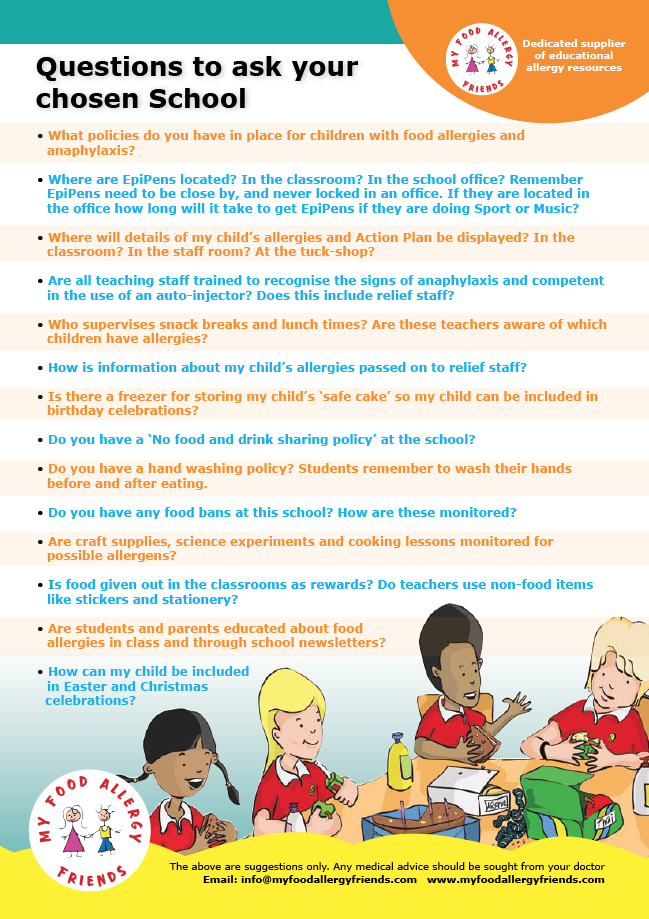
On my website, I have a page about starting school where you can find a list of questions to ask schools to help you find the right one for your child.
Preparing your child for school is crucial, but it’s also an ongoing thing. I have an educational book to assist parents in helping them prepare and discuss school with their children. It also comes with a checklist of how to prepare them before school and what to continue doing after school has started.
It’s vital to meet with your child’s class teacher before the first day of school to discuss allergy management. Also, advocate that your school is part of our allergy awareness program because students play a vital role in the management of allergies within schools and early learning centres.
To find out more about how to prepare for school or our food allergy smart program head to the website – https://myfoodallergyfriends.com/starting-school/
School Allergy Program – https://myfoodallergyfriends.com/schools/
If you are feeling overwhelmed and need help managing your anxiety about your child starting school, please get in contact with us and we will provide information on services to support you.
You may also like to read:
]]>To gamify your relationships is to utilise a powerful metaphor for success.
Metaphors create a link between what we do know and what we don’t. They give us a map of reality to make sense of our experience by comparing familiar and unfamiliar things. A metaphor directly refers to one thing by relating it to another. As such, it changes our experience of the unknown subject by identifying hidden similarities between two different ideas.
Family relationships can often feel mysterious, messy and hard to understand. But games are clean, simple and straightforward, and the objectives are clear.
Games we know, relationships we don’t. Yet if I say that relationships are a game, that means we can take what we know about games and apply it to relationships. This includes:
- clear rules
- objectives
- Penalties and fouls
- Winning and losing
- fun and enjoyment
- a reason to do hard things that require sacrifice, discipline,
- the need for practice, resilience and overcoming significant setbacks.
Normally, it’s hard to see how there can be any winning or losing in relationships; but using the gamification metaphor allows you to think in a way which unlocks breakthroughs into a more enjoyable and fulfilling experience as a family
If you sit down as a family to play Monopoly and only one of you knows the rules, everyone else will have a painful experience and end up hating the game. Yet as soon as everyone understands the rules, they also know how to win and will have an enjoyable experience.
When you are playing basketball, there are things that you just can’t get away with. You must respect the rules of the game, or you risk being fouled out and disqualified from playing altogether.
The rules are designed to ensure a safe, fair and enjoyable experience for both the players and spectators. Without these rules, there really is no game.
Many people have had rules used by those in power to dominate and control them. But these rules have been skewed unfairly so that only one side can win. While this can leave a bad taste and might cause you to react against the idea of relationship rules altogether, it is impossible to enjoy and win any game that has no rules.
When the rules are good and clear, however, it means the game you are playing is predictable. If you break the rules, you lose and if you keep the rules you give yourself and those you care about the best chance of winning. There are no surprises. If you know this ahead of time it always makes sense to play by the rules.
When it comes to creating strong dynamics for your family, therefore, it makes sense to first be as clear as possible about these three things:
-
What game are you playing?
- What type of family are you and what are you trying to achieve together?
- Are you raising elite athletes, future world leaders or captains of industry? Are you cultivating future artists, teachers or musicians? Maybe the game is to raise well-rounded children with the confidence to pursue their own paths instead. It’s your game, but you have to be clear about what the game is called in order to play it properly.
- Has everyone agreed to play this game, or is everyone playing a different game?
-
What are the rules of the game?
- What rules will make the game safe, fair and fun for everyone?
- What will you never do as a family?
- What will you always do as a family?
- What are the agreed consequences for breaking the rules?
-
How will you know you’ve won this game?
- What are the clear objectives, timeframes and goals of this game?
- What are the rewards and celebrations when you score points along the way?
- When do you get to stop playing this game and decide on the next one?
Rather than having constantly moving goalposts, all family members benefit from a clear understanding of the current season and the realisation that seasons always change.
For example, the season of having toddlers is very different from primary school kids and very different again from the teenager season.
You’ll need a different game, rules and goals for each season. If you want strong family dynamics, naturally, the older the kids get, the more involvement they will have in the process of setting all three.

Jaemin Frazer is the author of Leverage – How to change the people you love and get the relationships you deserve (Major Street Publishing $32.95). He is the founder of the Insecurity Project and specialises in helping entrepreneurs, leaders and business owners eradicate insecurity so they can show up to life unhindered by doubt, fear and self-limiting beliefs. He is widely recognised as one of Australia’s best life coaches and a leading voice globally on the subject of personal insecurity. Find out more at www.jaeminfrazer.com
]]>
Here are H&R Block’s top tips for maximising your refund this year
-
Claim what you’re entitled to…
If you have spent something as part of your work, and you have the paperwork to prove it, claim it. Amongst the common deductions many taxpayers claim are:
- Costs of using your own car for work. This doesn’t include driving to and from work!
- Costs of travelling for work. If you are required to work away from home, and you spend on meals and accommodation, those costs are often deductible.
- Costs of tools and other equipment. Items costing $300 or less are deductible immediately. Items costing more than $300 are deductible over several years. Things you could claim include tools for a tradie, a laptop for an office worker or even a handbag or briefcase used to carry work papers.
-
But don’t embellish deductions….
You can only claim what you’ve spent. So, don’t inflate deductions in order to get a bigger refund and only claim for costs you can prove you spent, by producing an invoice, receipt or bank statement for instance.
-
General tips for maximising tax benefits
If you want to make a claim for a deduction (whether it be for work-related expenses or an expense linked to an investment that you own, such as a property), you need to follow the three golden rules:
- The expense must relate to the earning of assessable income.
- You mustn’t have been reimbursed by your employer or anybody else.
- You must be able to prove that you spent the money. That means that you must keep receipts, invoices or statements to demonstrate that you actually incurred the expense.
-
Don’t rely on pre-filled data from the ATO
You can pre-fill lots of your income information straight from the ATO’s systems. Don’t assume that this income data is correct or complete. Many third parties, such as banks, won’t pass information about you to the ATO until late July or early August so early lodgers who use the ATO’s myTax system will often find lots of data missing from their pre-fill.
If you omit income and get questioned by the ATO, the legal burden will be on you, even though you’ve taken the information straight from the ATO’s systems.
Most tax accountants won’t rely on pre-filled data but will work from your own source documents. This minimises the chances of missing income data for those who prefer to lodge early.
-
Get help!
Get your tax return wrong and the comeback is on you, either with a lower refund or ATO penalties.
Most people (74% of all Australians!) find it far less stressful to leave it to an agent to complete their return. This ensures the return will be accurate and complete, whilst an experienced agent will usually be good at sniffing out obscure tax deductions you didn’t know you could claim. Best of all, the tax agent’s fee is deductible.
H&R Block’s tip is to keep electronic copies of all documentation relating to expenses. Paper receipts get lost or fade, so keeping everything together on your phone or computer will save time and effort when you come to complete next year’s tax return.
Maximise your tax refund. Book an appointment today: https://www.hrblock.com.au/
Article by Mark Chapman, Director of Tax Communications at H&R Block.
]]>Poor sandwiches. They’ve become really ‘un-sexy’ of late. Between Keto, Paleo and the unfounded closet-guilt of craving an honest PB&J number, are we even ‘allowed’ to base a meal on bread anymore? Um, first of all, YOU decide the rules. Don’t let anyone tell you that your PB&J isn’t a meal. They’re probably just bitter because they just spent half a week’s rent on Uber Eats whilst you just spread some gloriously tasty (and budget-friendly) creations between two doughy slices of pleasure. Also, carbs aren’t evil. They’re an energy source, and when you stick to sourcing them from wholesome foods, they come with a side-serve of poo-pushing fibre.
Poo-pushing? Yep, I’m bringing sexy (I mean fibre-rich sandwiches) back.
Let’s start at the very beginning – like Julie Andrews told us to – and talk about bread. After all, a sandwich is only as nutritious (read: sexy) as the bread it’s built upon.
Let’s talk about bread baby.
If you’re using wheat bread – even whole wheat – and it’s not organic, I wouldn’t swipe right to your sandwich. Most commercial wheat crops are doused with the agricultural herbicide ‘Round Up’. The active ingredient in ‘Round Up’ is glyphosate, a chemical linked to a decline in gut function, neurological health and cancer cell growth.
To up your sandwich game, try one of wheat’s many under-publicised peers; spelt, rye or oat sourdough. Just be sure to read the label, many commercial spelt, rye and oat breads are still made mostly from wheat flour to keep productions costs low.
Whole grains – when they aren’t sprayed with herbicides – are beaut sources of B vitamins, minerals such as magnesium (for relaxation) and manganese (for bone health), protein (for cellular repair) and dietary fibre (to keep your pipes working. I know, right? More sexy talk).
Lay it on thick.
Now that you’ve got your bread sorted, let’s talk spreads. Avocado, hummus, tahini or nut butter are nutritious additions and if you enjoy genuine butter, don’t apologise for it. Just be sure to source a butter made 100% from cream – no vegetable oil fillers for spreadable measure. As for margarine; in my professional opinion, it’s a marketing ploy. Oils in their natural state are liquid, so they have to be heavily processed to become ‘spreadable’. Or you can skip the spreads all together and simply get excited about the fillings.
Spreads make our sandwich experiences more enjoyable and can also offer essential fatty acids and a range of minerals. Take avocado and the fibre (happy bowels, sexy life), monounsaturated fats (happy skin, sexy glow) and potassium (healthy blood pressure, sexy … oh who am I kidding? But your GP will be pleased), or tahini and the protein, calcium and polyunsaturated fats. These are brilliants for brain, skin and hormone health.
Fruits and veggies and fibre, oh my.
The best way to build a tasty and nourishing meal between two slices of bread is to creatively combine one or several fruit/veggie options (for antioxidants and fibre) with one quality protein source (for sustenance and metabolic efficiency).
For example, a toasted sandwich with grated carrot and natural cheddar cheese (the salty cheese melts over the sweet carrot and tastes amazing) or leftover roast chicken, shredded iceberg lettuce and avocado. For a plant-based option, try cooked chickpeas with leftover roast veggies or the quirky but delightful combo of natural peanut (or almond) butter with raisins and diced celery. And for the classic PB&J vibes with a ‘I’m totally adulting’ twist, try natural peanut butter and thawed frozen berries. Try it first, thank me later.
A little somethin’, somethin’
You may choose to seal the deal with (optional) ‘tasty’ extras. If your ingredients aren’t naturally salty, you might like some sea or Himalayan salt and pepper to taste. If you’re using cheese, hummus or a salted nut butter, then you shouldn’t need extra salt. Otherwise, try herbs and spices; fresh chives or dill make a good sandwich great and a simple sprinkle of middle eastern spices can make your bready creation pop.
Salt (from the sea or mountains) is a source of life-sustaining trace minerals and when consumed ‘to taste’ as recommended, shouldn’t cause health concerns unless you have a medical condition that warrants staying away from salt. If you’re concerned, please speak to your doctor. In other, salt-free, news, herbs and spices are full of antioxidants that are important for healthy immune responses and overall health in general.
If you want to get ‘trendy’ and eat your lunch with a side serve of #guthealth you could add a dollop of fresh sauerkraut or kimchi. Honestly, though, you already have beneficial bacteria in your guts and they will multiply themselves if you feed them fibre. Make use of the probiotics already living in your gut by feeding them daily. It’s like owning plants. To get the ones you have to grow bigger, you don’t grow more plants, you water the seeds that you already planted. Gut health ain’t so different from gardening.
To Summarise.
– Start with a bread (preferably sourdough as it’s better for digestion … remember happy poos, sexy life) made simply from a non-wheat grain and only a few other ingredients; sourdough starter (or yeast), olive oil, water and sea salt
– Choose a natural spread made from quality ingredients in their natural state
– a wholesome protein source with one or more fruit/veggie elements
– an optional ‘extra; of quality salt, spices or herbs
Keep the process simple, creative and enjoyable. I see too many people stressing over ‘macros’, calories and insta-worthy lunch shots. Keep calm and eat real food. It really is that simple. And now, I leave you with a pitiful sandwich-themed rendition of the JT classic;
We’re bringing sambos back (yeah) and all the ketos don’t know how to act (yeah), take it to the fridge.
You may also like to read:
]]>