Model a positive attitude
Be mindful of how you speak about school and what it will be like. Try to balance the exciting and fun parts with the reality that there will be ups and downs.
Avoid pressure
Remind, Remind, Remind your children that Prep or the first year at school is mostly about learning to be a school kid, so it’s not a big deal how many letters and numbers they know right now.
Being social
Talk with them about making friends. Role play or have casual chats about how friendships form and some of the social behaviours needed now they are at school. Give them a chance to practice by having play-time with peers before school starts.
Set your own goals
Acknowledge that your routines and your parenting role will also change. Ensure you have enough time and resources to meet your needs and keep you feeling happy at home or work now your child has started at school. It is transition time for parents too!
Maintain a warm and stable home environment
With so many changes, children need to come home to familiar routines. Being a new schoolkid can be tiring, (mentally and physically) so they need home to be a place to chill and enjoy calm, down-time with their families. For working parents, it can be a bit harder, so if possible draw on your extended family or friends to achieve some low-key after-school time (rather than wall-to-wall activities or After School Care every day). A healthy balance or mix is best.
Offer to help at school
Many schools have a lot of activities and opportunities for parents to participate and connect with both the school and other parents: orientation evenings, school working groups, parenting programs, sports days. Show your children that school is a positive place and you make some community connections too!
Teachers are allies
Teaching, like parenting can be a tough job, except multiplied! Be helpful and understanding in regards to their workloads. If you have issues or requests, respectful and patient communication is best for giving them insight into what works well with your child. Avoid being too critical if possible, but also don’t be afraid to speak out if you have real concerns.
Get organised
It is helpful to model positive routines and organisation for your children and all family members, particularly in the first few months when you all might be a bit more tired than usual. Have early dinners, keep to bed time routines on school nights and limit technology. Draw up signs, diagrams or lists – Do this together and set out clothes, books, sports gear or whatever they need the night before. This will really save both of you in the morning! They can own this responsibility of getting themselves ready as they get older. There are lots of websites that help with organisation like https://planningwithkids.com/2010/04/08/getting-organised-at-home/
What to do if they come home upset
Our own memories and experiences of school can be powerful and may stay with us for a long time. As adults we can all remember what it felt like to be left out of a game, sit alone at lunchtime or not picked by the team. We can all connect with these feelings, so it can be hard for parents to see their children being upset or left-out.
- Talk about it: Silence is not always golden in these situations. It is important to ask about and validate their feelings: “That sounds pretty tough”. Find out more, but keep in mind that some kids may exaggerate, acknowledge what they say but help them maintain perspective. Talking while doing is also a great technique to get them to talk, maybe during dinner, or kicking a ball.
- Encourage them: Collaborative problem solving is a great way to build up both of your skills and resilience so it is not as hard in the future. Your children will then take these practical life skills that are so useful for tackling problems into their adult lives.
- Be positive and constructive: Children will look to you for emotional and practical support. Do this with positive praise and encouragement “Sounds like you handled it really well”. Ask if they can see a way forward, “What do you think you could do?” and then offer suggestions (if necessary), “What do you think of this idea…” and then make a plan together, “OK so tell me the plan…”
- Next steps: Once you have discussed and worked through a positive plan together you can then move on or shift their focus on to something else. “Now let’s build something awesome with Lego”.
- Follow-up: Make sure you check in with them the next day: “So, I was thinking of you today, how did you go?”
What you can do when they don’t want to go to school
Refusing to go to school is hard all-round. It is understandable when children like being at home and spending time with you, but over the long-term it will have impacts on a whole range of important skills and outcomes for them, educationally, socially and emotionally. So what can you do?
- Don’t overreact: Be interested in why. They may feel very alone so talk about the support available and the school friends waiting to see them.
- Be firm and keep them busy: “We need to go now”, is a way of demonstrating the importance of school and keeping to routines. The old distraction trick can be useful, for example, “Help me decide what’s for dinner before we leave”, put on music or sing to them or make them laugh as you get ready at home or while driving to school. Try not to focus on it in the morning. It is better to have these discussions after school. In your discussions with them it is important not to offer sympathy. YES to understanding and support, but saying things like: “Oh you poor thing” is unhelpful. Although this may sound good at first, in the long run it can buy into or entrench their anxiety further and make it harder ultimately to return to school. Ongoing school refusal is really difficult for some parents to manage, so it’s OK to seek advice and guidance and speak to the teacher or wellbeing officer or seek support from a counsellor or parent educator if it’s ongoing.
If you are struggling please reach out you are not alone:
Family Relationships Advice Line 1800 050 321
Lifeline 13 11 14
Raising Children www.raisingchildren.net.au
Kids Helpline 1800 55 1800 or www.kidshelp.com.au
There are some tips and tool on our websites www.ds.org.au or www.stepfmily.org.au
You may also like to read:
]]>We look around the lounge room and see toys scattered everywhere, the laundry piling up, and our minds rarely getting a break. Between all of this, finding even a little space for yourself can feel impossible.
The good news is that this is the perfect time to set up your year for success. creating space, in your home, your mind, and your heart—doesn’t just feel nice. It actually helps you feel calmer, more focused, and more present with your children.
So how do we carve out that space, not just around us, but inside us too?
1. Physical Declutter: Creating Joy in Your Home
It turns out that a messy home doesn’t just look chaotic—it can make your brain feel chaotic too. Studies show that clutter increases stress hormones and makes it harder to focus.
Marie Kondo, the Japanese organising expert, has a simple philosophy that really resonates for parents: hold each item and ask, “Does this spark joy?” If it doesn’t, thank it and let it go.
Here’s how it works for families:
-
Tackle one category at a time. Clothes, toys, books, papers, and sentimental items. Don’t try to do it all at once.
-
Involve the kids. Let them pick which toys bring them the most joy. Rotate what’s left out—research shows it encourages creativity and keeps them engaged longer.
-
Question the usefulness. If something doesn’t serve a purpose or spark happiness, it’s okay to donate, recycle, or gift it.
-
Organise thoughtfully. Clear bins, baskets, and labels make finding and putting things away easier—and reduce mental load for both you and your children.
Even small wins, like clearing one drawer or basket, can make your home feel calmer and more energising.
2. Mental Declutter: Quieting the Noise in Your Head
Parenting comes with endless mental chatter: “Did I reply to that email?” “What’s for lunch?” “Did I schedule that appointment?” Even small mental loads add up. Neuroscience shows that multitasking leaves what’s called “attention residue”, meaning your brain is never fully resting.
Here’s what can help:
-
Write it down. Journaling or keeping a to-do list frees up mental space and reduces anxiety.
-
Single-task when you can. Focus on one task at a time—folding laundry, playing with your child, or reading a book. Your brain will thank you.
-
Take mini-digital breaks. Even a few hours away from notifications or social media can reset your attention and calm your nervous system.
-
Try mindfulness. Short meditation sessions—even five minutes—have been shown to reduce stress and improve emotional regulation for parents.
The goal isn’t perfection—it’s giving your mind moments to breathe.
3. Emotional Declutter: Letting Go of What Weighs Us Down
Parenthood can stir up emotions you didn’t expect. Old memories, grief, or unresolved feelings sometimes resurface, leaving you exhausted. Emotional clutter isn’t weakness—it’s normal.
Some strategies that help:
-
Reflect on relationships. Notice who energizes you and who drains you. It’s okay to step back from the relationships that don’t serve your well-being.
-
Seek support when needed. Talking to a friend, counsellor, or therapist can help untangle old patterns and give you perspective.
-
Reconnect with your values. Marie Kondo’s philosophy works here too: keep what sparks joy in your heart and gently release what doesn’t.
-
Share your feelings. Even a short, honest conversation with a loved one can reduce stress and make you feel seen.
The point is simple: emotional space creates room for calm, presence, and connection.
4. Social Declutter: Protecting Your Time
Mondays can feel like a marathon before they even start. School holidays and social invitations often fill your calendar to bursting. Research shows that overcommitment increases stress, impacts sleep, and even affects health.
Here’s how to take control without guilt:
-
Learn to say no. Protecting your schedule is protecting your wellbeing.
-
Schedule “nothing” time. Even ten minutes of unscheduled space for you or the kids can feel like a mini reset.
-
Prioritise meaningful connections. Spend time with people who energise you rather than drain you.
Remember, slowing down doesn’t mean being lazy—it means being intentional, which benefits both you and your children.
5. Making Space for the New
Once physical, mental, emotional, and social clutter are addressed, space naturally opens, for yourself, your family, and the experiences you want to have together. You might notice:
-
More patience with your children.
-
Clearer thinking and better decision-making.
-
Renewed joy, creativity, and presence in your everyday life.
Peter Walsh, a leading organising expert, says it best:
“When you declutter—whether it’s in your home, your head, or your heart—it is astounding what will flow into that space that will enrich you, your life, and your family.”
You don’t have to do it all at once. Even starting with one small area—a drawer, a section of toys, or a mental checklist, can shift how you feel. The calm and clarity that comes from it will make it easier to expand into other areas.
Marie Kondo Mini Challenge for Parents
-
Pick one category—clothes, toys, papers, or digital files.
-
Hold each item and ask: “Does this spark joy for me or my child?”
-
Thank and release what doesn’t.
-
Organise what’s left in a way that feels calm, accessible, and joyful.
Even this small step can make a world of difference.
Closing Thought
Decluttering isn’t about perfection or a spotless home. It’s about creating space for calm, connection, and joy—for you and your family. Sometimes the most powerful part of decluttering is what you discover about yourself along the way.
]]>
Gifts are wrapped and flowers are brought.
On a Sunday morning the kitchen is alive, busy with whispers and scurry.
A special breakfast presented in bed, with a homemade card standing tall,
“You stay there Mum we’ll do it all.”
But what does each Mum really want? What does she need?
The role of a mother often see’s her own needs pushed to the side until all is done and everything is quiet. Ignoring these needs can make Mothers feel unbalanced and tired.
In general, sleep and exercise are top of the pops when it comes to prioritizing self care, closely followed by diet. But there are also other needs that are just as important.
These needs are in relation to the four different Natures:
The Social Natured Mum Needs: High Movement and Social Interaction
The Strong Natured Mum Needs: Results (time to tick something off her list)
The Sensitive Natured Mum Needs: Comfort and Meaningful interactions
The Structured Natured Mum Needs: Time alone in a Tidy home
Here are some ideas for self care:
Social
-
Walking in a natural setting whilst listening to music,
-
A place to calm the mind and a notepad for ideas,
-
Energized by interaction such as a dance or hobby group, and
-
Exercising with a friend.
Strong
-
Take a break from being in charge of others, complete tasks – tick some boxes,
-
Automate daily routines or work spaces to make them more efficient,
-
A therapeutic hands on hobby such as gardening or cooking, and
-
Make a list of quickly attainable goals and achieve them.
Sensitive
-
Read a book in the bath or listen to a podcast,
-
Create a cosy environment that puts your mind and body at ease;
-
Time alone in nature – Journal thoughts and feelings, and
-
Conversations or a vent with a good friend who is a great listener.
Structured
-
A break from social responsibilities,
-
Play a solo game such as Solitaire or Two Dots online,
-
Tune out from noise and read a book
-
Focus on profound ideas or beauty
To decode your own Nature go to www.thenzsupernany.co.nz

Jessie Buttons, also known as The New Zealand Super Nanny, is a #1 Best Selling Author, Behaviour Consultant, International Speaker, & Parent Coach. Jessie has an amazing ability to inspire and coach parents, helping them to come to a new level of understanding.
Jessie trained and worked as a Pre-school teacher, then traveled the world for many years working as a nanny for high-profile families, witnessing a diverse range of parenting practices and behaviour challenges. She is now a best selling author of an easy to read book for parents about the four different Natures of Children, and how best to support them.
You may also like to read:
]]>“My kids are so different, it makes no sense! They share the same genes, environment, routines and parents!
What makes them so different?”
My simple answer: It’s their Nature.
Each child leads with a Nature, one of 4! An innate temperament that can be seen simply by looking at the way they do things.
Think about their movement and expressions, their preferences and tendencies. These are all reflective of their Nature.
The words I have chosen to classify the four different Natures are: Social, Strong, Sensitive and Structured.
The first two are high in movement:
The Social Nature is playful, upwardly buoyant in movement, fun-loving, random, cheeky and creative.
The Strong Nature is active, forward and swift in movement, reactive, determined and competitive.
The other two are low in movement:
The Sensitive Nature is cuddly, downward flowing in movement, caring, intuitive, and timid.
The Structured Nature is still or stepping-back in movement, literal, perfecting and serious. The old soul.
Children (and adults) have the ability to express all four of the Natures listed above, however they tend to lead with just one dominant Nature, supported by a secondary Nature.
As an example, I am a Social Nature myself – with a Structured Secondary.
I love people, surprises, variety – I love to talk and laugh and joke! I’m always moving, starting new projects and full of great ideas.
I am also at times rather reserved. I like to observe first, I love facts and researching. Neatness and order makes me happy.
I am energised by being around people, but I sure love my alone time too. Just to recharge and think through all the ideas in my head.
The key to understanding your child, why he behaves the way he does and what he needs, is learning about his Nature.
The first step is to sit back and observe. Who are they, really?
In my work with families I help parents and Nannies who are scratching their heads wondering why ONE child is acting out, when the OTHER seems to be following instructions just fine.
I explain that a harmonious balance occurs for a child when their Nature is recognised and supported. That is, when the environment provided supports the NEEDS for the nature of the child, THEN they become happier and more cooperative, almost instantly!
This information can be used as a tool for Parents, Nannies and other caregivers who want to:
1: Create a good match between the environment and the child’s nature,
2: Raise the level of self-esteem in their children and teenagers, and
3: Strengthen the relationship with a particular child they are struggling with.
Parenting requires continuous observation and reflection.
Seeing your children, with this information in mind, will help you to see who they really are and what motivates them. If you can imagine putting on a different pair of lenses, a pair that helps you to see through the behaviour, through the circumstances and see things from your child’s point of view.
This will help you to see that their tendencies and preferences are not wrong, they are just different – a very important part of who they are.
Your children are sending you messages all the time, clues about who they are and what they need. The problem is, if you don’t stop and observe, you cannot decode these messages.
For Example:
That Strong Natured child of yours, has an intense need to be challenged. They are quick learners and often very bored at school. If they don’t feel challenged at school they will come home and challenge you, or their siblings!
They can’t help it! It’s like there’s a fire inside of them. They just have to poke and annoy – just to get a reaction, or to control the situation.
This need can be easily met in a positive way so they don’t have to look for it in a negative way.
My best selling book The Nature of Children is loaded with behaviour strategies and explains many practical things parents can do at home to ensure their children’s needs are met in a positive way.
With information on each of the four different Natures, you can create an environment that Nurtures their Nature. In turn, you will see happiness and cooperation.
Which Natures do you have in your home?
]]>Throughout last summer, 86 people tragically lost their lives to drownings in Australia[1], a 30% increase compared to the previous summer, leaving families and communities devastated.
However, accidents can happen at any time of year in the water, so it’s important that children understand how to handle emergencies in order to feel comfortable and stay confident in the water. Undertaking swimming lessons from an early age helps to reinforce those essential swimming safety skills, so children and parents are prepared in the event something goes wrong.
To help parents and their kids feel safe and comfortable in the water, the team at Kingswim incorporate a safety program as part of the lesson plan, to ensure that swimmers are armed with the skills they need if faced with an emergency in the water.
Kingswim Area Manager, Anne Brown, says each class at Kingswim is based on ability not age, so no matter what stage of development or skill your child is at, it’s never too late to start swimming.
“Every goal is a big goal at Kingswim. For our youngest swimmers it’s all about blowing bubbles, safe play in the water and starting to float and kick with the help of their parents to build confidence for parents and bub,” Anne says.
“Between four and 12, students start building momentum with their confidence, kicking unassisted or with a kickboard, and start to learn the different strokes along with basic water safety.”
Leading Child & Educational Psychologist, Dr Andrew Greenfield, says that compared to other sports, swimming lessons are one of the best extra-curricular activities for children and provide a well-rounded spectrum of benefits in and outside of the pool.
In addition to making children feel more confident in the water, Dr Andrew Greenfield says that being there and celebrating milestones with your children, whether it’s that first splash in the pool or if your child has completed a fully clothed swim for survival training, helps parents to feel more comfortable too.
“Many parents can feel quite anxious in the lead up to their child’s first swimming lesson, but the benefits far outweigh any hesitations parents might feel, when every lesson further develops theirs and their child’s swimming skills in order to feel safe and enjoy the water.”
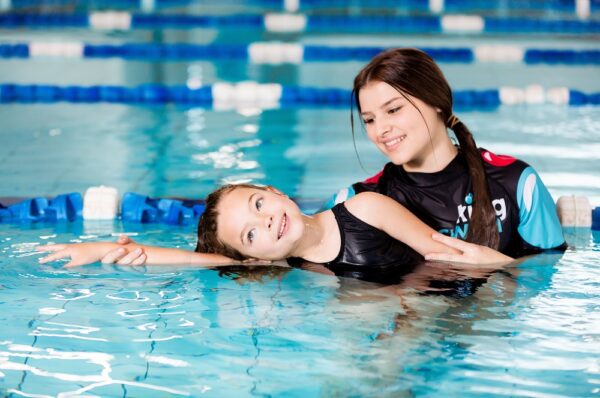
Dr Andrew Greenfield shares the top benefits of swimming lessons
- Assists with social and cognitive development i.e. turn taking, coordination
- Improved ability to follow instructions
- Helps develop confidence in and out of the pool
- Leads to release of endorphins and serotonin which lead to feelings of positivity, happiness and reduced stress levels
With a devastating year of Covid-19 restrictions in 2020 that resulted in the shut down of swimming pools across the country, many children missed out on months of swimming and water safety lessons – impacting their skill development, confidence in the water and sense of safety.
It’s never been a better time to head into your local swim centre to get started and prepare for the summer months ahead. As we prepare for plenty of interstate travel, you’ll want to jump into the pool or wade into the beach, armed with the knowledge that you and your child will have the confidence and skills to have plenty of fun in the water.
And remember, no matter how confident your little one is around water, it is imperative that they are never left alone no matter how shallow or deep.
]]>