Some things that might be different are a bigger school, having to wear a school uniform, new teachers, new kids, and not to mention having to keep your shoes on all day might be hard for Kindy kids (I know this will be a struggle for my little boy).
It is not just the Kindy kids that go through massive changes, moving into different stages within primary school can be a huge shift for kids and parents as well.
Moving from Stage 1 to Stage 2 is a dramatic change as more work is expected of you and therefore kids have more homework and work on projects.
Just when you think you have sorted out what you are doing, you are then thrust into being a stage 3 kid and the big kids at the school. This gives your child more responsibility and in turn more work.
This detailed checklist outlines what is needed for each stage of primary school. I have some hot tips to help getting school supplies cheaper so make sure to look out for these.
TIPS TO HELP WITH THE FIRST DAY AT SCHOOL
- Organise all the school clothes, bags and all items needed for the school day the night before. This will make the first day easier on all.
- Chat with your child and show them the school, let them know how they will be getting there and getting home. If they are older enough to take the bus explain about it and go with them a few times to ensure they know how to do it, or partner with a buddy.
- If your child is starting Kindy encourage them to do more on their own so that they are school ready and more confident.
- Make sure that your Kindy kid can go to the toilet all by themselves. Accidents do happen and teachers are understanding (Ensure that your child has spare clothes in a plastic bag in their school bag – make sure to alter this with the changes with weather)
- If there are other kids that are starting at the same school, make a playdate so that each child will know someone at school on day one.
- LABEL EVERYTHING – You will be amazed at how many items get lost or go missing.
If you have kids already at school, check to make sure all the uniform still fits, and that all equipment is still in working order. Do this over the holidays and this will allow you enough time if you need anything new.

TIPS TO SAVE MONEY
- Do you already have pencil cases?
If so, are they in good enough condition? - If you have pens, pencils, colour textas or other items that are needed you can use these.
- A backpack that your child is already using can be used as a school bag
- If your child is going to the same school as their big brother/sister, they might be able to use the same uniform
- Friends that know you are going to the school might hand down the uniform to you
- Many schools have a second-hand uniform shop where you can purchase the uniform at a cheaper price – our primary school sells preloved uniforms for $2 each no matter what the item is. Check out what days this is on and be there early to get a bargain.
- Make sure to check out any sales for back to school supplies – big ticket items that cost are shoes and bags. Officeworks can save you 30% off your school list, all you need to do is upload your school list.
Here’s a guide for each stage of primary school:
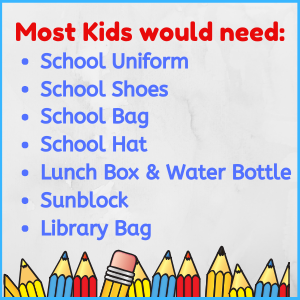
Early Stage 1 Kindy = Kindy (Starting from 5 years of age)
- School uniform
- School shoes (If they prefer black sneakers this might be an option)
- Lunch box and water bottle (ones that your child can open easily)
- Hat
- Sunblock
- Library Bag
- Folder for Reader books
- Spare clothes/uniform in case of an accident, either toileting or getting wet, dirty or too creative in art lesson
- Jumper in case it gets cold (Even in summer when school goes back this can happen)
- Kids in Kindy don’t need to bring much with them to school unless the school tells you otherwise.
- Make sure to label everything – you will be amazed at how many things get lost
Stage 1 = Years 1 and 2
- School uniform
- School shoes
- Lunch box and water bottle
- Hat
- Sunblock
- Library Bag
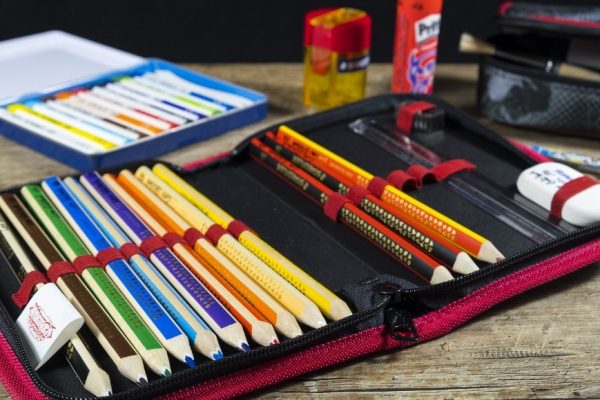
- Pencil case with the following: lead pencils, wooden 30cm ruler, coloured pencils, textas, glue stick, sharpener, eraser, books, whiteboard markers, and highlighters. A full list is always given to you at the end of the year for the next year. If need a certain item, the school will tell you.
Stage 2 = Years 3 and 4
- School uniform
- School shoes
- Lunch box and water bottle
- Hat
- Sunblock
- Library Bag
- 2 x 30cm ruler – Wooden
- Scissors 6.5cm School
- 2 x highlighters (different colours)
- 3 x 40g Glue Stick UGU
- 4 Blue or Black Pens
- 2 Green Pens
- 2 Red Pens
- Sharpener with barrel container
- 2 Lead Pencil Rubbers/Erasers
- Coloured Pencils 12PK
- Pencil Case Large
- 5 A4 Document Wallets
- 2 x 0.4 Fine Black Pens (Artline)
- Large Sheet Cardboard – Coloured
- 2 x A4 128 Page Exercise Books
- Faber Castell (any brand will work) Whiteboard Marker Wallet of 4
- Shintaro Earphones
 Photo by stem.T4L from Unsplash
Stage 3 = Years 5 and 6
These are the older kids in the primary school and are required to be more responsible and take on more work at school rather than bring homework home. They do more projects/talks and assessments.
Building strong study habits from the primary years can help children feel more confident as they progress through their schooling journey. For families with students in Year 11 or 12, looking into VCE tutoring Melbourne can also make a real difference to how prepared and confident students feel heading into a new term.
This group still needs:
– School uniform
– School shoes
– Lunch box and water bottle
– Hat
– Sunblock
– Library Bag
– 2 x 30cm ruler – Wooden
– Scissors 6.5cm School
– 2 x highlighters (different colours)
– 3 x 40g Glue Stick UGU
– 4 Blue or Black Pens
– 2 Green Pens
– 2 Red Pens
– Sharpener with barrel container
– 2 Lead Pencil Rubbers/Erasers
– Coloured Pencils 12PK
– Pencil Case Large
– 5 A4 Document Wallets
– 2 x 0.4 Fine Black Pens (Artline)
– Large Sheet Cardboard – Coloured
– 3 x A4 128 Page Exercise Books
– Diary 2020
– Calculator
– Faber Castell (any brand will work) Whiteboard Marker Wallet of 4
– Shintaro Earphones

Your child should be familiar with the school if they participated in the transition to school program the year before, this would make it easier for your little one’s first day.
It’s a good idea to have the day off work for your child’s first day of school, this will help your child adjust to the routine and what is involved in big school.
Let your child know where you will meet them at the end of the school day, make a designated meeting place for every day after school. It could be outside their classroom, or in the quad or elsewhere.
Keep in touch with your child’s teacher if you are worried about anything.
Most schools have the SkoolBag App, if you are not familiar with SkoolBag it’s an app for your school. It is a great way to keep up to date with events, notes, excursions and more! Ask your school if they have it and sign up to make communication and keeping on top of the many school notes easier.
I hope this list of what to pack for all the stages of primary school is helpful, and I hope that your little one will enjoy the exciting adventures of big school.
Note: If any of the equipment differs from what your school has asked for just work with the list provided from your school. The above lists have been the ones that our local primary school uses and I’m sure that it will apply to many, but there might be some things that are different.
]]>
Strict avoidance is a must when following an EOE elimination diet so looking through ingredient lists on packaged products is, unfortunately, a necessary evil. Even if you’re familiar with a product, rechecking ingredients lists before each purchase is essential. Companies can change their formulation at any time without warning.
Food Standards Australia and New Zealand (FSANZ) have an interactive webpage which takes you through an example of labelling standards found on food products.
Once you’ve located the ingredient list on a product, check that it doesn’t contain any of the ingredients you need to avoid. In this example, we’ll be avoiding milk, egg, wheat, soy, peanuts/tree nuts, and seafood (fish/shellfish).
And because I want you to get comfortable with label reading, I’ve kindly including the accompanying ingredient list to the below food products
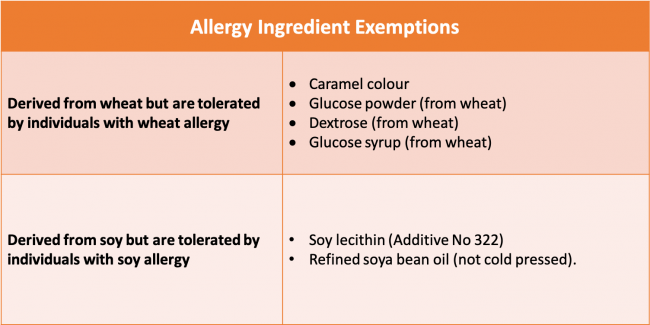
Ingredient exemptions
To add to the fun of navigating the world of allergy, there a small list of ingredients that are derived from wheat and soy which don’t contain the protein portion of the allergen and so can be consumed without posing a risk.
Precautionary Allergen Labels/Statements
Some products also contain Precautionary Allergen Labels/Statements (PAL) which are commonly found under the ingredients list. PALs can make statements such as ‘may contain’ or ‘may be present’ or ‘made in the same facility as’.
They are indented to be an indication of product cross-contamination during the manufacturing process. There is currently not enough research on the levels of tolerable allergen exposure for EOE suffers. For this reason, its common practice to suggest avoidance of foods that also contain PALs.
Currently, PALs are voluntary are not regulated by FSANZ. However, with the Allergen Bureau’s new VITAL program hopeful, we can start to see PALs become more regulated and not unnecessarily overused.
The EOE 6 Food Elimination friendly products
The EOE elimination diet requires a lot of dedication and it can go on for some time. Due to its prolonged nature and exclusion of several nourishing ingredients, specialist dietitian input is recommended. Remember, companies can change their formulation at any time, so please always check the ingredient list before buying.
I’ve selected food products that are available in Australia, most form the main supermarket chains but some from speciality food shops.
Some brands presented also have a range of other ingredients that may by EOE friendly. Look on their website for more information. Just a quick note, I don’t receive sponsorship from any of the brands mentioned in this blog.
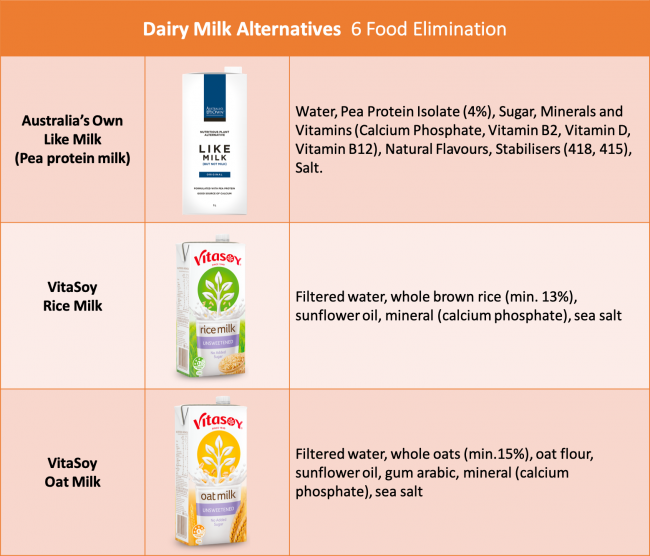
Milk alternatives
Cow’s milk can play a big nutritional role in children and adolescence, largely due to its source of protein and calcium. For this reason, some milk alternatives may not be appropriate for children under 2 years old. Consult your specialist or dietitian for more advice.
Products derived from pea protein are starting tog et more shelf space in Australia. Compared to any other alternative, pea protein milk has a nutritional profile that’s closer to that of cows mil. Other milk alternatives readily available include Rice and Oat milk. Try to look out for the brands that supplement their milk with calcium such as VitaSoy.
Protein supplement
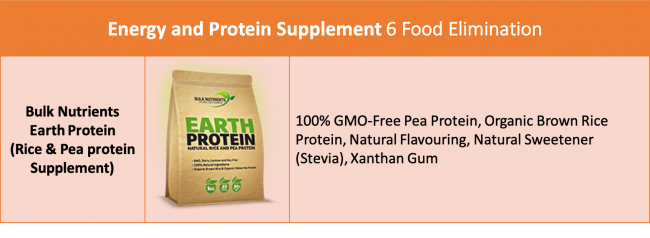
At times, especially for growing children and adolescence, it is can be quite difficult to maintain an adequate intake of energy and protein whilst on the EOE elimination diet. Bulk Nutrient’s rice a pea protein formula contains a respectable amount of protein and energy. Consult a dietitian for guidance on the use and dosage of and supplements.
Yoghurt alternatives
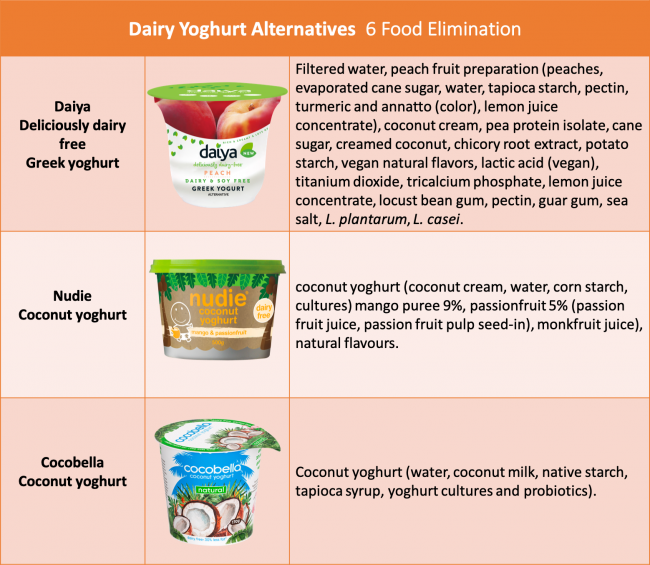
Yoghurt can be a quick nutritious snack. The Australian market has a wide range of coconut-based yogurts such as Cocobella and Nudie coconut. Unfortunately, coconut yoghurts have half the amount of protein as their dairy counterparts and typically don’t contain any calcium. Adding protein rich seeds and grains (chia, oats, teff, hemp, flax) to the yoghurt will help increase its nutritional profile. Be on the look out for allergy free yoghurts that have added pea protein, such as Daiya’s deliciously dairy free yoghurt. Sadly, I haven’t seen this product available at major supermarkets yet. Try talking to your nearest specialty food shop to see if the can arrange on order of stock, you might be pleasantly surprised. The added pea protein can significantly increase the nutritional profile of the yoghurt and every little bit helps when you are following such a restricted EOE elimination diet.
Cheese Alternatives
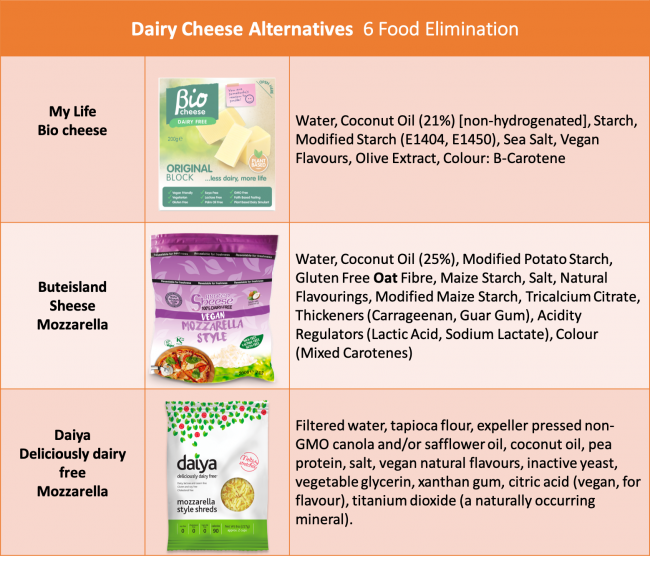
As with EOE friendly yoghurts, EOE elimination diet cheeses are predominantly coconut-oil- based and tend to have very small amounts of protein, if any. They however serve an important purpose by providing a source of energy and also contributing to food familiarity which, can be helpful when changing a diet so drastically. Both Bio cheese and Buteisland are readily available at major supermarkets. Again, keep an eye out for EOE friendly cheese with added pea protein such as the Daiya dairy free mozzarella.
Bread, grains and cereals alternatives
Bread, grains and cereals can be a big staple in our diets, especially for children so its important to spend some time finding an alternative you enjoy.
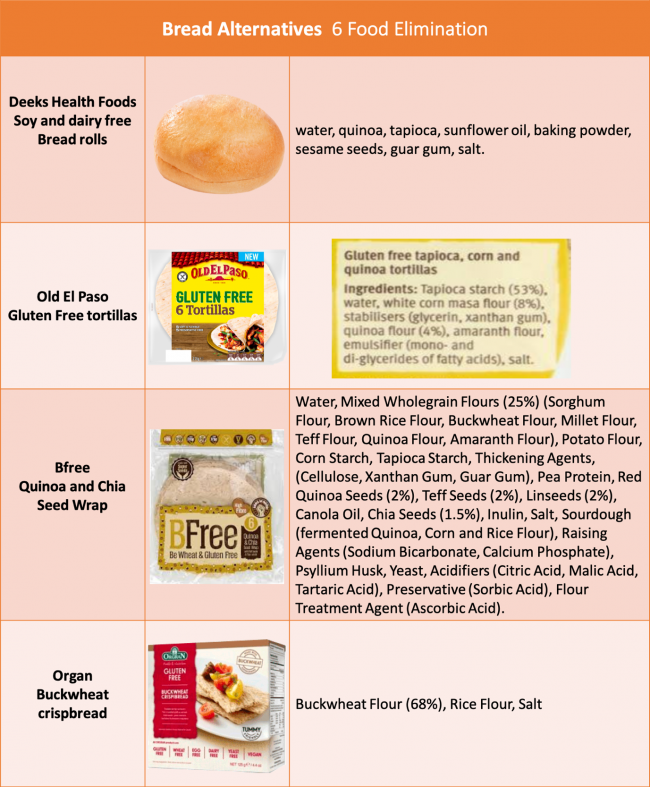
Excitingly, Old El Paso added gluten free tacos to their product range. These are available at the major supermarkets and just quietly, I find them delicious. Deeks make a range of EOE friendly bread and buns, have a look on their website to find a stockist hopefully, near you. Bfree, is another brand dedicated to making products free from gluten, wheat, dairy, eggs, nuts and soy. Their EOE friendly wraps are available at Woolworths.
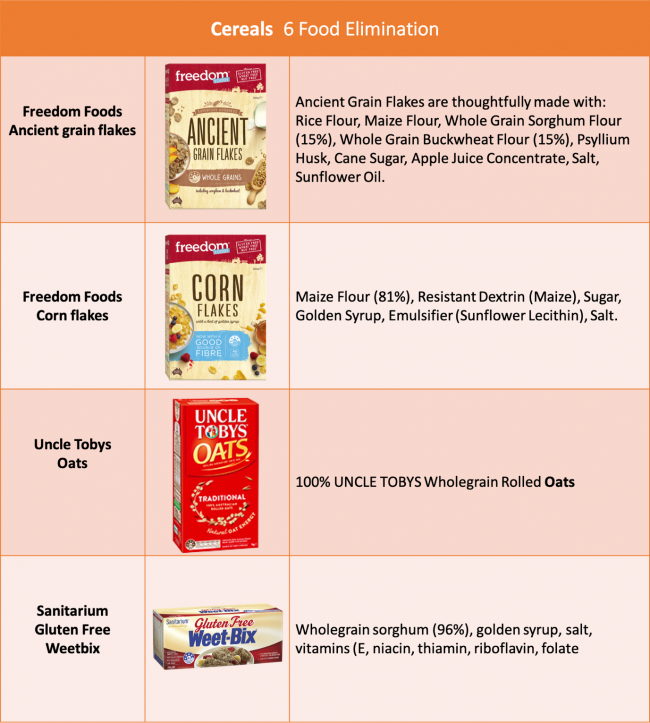
Freedom foods have a large selection of allergy friendly cereals such as corn flakes, cocoa bombs and rice puffs. Oats are an allergy friendly option too. Have a look at the recipe below for overnight apple and cinnamon oats. Sanitaruim also have a gluten free Weetabix range which does taste quite nice.
Grains such as quinoa, rice, buckwheat, millet and corn are good wheat free alternatives. Rye and barley may also be appropriate but because they are similar to wheat, your specialist may suggest excluding them too.
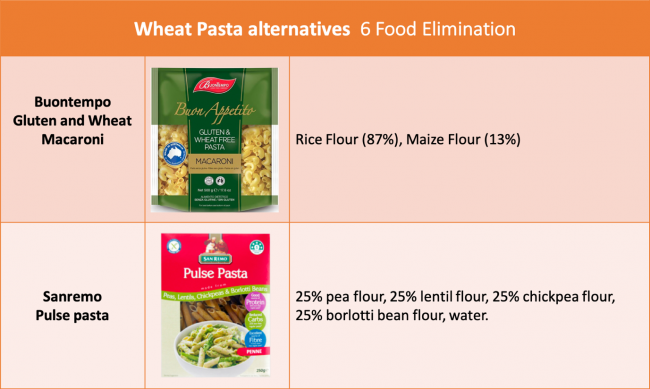
Pulses and legumes such as beans and lentils, chickpeas are a good allergy friendly alternative to wheat. Sanremo have introduces an EOE friendly pulse pasta. The pulse addition means that this pasta is also provides a good source of protein.
Snack alternatives
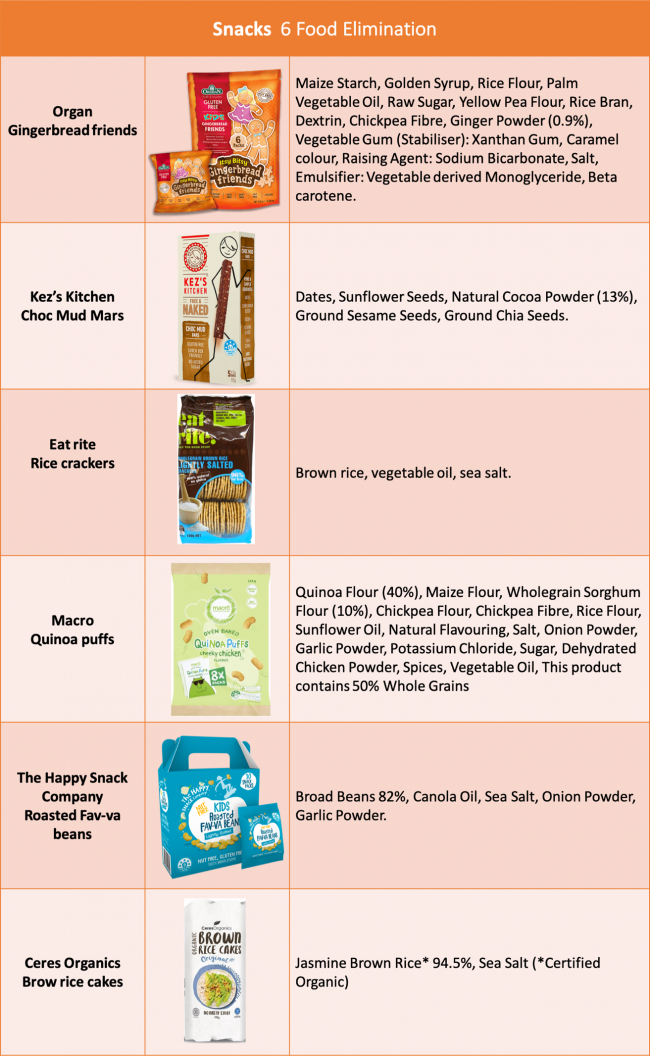
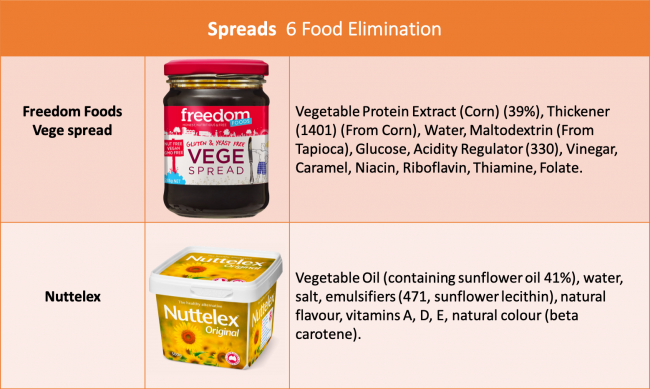
In regard to whole foods, Fresh fruit or vegetables sticks are a good option. If you’re needing to up the energy and protein intake then enjoying vegetables with dips such as hummus SSS hummus can help. Home-made popcorn can be a fun snack. When cooking it up use canola oil or dairy free margarine and try loading them up with allergy free cheese for some extra goodness. Cobs do make fun sized air popped corn, just double check the ingredients list for any allergens. Have a look at the snacks and spreads list bellow for some ideas.
I hope the list of product above proves to be helpful and that you now can feel more confidant and at easy about reading ingredient lists.
Disclaimer:
This post is not indented to replace medical or dietetic advice.
No conflicts of interest or sponsors to declare. The food products mentioned in the blog were all paid for in full.
You may also like to read:
Allergies and Special Occasions
]]>