How?
By showing us how to calm the mind and the body. By teaching us how to be more present, rather than worrying about the future or ruminating on the past.
And our kids are no different. Children who meditate have the opportunity to benefit even more, simply by starting from a younger age.
Let’s consider meditation in an all too common childhood scenario – schoolyard bullying.
The Bully:
The child that expresses their feelings by tormenting or intimidating another child is deflecting a lack of self-worth. They have a superficial sense of who they are, or, they’ve modelled behaviour that has taught them that the only way to feel empowered is to make another feel less.
What would happen if the bully learnt to love who they are instead? To develop self-worth and a strong sense of self. How would that change their interactions in the playground? Meditation can guide them here, to feel comfortable and worthy in their own skin.
The Bullied:
The child on the receiving end of domineering behaviour has yet to develop the self-confidence to walk away or seek help. This child is still learning the bully’s behaviour has nothing to do with them.
What would happen if this child learned that they are enough? That they are perfect just the way they are. That they don’t need external validation. Meditation can also help guide this child, in this case, to understand they are worthy of love and respect. That they are worthy simply for being.
I truly understand this situation because I experienced it firsthand. As a child who lacked self-esteem and self-concept, I believed I had less worth than my classmates who ‘appeared’ more confident, more capable, and more inspiring. So when they spoke down to me, laughed at me or excluded me, I started to believe them.
Enter meditation! Meditation changed my life by changing my perspective of my self-worth. Which sparked the drive within me to create a meditation practice specifically for children. So our kids could learn to love themselves deeply and truly, just like I did.
Meditation practices are becoming more readily available and more highly regarded because of the powerful benefits it provides. The power to make both adults and children feel happier, calmer and more content. Less suffering from five minutes a day of being truly present and understanding what it means to be self-aware and have self-respect.
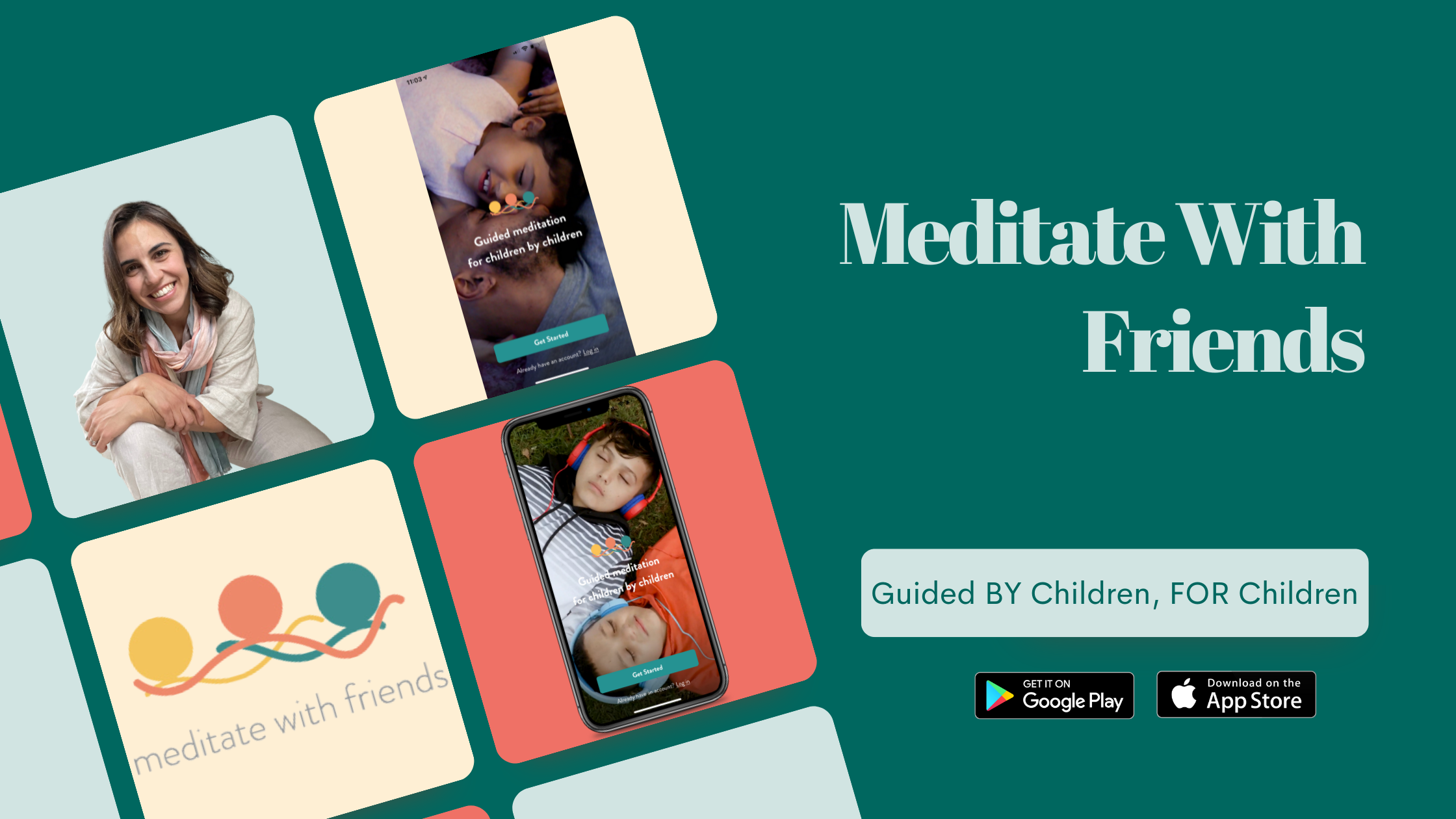
Children can learn and enjoy meditation in many ones. Guided meditation is an easy way to start- you simply press play and listen. Our Meditate With Friends app has guided meditations designed only for children, voiced by children.
Our guided meditations mean your child can listen with you or alone, with the voice of a kind peer to soothe and inspire a feeling of contentment. To learn the greatest lesson meditation teaches us all:
We are enough.
]]>
When I found out that my child had special needs, as her parent, I believed it was my fault. I had failed her. Selfishly, I got caught up in ‘why me’, ‘what did I do wrong’?
While it’s hard to talk about, I can now acknowledge the anger and resentment I carried, and the disappointment I felt. I played the victim, rather than seeing the gift I had right in front of me – the beautiful little girl.
It took some very turbulent life events, and a very direct pediatrician to initially diagnose Summer with ADHD and ODD (Oppositional Defiance Disorder). While this initially provided some mental and emotional relief – finally having a diagnosis – something still didn’t sit right.
Summer’s brother Kody had already been diagnosed with ADHD, yet despite similar diagnosis, they were very different children. While I knew that all kids present ADHD differently, even the ODD didn’t fit for me.
So, I trusted my gut and I persevered. After six months of tests, and thousands of dollars in practitioners, she was diagnosed with Level 2 Autism, needing the assistance of a Psychologist, Speech Therapist, Occupational Therapist and play-based learning activities.
Finally, I had the proof that Summer wasn’t bad or naughty, she was just a little different. And it was my job to parent her in the way that she needed, not the way I ‘thought’ I should.
My whole mindset changed. Her ‘inability’ to follow instructions became an understanding that she didn’t know how to follow my instructions. Her ‘defiance’ in not doing what she was told was now seen as an awareness that she can only do one task at a time. I now understood that when she screamed and yelled, she was sharing her frustration at not being able to communicate with us clearly in a way that we could understand.
So, what did I do?
Trial and error
Every child is different, and for Summer, there was a lot of trial and error. But if what worked for me can help even just one family, it’s worth sharing.
- Reward systems: we started with stickers, then moved to gold stars, checked boxes and finally a white board that Summer can draw on herself and rub it out when she had finished.
- Daily schedules: this helped Summer see what we had on. She can see what order we will do things in, and what she needs to do next.
- Consistent messaging: I work closely with her specialists and bring home the practice. What she does with them, she does with me.
- Talking at her level: no one wants to be talked down to so I kneel down and look her in the eye. Summer knows that I am not only listening, but that she is being heard.
- Safety at night: a big thing for Summer was feeling safe at night, so I often lie in her bed, read a book and let her fall asleep knowing she has nothing to worry about.
By far, though, the biggest change came when I implemented some changes to her diet and introduced alternative practitioners into her world. I learnt all about the gut and what we now refer to as ‘Summer’s second brain’. I know that if she is hungry, she cannot function. I also know that she cannot tolerate gluten, dairy, sugar, processed foods or preservatives. Here I was thinking I was feeding her a balanced diet. But I wasn’t giving her the right balanced diet for her needs.
She has now learned how to live and make conscious choices around her food so she can feel better and be happier. Her gut is her brain, so if her gut is happy so is she.
No cookie cutter approach
There is no one-size-fits-all approach, but rather a holistic approach to each individual person. I learned I needed to listen and get to know my child, as she has a voice, and it’s so important she feels heard.
One thing I realised is that Summer requires a healthy balance of power and attention. Power may come from decisions she makes – she chooses whether to eat corn or carrot, to wear pink or blue socks or to read a book or play a game. I give her options, within some boundaries, but I provide her the freedom and power to make decisions for herself.
My final tip?
Repair things as you go along. Every meltdown feels like its unbearable, and ‘the worst one yet’, but it’s not and the ‘repair’ that is done after a meltdown will help guide them through the next. They are not ‘bad’ or ‘naughty’ or ‘rude’ or ‘disrespectful’, they simply don’t understand, or have become frustrated, or aren’t being heard, or have made the wrong choice.
Life is all about choices, so letting them know and teaching them the difference between a right and wrong choice and the consequences of such, will help you in the long run, but most importantly will help them in the short term.
Get their opinion on what happened – how did they feel, what did they experience and then help them understand why you didn’t let them have that piece of cake right before dinner or let them buy that giant remote-control car at the shops. It’s done without blame or shame, but gives insight, clarity and potentially a solution – when can they have that cake, maybe they can have the car for their birthday.
Remember, their little brains just aren’t quite up to speed with ours, or where we expect them to be. It’s my job to slow down to Summer’s speed, not rush her to catch up to mine. It’s ok that I won’t always get it right. I just need to let her be her.
Kiani Mills is a serial entrepreneur, single mother and speaker. She is the Founder of Imperiale, a successful nationwide specialist property conveyancing firm and the co-founder of Edwards Mills, an industry-leading buyers advocacy business she co-founded with MAFS alumni Jake Edwards in 2021.
Images of Kiani Mills: https://bit.ly/3t2suh4
LinkedIn: https://www.linkedin.com/in/kiani-mills-bba19767/
Instagram: https://www.instagram.com/kianimills/
Website: https://www.kianimills.com/
]]>They become more and more capable of having their tears and thoughts on the inside and using their words to express how they feel and what they need. They no longer have to physically act out, or cry in response to every frustration in order to move through it.
An angry child is often just scared, they don’t feel safe or calm enough to find the words to tell you how they feel.
To reduce the fear you must calm the brain.
Every child can benefit from emotional regulation practice, taught by a calm, loving adult.
It starts with how we handle our own emotions in the face of theirs.
Whilst it is natural and understandable that our own level of frustration rises as we witness our children’s struggle, it’s up to us to keep ourselves in check.
It’s not always easy to remain calm, but in our parent-child relationships, it is essential that we dig deep and then rise to the occasion when our children need us most.
Mirror neurons are cells in a child’s brain that react when a particular action is performed and observed.
So, all you have to do is be the behaviour you are wanting to see, in this case; cool, calm and collected.
This looks like empathy and validation. Saying what you see such as;
“That didn’t go as you planned”
“I’m right here with you”
When there is no threat of punishment or disapproval (even though aggression is not what we want to see) the child’s brain can calm down and do its thing – learn!
Now, most parents at this point feel like there should be some form of discipline to let the child know this behaviour is not okay!?
It won’t help.
Let go of the fear that your child is ‘getting away with it and that if he is not reprimanded this behaviour will repeat.
This behaviour will only repeat until he has learnt a new way to respond differently; a new skill.
If you are seeing anger and aggression your child has been triggered into fight or flight mode.
His nervous system is overwhelmed.
In this state, the logical part of his brain has shut down.
He is reacting involuntarily.
(It looks like he knows what he is doing but there is too much emotion present for him to have self-control)
It is ineffective to teach, reason or punish at this point.
He will only change his behaviour when he has something else to do or say.
To teach him, he needs to be regulated and calm, not in fight or flight mode.
Validating his feelings (and his wants) will de-escalate the situation. Such as;
“You’re frustrated?”
“You wanted that toy, and your brother has it?”
Give him a moment to calm and suggest some words he can use such as:
“I was busy with that”
“Can I have a turn when you are finished?”
If he is unable to mimic your words, you can speak to the other person on his behalf, such as;
“Hey, looks like your brother would like a turn, will you let him know when you are finished?”
NOTE: If it is a behaviour you know they have the skill for, you still wait to address it. Choose a time later in the day, in private.
“Hey today I noticed you struggled to use kind words towards your brother?”
“Do you remember what to say if you want something?”
(Remind him, role play a little, have fun with it)
Then, let him know the consequence if he does it again next time.
Calm brains learn new things and behaviour changes.
]]>The overcare syndrome
In their book called “Heart Intelligence”, Doc Childre and the team behind the Heart Math Institute (who’ve been doing fascinating research into the heart/brain connection), shared a fascinating insight: “Numerous caregivers experience a high-rate energetic burnout from not being able to find the balance between care and overcare.”
Doc Childre describes overcare as: “that which happens when the mind and emotions cross the line of balanced care and get too bogged down with whomever or whatever you’re caring about. Overcare is when you become too entangled in another’s web and realize your energy is drained from overattachment.”
When we care too much, we pour everything we have into that person or that thing we care about, at the expense of our own needs. We also take over the other’s capacity to look after themselves. We become resentful and stressed. And who benefits from that? No one.

Caring with awareness
Awareness is always the first step towards change. There’s nothing wrong with caring but it’s worth asking: what is the motivation behind it? Whose needs are being met?
When caring comes from a place of genuine love and selfless compassion, it will usually be invigorating and nourish our sense of meaning and contribution. When caring is self-serving, feeds our need to feel important or to control, that’s when it becomes depleting, draining and stressful.
Here are some common areas where we can tip into overcare: children, work, relationships, money, diet, health, how we look, what people think of us, regrets, etc.
In what areas is care draining your energy right now? What are you over-attached to or over-identified with?
Overcaring doesn’t discriminate based on gender, however women and especially mothers, are often more prone to fall into the overcare trap because of society’s expectations of what a good mother should be and do. Remember that your worthiness comes from within: you don’t earn it through your mothering, your job, or your bank account.And perhaps the most important question of all is: have you taken time to give to yourself first? How do you care for your own needs?
If you need support to better manage your care, including the one you give to yourself, I’d love to help. You can find out more about my work and book your introductory session here.
]]>Anger can become an issue when it starts to affect those around you. When you start lashing out at your workmates or your family, then it is time for you to get your anger under control. There are some signs that you should look for to indicate that your anger is getting out of control. Some of these signs are :
- People commenting on your anger
- You remain angry for a long period of time
- You are getting depressed and anxious more often
- You get angry easily
- People are afraid of you or to be near you
Why should we manage our anger?
While being angry can have a positive influence on our bodies and our mind, being angry all the time is not good for anyone. It’s not good to keep emotions bottled up as it can cause all sorts of issues. However, it’s also not good for you to be in a constant emotional state of anger.
When it comes to finding ways to manage anger, some may feel that it is not necessary to manage their anger as they find expressing anger to be liberating. Some may feel that suppressing their anger will make them not able to stand up for themselves. While all these are valid points of your anger controlling your life, then something needs to be done to manage it.
Anger management techniques
As with most issues to do with your own health and wellbeing, there is no right or wrong way to manage your anger. It is a matter of finding what suits you and what works for you. The first step is to be able to identify what makes you angry and what are warning signs that you are about to lose control. If you are aware of this, then you’re well on your way to managing your anger.
Identify your warning signs
When you next get angry pay attention to how your body reacts. Make a list of the things that you noticed. Did you clench your jaw? Did you feel a fight or flight urge? Some warning signs to look out for could be :
- Pounding heart
- Sweating
- Shaking
- Anxiety
- Raising your voice
Once you understand how your body reacts to anger, you can then find ways to deal with your emotions.
Strategies for managing anger
In this section, you will find ways to control your anger and strategies you can put into o place next time you feel you are about to lose control.
Control your thinking – The art of self-talk
When you are about to have an angry outburst or you are finding yourself getting angry, have a look at the thoughts that are running through your head at that time. Is your thinking getting irrational? Are you exaggerating what is really happening? Are you overthinking too much? If you change the way you think, you will find yourself becoming calmer and more in control. If you find yourself thinking the worst of a situation, you will only make yourself feel more anxious.
You could develop a list of mantras or saying that you can say to yourself when you find yourself in situations that make you angry. Make these phrases that focus on how you can manage the situation.
Time out
Do you remember back in your school days when someone did soothing wrong they were given time out, and this time out was sitting away from others or the situation that causes the issues? Well, the same technique can be used to control your anger. If you find yourself in a situation that is about to cause you to distress you can remove yourself from it and take time to calm down. Just ensure that you do go back and resolve the situation once you are calm.
Distraction
If you are about to get angry over something, find a way to distract yourself from the situation. Some people swear by counting to 100 helps them to calm down as they are thinking of something else. Others like to listen to music or do the dishes. Others like to do a task like colouring in or even gardening to take their mind off the issue. While distraction is a great short-term solution, it is important that you address the situation that caused you to become angry.
Next time you find negative thoughts creeping into your mind, think about ways you can tell yourself to think differently. For example: instead of telling yourself “it’s all too hard and you can’t stand it (which will cause you to get upset) maybe tell yourself “it may be frustrating, but it’s not the end of the world and you can fix it with some patience”.
You could develop a list of mantras or saying that you can say to yourself when you find yourself in situations that make you angry. Make these phrases ones that focus on how you can manage the situation rather than other people managing the situation for you.
When to seek professional help
If you find that your anger is becoming a major issue and that despite your best efforts nothing is working, then it’s best that you seek professional advice.
]]>