Understanding the difference between speech, language and communication can help parents recognise what their child may be finding difficult — and know when it may be worth asking for help.
There are some parenting questions that sound simple until you start looking into them.
“My child isn’t talking yet — does that mean they have a speech problem?”
Or perhaps:
“They can talk, but I can’t understand them. Is that a language delay?”
And then there are the questions that come when your child seems to understand everything you say, but struggles to find the words they need.
For parents, it can all become a little confusing.
After all, we tend to use words like speech, language, talking and communication interchangeably in everyday life.
But from a developmental and clinical perspective, they aren’t quite the same thing.
Understanding the difference can be really helpful because a child can have difficulty with one area while developing typically in another.
And importantly, communication begins long before a child says their first word.
Speech and language are not the same thing
As a Speech Pathologist, one of the first things I would often discuss with families during assessment or when starting intervention is the difference between speech and language. This is a very confusing topic for many parents, but one I feeI is important to spend time discussing as they are two quite different things. Both are important when it comes to communication development.
Speech is about how we produce spoken sounds.
It involves the movements of the lips, tongue, jaw and other structures involved in producing speech, as well as learning how sounds are organised within a particular language.
Language is about understanding and using meaning.
It includes the words we understand, the words we use, how we put words together, how we understand sentences and questions, how we tell stories, explain our thoughts and participate in conversations.
So, while speech and language work closely together, they are not interchangeable.
A child can have difficulty producing speech sounds while having strong language skills.
Another child may pronounce words clearly but have difficulty understanding what other people say or putting their own thoughts into words.
Some children experience difficulties in both areas.
Australian guidance makes this distinction between speech and language particularly clear. Speech difficulties can involve producing or combining sounds, while language difficulties can involve understanding and/or using spoken language.
A simple way to think about it
Imagine your child wants to tell you:
“The dog is running.”
The language is the meaning behind that message — knowing the words dog and running, understanding how those words fit together and being able to communicate the idea.
The speech is how your child physically produces the sounds in dog, is and running.
The communication is the whole process of sharing that message with another person.
And communication doesn’t have to involve spoken words at all.
A child might point to the dog, gesture, use a sign, show you a picture or use a communication device.
They are still communicating.
So, what exactly is communication?
Communication is much bigger than speech.
Children communicate through:
- speech
- gestures
- pointing
- facial expressions
- body movements
- sounds
- signs
- pictures
- symbols
- written words
- communication books
- speech-generating devices and other technology.
Some children use several of these ways of communicating at the same time.
This is sometimes called multimodal communication — using different communication methods depending on what works best for the child and the situation.
Speech Pathology Australia describes Augmentative and Alternative Communication (AAC) as communication that uses something other than speech, including gestures, sign language, communication books and technology. AAC can be used alongside speech or instead of speech.
This is an important distinction for parents because spoken language is not the only meaningful form of communication.
A child who points to the fridge because they want a drink is communicating.
A toddler who reaches towards a favourite toy is communicating.
A child who uses a picture to request something is communicating.
A child who uses an AAC device to tell you what they want is communicating.
The goal is not simply to make every child communicate in the same way.
The goal is to help each child have an effective way to understand, express themselves, connect with other people and participate in everyday life.
Why language matters before — and alongside — speech
As you can imagine, when families come into the clinic for the first time the goal is often for their child to develop speech. Oftentimes, particularly in the case of younger children, they may not be speaking any words when they first present for assessment or therapy.
In order to develop effective verbal communication skills, language and speech are both vital to develop. If a child is not yet speaking any words, it can be tempting for families to want to move straight to developing speech, however, therapy needs to begin with language. After all, it is not much use knowing how to say all of the sounds if a child does not have any understanding of concepts, or words to say yet! For some kids, this might start with developing their understanding of language (receptive language). It might incorporate developing expressive language skills using different modalities, for example, gesture or sign language. As language develops, speech can also be targeted alongside language in therapy.
There is an important idea here for parents:
Speech is only one part of communication.
For a child who is not yet speaking, a speech pathologist may first want to understand what that child already knows, understands and communicates.
Are they showing you what they want?
Do they understand familiar words?
Can they follow simple instructions?
Do they use gestures?
Do they make sounds to communicate?
Do they copy actions?
Do they take turns with another person?
Do they attempt to communicate when they need help?
These skills can provide important information about a child’s developing communication.
At the same time, it is important not to think of development as a rigid staircase where a child must completely “finish” language before speech can begin.
Speech and language can develop alongside one another.
For some children, language and intentional communication may be the main priorities at first. For another child, speech-sound development may be a much more immediate focus. For another, both may need to be supported together.
The right starting point depends on the individual child.
That is one reason a good assessment matters.
Receptive language: understanding what is being said
One of the terms parents may hear from a speech pathologist is receptive language.
Receptive language is essentially about what a child understands.
This can include understanding:
- individual words
- questions
- instructions
- sentences
- concepts such as big, little, under and behind
- conversations
- stories
- increasingly complex language.
For example, a child may understand:
“Get your shoes.”
but struggle when an instruction becomes longer:
“Before we go outside, get your shoes and put them beside the door.”
As children grow, the language they need to understand becomes increasingly complex.
Difficulty understanding language can sometimes be less obvious than difficulty speaking because a child may learn ways to compensate.
They may watch what other children are doing.
They may copy.
They may rely on routines.
They may guess from context.
This is one reason that a child appearing to “know what is going on” doesn’t necessarily mean they are understanding all of the language around them.
Raising Children Network notes that language difficulties can involve responding to language, understanding words and sentences, following instructions and understanding questions.
Expressive language: finding the words to express yourself
Expressive language is about how a child communicates their own thoughts, ideas, needs and experiences.
This can include:
- vocabulary
- combining words
- sentence structure
- grammar
- finding the right words
- describing things
- asking questions
- answering questions
- telling stories
- explaining what happened
- expressing feelings
- taking part in conversations.
A child might know exactly what they want to tell you but struggle to find the words.
You might hear:
“Thing… there… that one.”
rather than the word they are searching for.
Or perhaps your child can name individual objects but struggles to put them into a sentence.
Another child might speak in long sentences but find it difficult to explain what happened at preschool or tell a story in the right order.
These are all examples of why language is much more than simply counting how many words a child can say.
A child can talk a lot and still have language difficulties
This is something many parents don’t realise.
Sometimes we assume that a child who talks frequently must have strong language skills.
But the amount a child talks isn’t the same thing as how effectively they understand and use language.
A child may be very chatty but have difficulty:
- finding the right words
- following longer instructions
- answering questions
- understanding less familiar vocabulary
- organising ideas
- telling a story
- staying on topic
- understanding what someone else means
- participating in conversations.
This can become increasingly noticeable as children get older and the language demands around them become more complex.
Developmental Language Disorder, or DLD, is one condition in which children can experience persistent difficulties with understanding and using spoken language.
Speech Pathology Australia describes DLD as a common but often hidden disorder affecting around 1 in 14 people, with difficulties potentially affecting vocabulary, grammar, comprehension, conversations, learning and participation.
Importantly, DLD is not caused by poor parenting. Speech Pathology Australia notes that there is no single clear cause and that many factors, including genetics, may influence whether someone develops DLD.
Not every child who is late to talk has DLD.
Some children with early language delay catch up.
Others have more persistent difficulties.
That is why professional assessment and ongoing monitoring can be so important.
A child can have speech difficulties while their language is developing well
The opposite can also happen.
A child may understand what you say, have a good vocabulary, put sentences together and love telling you stories — but their speech may still be difficult for other people to understand.
For example, a child might say:
“tat” instead of “cat”
or simplify more complex combinations of sounds.
Young children commonly make speech errors while they are learning.
Australian guidance explains that children typically develop different speech sounds at different ages, with some sounds emerging earlier and others continuing to develop into the early school years.
So a child making a few pronunciation errors does not automatically mean there is a speech disorder.
What matters is the child’s age, the types of errors they are making, how often they occur, how understandable their speech is and whether communication is becoming difficult or frustrating for the child.
How understandable should a child’s speech be?
One useful concept is speech intelligibility — simply, how much of what a child says other people can understand.
Australian guidance suggests that:
- around 2½ years, an unfamiliar listener may understand about half of what a child says
- around 4–5 years, an unfamiliar listener may understand around three-quarters
- by around 6–7 years, almost everything a child says should generally be understandable, although some later-developing sounds can still be tricky.
These are broad developmental guides rather than a pass-or-fail test.
Children develop differently, and a speech pathologist considers the whole picture rather than one milestone in isolation.
Communication starts long before the first word
One of the biggest misconceptions about early communication is that development begins when a child says their first word.
It doesn’t.
Long before children are saying words, they are learning about people, interaction, sounds, gestures, turn-taking and meaning.
You may notice a baby:
- looking towards you when you speak
- turning towards sounds
- smiling in response to interaction
- making sounds back to you
- copying facial expressions or actions
- reaching towards something they want
- pointing
- showing you objects
- taking turns in simple games
- using sounds or gestures to get your attention.
These early behaviours are all part of communication development.
Raising Children Network recommends seeking advice when children are not showing expected communication behaviours at different stages, including limited attempts to communicate using sounds, gestures or words.
This is why a speech pathologist can work with a child before they are speaking.
There is no requirement for a child to already have words before communication intervention can begin.
What about gestures and sign language?
For some families, the idea of using signs or gestures can initially feel like a step away from spoken language.
It is actually the opposite.
Giving a child another way to communicate can reduce the pressure of having to rely on speech before speech is reliable.
A child might learn a sign for:
more
help
finished
drink
or
eat
while spoken language continues to develop.
Raising Children Network notes that professionals may support children with language delay using other communication methods, including sign language, books or speech-generating devices.
The purpose isn’t to replace speech simply because speech is not important.
It is to make sure the child has a way to communicate now.
AAC: when speech isn’t enough
Some children need more support than gestures or signs.
This is where Augmentative and Alternative Communication (AAC) can become important.
AAC can include:
- gestures
- signs
- photographs
- pictures
- symbols
- communication boards
- communication books
- apps
- speech-generating devices.
Some children use AAC temporarily.
Others use it alongside speech.
Some people rely on AAC as their primary way of communicating.
Speech Pathology Australia emphasises that AAC can be used with speaking or instead of speaking, and that different people may need different combinations of communication supports.
The important question is not:
“How do we make this child speak?”
It is:
“How can we give this child the most effective way to communicate?”
For some children, the answer will involve speech.
For others, it will involve speech plus AAC.
For some, AAC may be their most reliable form of communication.
All of these are valid communication pathways.
What happens during a speech pathology assessment?
If you have any concerns about your child’s speech or language development, the first step would be to visit a speech pathologist. Speech pathologists are the experts in communication development, including speech and language. They can see children from a very young age, including prior to the development of speech. Your child will first have an assessment to determine whether their development is on track or if they might need a little help. If therapy is recommended, goals and a therapy program will be developed with you and intervention should ideally incorporate parents and families where possible.
For many parents, the word assessment can sound intimidating.
It doesn’t necessarily mean sitting your child at a table and asking them a series of questions.
Especially with younger children, a speech pathologist may use play, conversation, observation and interaction to understand how the child communicates naturally.
Depending on the child, assessment may consider:
- receptive language
- expressive language
- vocabulary
- sentence development
- speech sounds
- speech intelligibility
- social communication
- play and interaction
- gestures
- communication methods
- functional communication
- developmental history
- hearing
- family priorities and concerns.
The aim is not simply to attach a label to a child.
A good assessment should help answer practical questions such as:
What is my child already doing well?
Where are they having difficulty?
What matters most to my child and our family?
What can we do to make communication easier?
What support, if any, would be useful?
Hearing can be part of the picture
Hearing is an important part of the communication-development puzzle.
A child needs access to speech sounds in order to learn about the sound system of their language, and hearing difficulties can affect communication development.
This doesn’t mean that hearing loss explains every speech or language difficulty.
It doesn’t.
But if there are concerns about hearing, recurrent ear infections, inconsistent responses to sound or speech and language development, a hearing assessment may be appropriate.
Australian guidance recommends considering hearing assessment when there are concerns about hearing or communication development, and audiologists can assess a child’s hearing.
A speech pathologist may therefore work alongside other professionals, such as an audiologist, GP, paediatrician, educator or other members of a child’s support team.
What does good therapy actually look like?
Speech pathology isn’t simply about sitting in a room and practising words.
For young children especially, communication happens in the context of relationships, play and everyday life.
A child may be working on communication while:
- playing with blocks
- looking at books
- eating breakfast
- getting dressed
- playing outside
- singing songs
- shopping
- having a bath
- talking about something they love
- playing with siblings.
This matters because children need to be able to use their communication skills outside the therapy room.
Australia’s National Best Practice Framework for Early Childhood Intervention, released in 2025, places strong emphasis on family-centred, strengths-based, evidence-informed and outcomes-focused support, including opportunities to build children’s skills within everyday environments.
In other words, the goal isn’t simply:
“Can my child do this during therapy?”
It is:
“Can my child use this skill in real life?”
Parents are not expected to become speech pathologists
This is another important distinction.
Family involvement can be incredibly valuable, but parents don’t need to spend every waking moment “doing therapy”.
Sometimes the most powerful support is simply learning how to make everyday interactions a little more communication-friendly.
That might mean:
- following your child’s interests
- modelling language
- giving your child time to respond
- responding to gestures and sounds
- expanding on what your child says
- creating opportunities to communicate
- sharing books
- singing songs
- talking during everyday routines.
The Australian National Best Practice Framework specifically recognises families as partners in decision-making and emphasises helping parents and carers build confidence and skills within everyday life.
Simple things parents can do at home
Follow your child’s lead
If your child is fascinated by cars, talk about cars.
If they’re watching a dog, talk about the dog.
If they’re building a tower, join their world rather than trying to redirect the conversation to something you think they should be learning.
Connection creates opportunities for communication.
Add a little more language
If your child says:
“Dog.”
You might say:
“Big dog.”
Or:
“The dog is running.”
You aren’t demanding that your child repeat you.
You’re giving them a model.
Give your child time
It can be tempting to jump in when your child doesn’t answer immediately.
Try pausing.
Give them a moment to process what you’ve said and work out how they want to respond.
Model rather than constantly correct
Instead of:
“No, say cat.”
you might respond:
“Cat! Yes, that’s the cat.”
The goal is to keep communication positive rather than turning every interaction into a test.
Talk about what you are already doing
You don’t need flashcards and worksheets for every interaction.
Talk while:
- making breakfast
- packing the daycare bag
- getting dressed
- walking to the park
- putting toys away
- cooking dinner.
Everyday life is full of language.
Read together
You don’t have to read every word on every page.
Talk about the pictures.
Wonder what might happen next.
Point out something your child is interested in.
Let your child turn the pages.
Ask a question occasionally — but don’t feel as though you need to turn story time into an examination.
Respond to every form of communication
A point, gesture, sound, facial expression or movement can all be communication.
When we respond to these attempts, we show children that their communication has power.
Raising Children Network recommends giving children time to communicate and responding to and expanding their communication efforts, including actions and sounds as well as words.
Your child doesn’t need to perform for you to know they are communicating
Parents can understandably find themselves asking lots of questions when they’re worried about development:
“What’s that?”
“What colour is it?”
“What does the cow say?”
“Can you say dog?”
Questions aren’t bad.
But children also learn through watching, listening, sharing attention, copying, playing and being part of natural conversations.
Instead of constantly asking:
“What’s that?”
sometimes simply model:
“Look! A big red truck.”
Then wait and see what your child does.
Communication is a two-way relationship — not a test.
When should parents seek help?
There isn’t one magic age at which parents suddenly need permission to ask for help.
If you’re concerned, it is reasonable to ask.
You don’t need to wait until your child starts school.
You don’t need to wait until they are “old enough” for speech therapy.
And you don’t need to prove that something is wrong before talking to a professional.
You may want to seek advice if your child:
- isn’t showing expected communication skills for their age
- isn’t using words when you expected them to
- isn’t combining words as expected
- has difficulty understanding everyday instructions
- struggles to answer questions
- has difficulty finding words
- is very difficult for other people to understand
- becomes frustrated when trying to communicate
- relies heavily on gestures without developing other communication methods
- has known hearing difficulties or frequent ear infections
- seems to have difficulty participating in conversations
- or simply makes you feel that something isn’t quite right.
Raising Children Network recommends seeking professional advice when parents have concerns about language development and highlights signs across infancy, toddlerhood and childhood that may warrant assessment.
For speech, concerns may include very limited speech sounds, speech that is difficult to understand for the child’s age, frequent speech errors or frustration related to being misunderstood.
And there is one sign that should always be taken seriously:
If your child loses communication skills they previously had
If a child stops using words, gestures or other communication skills they previously used, don’t simply assume they will return on their own.
Raising Children Network specifically recommends seeking professional advice when a child loses previously acquired communication skills.
Talk with your GP, child and family health nurse, speech pathologist or another appropriate health professional.
What if my child is bilingual or multilingual?
Another important point for Australian families is that children may grow up hearing and using more than one language.
Speaking more than one language does not cause a language disorder.
Children learning multiple languages may develop their languages in different ways and may use different languages with different people and in different settings.
Raising Children Network notes that bilingual and multilingual children can sometimes appear to develop language differently from children learning only one language, but this should not automatically be interpreted as language delay.
If there are genuine concerns about a child’s communication, assessment should consider the child’s full language experience, rather than looking only at English.
For multilingual families, it is important that parents continue communicating with their child in the languages that are natural and meaningful within their family.
Early support doesn’t mean something is “wrong” with your child
Sometimes parents hesitate to seek an assessment because they worry that asking for help means putting a label on their child.
It doesn’t have to.
An assessment can simply give you more information.
Sometimes the outcome is reassurance.
Sometimes it identifies a skill that needs a little extra support.
Sometimes it identifies a more persistent communication difficulty.
And sometimes it highlights the need for further assessment by another professional.
The Australian Government’s National Best Practice Framework for Early Childhood Intervention emphasises the value of timely, evidence-informed support for children with developmental concerns, delays or disability and their families. It also emphasises strengths, participation, family priorities and everyday environments.
Early support isn’t about trying to make every child develop in exactly the same way.
It is about giving children the support they need to participate, communicate and thrive.
The most important thing to remember
It can be easy to become focused on the number of words a child can say.
But communication is so much bigger than a word count.
A child’s communication includes their ability to:
understand
connect
share attention
express themselves
make choices
ask for help
tell you what they want
share an experience
play
take turns
participate
and, ultimately, have a voice.
For some children, spoken language will become their primary way of communicating.
For others, speech may always be one part of a much broader communication system.
Neither journey has to look exactly the same.
What matters is that children are supported to communicate in ways that work for them.
And for parents, perhaps the most reassuring message is this:
You don’t have to wait for your child to start talking before you start supporting communication.
Communication is already happening — sometimes in words, sometimes in sounds, sometimes in gestures, sometimes in a look, a movement, a picture or a sign.
The job is to notice it, respond to it and, when your child needs more support, know that you don’t have to navigate the journey alone.
Key Takeaways
Speech and language are different. Speech is about producing spoken sounds, while language is about understanding and using meaning.
Communication is broader than speech. Children can communicate through gestures, facial expressions, signs, pictures, AAC and many other methods.
A child can have strong language but difficulty with speech. Equally, a child can speak clearly while experiencing significant language difficulties.
Communication starts before first words. Gestures, sounds, shared attention, turn-taking and intentional communication are all meaningful parts of early development.
AAC can support communication. AAC may be used alongside speech or instead of speech, depending on a child’s individual needs.
Speech and language can develop together. Therapy isn’t necessarily a matter of waiting for one area to completely develop before addressing another.
Hearing can be an important part of the picture. Where hearing is a concern, an audiological assessment may be appropriate.
Parents don’t need to wait until a child is older to seek help. Speech pathologists can assess young children, including children who are not yet speaking.
Early support should be family-centred and practical. Current Australian best-practice guidance emphasises strengths, family priorities, participation and learning within everyday environments.
If your child loses communication skills they previously had, seek professional advice.
Most importantly, there is no single “right” way for every child to communicate.
The aim is not simply to get children talking.
The aim is to help children understand, connect, express themselves and be understood.
Australian References & Further Reading
Australian Government Department of Health, Disability and Ageing. (2025). National Best Practice Framework for Early Childhood Intervention. The framework provides nationally consistent guidance for supporting children with developmental concerns, delays or disability and their families, with an emphasis on evidence-informed, family-centred, strengths-based and everyday-setting approaches.
National Best Practice Framework for Early Childhood Intervention – Australian Government
Australian Government Department of Health, Disability and Ageing. (2025). The National Best Practice Framework for Early Childhood Intervention – A guide for families.
Guide for Families – National Best Practice Framework for Early Childhood Intervention
Raising Children Network. (2025). Language delay in children. Australian Government-supported parenting resource developed with the Parenting Research Centre and Murdoch Children’s Research Institute.
Raising Children Network – Language delay in children
Raising Children Network. (2025). Speech disorders in children 1–8 years.
Raising Children Network – Speech disorders in children
Speech Pathology Australia. Developmental Language Disorder. Australian professional information for families and the wider community.
Speech Pathology Australia – Developmental Language Disorder
Speech Pathology Australia. Augmentative and Alternative Communication (AAC).
Speech Pathology Australia – Augmentative and Alternative Communication
Speech Pathology Australia. Communication aids and supports.
Speech Pathology Australia – Communication aids and supports
]]>What is the difference between speech and language?
Speech is verbal communication and includes articulation (or pronunciation). Speech is about how clear we sound to others when talking. Speech can also be impacted by rate, volume and pitch.
Language refers to a system used to communicate meaning. It can include spoken or written words and symbols, plus hand and body gestures e.g. Auslan. Language is how we use words in order to communicate our wants and needs, share ideas and interact with others.
What are speech and language delays or disorders?
Whilst children develop speech and language at different rates, there are certain skills that typically emerge by certain ages. When a child isn’t developing speech and language at an expected rate, it may be indication of a delay or disorder. A child may have difficulty with speech, language or both. “Speech and language impairment is common and studies have found that it affects up to 1 in 4 Australian preschool children” said Amy Turner, Chief Operating Officer Youthrive.
Signs and symptoms of a delay or disorder
A baby who doesn’t respond to sound or vocalise should be checked by a doctor right away. But often, it’s hard for parents to know if their child is taking a bit longer to reach a speech or language milestone, or if there’s a problem.
Here are some things to watch for.
by 12 months: isn’t using gestures, such as pointing or waving bye-bye, doesn’t respond to their name
by 18 months: no clear words or has trouble following short instructions
by 2 years: not learning new words, not putting 2-word phrases together (e.g. big dog).
by 3 years: Parents and regular caregivers should understand about 75% of their child’s speech at 3 years and they should be starting to use simple sentences (e.g. fast car go).
By 4 years: child should be mostly understood, even by people who don’t know the child.
By 5 years: having difficulty telling a short story with a start, middle and end.
How are speech or language impairments diagnosed?
If you are concerned about your child’s speech or language development, it’s important to see a speech-language pathologist right away.
“Sometimes parents are unsure whether they should book their child in for an appointment, but it’s important not to wait-and-see, as early intervention is known to achieve best outcomes”, said Amy Turner.
The speech pathologist (or speech-language pathologist/speech therapist) will assess your child’s speech and language skills. They may use a range of tools and assessments to check your child’s speech and language development and how this compares to norms for their age.
“It’s also important to have a hearing assessment completed, as hearing impairment can cause speech and language difficulty”.
How can parents help?
Here are a few ways to encourage speech development at home:
- Focus on communication. Talk with your baby, sing, and encourage imitation of sounds and gestures.
- Read to your child. Start reading when your child is a baby. Look for age-appropriate soft or board books or picture books that encourage kids to look while you name the pictures.
- Use everyday situations. To build on your child’s speech and language, talk your way through the day. Name foods at the grocery store, explain what you’re doing as you cook a meal or clean a room, and point out objects around the house. Keep things simple but avoid “baby talk.”
If you have any concerns about your child’s development, it is best to seek professional advice as soon as possible.
]]>If you’ve ever had a child sing the same song on repeat for days, you’ve already seen something researchers have been studying for years: music is one of the most powerful learning tools in early childhood development.
So when a global children’s media institution like Sesame Workshop releases an album built entirely on pop-parody learning songs, it’s more than entertainment — it’s a window into how modern educational media is evolving.
This sits directly alongside what Australian early childhood frameworks already emphasise: play-based learning, repetition, emotional regulation, and language development through rhythm and music.
According to the Australian Government Department of Education and the Early Years Learning Framework (EYLF), children learn best through:
- imitation
- repetition
- rhythm and storytelling
- social and emotional connection through play
And that’s exactly where this new release becomes interesting from a developmental perspective.
 Sesame Workshop Announces New Album, Parody Party, Full of Family-Friendly Twists on Today’s Biggest Pop Hits
Lead Single “Take A Bite” (“I Just Might” Parody) Available Now on All Streaming Platforms, With the Official Music Video Premiering Today on YouTube
 A cultural release with developmental weight
Sesame Street has delighted audiences for decades with its playful parodies of popular songs, reimagining the biggest hits of every era in whimsical, family-friendly ways. The iconic children’s series has long harnessed the power of music to spread joy, connection, and learning across generations, producing captivating music that encourages both children and caregivers to sing and dance along. This summer, Sesame Workshop is bringing this legacy together in a dedicated album, Parody Party, featuring inspired takes on some of the biggest recent pop hits.
From a child development lens, this approach aligns closely with findings from Australian research bodies such as:
- Telethon Kids Institute
- Murdoch Children’s Research Institute
- Australian Early Development Census (AEDC)
These organisations consistently highlight that music supports early cognitive wiring, particularly in:
- language acquisition
- memory formation
- emotional regulation
- social bonding
 What Sesame Workshop is saying
“Sesame Street has always been at the forefront of popular culture, using music as a powerful way to connect with each new generation,” said Aaron Bisman, SVP, Head of Marketing, Sesame Workshop. “From iconic original songs to clever, catchy parodies, music has long helped us engage the adults in young children’s lives while bringing our educational mission to life in fresh, engaging ways. Parody Party marks an exciting new chapter in Sesame Street’s musical history and reinforces our ongoing commitment to creativity, innovation, and cultural relevance.”
From a parenting perspective, this is key: co-viewing and co-listening matter. When adults engage with children’s media, learning outcomes increase significantly because children mirror attention, tone, and emotional cues.
 Lead single spotlight: “Take A Bite”
The album’s lead single, “Take A Bite,” also drops today on all major streaming platforms, alongside a music video available now on YouTube. A play on Bruno Mars’ “I Just Might,” the retro-inspired video is set in a colorful kitchen-meets-recording studio, where a band of Cookie Monsters performs a feel-good disco-pop anthem all about baking and enjoying — what else — cookies.
From a developmental standpoint, songs like this support:
- sequencing (step-by-step thinking)
- cause-and-effect learning
- vocabulary expansion through repetition and humour
These are foundational skills in early numeracy and literacy development supported by Australian early learning frameworks.
 Full release details
Parody Party arrives in full on July 26, 2026, and is available to pre-save now. Distributed by Warner Music Group’s Arts Music, Sesame Workshop’s music distribution partner since 2019, the album features four brand-new parodies and three fan-favorite tracks that were previously available only on YouTube.
Track list (with learning lens)
Below is the track list, with an added parent perspective on what each song supports developmentally:
“Take A Bite” (“I Just Might” – Bruno Mars)
A funky, joy-filled retro-pop track featuring a band of Cookie Monsters jamming out together and celebrating a profound love of cookies Supports imitation learning, rhythm memory, and emotional joy association
 “Where Is My Lovie?” (“Where Is My Husband!”- RAYE)
A heartfelt, R&B-inspired take on a relatable family moment — the frantic search for a misplaced favorite toy Supports emotional regulation, object permanence, and problem-solving
 “Go for the Gold” (“Golden”- KPop Demon Hunters)
An upbeat K-pop–style song celebrating teamwork and friendship Supports social learning, cooperation, and group identity building
 “Got to Go” (“Hot to Go” – Chappell Roan)
A potty-training anthem encouraging children to recognise bodily cues Supports body awareness and independence skills
 “Me Want It (But Me Wait)” (“I Love It”- Icona Pop)
A playful dance track about self-regulation Strong link to delayed gratification and impulse control, key developmental milestones highlighted by the Australian Children’s Education & Care Quality Authority (ACECQA)
 “Sort It All” (“Shake It Off” – Taylor Swift)
A recycling-themed track about sorting waste Reinforces environmental awareness and classification skills
 “Share It Maybe” (“Call Me Maybe” – Carly Rae Jepsen)
A bubbly pop song about sharing treats Encourages prosocial behaviour and empathy development

Why parody songs work so well for children
From a neuroscience perspective, parody-based learning works because it combines:
- familiar melody (low cognitive load)
- new lyrical information (high learning input)
- emotional engagement (dopamine activation)
Australian child development research, particularly from Early Childhood Australia, reinforces that emotionally engaging learning experiences significantly improve memory retention in young children.
In simple parent terms: If they can sing it, they can learn it.
 Why this matters in an Australian context
This type of content aligns closely with the EYLF learning outcomes, particularly:
- Outcome 1: Children have a strong sense of identity
- Outcome 3: Children have a strong sense of wellbeing
- Outcome 5: Children are effective communicators
Music-based learning is already embedded in Australian early childhood education settings — not as entertainment, but as a core learning strategy.
 A bigger picture: where children’s media is heading
What Sesame Workshop is doing here reflects a broader shift in global children’s media:
We are seeing the rise of:
- entertainment-led education
- music-driven literacy tools
- character-based behavioural learning systems
In other words, learning is increasingly being embedded inside culture children already consume, rather than separated from it.
 Closing perspective for parents
By bringing together beloved characters, a proven educational approach, and playful storytelling, Sesame Street continues to do what it does best: teaching important life lessons through song as it reimagines classic hits and creates new favorite tunes that families will be singing for generations to come.
And perhaps that’s the real takeaway for parents:
when learning feels like music, children don’t resist it — they absorb it.
Stream your favorite songs
https://sesamestreet.lnk.to/SesameMusic
 About Sesame Workshop
Sesame Workshop is the global nonprofit behind Sesame Street and so much more. For over 50 years, we have worked at the intersection of education, media, and research, creating joyful experiences that enrich minds and expand hearts, all in service of empowering each generation to build a better world.
Our beloved characters, iconic shows, outreach in communities, and more bring playful early learning to families in more than 190 countries and advance our mission to help children everywhere grow smarter, stronger, and kinder.
Learn more at www.sesame.org and follow Sesame Workshop on Instagram, TikTok, Facebook, and X.
]]>Learning and therapy for children with special needs is quite a challenge and requires different teaching methods. They may also require additional intervention to develop motor skills, interpersonal communication, and other essential abilities.
Key areas of development covered include cognitive, social-emotional, physical, and oral health. You will gain a comprehensive understanding of the benefits of early childhood education and resources that support the developmental process.
The importance of early intervention
Early intervention is an essential component of disability support services for children. Programs focusing on comprehensive kindergarten preparation ensure that children enter school with the cognitive, social, and physical skills needed to succeed.
- Enhanced cognitive development: When problems are solved and addressed at an early stage, the following characteristics will be developed: the aspect of problem-solving, undertaking of critical thinking, and creativity.
- Improved social-emotional skills: This program enhances children’s sociometric skills, self–regulation, and emotions in the early stages.
- Enhanced physical development: If the child receives attention early enough, they will be able to develop fine and gross motor skills, balance, and coordination.
- Improved communication and language skills: Early intervention leads to better language comprehension and expressive language in children.
- Enhanced sensory processing: Sensory processing disorders can also be handled with early intervention to facilitate the child’s processing of sensory input.
Cognitive development
Cognition in an educational context is crucial, as all learning is rooted in cognitive development. It encompasses problem-solving, critical thinking, creativity, and language acquisition.
Key aspects of cognitive development include:
- Symbolic thinking: The ability to use certain things like words and images to depict objects and concepts.
- Memory, attention and problem-solving: Cognition can be defined in relation to the skills of getting attention, holding and searching for information, and employing past experiences in problem–solving.
- Creativity: Ideation and creativity are used here to advance out of conventional and known thinking patterns.
- Language development: Language communication can be defined as the process of comprehension and utilisation of language to transmit messages.
Parents and educators should be aware that motivating and engaging educational processes in childhood provide children with a robust foundation for child learning and development throughout their lives.
Social-emotional development
Social-emotional development is central to children’s primary living. It includes a spectrum of skills and personal competencies, such as self-orientation, self-control, interpersonal understanding, and interaction skills.
Key aspects of social-emotional development include:
- Self-awareness: Mentally accessing emotions, helping others, and identifying weaknesses.
- Self-regulation: The capacity that an individual has to regulate the feelings and actions of others.
- Social skills: Competence with regard to understanding the ways of behaving with others.
- Empathy: To be able to feel emotions for other people and to try to think as they do.
In this way, young children stay engaged and motivated, allowing them to practice, become stronger, and prevent failure.
Physical development
Physical development is crucial to a child’s total wellness. It includes body control, the use of large and small muscles, space awareness, and fitness. Engaging in nature-based play with your child can further enhance these skills by encouraging outdoor movement, exploration, and sensory development.
Key aspects of physical development include:
- Gross motor skills: These activities entail using significant muscles in your body, including your legs, arms, abdomen, and back, through exercises like running, jumping, or climbing.
- Fine motor skills: These pertain to delicate and slight movements of the micro-motor type, such as writing, drawing, and lifting spoons and forks.
- Sensory processing: This will assist in processing and decoding environmental sensory stimuli.
- Physical fitness: This means exercising the body to overcome the effects of disease and ill health.
Thus, physical activities play a vital role in developing children’s muscular, healthy bodies, minds, and motor skills.
Oral Health
Oral health is part of general health and wellness. Practising regular hygiene activities concerning the mouth and teeth gives a child excellent physical, social and emotional developed ability. For children with specific needs, accessing specialised services such as pediatric dentistry for special needs children ensures that they receive tailored care and attention, addressing unique oral health challenges effectively.
Key aspects of oral health include:
- Regular dental check-ups: Dental check-ups ensure that a person’s mouth, teeth, and gums are free of problems such as cavities or inflammation.
- Healthy diet: Sodas and sugary foods placed on high tables should be avoided as they can demineralise the teeth.
- Good oral hygiene: Proper oral hygiene involves brushing teeth twice a day and flossing.
Education on good oral hygiene would give them the best and most beautiful smiles ever in their lives.
Supporting children with special needs
Children with special needs must receive individualised attention and unique approaches to training and education. Early intervention, coupled with inclusive education and tailored programs such as therapy for dialectical behaviours in Sydney, helps them discover their full potential.
Key strategies for supporting children with special needs include:
- Early intervention services: Special programs, such as counselling for early identification or remediation, must be provided in a timely manner, along with other services such as speech, occupational, and physical therapy.
- Assistive technology: A tool known as assistive technology is used to enable learning and give information.
- Positive Behavioural Interventions and Supports (PBIS) are methods of addressing adaptive and maladaptive behaviours, including the proactive classroom behaviour support program.
Early intervention education provides children with learning difficulties with the opportunity to reach their full potential. Children facing challenges benefit from early intervention, individualised education plans, and integration into classrooms alongside their peers.
The recommended practices for early childhood education concern policy and practice for early schooling, inclusion, and funding in early childhood learning programs. Educators, caregivers, and policymakers must work together to ensure that every child has an equitable environment in which to thrive. As a result, with the necessary support of corresponding programs, a better future can be conditioned for children with disabilities and other issues.
It is essential to recognise that every child deserves the opportunity to learn, develop, and succeed.
]]>
You’ve probably marvelled at babies’ and toddlers’ insatiable desire to touch, bite or otherwise interact with most things you put in front of them. It’s through these sensory explorations or ‘sensory play’ that they learn to perceive the world and gradually, their role within it.
At its simplest level, sensory play involves any activity by your child that stimulates the five core human senses: sight, smell, taste, touch, and hearing. Children crave sensory play, and they will seek it out whenever the opportunity strikes – such as squelching their hands through the food you’ve just prepared them! Truth be told, sensory play can sometimes get messy, but as you reach for the wipes, keep in mind that the sensory journey for babies and toddlers is signposted with some crucial learning milestones.
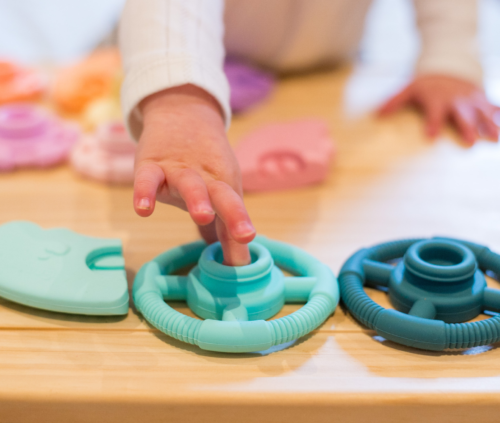
Our friends at Jellystone Designs are experts in facilitating children’s sensory play, with a trusted range of sensory toys and devices to facilitate babies and toddlers’ development, including teethers and chew pendants, sensory balls and stackers. Together, we canvass 10 amazing benefits of sensory play.
Early childhood brain development
Topping the list of sensory play’s amazing benefits is its impact on children’s overall brain development from the moment they are born. With their instinctual search for sensory input to perceive the world around them, the earliest signs of sensory exploration in babies can be seen when they turn their head towards sounds, use their eyes to follow moving objects, and find their hands and feet through the sensation of touch.
These senses operate independently to begin with, but by the time they reach 1 year of age, an exciting period of ‘sensory’ integration occurs where they can process information from different senses simultaneously – it’s when sensory play really comes alive! In fact, research shows that sensory play builds nerve connections in the brain’s pathways (source) and sets the foundation or memory for skills they will retain in later life. If you fancy your child to be a budding athlete or musician, take note! Let’s now look at the specific faculties of the brain that sensory play invokes.
Fine motor skills and hand-eye coordination
Compared to gross motor skills which involve coordination of major muscle movement such as walking and running, fine motor skills are focused on alignment of smaller muscle movements and more nuanced physicality such as learning to tie shoelaces, pulling a zipper up and down, or peeling off and attaching velcro. Sensory play taps into these fine motor skills and tends to combine with other sensory outcomes for added benefit, whether it’s using a paint brush to ‘colour inside the lines’, tapping the tiles on a xylophone, or threading pasta to make jewellery.
Language development
When exposed to different stimuli, it’s human nature to label and categorise based on known characteristics. Once toddlers have begun to develop their speech, they will search for ways to describe the textures, patterns, smells and temperatures they encounter, in order to make comparisons. Engaging in different types of sensory activities will give them more opportunities to identify whether something is sticky, hot, wet, slimy, soft – embedded in practical examples to ground their understanding. They’ll expand their vocabulary with such adjectives which will get increasingly more sophisticated as they grow older, and you might even have a future writer or storyteller on your hands!
Curiosity and an investigative mindset
You may have heard of the concept that “play is the work of the child”, which points to the legitimacy of play as the method by which kids learn and mature. A desire for play should be interpreted by parents as a thirst for knowledge in young children, and truly, the entry point for curiosity and problem-solving skills they will need in later life. For instance, if they’re plunging their fingers through a substance like dry sand only to find it ‘collapses’ when they try to roll it into a ball, and then make the realisation that wetting the sand allows them to make shapes, it’s this kind of trial-and-error learning that will turbocharge their logical thinking. Indeed, this ‘messier’ side of sensory play allows kids to test assumptions and observe cause and effect, which is precisely the kind of experimentation that forms the basis for scientific inquiry.

Sparks creative thinking
Similar to the experimentation that strengthens problem-solving skills, there is an unstructured element to sensory play that allows your child to develop and act on their imagination. Age-appropriate arts and crafts-based activities (think finger-painting and play-dough for the younger ones) are an excellent outlet for this creativity, involving pattern, texture and colour recognition to stimulate the senses. Of course, children will need a little parental guidance (and supervision) here, which is where a ‘sensory bin’ can be of enormous value for toddlers. Essentially a container filled with carefully selected materials to engage all the senses, it can get little ones thinking outside of the box, and you might find yourself nurturing a budding artist!
Settles the body and mind
Young children are not as adept as adults in processing and regulating sensory information, and this is demonstrated in an agitated toddler at a loud, busy shopping mall, or alternatively, an impatient and boisterous one in a quiet doctor’s waiting room. In both scenarios, reactions to sensory input are at work. It’s important to note that when kids underreact to sensory input, they may seek out more stimulation, whereas when kids overreact to it, they become overwhelmed and may seek to avoid the sensory input. You’re probably wondering, ‘what can I do in the moment to take off the edge, when my child is overloaded?’
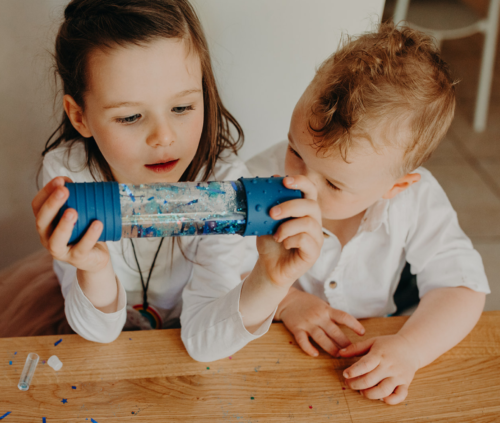
A highly effective way to settle a child’s body and mind is through sensory play to trigger ‘proprioceptive input’. This is a fancy phrase to describe sensory information sent to our joints and muscles that make us acutely aware of our body’s position and related movements. Take for instance, ‘sensory bottles’, which are vessels filled with colourful, slow-moving objects such as glitter, for a visual display that mesmerises young children. Dubbed ‘calm down bottles’, they’ve been used by parents, teachers and therapists to help children self-regulate their breathing and improve their focus. For a customised and reusable calm down bottle your child is sure to love, check out the Jellystone website.
Concentration, focus and mindfulness
Appreciating the connection between sensory processing and your child’s attention span is the first step to productively engaging your young child. Disruptive, distracted or absent-minded behaviours can be masking an underlying need for sensory input, and there are plenty of immersive activities that can keep them focused. In fact, research has shown that children (and even adults) are more likely to stay motivated and committed to tasks that appeal to their senses ( Although you’ll want a variety, experiment to see which sensory input your child favours, such as music-making activities for children that feed off sounds, and fidget and chew toys for the more touch-based child.

Aids children on the spectrum
For children diagnosed on the autism spectrum, sensory processing issues are chronic. Their senses can be over- or under-sensitive, and they may require aids to increase their oral muscles during speech therapy. Oral-based sensory toys can deliver in both respects, bringing controlled relief to children on the spectrum as they navigate each new day.
Since children tend not to discriminate over objects that pose threats to their safety, we recommend introducing a safe, chewable device at the earliest opportunity. Even for children who aren’t on the spectrum, oral toys provide positive stimulation and help them self-regulate during periods of anxiety, plus support their attention-to-task. Jellystone Design’s popular range of fidget toys and chewable pendants have been created to suit this very purpose and are endorsed by leading occupational therapists.
Quote from a child Psychologist who uses Jellystone Designs’ pendants in her therapy:
“I love these. When I come across children and teens who chew their school uniform shirt collars, I always suggest silicone pendants! I suggest parents get these for their child because chewing can be a form of anxiety, sensory dysregulation (particularly for children/teens on the spectrum) and a way of managing overwhelm. So instead of chewing clothes, or headphone cords, chewing a silicone pendant is a way to channel this behaviour.”
Socialisation
Although sensory play can serve as a more solitary exercise, experiencing it with family members or other children offers learning through observation and promotes healthy social habits. Let’s face it; different types of stimulation can bring out the good, the bad and the ugly in children’s behaviour, but the more they are safely exposed to sensory experiences, the more familiar they will become in processing sensory input in a productive way that meets the expectations of family and peers. Stick with it, and it will plant the seeds for collaboration and cooperative play as they grow.
Sensory toys to facilitate play
Extending out the above-mentioned phrase, “if play is the work of the child, toys are the tools.” Provided you select age-appropriate toys and activities, it’s never too early to start the rewarding journey of sensory play for your child. Toys specifically designed for sensory enrichment are particularly useful in an indoor setting, and especially for babies and younger infants who are still a little too young to explore some of the stimuli in the outside world.
A collection of high-quality sensory toys will encourage children to use all their senses – exploring the surfaces with their fingers, bringing to their mouth, matching colours, etc.
In addition to their award-winning range of sensory input toys, Jellystone Designs’ new ‘Triblox’ are the perfect sensory tool. Comprising 9 coloured blocks numbered 1 – 9 with corresponding textured illustration on the other side, they are the perfect shape and weight for little hands to explore, line up, balance and stack, featuring tactile surfaces that can be squished and squeezed.
To explore the full range, visit Jellystone Designs.
To view on YouTube: