Nervous about your child starting at an early learning centre or kindergarten? Many parents are. Below are some tips from a psychologist, to ensure it’s a smooth transition for your little one.
Settling in can be a challenging time for some families, perhaps because you have a sensitive, very attached child, are anxious yourself or just aren’t sure how to manage the transition.
If it makes you feel any better, you’re in good company. Child psychologist Lisa Ford from The Resilience Co says that separation anxiety is one of her most popular talks when presenting to parents. “It’s a common problem and it can be just as distressing for the parent as it can be for the child,” she explains. “It’s not easy leaving your child when they’re upset and clinging to you; it’s an emotionally difficult journey, so of course people want tips and strategies.”
Why does separation anxiety occur?
It’s actually the most prevalent anxiety condition in children under 12, mainly in the 2-3 age group and then later when children start school, says Ford. “The temperament of the child can be a significant factor; fairly confident or independent children may have no trouble at all separating from mum or dad. However, separation anxiety can affect any child.”
Ford adds that separation anxiety can occur for many reasons. “It can also be triggered by changes such as moving house, a big holiday or family changes.”
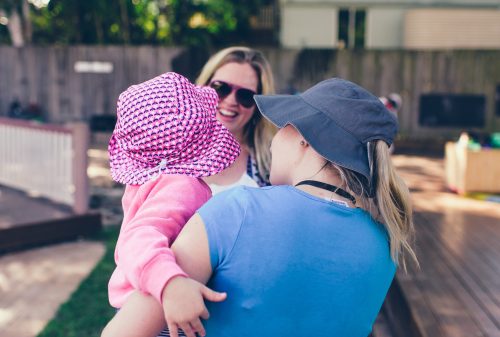
3 ways to help your child adjust
There are lots of things you can do (and things you shouldn’t!) to help prepare your child for the transition to early learning or kindergarten – and lessen the impact of separation anxiety.
- Talk about it in the right way “You want to be really positive and upbeat about this wonderful experience they’re going to have,” says Ford, “but don’t overdo it or provide too much information – children will sense if you’re feeling anxious.”
- Help them get used to being away from you “Expose your child to gradual separations, leaving them with a grandparent or family friend for an hour or two. Early learning centres allow settling in periods where the child can go for short stretches of time.”
- Encourage their independence “Time alone for your child is great. Little things like getting them to go and check the letterbox on their own or playing in the backyard on their own – while you monitor them, obviously – can be a really big factor in helping your child learn to be without you and feel safe and confident.”
What can you do to support your child?
How you react as a parent when dropping your child at an early learning centre or kindergarten is key, says Ford, and some things can exacerbate the problem.
“Going back when we see they’re upset may send the message to our children that we don’t trust them to cope,” she explains. “Another thing we might do is avoid the separation. We might think, ‘Oh it’s too difficult’ so we’ll stop sending them – but a child that’s struggling to separate actually may need more exposure to that, not less, to help them adjust.”
Try not to fall into the trap of reassuring your child too much or give too many instructions to the carer or the person you’re leaving your child with. “That can make your child overthink things and worry that mum or dad leaving is a really big deal,” says Ford.
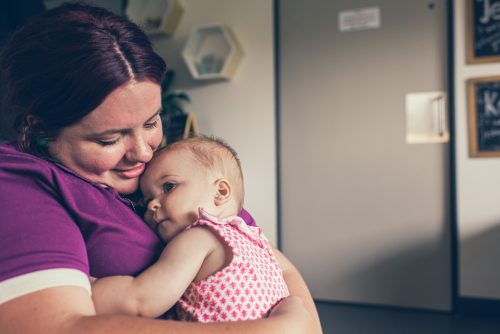
5 rules for drop-offs and pick-ups
If your child is suffering separation anxiety, there are several things you can do to help them get through it. Below are some tips:
- Talk to the centre or kindy. Working together with your children’s teachers and educators is essential, as they’ll have been in this situation many times before and will be able to offer advice and guidance.
- Have a goodbye ritual. “Saying goodbye, in the same way, provides familiarity and comfort for your child. Rather than a hug – because they’ll cling to you – try including a kiss on the cheek or a high-five and if they’re upset, words like, ‘I can see this is tricky for you, but I know you’re going to have a great day! I’ll see you after nap time’. Children don’t have a great sense of time so give them a point of reference as to when you’ll return.”
- Be positive when you arrive. “You want to acknowledge that it’s hard for your child but also show them that you trust them to cope with it.”
- Avoid sneaking away. “It might feel like a victory at the time but what it does is create mistrust and really increases that anxiety and clinginess.”
- Try not to linger when leaving. “Keep your farewell simple, straightforward and upbeat. I know that’s so hard if your child is upset, however, show them you’re feeling calm and confident about this environment and about leaving them. Show them your smile as you walk out the door.”
At pick up time, be happy “When you walk in the door at the end of the day, smile at your child and spend extra time together while you encourage him or her to talk about their experiences.”
Looking to enrol your child in a caring and nurturing environment?
Goodstart Early Learning partners with families and children transitioning into our centres who are suffering from separation anxiety.
Talk to us about how we can help make this process easier for you and your child.
To find a centre and book a tour, contact Goodstart Early Learning.: www.goodstart.org.au/enrol or find us on Instagram or Facebook.
You may also like to read:
Choosing childcare for your child
Ways to Help out the Grandparents who Help with Regular Childcare
An explanation of the Additional Childcare Subsidy for when the Childcare Subsidy isn’t sufficient?
]]>Your child’s educators will work with you to prepare your child for a positive transition to school. You might find these strategies helpful during the transition period too.

Image supplied by Early Childhood Management Services (ECMS)
Be flexible
Everyone is different. No child will have the same reaction or process to managing change. It’s important to go at the pace that suits your family and child.
Communication is key
Give your child plenty of opportunities to tell you how they feel and what they think about going to school. Remember – good communication isn’t only about talking; it’s also about listening, empathy and understanding.
Positive reinforcement
Talk to your child about how excited you are and how much you’re looking forward to them starting school. Let them know it’s a big achievement and how proud you are of them.
Partner with educators
Positive relationships between families, educators and children are a platform for effective transitions to school. Remember to share as much information about your child and family with your child’s educators as possible so they can pass this onto the Prep teacher in their transition statement.
Take part in the transition program
Most schools offer extensive transition programs so children can become familiar with the new school environment and teachers. Attend as many of these sessions as possible to help your child feel secure and confident in their new surrounds.
Practice routines
Start introducing your child to school routines. Let your child go to kinder in their school uniform or to wear it around the house. Practice packing a school lunchbox with your child and walk to school to see what the journey’s going to be like.
Prepare yourself for change
Don’t forget that starting school is a big change for parents too! Give yourself plenty of time to prepare for the transition.
Need more information?
If you’d like more information on the transition to school, please speak to your child’s educators. You can also find useful information on the KidsMatter website.
Content provided by Early Childhood Management Services (ECMS)
For more information please visit www.ecms.org.au or call 03 8481 1101
You might also like to read:
]]>Usually that anxiety is most obvious in the first few days. Children might cling, cry, or talk about their worries (like worrying about fitting in). Sometimes the anxiety comes out as behavioural changes (like set backs in toilet training), disturbed sleep, or irritability.
As young children make the adjustment to spending time away from parents, some anxiety is quite normal. Parents are also not immune to anxiety either. I often talk to parents about their feelings of guilt regarding putting their children in child care, or leaving a preppy at school when they know their child is anxious. The important thing is, most children (and parents) get through this phase within a few days (or weeks at most).
There are a number of things parents can do to ease the process of starting childcare, kindergarten and school. In fact, most places will have a clear process for helping children get accustomed to being there. It usually involves gradually increasing the amount of time the child spends at the school without a parent present. But you can start earlier than that. From a very early age it can be helpful to leave children (even babies) with grandparents or other trusted carers. This instils in children that their parents will return (it also gives the parents a breather, which can be invaluable from time to time). Joining play groups helps children get use to interacting with other kids.
Helping your child get used to being frustrated also makes a difference. In a group environment your child is not going to get his or her need met immediately all the time. Practicing making children wait is an important part of preparing them for the reality of the rest of their lives.
For some it’s not that simple. Separation anxiety disorder is a more severe problem that emerges amongst a small percentage of children at this stage of life. So “what’s the difference between every day anxiety, and separation anxiety disorder?” I hear you ask.
To meet the criteria for a diagnosis of a disorder your child must experience at least 3 of these problems for at least 4 continuous weeks:
- Recurring extreme distress when thinking about separation from home or parents, or when actually separating (eg at school drop off time)
- Fear of going to sleep without a parent being close by
- Recurring nightmares about separation
- Repeated physical complaints like headaches or tummy aches, when thinking about separating (eg the start of a school day).
- Persistent fear of an event like getting lost or kidnapped
- Persistent refusal to leave home or go to school because of fear of separation
- Fear of being left alone without a parent in the house
- Persistent and unjustified worry about losing a parent or loved one, or about loved ones being harmed by illness, injuries or disasters
- Fear of anxiety is not related to other conditions like autism.
The critical point about these more extreme situations is to get help early. Many parents feel helpless or get frustrated, and some even think their children are just being naughty. When young children show this type of distress it’s not because they are trying it on, they need understanding and probably a bit of professional help. The other fact to remember here is that getting help early usually means that you will need less help.
So as you let go of your children as the year starts, don’t panic if there is some anxiety. Talk to them, work with the school, and get their friends involved.
If you are concerned that the anxiety is getting too severe, get help as soon as possible.
This post is written by Dr Simon Kinsella, Clinical Psychologist Director of CPC Consulting.
CPConsulting is a leading psychology practice in Melbourne offering a range of services for optimum health and wellbeing with a range of clients including individuals, couples, families, executives and organisations.
To contact please visit @simonmkinsella or for more information visit https://cpc.com.au/
You might also like to read:
The long road to Independence.
Eight vital skills children develop in early learning and care settings
]]>- Confidence
Children build confidence when they are able to master new skills in a supportive environment at their own pace. In early learning and care settings, such as kindergarten and childcare settings, play-based learning experiences help build children’s interests and capabilities. Children become curious about their world and begin to explore and research the world around them. They also start to make decisions and develop problem-solving skills. Through this process, children gain social, emotional, language, physical and cognitive skills. In learning these skills, children gain a real sense of self-confidence and independence.
- Relationship-building
The ability to build relationships with people outside of the family before school starts is very important. In early learning and care settings, children are able to develop meaningful relationships with others and learn how to talk to and play with their peers and educators. They learn how to start conversations, how to understand and cooperate with others and how they operate in group settings.

- Participation and contribution
In kindergarten and childcare settings children become participants in their world. They are encouraged to contribute to their early learning community every day. This gives children a real sense of ownership and belonging to their early learning community. Children learn that being able to participate and contribute is very important and that being ‘known’ and recognised by others makes them feel good about themselves.
- Problem-solving
Problem-solving and decision-making are crucial life skills both socially or intellectually. In kindergarten and childcare children have the opportunity to practice these skills by choosing and deciding how things should happen, which helps them develop critical thinking. Children also learn patterns, sequencing, puzzle solving and reasoning – vital pre-numeracy skills.

- Language and communication
Language-rich environments are important for children to understand the world around them. That’s why in early learning and care settings you will see lots of conversations, stories, singing and chatter. To be understood and have your needs met, you need to be able to ask, tell and enquire. Having a voice to be heard and understood gives children a sense of connection and belonging. Talking and discussions also help children develop thinking and literacy skills.
- Emotional regulation
Children start to manage their emotions and develop a sense of reason at about the age of two or three. Before this, children are still ‘collecting’ and ‘experiencing’ emotions. In kindergarten and childcare children can practice managing themselves as they relate to others. In these settings, children begin to understand that action and reaction are linked. Through this, children can master self-control and have an impact on what happens. This is an exciting time for children once they realise they are ‘powerful.’

- Empathy
At about the age of two, children start to show understanding of other people’s feelings. Pretend play is a really interesting way of feeling and showing empathy as children need to have an understanding of what someone else believes. Empathy is a sophisticated feeling that is a platform for strong social connections in the future. Early learning and care settings open up opportunities for children to explore and practice their empathy with other children. Educators design play-based experiences that encourage children to understand and develop language around empathy.
- Resilience
Resilience requires children to step out of their comfort zones and try new things. Resilience is born from facing challenges, sometimes feeling a bit scared or vulnerable and finding ways to overcome this, like by being strong, brave and confident. Kindergarten and childcare can provide lots of experiences for children to develop and practice resilience skills like problem-solving, optimism, independence and social connection.
Best of all, in kindergarten and childcare settings, children have the opportunity to have fun and make the most of their carefree childhoods.
Content provided by Early Childhood Management Services (ECMS)
For more information please visit www.ecms.org.au or call 03 8481 1101
You might also like to read:
Stay-At-Home-Mum: A Day in the Life.
]]>Getting children ‘ready’ for their first day of formal schooling is a topic that has been coming up in conversation lately. It seems that for a fair few parents there is a focus on the ‘academic’ side of getting their children ‘ready’ however there are many other skills that will make transition into Kindy much smoother for your child rather than focusing on ABCs and 123s.
Allowing your child to develop some independence will make a huge difference when entering into the world of Kindergarten. Being able to put on their own hat, put on and remove a jumper, open the snaps on their lunch boxes and tie their own shoe will have a great impact on their day.
Imagine a class of students each needing their shoes tied and how much time educators would spend in a day away from the lesson if they were tying laces. Allow your child to practise threading and tying their shoes with our Lacing Shoe toy. The bright laces are the perfect contrast against the ‘shoe’ base. This is quite a complex skill and does take time to perfect. If your child hasn’t mastered shoelace tying come beginning of term, perhaps consider a different style of fastener.
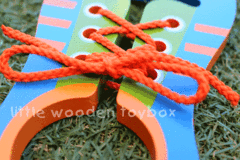
Can your child blow their nose or tend to their own personal care in the bathroom and recognise if they are feeling hot or cold and then know how to remedy the situation? Using the characters from any of our play sets (Pirate Ship, Flower House, Dinosaur or Farm House) can be a great way to provide your child with a sequence of steps to follow when in these situations. During play you can discuss different scenarios and different paths your child could take. Planting the seed through play is very handy to prepare for these type of situations.
Can your child recognise their own belongings? A character swing tag fastened to the handle of their school bag may help them identify their own bag. Be mindful of labelling your children’s bags in public view as a less than desirable person may also read the child’s name and use this to lure your child into a false sense of security.
Being able to follow verbal instructions is a skill that is so important when entering into school years. Ask your child to collect their book and then pop it on the shelf or collect their water and have a drink. Being able to perform two step tasks is a useful skill!
Reading to your child will arm them with so many skills which are necessary upon entering into a formal learning environment. It allows them to build their vocabulary to assist them with communication, retaining information and will encourage them to ask questions. Point to the words as you are reading so your child can understand that we read/write left to right. Ask your child what they think is going to happen next or how they think the character may be feeling.
In Kindergarten your child isn’t always going to be able to do what they want, when they want. Teaching them to follow instruction, identify and regulate their emotions will help this transition. If their little friend doesn’t wish to play ball with them today, ingrain some alternative activities your child could do instead. Perhaps play another game or play with another child. Try to build a solid understanding of turn taking, sharing and the importance of caring for the needs of others as much as their own. These social skills will make time in the classroom and playground much more enjoyable.
The last skill set that we are going to bring to light are Fine Motor Skills. Holding a paint brush, cutting out and writing all require the use of those small muscle groups in the hands and fingers. Fine motor skills can definitely be worked on both through play with a large selection of our toys (check out our Fine Motor Skills Packs!) and with our Letter Basics range.
Roll out playdough worms and mould them on our Alphabet Playdough Mat. Then turn them into serpent letters by pinching plates along their backs! Practise penmanship with our Kindy Pre-Writing Guides. This is a fun way of encouraging your child to develop control over their movements and to stay on the lines which can easily transition to forming letters and numbers later on down the track.

Your child will be spending their days learning about the alphabet and maths giving them a solid foundation to be able to learn in this environment.
A love for learning is the best way to get them ready for this next chapter – Kindy is going to be so much fun!
All the best!
– Dani Davidson, Little Wooden Toybox Toy Representative
You might also like to read:
Supporting your child’s transition to school
Eight vital skills children develop in early learning and care settings
How to Strengthen your Child’s Emotional Intelligence (EQ)
]]>