However, it can be really helpful to understand that our kids are not being naughty or disobeying us deliberately. Their brains are still developing, and essentially they are unable to multitask, so if they are emersed in play they may look like they are ignoring you but actually they just need us to communicate a bit differently in order for them to HEAR us.
Here are five steps to helping your child to hear you:
First we need to ‘acknowledge’.. explain..?
-
Connection
This is all about noticing what they are doing. In a nutshell – kids are more able to process instructions that require them to change direction better if we acknowledge where they are at first. So your child might be playing LEGO and you notice what they have built or ask them about it. This makes them feel seen and heard.
-
Touch
Touch is a wonderful way to tune their bodies in to hear us. By simply touching your childs shoulder or getting down low and close, and being physically near your child it lets them know you are there. This helps them to ‘tune in’.
-
Whisper, don’t yell
Let’s be honest none of us really feel great when we are being yelled at.
For kids, when our volume goes up, their ability to be calm and hear us goes down.
-
Big gestures
90 per cent of our communication is non-verbal.. so our kids would be picking up on our gestures much more than our words. Big gestures allow our kids to ‘see’ what we man as well as her and this often helps them process our instructions. A wink or a big clear stop sign can communicate much more clearly than our words for our kids.
-
Notice the emotions
Sometimes our kids can’t listen because they are processing emotions. It’s really important to be able to spot the moments when despite us following all the steps, our child is not putting on their shoes. This can be a moment of curiosity. We might notice “that’s not like my child normally…. I wonder what’s going on” spotting the emotions behind not listening can be a beautiful way to feel more connected with your child. Some days they simply need our help with the task, and other days this might initiate a conversation about what’s going on at school.
When we can view kids as generally doing the best they can, and know they actually do want to listen and get it right for us, but that they need us to change the way we communicate with them, so that that can hear us. The upside for us of course is that this often feels better and brings more peace to our homes.
Gen Muir is an Obstetric Social Worker, Parenting coach, and mum to four boys with a passion for helping parents in to understand behaviour and emotion in kids.
With the experience of working with over 40,000 parents though her work at the Mater and privately, Gen has a great understanding of the real challenges facing modern parents.
Website https://www.connectedparenting.com.au/
Instagram https://www.instagram.com/connectedparentingau/?hl=en
Facebook https://www.facebook.com/connectedparentinggenmuir
]]>The Sense of Touch
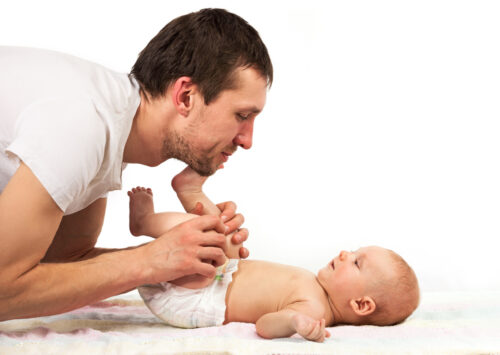
Newborn’s love being touched gently by their parents, they love skin to skin contact which happens many times a day of breastfeeding. But even bottle-fed babies can have this skin to skin and both parents can do this.
Research shows that premature babies benefit from skin to skin contact with their parents and are more settled and grow and develop faster, this is called ‘kangaroo care’. All babies can benefit from this, and it also helps to develop a closer bond.
You can cuddle your baby skin to skin at any time, try using a simple carry pouch that allows the baby directly against the parent or even shower or bath with your baby. You will find other opportunities for skin-to-skin contact.
Baby Massage
Touch and physical contact is enjoyed by newborns and gentle baby massage is a wonderful activity to share with your baby. You can take a class to learn the techniques or even just try it yourself. If your baby enjoys it then it is fine. You can try using some baby massage oil as this can enhance the feelings of pleasure, test this on a small area first to make sure your baby does not react to it. You may find this helps your baby get drowsy and ready for sleep.
How Far Can Newborn Babies See?
At birth, your baby can see you well if cradled in your arms (20-40cm away) anything further away will be blurred. So, when they are breastfeeding, they can see you very well and given that they spend a lot of time in this position it is good to know. This gradually improves and extends over many months.
What Do Newborns Like to Look At?
They love looking at their parents faces the most. If you are smiling or talking to them, they love that even more. Your face is your baby’s first toy!
Newborns have a preference for high contrast If showing books and other pictures, paintings newborn babies love high contrast such as black and white with some pops of colour. These are easy for them to see, and they seem to enjoy looking at them. There are many books aimed at young babies that suit well.
What Can Newborns Hear?
Newborn babies already know their parents’ voices as they’ve been listening to you throughout the later months of pregnancy, and they will recognise these as comforting.
Newborns will often turn their head toward a sound, a parent’s voice or a bell ringing, it is a delayed response, but they will search for the source of the noise. This is always reassuring to parents as they know that they can hear.
What Do Newborns Like to Listen To?
Newborns favour their own parent’s voices over all other sounds. They prefer high pitched voices, and most adults automatically begin to speak this way with their baby. They don’t like loud or sudden sounds.
Your baby will love to hear you sing to them, even if you’re not a good singer, they won’t mind, try it you may be surprised. Even nursery rhymes are enjoyed.
Newborn Reflexes:
Babies are born with many primitive reflexes which help to protect them and keep them alive.
Searching/rooting reflex
If a young baby’s cheek is touched, they will open their mouth and start to look around for the nipple to feed, even if they are not hungry.
Sucking reflex
When the roof of a young baby’s mouth is touched, they will begin to suck.
Palmer grasp reflex
If you put your finger into the palm of a young baby, they will grasp hold quite tightly.

The startle or moro reflex
The startle reflex occurs when a newborn baby has a fright such as hearing a loud sound or feeling like they are falling, their arms will fly outwards, hands open, arch their back then arms come back in like an embrace. This reflex usually lasts until around 4-6 months of age.
Stepping reflex
When standing a newborn baby up, fully supported and place their feet on the floor or surface they will begin to step with one leg then the other, even though they are not able to hold themselves up yet.
Babinski reflex
If you stroke your baby’s foot from heel to toe, their toes will push upwards, and their foot will turn inwards.
These primitive reflexes will gradually reduce and be replaced by more voluntary responses over the coming months.
Your health professionals will check these reflexes after birth and in the early months of life.
We know that you are your baby’s expert, no one knows them like you do. If you have any concerns with your baby, please talk to your health care professionals, your GP, midwife or maternal and child health nurse.
Enjoy these special early weeks and months with your baby, although it doesn’t feel like it at the time, this time does pass quickly.
]]>With decades of providing world-leading early intervention services, First Voice and its respective centres across the country are urging Australian families to understand the options available for children with hearing loss today.
Despite the fact that children born deaf in Australia can learn to hear, listen and speak just like a child with typical hearing, 94 per cent of Australians are unaware of this life-changing reality and 84 per cent of Australians don’t know where to turn to for support if their child is born with or develops hearing loss.
First Voice Chair and Director, and Telethon Speech & Hearing CEO Mark Fitzpatrick, says he is on a mission to educate Australians to know that with timely and effective interventions, a life of hearing, listening and speaking is possible for kids who are deaf in 2022.
“For parents, a hearing loss diagnosis can be full of unknowns and uncertainties about the future, so it is critical that we educate them on the options available to encourage informed decisions that can enable their child to embrace a world of sound,” said Mr Fitzpatrick.
“Over 99% of Australians have an oral language – and many families who have a child with a hearing loss want their kids to have the same opportunities as any other child their age.
“We know that children with hearing loss who receive listening and spoken language therapy and hearing technology, such as cochlear implants and hearing aids, have the potential to develop speech and language skills at the same level as their typical hearing siblings and peers.
“With the number of Australians with hearing loss only set to double by 2060, now is the time to make some noise on the life-changing possibilities that early interventions can enable those who are deaf,” he added.
Parents, Sally and Phil Wuersching were frightened by the unknown when four-year-old, Max was diagnosed with moderate to severe hearing loss in his right ear, picked up during a routine check-up.

Since connecting with Queensland First Voice centre, Hear and Say, Max has been supported to meet speech and language goals, undergoing cochlear implant surgery in his right ear and since learning to hear, listen and speak.
“Over the past four years, Hear and Say has supported our family through Max’s hearing loss, with tailored listening and spoken language therapy that has reassured us that he can go on to reach his dreams and allowed him to hear, listen and speak beyond what we thought was possible,” said Mr Wuersching.
“It can be daunting for any parent to navigate the unexpected, which is why it is so important that parents listen up this Hearing Awareness Week and understand that with the right support and tools, your child can soak up those small and special moments in life – like the sound of laughter, music or the words, ‘I love you’”.
This Hearing Awareness Week, the Wuersching family and First Voice challenge the public to increase their understanding on how recent advances in technology, such as cochlear implants and hearing aids, are drastically reshaping outcomes for Australians with hearing loss.
The intervention services and support provided by First Voice centres across the country is opening worlds and giving children the ultimate gift – the ability to hear their parents voice for the first time, the sound of the ocean, the power to communicate without restraint and the ability to enjoy a world full of joy and colour.
For more information, head to https://www.firstvoice.org.au/ or call 07 3850 2111.
]]>