Children are often slower to develop speech and language if they develop middle ear issues. You can refer to the information on the Hear Today clinic website – www.heartoday.org.au – that explains all about ear infections and how this impacts on speech and language. 80% of children will get an ear infection in these early years. This becomes a problem if ear issues are ongoing or start to affect hearing.
Ear infections often go unnoticed, and so are untreated. For many children, it sounds as if they are listening underwater, with everything muffled and words not clearly distinguishable. If your child has ear infections, you may not realise unless you have an ear check with an Audiologist (hearing specialist). The Audiologist can tell you if there is an ear infection and also if this is impacting on hearing.
These are the signs to look for in your child that may indicate an ear infection:
- Your baby cries for no reason (after 5 months of age)
- Your toddler pulls at their ears
- Your toddler says there are “quacks” “Wheaties” or something else in their ears (children use this language because they can’t explain what’s going on)
- Your child’s speech is unclear
- Your child stops learning new words
- Your child doesn’t follow simple instructions
- Your child becomes scared of new situations or new people
Hearing loss is invisible, so, unless a hearing is measured, you won’t know whether your baby or toddler can hear all the soft sounds needed to develop speech and language. An annual hearing test is recommended for all children until they reach school age. If you are concerned about hearing or speech and language development, talk with a Paediatric Audiologist or have your baby or child’s hearing tested.
There are many services available to support children with hearing loss and early intervention is important in ensuring the best possible outcomes.
By Dr Lara Shur Au.D,
Director Clinical Services & Outcomes, COO & Co-founder Earbus Foundation of WA
With decades of providing world-leading early intervention services, First Voice and its respective centres across the country are urging Australian families to understand the options available for children with hearing loss today.
Despite the fact that children born deaf in Australia can learn to hear, listen and speak just like a child with typical hearing, 94 per cent of Australians are unaware of this life-changing reality and 84 per cent of Australians don’t know where to turn to for support if their child is born with or develops hearing loss.
First Voice Chair and Director, and Telethon Speech & Hearing CEO Mark Fitzpatrick, says he is on a mission to educate Australians to know that with timely and effective interventions, a life of hearing, listening and speaking is possible for kids who are deaf in 2022.
“For parents, a hearing loss diagnosis can be full of unknowns and uncertainties about the future, so it is critical that we educate them on the options available to encourage informed decisions that can enable their child to embrace a world of sound,” said Mr Fitzpatrick.
“Over 99% of Australians have an oral language – and many families who have a child with a hearing loss want their kids to have the same opportunities as any other child their age.
“We know that children with hearing loss who receive listening and spoken language therapy and hearing technology, such as cochlear implants and hearing aids, have the potential to develop speech and language skills at the same level as their typical hearing siblings and peers.
“With the number of Australians with hearing loss only set to double by 2060, now is the time to make some noise on the life-changing possibilities that early interventions can enable those who are deaf,” he added.
Parents, Sally and Phil Wuersching were frightened by the unknown when four-year-old, Max was diagnosed with moderate to severe hearing loss in his right ear, picked up during a routine check-up.
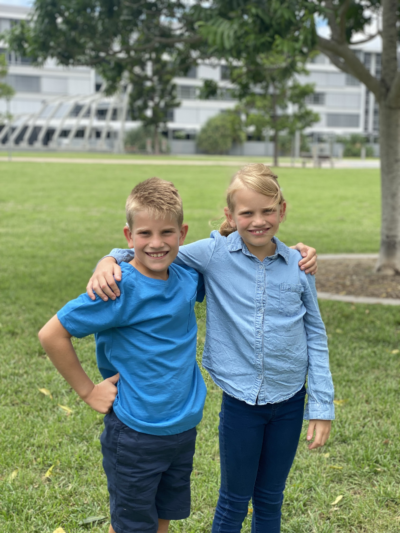
Since connecting with Queensland First Voice centre, Hear and Say, Max has been supported to meet speech and language goals, undergoing cochlear implant surgery in his right ear and since learning to hear, listen and speak.
“Over the past four years, Hear and Say has supported our family through Max’s hearing loss, with tailored listening and spoken language therapy that has reassured us that he can go on to reach his dreams and allowed him to hear, listen and speak beyond what we thought was possible,” said Mr Wuersching.
“It can be daunting for any parent to navigate the unexpected, which is why it is so important that parents listen up this Hearing Awareness Week and understand that with the right support and tools, your child can soak up those small and special moments in life – like the sound of laughter, music or the words, ‘I love you’”.
This Hearing Awareness Week, the Wuersching family and First Voice challenge the public to increase their understanding on how recent advances in technology, such as cochlear implants and hearing aids, are drastically reshaping outcomes for Australians with hearing loss.
The intervention services and support provided by First Voice centres across the country is opening worlds and giving children the ultimate gift – the ability to hear their parents voice for the first time, the sound of the ocean, the power to communicate without restraint and the ability to enjoy a world full of joy and colour.
For more information, head to https://www.firstvoice.org.au/ or call 07 3850 2111.
]]>