You’ve probably marvelled at babies’ and toddlers’ insatiable desire to touch, bite or otherwise interact with most things you put in front of them. It’s through these sensory explorations or ‘sensory play’ that they learn to perceive the world and gradually, their role within it.
At its simplest level, sensory play involves any activity by your child that stimulates the five core human senses: sight, smell, taste, touch, and hearing. Children crave sensory play, and they will seek it out whenever the opportunity strikes – such as squelching their hands through the food you’ve just prepared them! Truth be told, sensory play can sometimes get messy, but as you reach for the wipes, keep in mind that the sensory journey for babies and toddlers is signposted with some crucial learning milestones.
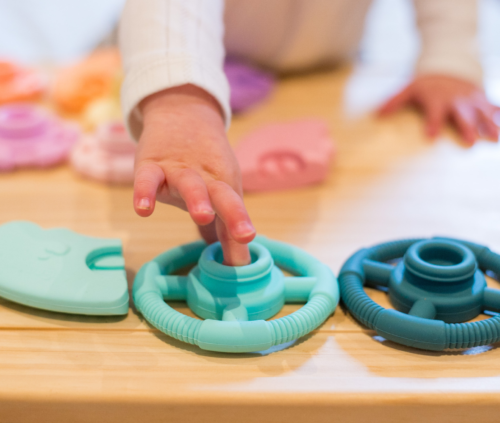
Our friends at Jellystone Designs are experts in facilitating children’s sensory play, with a trusted range of sensory toys and devices to facilitate babies and toddlers’ development, including teethers and chew pendants, sensory balls and stackers. Together, we canvass 10 amazing benefits of sensory play.
Early childhood brain development
Topping the list of sensory play’s amazing benefits is its impact on children’s overall brain development from the moment they are born. With their instinctual search for sensory input to perceive the world around them, the earliest signs of sensory exploration in babies can be seen when they turn their head towards sounds, use their eyes to follow moving objects, and find their hands and feet through the sensation of touch.
These senses operate independently to begin with, but by the time they reach 1 year of age, an exciting period of ‘sensory’ integration occurs where they can process information from different senses simultaneously – it’s when sensory play really comes alive! In fact, research shows that sensory play builds nerve connections in the brain’s pathways (source) and sets the foundation or memory for skills they will retain in later life. If you fancy your child to be a budding athlete or musician, take note! Let’s now look at the specific faculties of the brain that sensory play invokes.
Fine motor skills and hand-eye coordination
Compared to gross motor skills which involve coordination of major muscle movement such as walking and running, fine motor skills are focused on alignment of smaller muscle movements and more nuanced physicality such as learning to tie shoelaces, pulling a zipper up and down, or peeling off and attaching velcro. Sensory play taps into these fine motor skills and tends to combine with other sensory outcomes for added benefit, whether it’s using a paint brush to ‘colour inside the lines’, tapping the tiles on a xylophone, or threading pasta to make jewellery.
Language development
When exposed to different stimuli, it’s human nature to label and categorise based on known characteristics. Once toddlers have begun to develop their speech, they will search for ways to describe the textures, patterns, smells and temperatures they encounter, in order to make comparisons. Engaging in different types of sensory activities will give them more opportunities to identify whether something is sticky, hot, wet, slimy, soft – embedded in practical examples to ground their understanding. They’ll expand their vocabulary with such adjectives which will get increasingly more sophisticated as they grow older, and you might even have a future writer or storyteller on your hands!
Curiosity and an investigative mindset
You may have heard of the concept that “play is the work of the child”, which points to the legitimacy of play as the method by which kids learn and mature. A desire for play should be interpreted by parents as a thirst for knowledge in young children, and truly, the entry point for curiosity and problem-solving skills they will need in later life. For instance, if they’re plunging their fingers through a substance like dry sand only to find it ‘collapses’ when they try to roll it into a ball, and then make the realisation that wetting the sand allows them to make shapes, it’s this kind of trial-and-error learning that will turbocharge their logical thinking. Indeed, this ‘messier’ side of sensory play allows kids to test assumptions and observe cause and effect, which is precisely the kind of experimentation that forms the basis for scientific inquiry.

Sparks creative thinking
Similar to the experimentation that strengthens problem-solving skills, there is an unstructured element to sensory play that allows your child to develop and act on their imagination. Age-appropriate arts and crafts-based activities (think finger-painting and play-dough for the younger ones) are an excellent outlet for this creativity, involving pattern, texture and colour recognition to stimulate the senses. Of course, children will need a little parental guidance (and supervision) here, which is where a ‘sensory bin’ can be of enormous value for toddlers. Essentially a container filled with carefully selected materials to engage all the senses, it can get little ones thinking outside of the box, and you might find yourself nurturing a budding artist!
Settles the body and mind
Young children are not as adept as adults in processing and regulating sensory information, and this is demonstrated in an agitated toddler at a loud, busy shopping mall, or alternatively, an impatient and boisterous one in a quiet doctor’s waiting room. In both scenarios, reactions to sensory input are at work. It’s important to note that when kids underreact to sensory input, they may seek out more stimulation, whereas when kids overreact to it, they become overwhelmed and may seek to avoid the sensory input. You’re probably wondering, ‘what can I do in the moment to take off the edge, when my child is overloaded?’
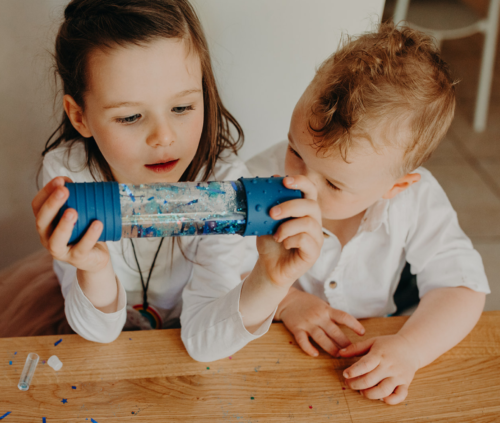
A highly effective way to settle a child’s body and mind is through sensory play to trigger ‘proprioceptive input’. This is a fancy phrase to describe sensory information sent to our joints and muscles that make us acutely aware of our body’s position and related movements. Take for instance, ‘sensory bottles’, which are vessels filled with colourful, slow-moving objects such as glitter, for a visual display that mesmerises young children. Dubbed ‘calm down bottles’, they’ve been used by parents, teachers and therapists to help children self-regulate their breathing and improve their focus. For a customised and reusable calm down bottle your child is sure to love, check out the Jellystone website.
Concentration, focus and mindfulness
Appreciating the connection between sensory processing and your child’s attention span is the first step to productively engaging your young child. Disruptive, distracted or absent-minded behaviours can be masking an underlying need for sensory input, and there are plenty of immersive activities that can keep them focused. In fact, research has shown that children (and even adults) are more likely to stay motivated and committed to tasks that appeal to their senses ( Although you’ll want a variety, experiment to see which sensory input your child favours, such as music-making activities for children that feed off sounds, and fidget and chew toys for the more touch-based child.

Aids children on the spectrum
For children diagnosed on the autism spectrum, sensory processing issues are chronic. Their senses can be over- or under-sensitive, and they may require aids to increase their oral muscles during speech therapy. Oral-based sensory toys can deliver in both respects, bringing controlled relief to children on the spectrum as they navigate each new day.
Since children tend not to discriminate over objects that pose threats to their safety, we recommend introducing a safe, chewable device at the earliest opportunity. Even for children who aren’t on the spectrum, oral toys provide positive stimulation and help them self-regulate during periods of anxiety, plus support their attention-to-task. Jellystone Design’s popular range of fidget toys and chewable pendants have been created to suit this very purpose and are endorsed by leading occupational therapists.
Quote from a child Psychologist who uses Jellystone Designs’ pendants in her therapy:
“I love these. When I come across children and teens who chew their school uniform shirt collars, I always suggest silicone pendants! I suggest parents get these for their child because chewing can be a form of anxiety, sensory dysregulation (particularly for children/teens on the spectrum) and a way of managing overwhelm. So instead of chewing clothes, or headphone cords, chewing a silicone pendant is a way to channel this behaviour.”
Socialisation
Although sensory play can serve as a more solitary exercise, experiencing it with family members or other children offers learning through observation and promotes healthy social habits. Let’s face it; different types of stimulation can bring out the good, the bad and the ugly in children’s behaviour, but the more they are safely exposed to sensory experiences, the more familiar they will become in processing sensory input in a productive way that meets the expectations of family and peers. Stick with it, and it will plant the seeds for collaboration and cooperative play as they grow.
Sensory toys to facilitate play
Extending out the above-mentioned phrase, “if play is the work of the child, toys are the tools.” Provided you select age-appropriate toys and activities, it’s never too early to start the rewarding journey of sensory play for your child. Toys specifically designed for sensory enrichment are particularly useful in an indoor setting, and especially for babies and younger infants who are still a little too young to explore some of the stimuli in the outside world.
A collection of high-quality sensory toys will encourage children to use all their senses – exploring the surfaces with their fingers, bringing to their mouth, matching colours, etc.
In addition to their award-winning range of sensory input toys, Jellystone Designs’ new ‘Triblox’ are the perfect sensory tool. Comprising 9 coloured blocks numbered 1 – 9 with corresponding textured illustration on the other side, they are the perfect shape and weight for little hands to explore, line up, balance and stack, featuring tactile surfaces that can be squished and squeezed.
To explore the full range, visit Jellystone Designs.
To view on YouTube:
Dovi told me he wants to build a sandcastle and needs a bucket for this purpose.
He looked around, searching for a bucket, but none was in sight.
I asked – why do you need a bucket? He answered he needed it to carry water to get the sand wet so he could build a castle.
I said – there is wet sand near the water. You can bring it with your hands.
Dovi looked at me unconvinced and firmly said – I need a bucket.
I tried again- what about carrying water in your hands? Do you want to give it a go?
Dovi looked at me as if I said the most ridiculous thing and then reiterated- I need a bucket.
I wasn’t going to give up, so I tried again- you know, if you dig deep enough, you will get to wet sand. Dovi looked at me as if I really didn’t get it and said – I need a bucket. I left my bucket in the car.
I realised that to adopt a different idea, Dovi must be the one that comes up with the new concept.
So I asked him – how else can you get water?
Dovi looked at me, right in the eye, without blinking and said – I need a bucket.
It was clear that Dovi was stuck, and I had to find a way to get him unstuck.
I needed to get his conscious mind to think about other things while his subconscious mind working on his problem in the background.
Therefore, I said- let’s walk along the beach and see what treasures we can find.
So we walked.
Soon enough, Dovi picked up one of the many shells lying on the sand, looked at me and said – I can use this to bring water. I was so thrilled! Yes! It’s working!
I replied excitedly – this is a fantastic idea, Dovi!
Shortly after that, Dovi picked up a bottle top and said – I can use this as well to bring water!
I was over the moon. His mind overcame the hurdle and developed different, creative solutions to his problem. Dovi was no longer stuck on what was “supposed” to be the solution to his problem.
So Dovi took the shell and the bottle cap and walked towards the water.
As he got to the water, a wave crashed on the shore, and the water rushed towards him.
Dovi quickly turned around, ran away from the water, and shouted, “There is a wave. I can’t get water!”
Now Dovi had another problem to solve….
I enjoy having conversations with children. Often, I come out of these engagements with insights and valuable lessons.
Here are three insights from my time with Dovi:
- You better have nerves of steel when talking with children.
- Children are not interested in your ideas.
- It is never too early to help your child develop creative thinking.
We live in a world where we constantly need to solve problems and overcome challenges.
Our children’s ability to think creatively and find innovative solutions to problems drives their success and happiness.
Want to help your child thrive in our complex world?
My book “Think Unique – Raising a successful, innovative child” provides you with the knowledge, skills and tools you need to help your child become a confident problem-solver that prospers in our fast-changing world.
Learn more about this book here.
]]>
Besides promoting social, emotional, physical, and cognitive skills, play-based learning encourages language development, creative thinking, and problem-solving skills.
So, in today’s blog post, we’ll talk about ten ways you can implement play-based learning at home or school.
1. Get down on the floor.
One of the best ways to encourage play-based learning is to get fully involved with children.
So, get down on the floor and play with your child. This shows them that you value play just as much as they do and are interested in what they are doing.
It also helps them feel comfortable and build trust in a person early in life. Plus, it’s also a great way to bond with your child while having fun!
2. Give children open-ended materials or toys.
Open-ended toys are items that can be used in many different ways. They encourage children to use their imagination and be creative.
Open-ended materials include toys like legos, blocks, balls, clay, play-dough, and paper. Children can design, arrange, line up, or create different shapes and figures using these toys, and channel their creativity in many ways.
Moreover, playing with toys is proven to enhance reading and writing skills in kids, so that’s another thing to keep in mind.
3. Encourage make-believe play.
Make-believe play is when children use their imagination to pretend they are someone or something else.
This kind of play is a great way for children to explore different emotions and situations. It also helps them develop their language skills as they use new words and phrases in their play.
While it could be challenging to keep young children engaged in this game for long, using props such as toys and play dresses can be highly beneficial. This way, they can feel like they are actually in an imaginary situation and have more fun.
4. Get active with gross motor play.
Gross motor play is any activity that uses large muscles, such as running, jumping, and climbing.
This type of play is important for developing coordination, balance, and strength. It’s also a great way to get some energy out!
There are different fun gross motor play activities that you can try with children to promote physical literacy and long-lasting health.
5. Practice turn-taking and sharing.
Sharing and turn-taking are important social skills that children need to learn. And, what better way to learn them than through play?
You could try different games that encourage sharing and turn-taking, such as Zingo, Candy Land, or even simple card games.
These games help children develop patience and social skills, and are an excellent way to teach them about cooperation and working together.
6. Mix up music and movement.
Music and movement activities are great for children of all ages, especially 2 to 5-year-olds.
You could try different musical games such as dancing, Freeze Dance, or musical chairs. These games are a fun way to mix music and movement for kids.
While coordinated movements help develop motor skills, improve coordination, and promote creative expressions, music alone can benefit a child’s brain development.
Moreover, these games are fun, and the lyrics can help promote language development in kids.
7. Encourage cognitive development games.
Cognitive development games are a great way to promote critical thinking and problem-solving skills.
They help children understand concepts such as numbers, shapes, and colours. They also promote memory and concentration.
Examples of cognitive development games include Simon Says, I Spy, or even simple puzzles.
8. Foster creativity through art.
Art is a great way to encourage creativity and self-expression. It also helps children develop fine motor skills.
There are many different ways to do art activities with children. You could try painting, drawing, clay modelling, or even simple collages.
The important thing is to let them explore and be creative.
9. Try “Nature Play.”
Nature play is any activity in nature, such as hiking, playing in the park, or exploring the backyard.
This is a great way to encourage physical activity and help children explore the world around us.
It also helps children develop an appreciation for nature while promoting creativity and imagination.
10. Promote outdoor play.
Outdoor play is important for children’s physical and mental well-being. It helps them develop large muscles, get some fresh air, and explore the world around them. Plus, it’s a great way to burn off some extra energy!
There are endless possibilities for outdoor play. You could try activities like playing in the park, going on a nature walk, or even riding bikes.
So there you have it — 10 ways to encourage play-based learning. To learn more about play-based learning and how to make it work you can find out more here. Most of these ideas can be easily implemented at home or in the classroom. Good luck and don’t forget to have fun!
]]>
Anime, or anime-influenced animation, is a diverse creative medium characteristic of unique and recognisable art styles. Typically a hand-drawn and computer-generated animation originating from Japan, Anime’s entertainment value carries a range of themes, making them relatable to a wide range of audiences, including children.
Anime expose children to a wide variety of topics and narratives. Genres like “adventure” and “comedy” are among them. Anime Cartoons use animation and drawing to convey a humorous or satirical message. Cartoons and Anime are great for evoking a sense of motion. As a result, Children often develop a deep love for such art forms by watching them for endless hours at a time.
Subsequently, children and teenagers are a significant percentage of Anime’s large domestic audience. Children are drawn to Anime’s bright visuals, characters’ distinct and exaggerated physical features, including large doe-like eyes, each with many moods, emotions and expressions.
The Anime industry is classified into numerous genres, including adaptations across Japanese Comics (Magna), light novels, video games, and board games, like the new Bakugan Genesis Collection. A key characteristic of Anime is television series with a continuous story arc that carries over multiple seasons and episodes.
Anime has the potential to send powerful messages through the interactions of its characters, the atmosphere of its setting, and the overall feeling evoked by a single episode. The Bakugan Battle Brawlers is an addictive anime series on Prime Video, Disney Plus, Foxtel, etc., for children.
At Kiddipedia, we spoke to the experts at Bakugan to understand the benefits of children watching age-appropriate Anime Cartoons. They have recently launched their brand new Bakugan Genesis Collection, which is the perfect starter pack for Bakugan collectibles. Their premium product has authentic detailing and exclusive character cards to keep your children hooked.
Let’s Dive in!

Benefits of children watching age-appropriate Anime Cartoons like Bakugan Battle Brawlers:
-
Relate to the characters
Characters in Anime tend to be teenagers or young adults. Some adults are present, but they play minor or ancillary roles. Younger viewers are likelier to enjoy Anime if they can relate to the protagonists. They’ll want to see people their age who faced adversity and came out on top, especially during a stressful time like this. Anime gives young viewers hope that they can overcome any obstacle they face.
-
Learning Unexpected Things
To begin, by watching an anime, you can gain insight into the daily routines of a specific group, say, arms dealers. You will see them go from one end of the world to the other, employ bodyguards, and deal with potentially life-threatening situations. If you pay attention, you can gain insight into various exciting and applicable topics from Anime.
-
Learning about Relationships
To be sure, the romantic relationships depicted in most Anime are unrealistic. That much is certain. But the genuine ones can teach you about the sorrow, suffering, and rewards of love. You can take on any challenge in life using Anime as inspiration.
-
Learning about Teamwork
Some shows in the anime genre can teach you valuable lessons about working with others. Among the many things they may guide you are the value of hard work, goal-setting, and regular practice. Similarly, they can encourage you to fight for what you want and assist you in achieving your goals. Anime’s wide range of subject matter and style allows it to impart valuable lessons not found in traditional media.
-
Inspire Creative Thinking
The complexity of anime stories will encourage your child’s imagination and critical thinking skills. Kids can be inspired to try new things and use their imaginations by watching Anime. Kids may be inspired to try their hand at animation, drawing, shading their anime characters, and other forms of creativity after watching an anime series.
-
Teach the Value of Friendship
Many anime series have educational goals, and one of their main goals is to instil an appreciation for friendship in young viewers. Having reliable friends is emphasised in Anime as a lesson for children. The concept of friendship is central to popular Anime. The popularity of anime shows has skyrocketed in recent years due to their promotion of progressive ideas.

Get the Bakugan Genesis Collection and bring some light to your battles.
Until now, this has been the most extensive collection of Bakugan toys. It’s got everything a collector or brawler could want and more! Get ready for a transformation from Bakugan that is nothing short of epic! This Bakugan starter pack is an excellent way to begin a collection of Bakugan playsets, and it also makes a fun birthday present for kids and toys for 6-year-old boys. Astonish your opponents with the brand-new Light-Up Bakugan! Observe as they transform through 7 distinct hues.
Put them on the provided display stands when you’re not using them in battle so that everyone can see how awesome they are! If you want to defeat your opponent quickly, a sneak attack using your Nanogan to boost your Bakugan’s strength is the way to go. Any Bakugan can benefit from the Nanogan’s powerful boost in battle if they attach it to them. Incredible patterns and see-through accents characterise Nanogan.
Create devastating new combinations with each new battle. Get even more out of the game and earn more rewards using the unique Ability cards included in the set. Gather all the Season 4 Bakugan Evolutions figures and create your ultimate squad! Get ready for some serious battles with the brand-new Bakugan Genesis Collection!
Features
- GREATEST COLLECTION EVER:
Everything you need for battle can be found in the Bakugan Genesis Collection. This set includes four exclusive Bakugan, 2 Light-Up Bakugan with stands, six character cards, two exclusive Nanogan, and more!
- 2 LIGHT-UP BAKUGAN WITH STANDS:
These 2 Light-Up Bakugan will bring seven different colours to your battles. An invaluable addition to any Bakugan collection! Use as weapons in combat or display them with the stands provided.
- 4 EXCLUSIVE BAKUGAN:
With these four special Bakugan, you can transform epic proportions. Simply rolling your Bakugan over the BakuCores will cause it to open up and turn from a harmless BakuBall into a dangerous beast.
- 2 EXCLUSIVE NANOGAN
The new translucent Nanogan has unmatched power. If you attach extra power packs to your Bakugan, they will become even more formidable in battle. In other words, you should prepare to fight.
]]>Why is school harder for children with ADHD?
If your child struggles with attention deficit disorder, here are some common challenges that may be getting in the way of their education:
- Disorganisation
- Staying focused
- Turning off from distractions
- Failure to meet homework deadlines
- Paying attention for long periods
- Missing important details
- Forgetfulness
- Not communicating well with teachers
- Boredom
While it’s true that we all children face the above issues occasionally, for children with ADHD, staying on top of schoolwork can be an endless struggle.
Are there ADHD traits that are positive which can be used in school?
Yes! On the flip side, there are several strengths that come with well-managed ADHD that your child can use to their benefit. These include:
- Creative thinking – non-linear thinking that involves a fresh way of looking at problems with an ‘outside the box’ solution
- Curiosity – a willingness and desire to explore what schooling and education has to offer
- Resiliency – bouncing back after failures
- Risk-taking – being willing to take a chance to achieve their dreams and goals
- Hyper focus – when an ADHD brain is properly stimulated, it can lead to a clear focus for long periods
When managed properly, ADHD could actually give your child a useful advantage.
Tips to help your child work around ADHD
A key factor to managing child ADHD is to tailor their environment so that it helps them to make the most of their strong points – such as people skills or creativity – while minimising their symptoms.
Here are a few tips that may help your child:
- In the classroom, ask that your child be seated close to their teacher and if possible, away from any windows or doors. This can reduce potential distractions and help them to stay focused.
- Staying in their classroom seat for long periods of time may be difficult for children with ADHD. Consider asking their teacher to allow your child to stand for short periods – as long as this would not be too disruptive to other students.
- Find a distraction-blocker. Whether this means earphones or earplugs during work and school tests or having a privacy divider set up.
- Establish a regular homework routine. Your child may need to have a break between school and assignments, and they will likely perform best when taking frequent breaks between their homework. You may also need to supervise them to make sure they stay on task.
- At home, help your child set up a distraction-free environment to do their homework. You may need to experiment in different locations until you find the ideal learning spot.
The takeaway?
Think about all the amazing ADHD traits that your child has and find ways to better use them to suit their learning needs. If you need help learning how to manage your child’s ADHD, Positive Mind Works can help. We have several ADHD child psychologists and psychiatrists who would be happy to help. To learn more, click here or contact us here.
]]>